A closed joint stock company in Saudi Arabia may be suitable for ventures that require share-based capital, a formal governance structure separating ownership from management, and the flexibility to admit investors or transfer shares without creating a new legal entity.
The expression “closed joint stock company” is commonly used in Saudi business practice to describe a joint stock company whose shares are not listed on the Saudi capital market. Under the Saudi Companies Law, the entity remains a joint stock company, although certain provisions specifically distinguish an unlisted joint stock company from a listed company.
The right starting point is not downloading a standard template. Founders should first decide what the company’s constitutional documents must regulate: who owns the business, who controls management, which decisions require enhanced shareholder approval, and how investors may enter or exit without disrupting the company.
To understand how this structure fits within the wider Saudi corporate framework, founders should also review the principal forms of companies recognised under the Saudi Companies Law.
What Is a Closed Joint Stock Company?
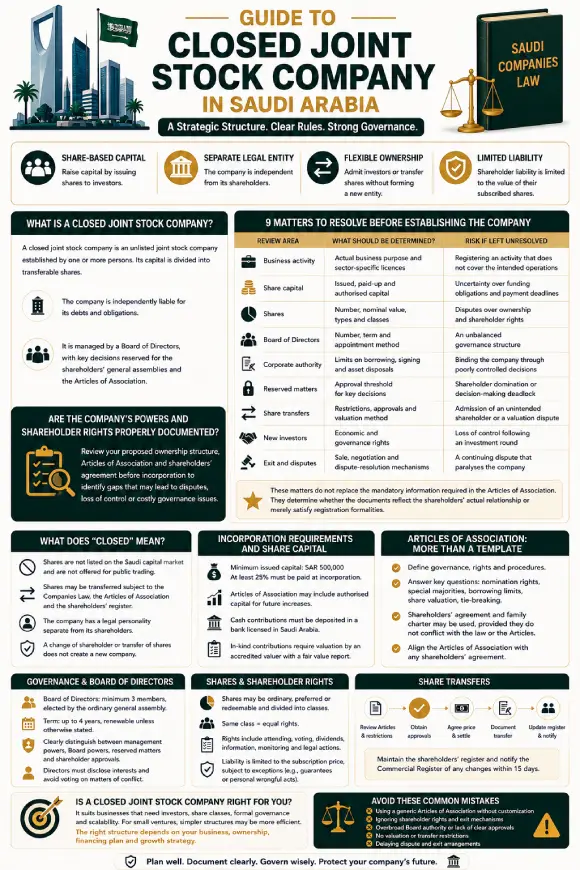
A closed joint stock company is an unlisted joint stock company established by one or more persons whose capital is divided into transferable shares. The company is independently liable for its debts and obligations, while each shareholder’s liability is generally limited to paying the value of the shares subscribed for.
The company is managed by a Board of Directors. Fundamental corporate matters remain subject to the authority of the shareholders’ general assemblies and the company’s Articles of Association.
Are you concerned that your company may be properly registered while shareholder control, investor entry, share transfers and exit rights remain unclear? A focused review of the proposed ownership structure, Articles of Association and shareholder arrangements can identify gaps before they develop into governance disputes or costly amendments.
Request a Company Structure Review
Prefer to understand the structure first? Continue reading the guide below.
Are the Company’s Powers and Shareholder Rights Properly Documented?
Incorporation procedures may appear straightforward while leaving critical matters—such as shareholder authority, investor admission, share valuation and exit rights—insufficiently regulated.
Reviewing the proposed ownership structure, Articles of Association and shareholders’ agreement before incorporation can identify provisions that should be refined to reflect the company’s governance model and growth strategy.
Nine Matters to Resolve Before Establishing the Company
The principal challenge is rarely completing the electronic incorporation application. It lies in the decisions that founders must make before the application is submitted.
| Review Area | What Should Be Determined? | Risk if Left Unresolved |
|---|---|---|
| Business activity | Actual business purpose and sector-specific licences | Registering an activity that does not cover the intended operations |
| Share capital | Issued, paid-up and authorised capital | Uncertainty over funding obligations and payment deadlines |
| Shares | Number, nominal value, types and classes | Disputes over ownership and shareholder rights |
| Board of Directors | Number, term and appointment method | An unbalanced governance structure |
| Corporate authority | Limits on borrowing, signing and asset disposals | Binding the company through poorly controlled decisions |
| Reserved matters | Approval threshold for key decisions | Shareholder domination or decision-making deadlock |
| Share transfers | Restrictions, approvals and valuation method | Admission of an unintended shareholder or a valuation dispute |
| New investors | Economic and governance rights | Loss of control following an investment round |
| Exit and disputes | Sale, negotiation and dispute-resolution mechanisms | A continuing dispute that paralyses the company |
These matters do not replace the mandatory information required in the Articles of Association. They determine whether the documents reflect the shareholders’ actual commercial relationship or merely satisfy registration formalities.
What Does “Closed” Mean Under Saudi Company Law?
The Saudi Companies Law does not classify the closed joint stock company as a separate legal form from a joint stock company. Certain provisions instead refer to a “joint stock company not listed on the capital market” to distinguish it from a company whose shares are publicly listed and partly governed by Saudi capital-market regulations.
The word “closed” does not mean that shares can never be sold or that the shareholder base must remain permanently unchanged. It means that the company’s shares are not admitted to public trading on the capital market. Their transfer remains subject to the Companies Law, the Articles of Association and the procedures applicable to the shareholders’ register.
Once registered with the Commercial Register, the company acquires a legal personality separate from its shareholders. Its assets, rights and obligations are distinct from their personal property, and contracts are entered into in the company’s name rather than in the names of its owners.
A change in the identity of a shareholder, or a lawful transfer of shares, does not by itself result in the creation of a new company.
Incorporation Requirements and Share Capital
A Saudi joint stock company may be established by one or more natural or legal persons. This allows the structure to be used for a wholly owned venture, a family business or an investment involving several corporate and individual investors.
The issued capital must not be less than SAR 500,000, and at least one quarter of the issued capital must be paid at incorporation.
Issued capital represents the value of the shares issued and subscribed for by the founders. The Articles of Association may also provide for authorised capital, which establishes a maximum amount up to which the issued capital may subsequently be increased in accordance with the applicable requirements.
Where the contribution is made in cash, the incorporation application should include evidence that the paid amount has been deposited with a bank licensed in Saudi Arabia.
Where a founder contributes property, equipment, intellectual-property rights or another in-kind asset, the contribution must be valued by an accredited valuer, supported by a report stating its fair value.
Although a closed joint stock company may be established by a single shareholder, the choice of legal form should not depend solely on the number of founders. The proposed capital, governance needs, financing plan and expected admission of future investors should also be considered.
The Articles of Association Are Not a Standard Formality
The constitutional document of a Saudi joint stock company is its Articles of Association.
The Articles of Association should state the company’s name, registered office, business purpose, authorised capital where applicable, issued and paid-up capital, number and classes of shares, rights attached to each class, duration of the company where limited, governance structure, number of Board members and the beginning and end of the financial year.
Completing these mandatory fields does not necessarily make the document suitable for the underlying business.
A generic constitutional document becomes commercially effective only when it answers practical governance questions.
Questions the Constitutional Documents Should Answer
- Who is entitled to nominate members of the Board of Directors?
- Which decisions require an enhanced shareholder majority?
- When may the company borrow money or provide guarantees?
- How will shares be valued when a shareholder wishes to exit?
- What mechanism applies if voting is tied or decision-making becomes deadlocked?
The Saudi Companies Law allows founders and shareholders to enter into an agreement governing their relationship with one another or with the company. It also permits the adoption of a family charter addressing ownership, governance, family-employment policies, profit distribution and exit arrangements.
Such documents are binding to the extent that they do not conflict with the Companies Law or the Articles of Association.
This makes coordination between the Articles of Association and the shareholders’ agreement essential. A shareholders’ agreement should not create a right that cannot be implemented within the company’s corporate structure or allocate authority in a manner inconsistent with the statutory powers of the Board or the general assembly.
Managing a Closed Joint Stock Company
A closed joint stock company is managed by a Board of Directors comprising at least three members.
Members are elected by the ordinary general assembly. The Articles of Association determine the term of office, provided that a Board term does not exceed four years. Members may be re-elected unless the Articles of Association provide otherwise.
Specifying the number of directors and the length of their term is not enough. The effectiveness of the company’s governance depends on how decision-making authority is distributed.
The Articles of Association and internal governance documents should distinguish between:
- Day-to-day powers delegated to executive management.
- Matters reserved for the Board of Directors.
- Decisions falling within the authority of the general assembly.
- Transactions requiring a special shareholder approval threshold.
The Board generally has broad authority to manage the company and achieve its stated purposes, subject to restrictions imposed by law or the Articles of Association.
Board members must also disclose direct and indirect interests in the company’s business and contracts. A director with an interest in a proposed decision should not participate in voting on that matter where the applicable rules prohibit such participation.
One practical mistake is granting a single individual unrestricted authority to borrow, dispose of significant assets or contract with related parties. At the opposite extreme, requiring unanimous shareholder approval for routine operational matters may make the company unable to function efficiently.
Share Classes and Shareholder Rights
A Saudi joint stock company may issue ordinary, preferred or redeemable shares. A particular type of share may also be divided into separate classes carrying different rights, privileges or restrictions under the Articles of Association.
Shares belonging to the same type and class should carry equal rights and obligations.
Founders should therefore consider more than the percentage ownership allocated to each investor. An investor’s actual position may depend on voting rights, priority in profit distributions, liquidation preferences and restrictions attached to the relevant share class.
The principal shareholder rights may include:
- Attending general assemblies.
- Participating in deliberations.
- Voting in accordance with the rights attached to the shares.
- Receiving a proportionate share of declared distributions.
- Inspecting company records and documents within the legally permitted limits.
- Monitoring the conduct of the Board of Directors.
- Bringing a liability claim or challenging an assembly resolution where the legal requirements are satisfied.
A shareholder’s liability is generally limited to paying the subscription price of the shares.
This limitation does not protect a shareholder from liability for a personal wrongful act, an independent guarantee given to a creditor or obligations incurred in a separate capacity as a director or executive officer.
Sale and Transfer of Shares
The fact that shares are transferable does not mean that they may be transferred without examining the Articles of Association.
The company’s documents may include transfer restrictions, approval requirements, rights of first refusal or valuation procedures, provided that these arrangements comply with the Saudi Companies Law.
An unlisted joint stock company must maintain a shareholders’ register containing each shareholder’s details, number of shares, share numbers where applicable and the amount paid against them.
The company must also provide the Commercial Register with the shareholders’ register information and any amendments within the applicable statutory period, stated in the source material as fifteen days from the relevant entry or change.
Signing a share sale agreement should therefore not be treated as the final stage of the transaction. The parties should:
- Review the Articles of Association and contractual transfer restrictions.
- Obtain any required corporate approvals.
- Agree and settle the purchase price.
- Document the transfer.
- Update the shareholders’ register.
- Complete the required Commercial Register notifications.
Saudi law may also permit arrangements under which majority shareholders can require minority shareholders to accept an offer for all shares on the same terms, or minority shareholders can participate in a sale made by the majority.
Such drag-along and tag-along provisions should be drafted to comply with Saudi law and the company’s constitutional documents, rather than copied from a foreign-law template without localisation.
When Is a Closed Joint Stock Company Suitable?
A closed joint stock company may be appropriate where a business requires a clear separation between ownership and management, expects several investors, needs different classes of shares or seeks a structure capable of supporting future expansion or a potential capital-market listing.
It may be less suitable for a small venture that does not require a Board of Directors, formal shareholder assemblies or detailed corporate-governance procedures.
The statutory capital, governance framework, records and decision-making requirements may impose obligations that are unnecessary for a simpler business.
The relevant question is therefore not, “Which company type is best?” It is:
Which legal structure matches the size of the business, number of owners, financing strategy, management model and likelihood of admitting or exiting investors?
Common Mistakes to Avoid Before Incorporation
The first mistake is treating the Articles of Association as a fixed template that requires no commercial or legal customisation.
The second is allocating ownership percentages without regulating the rights attached to each class of shares.
Other recurring problems include:
- Granting the Board excessively broad and uncontrolled authority.
- Failing to identify matters requiring enhanced approval.
- Relying on oral understandings to regulate shareholder exits.
- Failing to confirm whether the business activity requires a sector-specific licence.
- Overvaluing in-kind contributions.
- Signing a shareholders’ agreement that conflicts with the Articles of Association.
- Leaving valuation, investor admission and exit procedures unresolved.
The most expensive mistake is often postponing the regulation of shareholder exits and disputes until a conflict has already arisen.
These provisions are easier to negotiate before the company begins operating and before its value, control dynamics and investor expectations have changed.
When Should the Draft Documents Be Legally Reviewed?
Legal review becomes particularly important where the proposed company involves:
- A foreign investor.
- Multiple classes of shares.
- An in-kind contribution.
- Conditional or staged financing.
- A controlling shareholder.
- A family-ownership structure.
- A future conversion or listing plan.
- Restrictions on share transfers.
- Special voting or exit rights.
Review is also advisable where the company will have a separate shareholders’ agreement, family charter, investor-rights agreement or contractual deadlock mechanism.
Do the Documents Reflect What the Shareholders Actually Agreed?
A draft may satisfy the technical registration requirements without adequately regulating management authority, investor admission, share valuation or a shareholder’s exit from the company.
The documents should be reviewed as an integrated package rather than as unrelated forms. The Articles of Association, shareholders’ agreement, Board authorities and any investment documentation should support the same commercial arrangement.
The scope of any professional engagement is determined after an initial review. Submitting information does not constitute final legal advice or automatic acceptance of an instruction.
A closed joint stock company in Saudi Arabia should not begin with a generic document. It should begin with the decisions that the Articles of Association and related agreements must accurately reflect.
Share capital, share classes, Board composition, management authority, voting rights, transfer restrictions and exit mechanisms are not secondary details. They determine how the company will operate when it expands, admits an investor or encounters a disagreement.
The more closely the constitutional and contractual documents reflect the nature of the venture and its ownership structure, the fewer uncertainties are likely to develop into shareholder disputes or corporate deadlock.
Frequently Asked Questions About a Closed Joint Stock Company
Warning: Undefined array key "name" in /home/u798195860/domains/mohammedaldosari.sa/public_html/wp-content/plugins/seo-by-rank-math-pro/includes/modules/schema/shortcode/faqpage.php on line 31
Warning: Undefined array key "text" in /home/u798195860/domains/mohammedaldosari.sa/public_html/wp-content/plugins/seo-by-rank-math-pro/includes/modules/schema/shortcode/faqpage.php on line 32
Warning: Undefined array key "name" in /home/u798195860/domains/mohammedaldosari.sa/public_html/wp-content/plugins/seo-by-rank-math-pro/includes/modules/schema/shortcode/faqpage.php on line 31
Warning: Undefined array key "text" in /home/u798195860/domains/mohammedaldosari.sa/public_html/wp-content/plugins/seo-by-rank-math-pro/includes/modules/schema/shortcode/faqpage.php on line 32
Warning: Undefined array key "name" in /home/u798195860/domains/mohammedaldosari.sa/public_html/wp-content/plugins/seo-by-rank-math-pro/includes/modules/schema/shortcode/faqpage.php on line 31
Warning: Undefined array key "text" in /home/u798195860/domains/mohammedaldosari.sa/public_html/wp-content/plugins/seo-by-rank-math-pro/includes/modules/schema/shortcode/faqpage.php on line 32
ما المقصود بالشركة المساهمة المقفلة؟
هي شركة مساهمة غير مدرجة في السوق المالية، يقسم رأس مالها إلى أسهم، وتكون الشركة مسؤولة عن ديونها، بينما تقتصر مسؤولية المساهم على قيمة أسهمه بحسب الأصل.
ما التسمية القانونية الأدق لهذا الشكل؟
يستخدم وصف «المقفلة» شائعًا، بينما يرد في النظام تعبير «شركة المساهمة غير المدرجة في السوق المالية» عند تنظيم بعض أحكامها الخاصة.
كم يبلغ رأس المال المطلوب؟
لا يقل رأس المال المصدر عن خمسمائة ألف ريال، ولا يقل المدفوع منه عند التأسيس عن الربع، وفق متطلبات نظام الشركات وخدمة التأسيس الرسمية.
أيمكن تأسيسها من شخص واحد؟
نعم، يجوز أن يؤسس شركة المساهمة شخص واحد أو أكثر من الأشخاص الطبيعيين أو الاعتباريين، مع استكمال متطلبات النشاط ورأس المال والتسجيل.
ما الوثيقة الأساسية للتأسيس؟
الوثيقة الأساسية هي نظام الشركة الأساس، وليس عقد التأسيس بالمصطلح المستخدم في بعض أشكال الشركات الأخرى.
من يتولى إدارة الشركة؟
يتولى الإدارة مجلس إدارة مكون من ثلاثة أعضاء على الأقل، وتحدد وثائق الشركة عددهم ومدتهم وصلاحياتهم وطريقة انتخابهم.
كيف تختلف الأسهم العادية عن الفئات الأخرى؟
تختلف بحسب الحقوق والمزايا والقيود المحددة لكل نوع أو فئة، مثل حقوق التصويت أو الأرباح أو الأولوية عند التصفية.
متى يصبح نقل الأسهم مكتملًا؟
يتطلب النقل تصرفًا صحيحًا واستكمال القيود والموافقات، ثم تحديث سجل المساهمين والبيانات النظامية المرتبطة بالملكية.
ماذا يحدث عند وفاة أحد المساهمين؟
تدخل الأسهم في التركة وتنتقل وفق أحكام الإرث والإجراءات النظامية، ولا تنقضي الشركة لمجرد وفاة مساهم.
متى تناسب الشركة المشاريع العائلية؟
قد تناسب المشروعات العائلية التي تحتاج إلى فصل الملكية عن الإدارة وتنظيم انتقال الأسهم، بشرط إعداد نظام أساس وميثاق عائلي متسقين.
Official Sources: