A company merger in Saudi Arabia is a legal process where two or more companies become one entity, either by merging into an existing company or by forming a new company. Its effect is not limited to the trade name or commercial registration. It may affect debts, contracts, creditors, partners, shareholders, and the legal position of each company involved.
A merger becomes important when the goal is not only business growth, but a clearer legal and financial structure. It may help combine related activities, reduce duplicated entities, reorganize a family business, or simplify ownership within a group of companies.
For the wider legal framework, see the article on Saudi Companies Law, which explains the main rules governing company forms, management, and structural changes.
What Does a Company Merger in Saudi Arabia Mean?
A company merger in Saudi Arabia means that two or more companies combine into one legal structure. The rights and obligations of the merged company pass to the absorbing company or to the new company formed by the merger, depending on the chosen structure.
Are you considering a company merger in Saudi Arabia and unsure how it may affect debts, creditors, contracts, or merger consideration? A focused legal review before signing helps you understand the risk points, organize the merger file, and approach the decision with clearer legal and commercial visibility.
Prefer to understand the process first? Continue reading the guide calmly.
This definition is simple, but its legal effect is broad. The merged company does not only transfer its business activity. It may also transfer contracts, claims, debts, guarantees, employment obligations, and rights against third parties. For that reason, a basic agreement between partners is not enough. The process must be supported by a clear merger proposal, proper valuation, and legal due diligence.
A merger is also different from a simple amendment to the articles of association or a change in ownership. In a merger, the legal position of the merged company changes, and either an existing company continues with a wider structure or a new company replaces the companies involved.
The practical question is not only whether the parties want to merge. The more important questions are: what will transfer after the merger, who will bear the debts, how will the consideration be valued, and were creditors given the required opportunity to protect their rights?
Types of Mergers in Saudi Arabia
There are two main forms of merger: merger by absorption and merger by combination. The choice is not just a technical label. It affects the fate of the company, the commercial register, and the way rights and obligations move.
Merger by Absorption
A merger by absorption occurs when one or more companies merge into an existing company. The continuing company is usually described as the absorbing company, while the company whose separate legal position ends is the merged company.
This structure is common when one company is stronger in management, market position, or financial standing, and it is more practical for that company to continue. It may also be suitable where a parent company and a subsidiary are involved, or where owners want to reduce the number of entities without establishing a new company.
The key point is that the absorbing company does not only receive the business. It must also address the obligations, contracts, and debts connected with the merged company. That is why the merged company’s legal and financial position should be reviewed before the absorption, not after it.
Merger by Combination
A merger by combination occurs when two or more companies combine to establish a new company. In this case, there is no existing company absorbing the others. A new company is created to replace the companies involved in the merger.
This structure may suit parties that want a fresh legal entity without giving one existing company full continuity over the others. It also requires careful attention to asset valuation, merger consideration, and the allocation of shares or ownership interests in the new company.
Its risk increases when the merging companies differ in size, assets, liabilities, market position, or financial performance. Any weak valuation may later become a dispute over ownership percentages or the fairness of the consideration.
Conditions for Mergers under the Saudi Companies Law
A company merger in Saudi Arabia does not arise from commercial intention alone. It requires a formal file that shows the seriousness of the transaction and protects partners, shareholders, and creditors.
The core requirement is the preparation of a merger proposal. This proposal should set out the terms of the merger, the form of consideration, its value, and the shares or ownership interests that the merged company will receive in the absorbing company or in the new company formed by the merger. It should also address each party’s ability to meet its debts.
Valuation is another practical condition. The assets and liabilities of the companies should be reviewed before the parties agree on consideration or ownership ratios. This helps reduce disputes and gives partners or shareholders a more reliable basis for approval.
The required approvals depend on the form of each company. A limited liability company may require a different process from a joint stock company. A listed company or a regulated business may also need additional disclosure or approvals from the relevant authority.
| Condition | Meaning | Why it matters |
|---|---|---|
| Merger proposal | A document setting out the terms, parties, and structure of the merger. | It prevents uncertainty before partners or shareholders approve the transaction. |
| Merger consideration | The shares, interests, or other value given to the owners of the merged company. | It reduces disputes over valuation and ownership after the merger. |
| Debt position | A review of each company’s ability to meet its obligations. | It protects creditors and prevents the merger from hiding financial risk. |
| Required approvals | Approval under the rules for amending the articles or bylaws. | It ensures the decision is properly authorized. |
Steps for Completing a Merger in Saudi Arabia
A company merger in Saudi Arabia should start with review, not signature. A legally sound decision requires a clear file before the merger proposal is presented to partners or shareholders.
First, each company’s legal and financial position should be reviewed. This includes the articles of association or bylaws, commercial registration, debts, loans, current contracts, guarantees, employment obligations, and any claims or disputes.
Second, the merger proposal is prepared. It should answer basic questions: what form of merger is used, which company is absorbing the other, whether a new company will be formed, what consideration will be given, and how debts and creditors will be handled.
Third, the proposal is announced in accordance with the applicable requirements before the decision is taken. This step gives creditors and other interested parties a clearer view of the proposed transaction.
Fourth, partners or shareholders issue the required resolutions, depending on the legal form of the company. The Saudi Ministry of Commerce guidance refers to resolutions of the absorbing and merged companies, proof that the merger proposal was prepared and announced, and an amended contract reflecting the merger.
Finally, the documents and commercial registration are updated. At that stage, the merger becomes visible to third parties, and the legal position of the absorbing company or the new company becomes clearer.
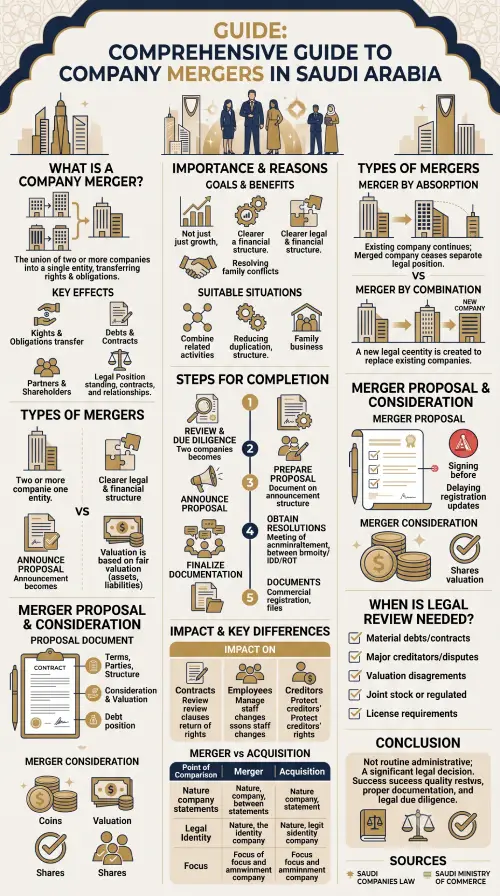
Merger Proposal and Merger Consideration
The merger proposal is the document that shows whether the transaction has been properly structured. A vague proposal can create disputes even if the parties initially agree.
A strong proposal should identify the merger type, the parties, the consideration, the value of shares or ownership interests, the debt position, and the companies’ ability to meet their obligations. The reason is simple: the merger affects not only the owners, but also creditors, employees, contractors, and other third parties.
Merger consideration is the value received by partners or shareholders of the merged company. It may take the form of shares or ownership interests in the absorbing company or the new company, depending on the structure.
This point often becomes sensitive when a partner or shareholder believes the company was undervalued. The valuation should therefore be supported by assets, liabilities, and financial results that can be reviewed.
It is not enough for the file to state that the consideration was agreed. A well-prepared file should explain how the consideration was calculated, what valuation basis was used, and how any differences or fractions in shares or interests will be handled.
Effect on Debts and Creditors
A merger does not erase debts. This should be clear before any document is signed. Once effective, a merger may transfer rights and obligations to the absorbing company or the new company, while creditors’ rights remain an important part of the legal analysis.
For this reason, debts should be reviewed before the proposal is approved. The review should not be limited to debts shown in the financial statements. It should also include loans, guarantees, long-term contracts, potential claims, unpaid invoices, and disputed obligations.
Creditors have a direct interest in the transaction if it may affect their legal or financial position. The announcement process and any objection rights should therefore be treated as part of protecting the merger, not as a minor administrative formality.
Effect on Contracts, Employees, and Commercial Registration
A company merger in Saudi Arabia affects more than the internal decision of owners. A company is also a network of contracts, employees, permits, and commercial relationships.
Existing Contracts
Existing contracts should be reviewed before the merger. Some agreements may include clauses on change of entity, transfer of obligations, prior notice, consent, or change of control.
This issue often appears in financing agreements, leases, supply contracts, franchise arrangements, construction contracts, agency agreements, and technology contracts. It is not enough to assume that all contracts will continue without review. Each contract should be checked for the effect of the merger.
Employees
The merger may affect management structure, job roles, internal policies, and employment obligations. Employment contracts, accrued benefits, internal regulations, and any administrative changes should be reviewed before implementation.
Employees should not be treated as a secondary issue. Poor planning after a merger may disrupt operations even where the formal legal documents are correct.
Commercial Registration
Commercial registration is the stage where the legal effect of the merger becomes visible to third parties. The company should retain partner or shareholder resolutions, the merger proposal, amended documents, and any proof of announcement or creditor objection.
These documents may become decisive if a later dispute arises over the validity of the procedure, the effective date, or the effect of the merger on creditors and contractors.
Merger and Acquisition: Key Difference
Merger and acquisition may share a commercial objective, but they are not the same legal route. A merger unifies two or more companies in one existing or new company. An acquisition usually involves buying shares or interests, or obtaining control, while the target company may continue to exist.
| Point of comparison | Merger | Acquisition |
|---|---|---|
| Nature | Companies unite in one entity. | Shares or interests are purchased. |
| Legal identity | The merged company may cease to exist separately. | The target company may remain in existence. |
| Main focus | Transfer of rights and obligations. | Transfer of ownership or control. |
| Common risk | Ignoring debts and creditor rights. | Weak due diligence on ownership and liabilities. |
When Is a Merger the Right Option?
A company merger in Saudi Arabia may be suitable when there is a clear business reason beyond general expansion. Examples include combining subsidiaries, merging complementary activities, reducing duplicated administrative costs, restructuring a family business, or clarifying ownership within a group.
It may also be useful when multiple companies make contracting, management, or financial supervision unnecessarily complex. A single entity can make responsibilities clearer for creditors, contractors, and internal management.
A merger is not suitable in every case. If debts are unclear, partners are in dispute, valuation is contested, or contracts restrict transfer of obligations, the merger may create more risk than it solves.
The decision should be based on review, not impression. A sound merger answers questions on debts, contracts, creditors, consideration, and approvals before implementation.
Common Mistakes Before a Merger
One common mistake is signing an initial agreement before reviewing debts. A company may look stable, but undisclosed claims, guarantees, or contract obligations may later affect the agreed consideration.
Another mistake is preparing a short merger proposal that does not explain valuation, consideration, or the companies’ ability to meet debts. This may allow the transaction to start, but it also creates space for objections and disputes.
A further risk is confusing a merger with an acquisition. An investor may need to buy shares, not merge two companies. Owners may need internal restructuring, not a full merger.
Ignoring existing contracts is also risky, especially where the contract requires notice or consent after a change of entity. Delaying commercial registration updates or failing to keep the merger documents may also create problems with banks, regulators, and contracting parties.
When Should the Company Request Legal Review?
A company merger in Saudi Arabia should be reviewed legally when there are material debts, long-term contracts, major creditors, partner disputes, valuation disagreements, employment obligations, or financing arrangements that cannot be assessed quickly.
Legal review becomes more important if the company is a joint stock company, subject to a regulator, holds activity-specific licenses, or is part of a larger group structure.
The purpose of legal review is not to delay the merger. Its function is to organize the file before the decision: review documents, identify risks, examine the proposal, test the consideration, consider creditor rights, and prepare the documents required for registration or submission to the relevant authority.
FAQ About Company Merger in Saudi Arabia
What is a company merger in Saudi Arabia?
It is the combination of two or more companies into an existing company or a new company, with rights and obligations moving according to the applicable legal rules.
How does absorption differ from combination?
Absorption means that one company merges into an existing company that continues. Combination means that two or more companies unite to form a new company.
Which conditions should be checked before a merger?
The key conditions include a merger proposal, merger consideration, valuation, required approvals, debt review, and creditor protection.
Where do merger procedures usually begin?
They usually begin with reviewing documents, debts, and contracts, then preparing and announcing the proposal, issuing approvals, amending documents, and updating registration.
Why is the merger proposal important?
It sets out the merger terms, structure, consideration, and the position of the merged company in the absorbing or newly formed company.
Does the merged company’s debt transfer?
Once the merger becomes effective, rights and obligations may pass to the absorbing company or the new company, subject to creditor rights and applicable rules.
Who may object to the merger?
Creditors of the merged company may object where the transaction affects their position or the assurance of payment.
When do contracts become a risk in a merger?
Contracts become a risk when they contain notice, consent, change-of-control, or transfer restrictions that must be addressed before signing.
Is debt a complete barrier to merger?
Debt is not necessarily a barrier, but it makes solvency review, creditor rights, and payment arrangements critical before completion.
At what stage should legal review be requested?
Legal review should be requested before signing or voting where debts, long contracts, major creditors, valuation issues, employee matters, or registration risks exist.
This article is prepared for general legal awareness about company merger in Saudi Arabia. It is not a substitute for reviewing the articles of association or bylaws, debts, contracts, creditors, merger type, and available documents before making a decision.
Conclusion
A company merger in Saudi Arabia is not a routine administrative step. It is a legal decision that may affect the financial position, contracts, creditors, and commercial registration of the companies involved. Its strength comes not from signing the agreement alone, but from the quality of the review that comes before it.
The practical rule is that a sound merger starts with documents: articles of association, debts, contracts, valuation, consideration, and creditor rights. The merger proposal, corporate resolutions, and commercial registration updates should follow a clear and well-documented process.
The clearer the merger file is before signing, the more stable the decision is likely to be after it becomes effective.
Official Sources: