A commercial registration without a store in Saudi Arabia may be possible for a sole proprietorship without a traditional shop being listed as a general requirement for commercial registration. However, the business must still provide the required establishment information and approved address, and its activity may be subject to separate premises, licensing, or regulatory requirements.
Since 3 April 2025, Saudi Arabia has also moved to a single commercial registration for each establishment across the Kingdom and replaced the previous renewal model with annual confirmation. For that reason, older guidance on commercial registration should be checked carefully before relying on it.
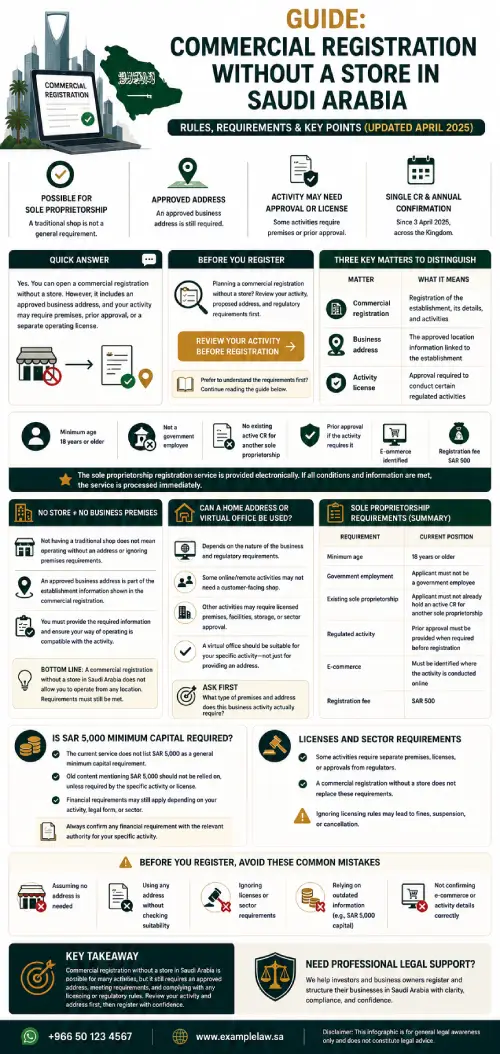
Quick Answer: Can You Open a Commercial Registration Without a Store?
Yes. A traditional retail shop is not listed as a general requirement for registering a sole proprietorship. However, the commercial registration without a store includes an approved business address, and the intended activity may require premises, prior approval, or a separate operating license.
Planning a commercial registration without a store but unsure whether your activity requires business premises, prior approval, or a separate license? Reviewing the activity, proposed address, and regulatory requirements first can help you approach the registration process with greater clarity.
Prefer to understand the requirements first? Continue reading the guide below.
The key is to distinguish between three different matters:
| Matter | What it means |
|---|---|
| Commercial registration | Registration of the establishment, its details, and activities |
| Business address | The approved location information linked to the establishment |
| Activity license | Approval required to conduct certain regulated activities |
The current sole proprietorship registration service requires the applicant to be at least 18 years old, not be a government employee, and not already hold an active commercial registration for another sole proprietorship. Prior approval must also be obtained where the selected activity requires licensing before registration.
If the establishment will conduct e-commerce, this must also be identified during the application process. The current registration fee for a sole proprietorship is SAR 500.
For a broader overview of the registration framework, commercial register information, and its legal implications, see our Saudi Commercial Registration Guide.
What Is the Difference Between No Store and No Business Premises?
Not having a traditional shop does not mean operating without an address or ignoring premises requirements.
A physical store generally refers to a location from which an activity is conducted, such as a retail shop or an office receiving customers. An approved business address, by contrast, forms part of the establishment information associated with the commercial registration.
The current commercial registration framework includes the establishment’s approved address among the information shown in the registration record.
For this reason, meeting the requirements for a commercial registration without a store in Saudi Arabia does not automatically allow a business to operate from any location. The owner must still provide the required information and confirm that the intended way of operating is compatible with the activity.
Can a Home Address or Virtual Office Be Used?
There is no single rule making a home address or virtual office suitable for every business activity.
The answer depends on the nature of the business and the regulatory requirements governing it.
An online or remote service business may not need a customer-facing retail shop. Another activity may require licensed premises, specialised facilities, storage space, or approval from a sector regulator.
A virtual office should therefore not be selected simply because it can provide an address. The more important question is whether that type of premises is acceptable for the specific activity.
Before renting an office or arranging a virtual address, determine:
What type of premises and address does this business activity actually require?
That approach is safer than trying to find an address that can be used for any commercial registration without a store.
What Are the Requirements for a Sole Proprietorship?
The published requirements for registering a sole proprietorship apply whether or not the business needs a conventional store.
According to the current Saudi Business Center service information, the main requirements include:
| Requirement | Current position |
|---|---|
| Minimum age | 18 years or older |
| Government employment | Applicant must not be a government employee |
| Existing sole proprietorship | Applicant must not already hold an active CR for another sole proprietorship |
| Regulated activity | Prior approval must be provided when required before registration |
| E-commerce | Must be identified where the activity is conducted online |
| Registration fee | SAR 500 |
The sole proprietorship registration service is provided electronically. Where all conditions and required information are satisfied, the Saudi Business Center lists the service as immediately processed.
Is SAR 5,000 Minimum Capital Required?
The current sole proprietorship registration service does not list SAR 5,000 as a general minimum capital requirement for obtaining the commercial registration.
This matters because the SAR 5,000 figure continues to appear in older online content.
It should therefore not be presented as one of the general requirements for a commercial registration without a store in Saudi Arabia unless a separate financial requirement applies to the specific activity, legal form, or license.
This does not mean that every type of business is free from financial requirements. A regulated activity may have capital, financial capacity, guarantee, or licensing conditions of its own.
The correct approach is to separate the general requirements for registering a sole proprietorship from financial conditions that apply to a particular regulated business.
Is a Lease Agreement Required?
A lease agreement is not listed among the general published requirements for the current sole proprietorship registration service.
However, a lease or other evidence of the right to use premises may become relevant if the activity requires a specific location or if the licensing authority requires proof of lawful use of the site.
This again illustrates the distinction between:
obtaining the commercial registration and obtaining permission to operate the business activity.
A business owner should therefore check the requirements of the activity before signing a lease solely for the purpose of obtaining a CR.
How to Open a Commercial Registration Without a Physical Store
The electronic process is relatively straightforward. The important step is checking the activity before submitting the application.
A practical sequence is:
- Choose the appropriate legal form. Determine whether the project should operate as a sole proprietorship or under another legal structure.
- Identify the activity accurately. Select the activity that reflects what the business will actually do.
- Check for prior licensing. Some activities require approval from the competent authority before a CR can be issued.
- Prepare the establishment information. This includes the activity, address, and other required details.
- Identify e-commerce activities. State that the business will conduct e-commerce where applicable.
- Submit the registration application electronically. The process is handled through the Saudi Business Center.
- Review the application carefully. Pay particular attention to the selected activity and business address.
- Pay the registration fee. The current sole proprietorship registration fee is SAR 500.
- Track the annual confirmation date. The commercial registration without a store information must later be confirmed under the new system.
The process normally does not require visiting a service centre when the electronic requirements are completed successfully.
What Should You Check Before Submitting the Application?
Before filing the application, check the following:
- Does the selected activity accurately describe the business?
- Is the activity supervised by a specific regulator?
- Is prior approval required?
- Does the activity have premises requirements?
- Is the proposed business address suitable?
- Is a sole proprietorship the appropriate legal form?
- Will the business conduct e-commerce?
These checks matter more than simply getting the electronic application approved.
A CR issued for an activity that does not reflect the actual business will not solve licensing or operational problems later.
Can the Business Operate Without a Store After Registration?
Not necessarily.
A commercial registration confirms the establishment’s registration and recorded activity. It does not remove licensing, premises, or operational conditions imposed on that activity.
For example, an online business may not require a customer-facing shop. A business involving storage, food, healthcare, distribution, or another regulated sector may require approved premises or additional authorisations.
That is why there is no reliable universal list of “business activities that do not need a store” that can safely be applied to every project.
A better approach is to classify the intended activity first:
| Type of activity | What should be checked? |
|---|---|
| Online business | E-commerce information and applicable regulatory requirements |
| Remote service | Whether specific premises are required |
| Customer-facing activity | Requirements for the operating location |
| Storage or distribution | Warehouse or site requirements |
| Regulated business | Licensing requirements of the competent authority |
Does a Commercial Registration Replace a Municipal or Activity License?
No.
A commercial registration does not replace a municipal license, professional approval, or other operating license where one is required for the activity.
The sole proprietorship registration service itself requires approval from the competent licensing authority where the selected activity must be licensed before the commercial registration is issued.
This is an important distinction.
Receiving the CR does not always mean that the business may begin operating immediately. The registration may be valid while separate regulatory or operational requirements still need to be completed.
Before launching the business, determine whether the commercial registration is the final requirement or only one stage in the licensing process.
What About Online Businesses and Home-Based Activities?
Operating without a retail shop is common for e-commerce businesses and services delivered remotely. This does not remove the need to understand the regulatory structure of the activity.
The sole proprietorship application requires the applicant to identify e-commerce activity when it will form part of the business.
The question:
Does an online store need a physical shop?
is therefore different from:
What legal and regulatory requirements apply to the online business?
An online project may not need premises that are open to customers. It will still have establishment information, an approved address, and obligations connected to its actual business activity.
What Should a Home-Based Business Check?
Before operating a business from home, review three issues.
Does the activity require a commercial registration?
This depends on the type of activity and the legal framework through which it is conducted.
Can the activity legally operate in that way?
Some businesses can operate without customer-facing premises. Other activities may have location or facility requirements.
Is a separate license required?
Obtaining a commercial registration may only be the first stage for certain activities.
A commercial registration should also not be treated as interchangeable with a freelance document. They serve different purposes and apply in different contexts.
The detailed comparison between freelance registration and commercial registration is a separate search intent and should be assessed according to the specific business model.
How Much Does Registration Cost and What Changed in 2025?
The current fee for registering a sole proprietorship through the Saudi Business Center is SAR 500.
This fee should not be confused with the total cost of launching a business.
Additional costs may apply depending on licensing requirements, premises, regulatory approvals, or other services required for the project.
Saudi Arabia’s new Commercial Register Law also changed the way commercial registrations are managed from 3 April 2025.
| Previous approach | Current framework |
|---|---|
| Main and branch commercial registrations | One commercial registration for the establishment across Saudi Arabia |
| Separate branch CRs | New branch registrations are no longer issued |
| Expiry and renewal model | No traditional expiry; annual confirmation applies |
| Multiple registrations for branches and activities | The establishment’s activities are recorded under its single CR |
Under the new framework, an establishment has one commercial registration covering its activities across the Kingdom.
The previous concept of issuing new branch commercial registrations has therefore been discontinued.
What Is Annual Confirmation of a Commercial Registration?
Annual confirmation is the process of verifying that the information recorded in the commercial registration remains correct.
The confirmation becomes due after 12 months from the registration date.
If the required confirmation is not submitted within 90 days from the due date, the commercial registration and related services may be suspended under the current framework.
Accordingly, businesses searching in 2026 for “commercial registration renewal in Saudi Arabia” should be aware that the system now operates through annual confirmation, rather than the previous renewal model.
7 Mistakes to Avoid Before Registering Without a Store
Many problems involving a commercial registration without a store in Saudi Arabia arise not from the electronic form itself, but from misunderstanding what the registration allows.
1. Assuming no store means no address
The current commercial registration includes the establishment’s approved address.
2. Choosing the easiest activity to register
The selected activity should reflect what the business will actually do.
3. Ignoring prior licensing
Where an activity requires approval before registration, that requirement should be resolved first.
4. Relying on outdated guidance
Older information about renewals, branch registrations, and general capital requirements may no longer reflect the current framework.
5. Renting premises before checking the activity requirements
A business may rent a site only to find that it does not satisfy the relevant licensing conditions.
6. Treating the CR as a complete operating permit
A commercial registration does not replace licenses required for regulated activities.
7. Forgetting annual confirmation
Failure to complete the required annual confirmation within the applicable period may result in suspension.
The goal should therefore not be simply to find a way around having a store. The better approach is to establish what the business actually requires before filing.
When Is Legal Review Useful Before Opening the CR?
Not every commercial registration without a store application requires a lawyer.
Where the activity is straightforward, no special licensing issues exist, and the task is limited to completing an electronic application, the procedure may be direct.
Legal review becomes more useful when the uncertainty concerns the business activity, legal structure, licensing path, or premises requirements.
| Situation | What should be reviewed? |
|---|---|
| No traditional business premises | Whether the activity has location requirements |
| Activity classification is unclear | Appropriate legal description of the activity |
| A regulator is involved | Timing of approval and operating conditions |
| Online business | Regulatory structure and activity obligations |
| Several activities are planned | Compatibility with the single CR and each activity’s requirements |
| Rapid business expansion is expected | Whether a sole proprietorship remains suitable |
A useful review normally begins with four pieces of information: the activity, how the business will operate, the available address, and any authority believed to regulate the activity.
Resolving those points first can prevent unnecessary licensing, leasing, or registration steps.
Frequently Asked Questions
Can I open a commercial registration without a physical store in Saudi Arabia?
A traditional shop is not listed as a general requirement for registering a sole proprietorship. However, the business must provide an approved address and comply with any premises or licensing rules applying to its activity.
Does a sole proprietorship need a physical shop?
Not as a universal condition for commercial registration. Whether physical premises are required depends on the business activity and applicable licensing requirements.
Does the commercial registration require a business address?
Yes. The current commercial registration includes the establishment's approved address among its registered information.
Can I use my home address for the business?
That depends on the activity and the applicable address, premises, and licensing requirements. A home address should not be assumed to be suitable for every business.
Is a lease agreement required to obtain the CR?
A lease is not listed as a general requirement for the current sole proprietorship registration service. It may still be required for an activity license or premises approval.
How much is the sole proprietorship registration fee?
The current fee is SAR 500.
Is SAR 5,000 minimum capital required?
The current sole proprietorship registration service does not list SAR 5,000 as a general minimum capital requirement.
Can a government employee register a sole proprietorship?
Under the current service requirements, the applicant must not be a government employee.
Can a university student open a commercial registration?
The published age requirement is 18 years or older. Student status itself is not listed as a separate restriction in the referenced registration requirements.
Are the registration conditions different for men and women?
The current sole proprietorship service requirements do not provide separate registration conditions based on gender.
Conclusion
A commercial registration without a store in Saudi Arabia may be possible because a traditional shop is not listed as a general registration condition for a sole proprietorship. However, this does not remove the requirement for an approved business address or any licensing and premises conditions applying to the activity.
Before filing the application, check four points: the activity, the address, the licensing requirements, and the legal form.
If any of these are unclear, resolving them before registration is more efficient than restructuring the business after operations begin.
Information published before 3 April 2025 should also be treated carefully. The current system uses one commercial registration without a store for the establishment across Saudi Arabia, no longer issues new branch CRs, and uses annual confirmation instead of the former renewal process.
Sources.