Trademark counterfeiting in Saudi Arabia can lead to imprisonment for up to three years and a fine of up to SAR 1 million, or either penalty. However, similarity between two marks does not automatically amount to a criminal offence.
Saudi trademark law distinguishes between infringement of trademark rights and criminal conduct punishable under the applicable GCC Trademark Law.
A proper assessment therefore starts with the registration status of the mark, its scope of protection, the goods or services involved, the way the other mark is being used, and whether that use is likely to confuse the public.
The first step should not be an accusation. It should be to preserve the evidence, identify the nature of the infringement, and then select the appropriate legal route.
Quick Answer: What Are the Penalties for Trademark Counterfeiting in Saudi Arabia?
Under the GCC Trademark Law applicable in Saudi Arabia, a person who forges a registered trademark or imitates it in a manner likely to mislead the public may face:
- imprisonment from one month to three years;
- a fine from SAR 5,000 to SAR 1,000,000; or
- either of these penalties.
The same penalty range also applies to certain forms of bad-faith use of forged or imitated marks, including placing another party’s trademark on goods or using it in connection with services in circumstances covered by the law.
A different penalty applies where a person knowingly sells, offers, circulates, or possesses for sale goods carrying a forged or imitated trademark. In that situation, the penalty may be imprisonment from one month to one year, a fine from SAR 1,000 to SAR 100,000, or either penalty.
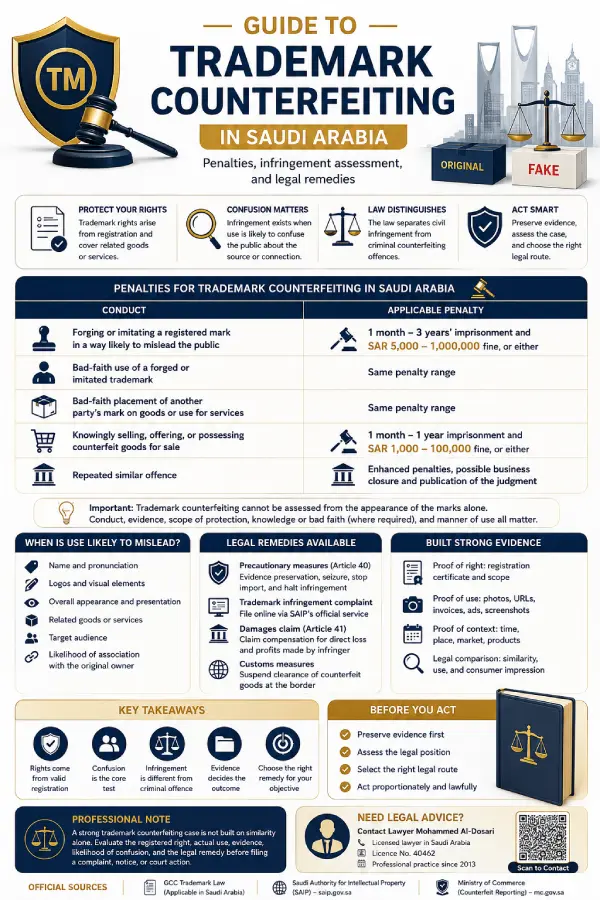
| Conduct | Applicable Penalty |
|---|---|
| Forging or imitating a registered mark in a way likely to mislead the public | 1 month–3 years’ imprisonment and SAR 5,000–1,000,000 fine, or either |
| Bad-faith use of a forged or imitated trademark | Same penalty range |
| Bad-faith placement of another party’s mark on goods or use for services | Same penalty range |
| Knowingly selling, offering, or possessing counterfeit goods for sale | 1 month–1 year imprisonment and SAR 1,000–100,000 fine, or either |
| Repeated similar offence | Enhanced penalties, possible business closure and publication of the judgment |
The important point is that trademark counterfeiting cannot be assessed from the appearance of the two marks alone. The conduct, evidence, scope of protection, knowledge or bad faith where required, and manner of use all matter.
This guide was prepared by reference to the trademark legislation applicable in Saudi Arabia and official Saudi Authority for Intellectual Property sources. It provides general legal information and does not replace an assessment of the trademark registration, scope of protection, evidence, and facts of a particular case.
Legal Practice Licence No. 40462
Professional practice since 2013
A strong trademark counterfeiting case is not built on similarity alone. The registered right, scope of protection, actual use, available evidence, likelihood of confusion, and the legal remedy sought should be assessed before a complaint, notice, or court action is started.
Trademark Infringement or a Criminal Counterfeiting Offence?
Not every infringement is a criminal counterfeiting offence. For that reason, the penalties for trademark counterfeiting should not be applied merely because two marks appear similar.
Article 17 gives the owner of a registered trademark the exclusive right to use it and to prevent third parties from using an identical or similar mark in trade for related goods or services where that use is likely to create confusion among the public.
This concerns the scope of the trademark right.
Criminal liability is a separate question. Article 42 identifies specific punishable conduct, including forging or imitating a registered trademark in a misleading manner, certain bad-faith uses, and knowingly dealing in goods carrying counterfeit marks.
The legal analysis therefore has two stages:
- Has the trademark right been infringed?
This depends on the registration, scope of protection, commercial use, and likelihood of confusion. - Does the conduct amount to a criminal offence?
This requires the facts to satisfy one of the offences and conditions set out in Article 42.
This distinction prevents two common mistakes: treating every similarity as a crime, and overlooking genuine infringement simply because the competing mark is not an exact copy.
For the wider registration and protection framework, see trademark registration in Saudi Arabia. This guide focuses specifically on infringement, counterfeiting, penalties, and enforcement.
When Is Trademark Use Likely to Mislead the Public?
There is no automatic rule that changing one letter or one colour prevents infringement. Equally, two marks sharing a single feature does not by itself prove unlawful imitation.
The mark should be assessed in the context in which consumers encounter it.
Relevant factors may include:
- the name and pronunciation;
- logos and graphic elements;
- the overall visual presentation;
- the relevant goods or services;
- the target public;
- whether consumers may believe that the goods or services come from, are connected with, or are authorised by the original trademark owner.
Saudi commercial court decisions also show the importance of considering the overall appearance and actual commercial use of competing signs. In one published decision, the court considered visual elements and the way the sign appeared on a shopfront and in advertising when examining whether the use created an association or confusion for consumers.
For this reason, saying that “the marks look similar” is not enough when analysing potential trademark counterfeiting.
A stronger assessment explains which elements are materially similar, how they are used commercially, which goods or services are involved, and why the presentation could cause consumers to connect the two businesses.
The need for action becomes more serious once the use is active in the market, on a product, in advertising, or through an online store, particularly where continued use could increase the harm or make evidence easier to remove.
What Are the Statutory Penalties for Trademark Counterfeiting?
The applicable penalty depends on the conduct. Saudi trademark law does not impose one universal punishment for every form of infringement.
First: Forging or Misleading Imitation of a Trademark
Article 42(a) provides for imprisonment from one month to three years and a fine from SAR 5,000 to SAR 1 million, or either penalty, for anyone who forges a registered trademark or imitates it in a manner likely to mislead the public.
The same provision covers certain bad-faith uses of forged or imitated marks and certain cases where another party’s trademark is placed on goods or used in connection with services without right.
This is the main provision when analysing the criminal penalty for trademark counterfeiting in Saudi Arabia.
Second: Knowingly Selling Counterfeit Goods
Article 42(b) applies a separate penalty to anyone who knowingly sells, offers, circulates, or possesses for sale goods carrying a forged, imitated, or unlawfully used trademark.
The penalty is:
- imprisonment from one month to one year;
- a fine from SAR 1,000 to SAR 100,000; or
- either penalty.
The requirement of knowledge is important in this category. The elements of criminal liability should therefore be examined according to the specific conduct alleged.
Third: Repeat Offences
Where a person commits a similar offence within three years of a previous final judgment, Article 43 allows a penalty of up to twice the maximum statutory penalty.
The court may also order:
- closure of the shop or business for between 15 days and six months; and
- publication of the judgment at the offender’s expense.
These criminal consequences are separate from any claim by the trademark owner for compensation.
How Do You Build Evidence of Trademark Counterfeiting?
A strong case links the protected right to the challenged use. A side-by-side image comparison alone is rarely enough.
Start with four areas.
Proof of the right: Keep the trademark registration certificate, registration number, owner’s details, current status, relevant classes, and protected goods or services.
Proof of use: Preserve photographs of the product, packaging, storefront, advertisements, online listings, screenshots, purchase invoices, seller details, and relevant communications.
Proof of context: Record when and where the use appeared, the goods or services involved, and how the public encounters the disputed mark.
Legal comparison: Compare the wording, pronunciation, logo, overall presentation, commercial activity, and likely consumer impression.
For digital infringement, evidence should be preserved promptly. A page, advertisement, product listing, or social-media account can be edited or removed quickly.
A useful practical rule is:
Preserve today what may no longer be available tomorrow.
What Legal Measures Can Stop Trademark Infringement?
The appropriate route depends on what the trademark owner needs to achieve.
The priority may be to preserve evidence, stop the use immediately, prevent counterfeit products from circulating, or claim compensation.
Precautionary Measures for Urgent Cases
Article 40 allows a rights holder to seek precautionary measures from the court where infringement has occurred or is imminent.
Depending on the case, these measures may include:
- documenting the infringement and related goods or tools;
- preserving evidence;
- seizing relevant goods, materials, or proceeds;
- preventing infringing goods from entering commercial channels or being exported;
- stopping existing infringement or preventing imminent infringement.
The court is required to determine the application within a period not exceeding 10 days, except in exceptional circumstances.
In certain cases, measures may also be ordered without first summoning the other party where delay could cause irreparable harm or create a risk that evidence will disappear.
The court may require an appropriate security, and the applicant must also observe the statutory requirements for filing the main action after obtaining the precautionary order.
These measures should therefore be used as legal protective tools, not simply as pressure tactics.
Where counterfeit goods are still at the import stage, the law also provides mechanisms relating to suspension of customs clearance for goods carrying counterfeit, forged, or confusingly similar marks.
Trademark Infringement Complaint
The Saudi Authority for Intellectual Property provides an online Trademark Infringement Complaint service for individuals and businesses.
The applicant submits information about the alleged infringement and attaches the required supporting material through the official electronic process.
However, an administrative complaint is not the only possible route.
A case may instead require:
- urgent court measures;
- a damages claim;
- action involving imported goods; or
- another enforcement route based on the circumstances.
The practical question should therefore be:
What outcome is required — preserving evidence, stopping the use, preventing circulation, or recovering losses?
Compensation for Trademark Counterfeiting
A criminal fine does not automatically compensate the trademark owner for commercial loss.
Article 41 allows a rights holder who has suffered direct damage from infringement to bring a claim before the competent court seeking adequate compensation.
When assessing compensation, the court may take into account matters such as:
- profits obtained by the defendant;
- the value of the infringing goods or services;
- other legitimate measures; and
- expert evidence where appropriate.
For that reason, a general statement such as “the infringement damaged the reputation of the brand” may not be enough to support a strong financial claim.
Evidence may include:
- a documented decline in sales linked to the infringement;
- lost contracts or confirmed orders;
- customer complaints showing actual confusion;
- direct expenditure incurred in responding to the infringement;
- accounting or commercial records supporting the claimed amount.
Article 41 does not make a prior criminal conviction a general prerequisite for every damages claim.
In practical terms, separate two questions:
Was the trademark right infringed?
and then:
What financial loss can actually be proven?
Proving infringement does not automatically prove the amount of compensation claimed.
What Changes When Counterfeiting Happens Through an Online Store?
The core legal principles remain the same online, but digital evidence can disappear much faster.
Online trademark counterfeiting may appear through:
- an online store name;
- a product listing;
- sponsored advertising;
- a social-media account;
- product packaging shown online;
- descriptions suggesting a false commercial association with the trademark owner.
When the use is discovered, preserve as much context as possible:
- full URL;
- account or store name;
- date of discovery;
- product images;
- product description and price;
- advertisements or posts;
- visible seller details;
- purchase evidence, where available.
Avoid keeping only a cropped screenshot of the logo where the full page and surrounding context can also be preserved.
For online cases, the first question is often not simply what the penalty is. It is:
Will the evidence still exist after the content is removed?
Common Mistakes That Weaken a Trademark Case
A strong underlying trademark right can still be undermined by poor early decisions.
Common mistakes include:
- Contacting the other party before preserving evidence: This may lead to the removal of the product, advertisement, or account.
- Relying on an old registration without checking its status: Confirm the current owner and the protected goods or services.
- Treating every similarity as a criminal offence: Criminal liability has specific legal requirements.
- Confusing a trade name with a trademark: They are legally distinct concepts and should not be treated as interchangeable.
- Making public accusations: The dispute should normally be handled through appropriate legal channels rather than creating a separate dispute over public statements.
- Ignoring an earlier agreement: The use may relate to a licence, distribution arrangement, franchise, or expired commercial relationship that must first be reviewed.
- Claiming damages without financial evidence: The amount of loss must be supported independently from proof of infringement.
When Is Legal Review Important?
Legal review becomes more important where the use is active and continuing, the businesses operate in closely related markets, there are signs of consumer confusion, the commercial harm could expand quickly, or relevant goods and evidence can easily be removed.
It is also important where you are the party who has received a cease-and-desist notice or other allegation concerning a similar trademark.
In that situation, the response should not start with a general denial. It should start by reviewing:
- the registration;
- its scope;
- dates of use;
- the two marks;
- any previous licence; and
- the commercial relationship between the parties.
Professional review does not guarantee a conviction or a successful claim. Its value is in answering four practical questions:
- What right can be established?
- What use can be proven?
- What is the actual legal risk?
- Which remedy best serves the client’s objective without unnecessary escalation?
If you have identified potentially infringing use of your trademark, or have received a notice from another trademark owner, an initial professional enquiry can help identify the appropriate channel for reviewing the matter.
Contact Lawyer Mohammed Al-Dosari
Please provide only a brief description of the enquiry through the general contact form. Do not send case files, confidential documents, party names, or sensitive information through the public form.
Frequently Asked Questions About Trademark Counterfeiting
What is the maximum penalty for trademark counterfeiting in Saudi Arabia?
For conduct falling under Article 42(a), the penalty may reach three years' imprisonment and a fine of SAR 1 million, or either penalty.
When does the use of a similar trademark become infringement?
It may amount to infringement where the mark is used commercially for related goods or services and is likely to cause confusion among the public within the registered mark's scope of protection.
What is the difference between infringement and criminal counterfeiting?
Trademark infringement concerns interference with the owner's exclusive rights and likelihood of confusion. Criminal counterfeiting requires conduct that falls within the offences specified by Article 42.
What is the penalty for knowingly selling counterfeit products?
Where the requirements of Article 42(b) are satisfied, the penalty may be imprisonment from one month to one year and a fine from SAR 1,000 to SAR 100,000, or either penalty.
How can I prove that someone is using my trademark?
Start with the registration and its scope, then preserve evidence of the actual use through photographs, URLs, invoices, advertising, screenshots, and related records.
Where can a trademark infringement complaint be filed?
SAIP provides an electronic trademark infringement complaint service for individuals and businesses.
Can the use be stopped before a final judgment?
Precautionary measures may be requested from the competent court under Article 40 where the statutory conditions are satisfied.
When is a cease-and-desist notice useful?
It may be useful after the evidence and legal position have been reviewed, but it is not necessarily the correct first step in every case.
Can compensation be claimed for trademark infringement?
Yes. A rights holder who suffers direct damage may seek compensation under Article 41, subject to proving the relevant elements and loss.
Is a criminal judgment required before claiming compensation?
Article 41 does not make a prior criminal judgment a general requirement for every compensation claim arising from trademark infringement.
The consequences of trademark counterfeiting in Saudi Arabia depend on the specific conduct involved.
Forging or misleadingly imitating a registered trademark, as well as certain forms of bad-faith use, may result in imprisonment for up to three years and a fine of up to SAR 1 million. Knowingly dealing in counterfeit goods is subject to a separate penalty range.
However, the penalty is not the first question to answer.
A stronger legal assessment follows this sequence:
Protected right → actual use → preserved evidence → relevant scope → likelihood of confusion → legal classification → appropriate remedy.
The appropriate route may involve a complaint, precautionary measures, an order to stop the use, a damages claim, or another procedure depending on the circumstances.
The practical rule is simple:
Preserve the evidence first. Assess the right second. Choose the remedy third.