A Holding Company in Saudi Arabia is an important legal structure for organizing ownership, managing subsidiary companies, and distributing risk across several business entities. It should not be treated as a commercial label added to the company’s name only. It is a regulated structure that requires reviewing the legal form of the company, the nature of control, the relationship between the holding company and its subsidiaries, and the separation of financial liabilities.
This structure became more relevant after the new Saudi Companies Law came into force on 19 January 2023. The law introduced a more developed corporate framework to support company formation, continuity, expansion, family businesses, and entrepreneurship. For this reason, incorporating a holding company may be suitable where an investor owns several companies, holds shares or interests in different entities, or manages a family business that requires organized ownership and stable governance.
Quick Answer: What Is a Holding Company in Saudi Arabia?
Before deciding whether a Holding Company in Saudi Arabia is the right structure, it is necessary to understand the broader framework of Saudi company forms and the practical issues that should be reviewed before incorporation or conversion.
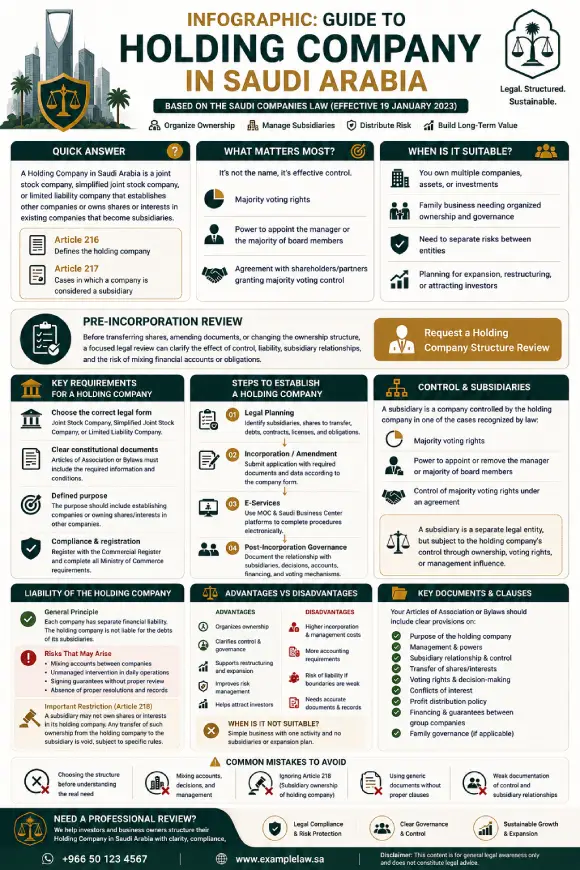
A Holding Company in Saudi Arabia is a company formed as a joint stock company, simplified joint stock company, or limited liability company. It may establish other companies or own shares or interests in existing companies that become subsidiaries. The Saudi Companies Law dedicates specific provisions to holding companies and subsidiaries. Article 216 defines the holding company, while Article 217 sets out the cases in which a company is considered a subsidiary of a holding company.
The key issue is not the company name. The real question is whether there is effective control or influential ownership over other companies. Control may arise through majority voting rights, the ability to appoint the manager or the majority of board members, or an agreement with shareholders or partners that gives the holding company majority voting control.
Considering a Holding Company in Saudi Arabia but unsure how control, subsidiary liability, share transfers, and governance should be structured? A focused legal review can help clarify whether incorporation, conversion, or a more tailored ownership arrangement is the right step before you amend documents or move company interests.
Or continue reading first to understand the legal structure, risks, and options.
What Is a Holding Company in Saudi Arabia?
A Holding Company in Saudi Arabia is a statutory company used to organize control or ownership in other companies. Its value appears when the business is not limited to one standalone activity, but includes several companies, assets, or investments that require centralized ownership oversight.
Saudi law does not treat every company that owns interests in another company as a holding company in the full practical sense. The assessment depends on the company’s legal form, constitutional documents, business purpose, and method of control over other companies. It is therefore important to distinguish between a company holding an ordinary investment interest and a company established or structured to own subsidiaries under a deliberate holding arrangement.
A company also does not acquire full legal personality in practice until it is registered in the Commercial Register, subject to the limited personality recognized during the incorporation period to the extent necessary to complete incorporation. Therefore, discussing a Holding Company in Saudi Arabia cannot be separated from registration, incorporation documents, and the purpose recorded in the articles of association or bylaws.
Adding the word “holding” to the company name is not enough. The name should match a real legal and operational structure. There should be subsidiaries, or at least a clear plan to establish subsidiaries or acquire shares or interests in other companies. Using the label without an actual structure may create confusion for partners, creditors, and counterparties.
When Is a Holding Company in Saudi Arabia Suitable?
A Holding Company in Saudi Arabia is suitable when there is a real need to organize several ownership interests or companies under one central entity. If the business is simple, operates one activity, and has no subsidiaries or expansion plan, a holding structure may be more complex than necessary.
The need for this structure often appears where a person or group owns an operating company, a real estate company, a technology company, or different investment interests and wants to place them under one legal umbrella. In this situation, the holding company helps organize the relationship between entities, clarify ownership, identify who manages each company, and separate operational risks.
The structure may also be useful for family businesses. A family that owns several companies may face difficulties over time in transferring shares, admitting heirs, separating ownership from management, or organizing voting rights. Saudi company law recognizes arrangements between founders, partners, or shareholders, including family charters that regulate family ownership, governance, management, employment of family members, profit distribution, and disposal of shares or interests.
For this reason, the decision to establish a Holding Company in Saudi Arabia should not begin with the question: “Is the name suitable?” It should begin with a more practical question: “Do we have ownership interests, companies, or assets that require structured control and governance?”
Requirements for Establishing a Holding Company in Saudi Arabia
The first practical requirement is choosing the correct legal form. Under the Saudi Companies Law, a Holding Company may take the form of a joint stock company, simplified joint stock company, or limited liability company. This means that the holding company is not an independent company type outside the recognized company forms. Rather, it is a functional description of a company that adopts one of those legal forms.
When selecting the form, the size of the project, number of partners or shareholders, governance needs, and management structure should be reviewed. A joint stock company may be suitable for larger entities or structures expecting multiple shareholders. A simplified joint stock company may offer flexibility in certain modern structures. A limited liability company remains a practical option for many small and medium-sized groups, depending on the number of partners and their objectives.
Clear incorporation documents are also required. Saudi law provides that each company has articles of association, except for a joint stock company, simplified joint stock company, and a single-member limited liability company, which have bylaws. These documents must include the required information and conditions based on the relevant company form.
If the project requires precise drafting of the company’s purpose and powers, the incorporation documents should not be generic. They should be tailored to the holding structure, especially where the company is expected to own subsidiaries, manage interests, exercise voting rights, or organize financing between related companies.
Steps to Establish a Holding Company in Saudi Arabia
The first step is legal planning, not filing the application. The founders should identify the companies that will become subsidiaries, the shares or interests that may be transferred to the holding company, and any new companies that may be incorporated later. Debts, guarantees, contracts, licenses, tax obligations, and zakat considerations should also be reviewed before transferring any ownership.
The next stage is incorporation or amendment. The relevant application is submitted with the required constitutional documents and data, depending on the company form. If the application is rejected, the rejection should be reasoned, and the founders may have the right to object within the periods prescribed by law.
Ministry of Commerce and Saudi Business Center services indicate that incorporation procedures for certain company forms may be completed electronically. These procedures may include entering business activities, partner or shareholder data, capital, management information, articles of association or bylaws, then proceeding through review, party approval, payment, and completion of the related government registrations.
The process does not end once the Commercial Register is issued. After incorporation, the relationship between the holding company and its subsidiaries should be documented. Management decisions, separate accounts, financing arrangements, voting mechanisms, and support arrangements should be clear. Problems in holding structures often arise not at incorporation, but when a dispute emerges over debts, management, profits, or control.
Relationship Between a Holding Company and Subsidiaries
A subsidiary is a company controlled by a holding company in one of the cases recognized by law. This may occur where the shares or interests owned by the holding company give it majority voting rights, where the holding company alone controls the appointment or removal of the manager or majority of board members, or where it controls majority voting rights under an agreement with other partners or shareholders.
This relationship differs from the relationship between a branch and a head office. A branch is not a separate company with the same independent legal and financial personality. A subsidiary, by contrast, is a separate legal entity in form, but it is subject to the holding company’s control through ownership, voting rights, or management influence.
Management of subsidiaries should be documented. If the holding company wishes to direct general policies, approve budgets, appoint representatives, or monitor performance, this should be done through clear resolutions, boards, and agreements, not through informal instructions or daily mixing of company administrations.
The rights of the holding company usually include voting, performance monitoring, appointment or influence over management according to the law and documents, and review of subsidiary results. However, exercising these rights does not mean eliminating the subsidiary’s independence. If the practical boundaries between companies disappear, disputes may arise over liability, debts, and authority.
Liability of a Holding Company for Subsidiary Debts
The general principle is that each company has a separate financial liability. A subsidiary should not be treated as a mere internal account of the holding company. Therefore, control under the law should not automatically be confused with liability for every obligation of the subsidiary. However, this protection may weaken in practice if the structure is misused.
Liability risks may arise where the accounts of the holding company and subsidiary are mixed, where one company’s assets are used to pay another company’s obligations without proper basis, where guarantees are signed without review, or where the holding company intervenes in daily management in a way that undermines the subsidiary’s independent decision-making. Risks also increase if board minutes and formal resolutions are absent.
It is also important to consider Article 218. This provision prevents a subsidiary from owning shares or interests in its holding company. Any transaction transferring ownership of such shares or interests from the holding company to the subsidiary is void, subject to the specific rules that apply where the subsidiary already held those shares or interests before becoming a subsidiary.
For this reason, any Holding Company in Saudi Arabia should maintain clear records, separate accounts, documented decisions, and properly drafted arrangements between related entities.
Advantages and Disadvantages of a Holding Company in Saudi Arabia
A Holding Company in Saudi Arabia is not the right answer in every situation. Its value appears when there is a real structural reason, such as multiple companies, family assets, or the need to organize ownership and control. Using the structure merely to improve the commercial appearance of the business may create unnecessary burdens.
| Point | Legal and practical assessment |
|---|---|
| Advantages | Organizing ownership, clarifying subsidiary relationships, supporting restructuring, and improving governance. |
| Disadvantages | Incorporation and management costs, need for documented resolutions, accounting requirements, and risk of mixing entities. |
| When suitable | Multiple companies, diversified investments, family businesses, or plans to transfer shares or interests. |
| When unsuitable | A single simple business that does not require subsidiaries or an ownership structure. |
From a financial perspective, records and financial statements should be treated as part of the integrity of the structure. Companies are required to keep accounting records and supporting documents, and to prepare financial statements at the end of each financial year according to the standards approved in Saudi Arabia. A controlled company may also need to provide the controlling or owning company with the information required to prepare its financial statements.
Difference Between a Holding Company, Subsidiary, and Parent Company
The difference between these terms matters in contracts and corporate resolutions. A Holding Company in Saudi Arabia is the entity that owns or controls according to the cases recognized by law. A subsidiary is the company subject to that control. This does not mean that the subsidiary loses its legal personality, but it does mean that its ownership or decisions fall within a structure controlled by the holding company.
The term “parent company” may sometimes be used as a general economic or reporting term. It is not always sufficient to determine the legal status. The documents should be reviewed: are there majority voting rights? Does the company have the power to appoint management? Is there an agreement granting control? These details determine the legal position.
A business group is also different from a holding company. A group may be a practical description of several companies owned by one person, family, or common partners. A holding company, however, is a specific legal entity exercising ownership or control over other companies.
These distinctions are not merely linguistic. Misdescribing the relationship may lead to errors in contract drafting, corporate resolutions, liability assessment, and dealings with creditors or partners.
Articles of Association of a Holding Company and Key Legal Clauses
The articles of association or bylaws are the starting point for protecting the holding structure. A generic document is not sufficient where the structure involves control, subsidiaries, ownership interests, group financing, and partner rights. Saudi law requires these documents to be written, and registration in the Commercial Register is significant for the company’s position toward third parties.
Key clauses requiring attention include the company name, legal form, purpose, capital, partner or shareholder details, management, powers, decision-making procedures, and whether the objective is to establish companies or own shares and interests in existing companies.
Additional protection clauses become important where the holding company is family-owned or has more than one partner or shareholder. These clauses may include transfer of interests, rights of first refusal, conflicts of interest, voting rules, profit distribution, exit rights, subsidiary dealings, and financing or guarantee arrangements between group companies.
A common mistake is focusing only on obtaining the Commercial Register while leaving the internal clauses too general. This may not cause difficulty during the first year, but it can become a serious issue when a new partner enters, a partner dies, an owner wants to exit, or a dispute arises over the management of a subsidiary.
Holding Company in Saudi Arabia and Family Businesses
A Holding Company may be an important option for family businesses that own more than one activity or asset. The purpose is not only to consolidate ownership, but also to reduce friction among heirs or partners, define who owns and who manages, regulate the transfer of shares, and set limits on family members’ disposal of interests.
A holding structure can help separate ownership from executive management. The family may remain the owner through the holding company, while specialized management teams run the subsidiaries. This reduces daily disputes and makes any disagreement more likely to relate to documented ownership decisions rather than mixed operational control.
The family charter is particularly relevant in this context. Saudi company law recognizes agreements or family charters as binding where they are included in the articles of association or bylaws and do not conflict with the law or the company’s constitutional documents.
The best use of a holding company in family businesses is therefore achieved when it is designed from the beginning around clear principles: organized ownership, exit rules, profit policy, employment standards, and internal dispute mechanisms before disagreements turn into legal claims.
Converting a Company or Group into a Holding Company
An investor does not always start by incorporating a new holding company. Sometimes a business already exists and later expands into several activities, creating the need to separate companies or establish a holding structure. In this case, conversion is not a formal step only. It requires legal, financial, and procedural review.
Saudi Companies Law permits a company to convert into another form by a resolution issued according to the procedures required to amend its articles of association or bylaws, after satisfying the incorporation, registration, and publication requirements of the form into which it is converted. The law also provides that conversion does not create a new legal person, and the company remains responsible for its pre-conversion rights and obligations.
Before conversion, debts, contracts, employees, licenses, ownership interests, tax or zakat obligations, and the effect of transferring assets or interests should be reviewed. Risks should not be isolated on paper while management, accounts, and actual conduct remain mixed.
Legal review becomes more important where subsidiaries have debts, financing contracts, personal guarantees, or licenses issued in the name of a specific entity. These elements may affect whether conversion is possible, when it should occur, and how it should be implemented.
Common Mistakes When Establishing a Holding Company
One common mistake is choosing the structure before understanding the risks. A Holding Company in Saudi Arabia may be useful for a group of companies, but it may be unnecessary for a single simple project. The decision should begin with a review of the commercial and legal need, not the appeal of the name.
Another mistake is failing to separate accounts and decisions. If subsidiaries and the holding company use the same management, same accounts, and same documentation informally, the boundaries between entities become weak, increasing the risk of disputes over liability.
A third mistake is overlooking Article 218, especially in relation to a subsidiary owning shares or interests in the holding company. The law prohibits this and treats the ownership transfer as void, subject to transitional rules where the ownership existed before the subsidiary relationship arose.
A further mistake is using a generic incorporation document that does not address the relationship between the holding company and its subsidiaries. A holding structure requires clear clauses on control, transfer of interests, voting, financing, conflicts of interest, and partner rights.
When Do You Need Legal Review Before Establishing a Holding Company?
Legal review is needed when the intended result is more than simply issuing a Commercial Register. This is usually the case where there are subsidiaries, a plan to transfer shares or interests, debts in one company, or a desire to convert a group of companies into a holding structure.
The need for review increases in family businesses, because the matter is not limited to incorporation. It also involves ownership governance, transfer of interests, and dispute prevention. Review is also important when drafting shareholders’ agreements, admitting foreign partners, or creating different levels of authority between owners and managers.
A professional review should cover five areas: legal form, control relationship, financial liability, documents, and implementation risks. Without reviewing these areas, the holding structure may shift from a tool for organization into a source of future disputes.
Legal Conclusion
A Holding Company is a useful structure for organizing ownership and managing subsidiaries, but it is not an automatic choice for every project. Its strength appears where there are multiple companies, family assets, or a need for a clear framework for control, voting rights, and transfer of interests.
Before incorporation, the appropriate legal form should be selected, subsidiaries should be reviewed, financial liabilities and accounts should be separated, and the relationship between the holding company and subsidiaries should be documented. Restrictions under the law should also be considered, including the prohibition on a subsidiary owning shares or interests in the holding company.
The practical conclusion is that the success of a Holding Company in Saudi Arabia depends not on the name, but on documents, governance, risk management, and correct implementation from the beginning.
Frequently Asked Questions about Holding Company in Saudi Arabia
What is a Holding Company in Saudi Arabia?
A Holding Company in Saudi Arabia is a joint stock company, simplified joint stock company, or limited liability company that establishes companies or owns shares or interests in existing companies that become subsidiaries.
When is a company considered a subsidiary of a holding company?
A company is considered a subsidiary where the holding company controls majority voting rights, controls appointment or removal of management, or controls voting rights under an agreement with other partners or shareholders.
What are the main requirements for establishing a Holding Company in Saudi Arabia?
The main requirements include choosing a recognized legal form, preparing proper articles of association or bylaws, defining the purpose, completing registration, and organizing the relationship with subsidiaries.
What is the difference between a holding company and a subsidiary?
The holding company is the controlling or influential owning entity. The subsidiary is the company subject to that control while retaining its legal personality under the law and documents.
Is a holding company liable for the debts of its subsidiary?
The general principle is separate financial liability, but risks may arise where there are guarantees, mixed accounts, unmanaged intervention, or absence of documents proving independence.
What legal forms may a holding company take in Saudi Arabia?
A Holding Company in Saudi Arabia may be a joint stock company, simplified joint stock company, or limited liability company.
Is a holding company suitable for family businesses?
Yes, it may be suitable where there are several family-owned companies or assets requiring organized ownership, transfer of interests, family governance, and clearer separation between ownership and management.
When is a holding company not suitable?
It may not be suitable where the business is simple, has one activity, and does not require subsidiaries or a structured ownership arrangement.
What are the main advantages of a Holding Company in Saudi Arabia?
Its main advantages include organizing ownership, clarifying control, supporting restructuring, managing subsidiaries, and improving governance within a group.
What are the main disadvantages of a holding company?
The main disadvantages include additional administrative and accounting requirements, the need for accurate documents, and liability risks if the holding company and subsidiaries are not properly separated.
Can an existing company be converted into a holding company?
Conversion may be possible where the company satisfies the requirements for amendment, conversion, registration, and publication according to its legal form and documents.
What are the key clauses in holding company documents?
Key clauses include purpose, capital, management, powers, subsidiary relationship, transfer of interests, voting, conflicts of interest, and profit distribution.
Can a subsidiary own shares or interests in its holding company?
A subsidiary may not own shares or interests in its holding company. Any transaction transferring such ownership from the holding company to the subsidiary is void under Article 218.
Why are financial statements and accounting records important?
They are important because companies must maintain accounting records and prepare financial statements. A controlled company may also need to provide information required for the controlling company’s financial reporting.
When should I consult a lawyer before establishing a holding company?
Legal advice is important where there are subsidiaries, share transfers, debts, guarantees, family partners, company conversion, or shareholder agreements.