The importance of a Joint Venture Company in Saudi Arabia comes from the fact that many older or informal business partnerships still use this term in contracts and commercial dealings. However, the current Saudi Companies Law identifies the company forms that may be incorporated under its provisions: general partnership, limited partnership, joint stock company, simplified joint stock company, and limited liability company. It does not list the joint venture company as a current statutory company form.
For this reason, a joint venture company should not be treated today as an independent registrable company form that can be incorporated and recorded by itself. It may still operate as a binding contractual arrangement between its parties, depending on its wording, facts, and supporting documents.
Direct Answer: What Is the Status of a Joint Venture Company under the New Saudi Companies Law?
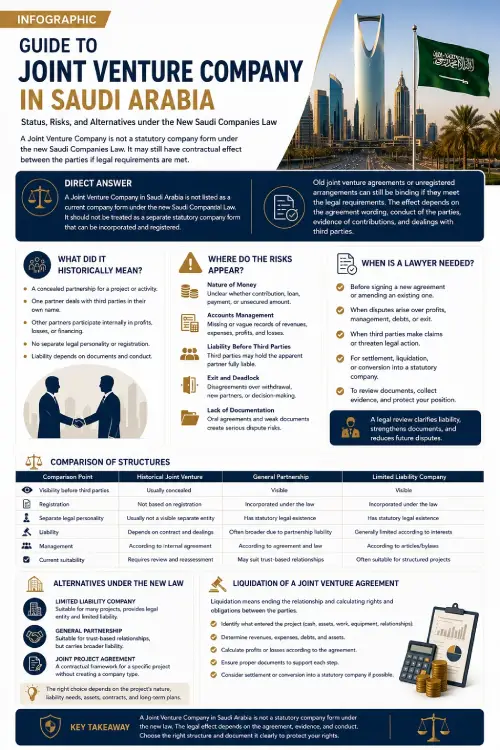
A Joint Venture Company in Saudi Arabia is not listed as a current company form under the new Saudi Companies Law. This means it should not be treated as a separate statutory company that can be incorporated and registered in the same way as a general partnership or a limited liability company.
However, this does not mean that every old joint venture agreement or unregistered business arrangement has no legal effect. The correct assessment depends on the wording of the agreement, the conduct of the parties, the evidence of contributions, who dealt with third parties, and whether the arrangement should remain contractual or be converted into a clearer statutory structure.
Have an old joint venture agreement or an unregistered partnership arrangement in Saudi Arabia? A focused legal review can help clarify its current effect, the available evidence, the liability position, and whether the relationship should be amended, settled, liquidated, or converted into a clearer legal structure.
Or continue reading first to understand the risks and available alternatives.
This distinction is important. The absence of a joint venture company from the current statutory company forms does not automatically cancel every previous arrangement described as a joint venture. It simply means the relationship must be examined for what it actually is: a partnership agreement, a project arrangement, a financing relationship, management on behalf of another party, or an insufficiently documented commercial venture.
The new Saudi Companies Law came into force on 19 January 2023 as part of a broader regulatory direction aimed at supporting company formation, continuity, and expansion. Choosing the correct legal structure is therefore not a procedural step only. It is a risk-management decision that affects liability, evidence, third-party dealings, and future disputes.
The practical problem appears when one party assumes that the phrase “joint venture company” is enough to protect their rights. In practice, the legal effect depends on the agreement wording, who appeared before third parties, how funds were managed, and whether the documents prove contributions, accounts, profits, and losses.
Professional note: before relying on an old or unregistered joint venture arrangement, three issues should be reviewed: the legal capacity of the parties, who dealt with third parties, and how contributions and accounts were documented.
What Did a Joint Venture Company Historically Mean?
Historically, a Joint Venture Company in Saudi Arabia referred to a concealed partnership relationship between parties who agreed on a project or activity without presenting that relationship as a separate legal personality before third parties. Usually, one partner dealt in their own name, while the relationship with the other partners remained internal, based on the agreement, accounts, and distribution of results.
The core idea was not the existence of a registered office, commercial register, or visible trade name. This is why it was often treated as a concealed or undisclosed partnership: third parties may not know about the other partners and may deal only with the person who appears externally.
Two practical terms are important here. The first is the apparent partner, meaning the party who conducts dealings with third parties, signs, contracts, or manages the activity in their own name. The second is the silent or concealed partner, meaning the party who participates internally in financing, profits, or losses without usually appearing in external dealings.
However, describing someone as apparent or concealed is not enough by itself to determine liability. The documents must be reviewed: who signed the contract? Who received the money? Who issued invoices? Who was contacted by third parties? Who managed the accounts?
For that reason, when discussing a Joint Venture Company in Saudi Arabia today, it is necessary to distinguish between the historical concept of an undisclosed joint venture and the current statutory company forms that can be incorporated and officially registered.
Where Do the Risks of a Joint Venture Agreement Appear in Practice?
The risks of a Joint Venture Company in Saudi Arabia appear when there is money, a project, and profits or losses, but no clear framework defining ownership, management, liability, and recourse between the parties. It appears when a financial dispute arises or when a third party makes a claim.
The first risk is ambiguity around the nature of the money. One party may pay an amount believing it is a project contribution, while the other later argues that it was a loan, a payment for services, or an unsecured contribution. If the agreement is unclear, proof may depend on correspondence, transfers, and the conduct of the parties.
The second risk is account management. Many older joint venture arrangements were managed through the apparent partner’s personal or business account. This may blur the distinction between project funds and the partner’s own funds, making the silent partner dependent on a claim for accounting if a dispute arises.
The third risk is dealings with third parties. If the apparent partner signed contracts in their own name, they may be the direct party facing customers, suppliers, or creditors. The rights of other partners may remain internal, depending on the contract and available evidence.
The fourth risk is the absence of a liquidation mechanism. A project may end without any clear method for calculating expenses, revenue, assets, and debts. The relationship then turns into a legal and accounting dispute.
Joint Venture Agreements after the New Companies Law
After the new Companies Law, a joint venture agreement should not be read as if it creates an independent statutory company. It should be examined as a contractual arrangement. It may be binding between the parties if its elements are clear and each party’s obligations can be established. However, it does not by itself provide the advantages of a statutory company, such as registration, separate legal personality, or formally regulated authority.
The agreement becomes riskier when it uses broad wording without defining practical consequences. For example, the contract may say that two parties are “partners in the project” without explaining who manages, who signs, how profits are calculated, who bears losses, and what happens if the project stops or a party withdraws.
The risks increase when one partner deals with third parties without controls. If the apparent partner signs contracts in their own name, receives revenues in their account, and pays expenses from their funds, it may later become difficult to separate the project account from their personal account unless detailed documents exist.
A joint venture agreement should therefore be reviewed through specific elements: parties, project scope, cash or in-kind contributions, management powers, third-party dealings, profits and losses, term, withdrawal, liquidation, and dispute resolution.
Liability of Partners in a Joint Venture Agreement
Partner liability in a joint venture agreement is not determined by the label alone. In practice, liability is affected by who dealt with third parties, who signed contracts, whether the existence of other partners was apparent or concealed, and what the agreement and documents prove.
Internally, the parties usually return to their agreement. If the contract defines profit and loss percentages, contributions, or management powers, these clauses become the starting point for accounting. But weak drafting or missing records may make proof more difficult.
Externally, the risk often appears with the apparent partner. If that partner contracted, issued invoices, opened accounts, and dealt in their own name, they may be the direct party facing creditors or counterparties. It is not enough to say that silent partners exist if the relationship was not apparent or documented in a way that affects the third party’s legal position.
Common disputes include claims for profit shares, attempts to impose losses on a party who did not accept them, objections to the apparent partner’s acts, refusal to provide accounts, project debts, or disagreement over termination.
Anyone holding a joint venture agreement or an undisclosed partnership arrangement should preserve the contract, bank transfers, correspondence, account statements, invoices, and any document showing the nature of contribution and management. These documents are not mere administrative details. They are evidence tools when a dispute occurs.
Can a Joint Venture Company Be Registered in the Commercial Register?
A Joint Venture Company in Saudi Arabia does not appear among the current company forms incorporated under the new Saudi Companies Law. It should therefore not be assumed that a separate company can be incorporated under the name “joint venture company” as an independent statutory type. If the objective is to create a visible and registrable business entity, an approved company form should be selected.
The internal agreement may create rights and obligations between its parties, but it does not automatically become an independent commercial entity before official authorities. A statutory company, by contrast, is based on a defined form, documents, registration, authority structure, and verifiable data.
If the activity requires a commercial registration, license, official dealings, bank accounts, invoices, employees, or tax and regulatory interaction, relying on a concealed relationship is usually not advisable. A suitable statutory form should be selected, or a clear project agreement should be drafted without claiming to create a company type not listed under the current law.
A visible business project needs a visible legal framework. Otherwise, liability, ownership, and accounting may remain disputed.
Brief answer: if the objective is to conduct a visible business activity before third parties, a Joint Venture Company in Saudi Arabia is not the appropriate independent registration route. The more accurate route is either to choose an approved statutory company form or to draft a clear contractual project arrangement according to the nature of the project.
Difference Between a Joint Venture, a General Partnership, and a Limited Liability Company
A general partnership, a limited liability company, and the historical Joint Venture Company in Saudi Arabia are not identical choices. They differ in visibility, registration, liability, and management.
| Comparison Point | Historical Joint Venture | General Partnership | Limited Liability Company |
|---|---|---|---|
| Visibility before third parties | Usually concealed | Visible | Visible |
| Registration | Not based on registration as a visible company | Incorporated under the law | Incorporated under the law |
| Separate legal personality | Usually not treated as a visible separate entity | Has statutory legal existence | Has statutory legal existence |
| Liability | Requires review of the contract and dealings | Often broader due to partnership liability | Generally limited according to interests |
| Management | According to internal agreement | According to the agreement and law | According to the articles or bylaws |
| Current suitability | Requires review and reassessment | May suit trust-based relationships with broader liability | Often suitable for structured projects |
A general partnership may be closer when the relationship is based on strong personal trust and the partners accept a broader liability effect. However, it is not a safe alternative in every case because it may carry greater risk if the partners do not understand joint liability.
A limited liability company is often suitable for projects that require a clear entity, statutory documents, and better separation between the company’s liability and the partners’ personal assets. It still requires clear documents, proper management, and financial separation.
A joint venture should also not be confused with mudarabah. Each relationship has its own legal character and effect. A joint venture historically relates to a concealed partnership arrangement, while mudarabah is usually based on a relationship between a capital provider and a manager of the business. Each case must be examined according to its source, documents, and method of implementation.
Alternatives to a Joint Venture Company under the New Saudi Companies Law
There is no single alternative suitable for every joint venture arrangement. The correct alternative depends on the parties’ objective: do they want a visible entity? Do they need limited liability? Is the project temporary? Are there assets, contracts, or employees? Is there a plan to admit partners later?
A joint venture agreement may resemble some forms of cooperation without being an independent statutory company. The article on types of partnerships in Saudi Arabia may be reviewed to understand the broader framework before converting the relationship into a company or clearer agreement.
The first practical alternative is a limited liability company. This form suits many small and medium-sized projects that need a clear entity and generally limited liability, with documents regulating management, interests, and amendments. However, it still requires real financial and administrative separation so that its advantages do not remain only formal.
The second alternative to a Joint Venture Company in Saudi Arabia may be a general partnership or limited partnership in certain cases based on personal consideration. These structures require greater awareness of liability, especially when a partner is general or appears before third parties.
The third alternative is a joint project agreement or commercial cooperation agreement. This may suit a specific project where the parties do not want to incorporate a company immediately. But it must be clearly drafted: it should not claim to create a company form not listed in the law, and it should not leave liability, management, profits, and liquidation undefined.
A simplified joint stock company may also be suitable for projects that need flexibility in governance and structure, particularly if growth or investor admission is expected. However, it should not be presented as the best solution in every case. The choice requires a case-by-case review of activity, obligations, and business goals.
Liquidation of a Joint Venture Agreement and Expected Disputes
Liquidating a Joint Venture Company in Saudi Arabia means ending the relationship and calculating the rights and obligations between the parties. This may be needed when the project ends, the objective is achieved, the activity stops, a partner withdraws, a party dies, or a dispute arises over profits and losses.
Before any distribution, it is first necessary to determine what entered the project: was there a cash contribution, assets, work, equipment, commercial relationships, or a combination of these? Then revenues, expenses, debts, and assets should be identified before calculating profits or losses according to the agreement.
Liquidation becomes a dispute when there are no clear records. If the apparent partner alone holds the accounts, invoices, or contracts, the other partner may request a detailed accounting. One party may deny the partnership entirely, claim the amount was a loan, or argue that the project did not generate profits.
For this reason, documents should be collected before escalation: the agreement, transfers, messages, invoices, bank statements, acknowledgments, purchase and sale documents, and any evidence of profit distribution or loss sharing.
In some cases, the solution is not immediate litigation or continuation. A settlement, exit agreement, or liquidation agreement may close the accounts and prevent a longer dispute. If the relationship is capable of continuing, it may be better to convert it into a statutory company or a clearer joint project agreement.
When Do You Need a Lawyer for a Joint Venture Agreement?
You need a lawyer for a joint venture agreement when the risk cannot be understood from the title alone. The problem often does not appear on the day of signing. It appears when the parties disagree over profits, management, debts, or project exit.
Before signing a new agreement, legal review helps determine whether the relationship is suitable as a contractual arrangement or whether incorporating a statutory company would be safer. It also helps regulate the clauses that often cause disputes: management, accounts, signing authority, third-party dealings, losses, and withdrawal.
For an old agreement, review is important to determine its current effect. Can it be amended? Does it need liquidation? Can the relationship be converted into a limited liability company or another form? Are there obligations toward third parties that must be settled first?
When there is a dispute involving a Joint Venture Company in Saudi Arabia, legal review begins with evidence. Who has the documents? What is the nature of the transfers? Do messages confirm the partnership? Who dealt with third parties? Are there books or accounts? Is the dispute only accounting-related, or does it include liability or a legal claim?
A calm conversion point: if you have a joint venture agreement or an unclear partnership arrangement, early review helps identify the right path: amendment, liquidation, claim, or conversion into a suitable statutory structure.
Legal Conclusion
A Joint Venture Company in Saudi Arabia is no longer listed among the current company forms incorporated under the new Companies Law. This means using it as an independent statutory company is no longer appropriate, especially where the objective is to create a visible or registrable business entity.
However, a joint venture agreement or an arrangement using this term may still have contractual effects between its parties if its requirements and facts can be proven. The correct assessment is not made by reading the title alone. It requires reviewing the contract, contributions, dealings, and how the parties appeared before third parties.
Frequently Asked Questions about Joint Venture Company in Saudi Arabia
Is a Joint Venture Company in Saudi Arabia a current company form?
No. A joint venture company is not listed among the current company forms under the new Saudi Companies Law. However, an agreement using this term may still have contractual effect between the parties depending on its wording and facts.
Can a joint venture company be registered in the commercial register?
A joint venture company should not be treated as an independent statutory company form that can be incorporated and registered by itself. If a visible business entity is needed, an approved company form should be selected.
Does an old joint venture agreement become invalid automatically?
Not necessarily. The fact that the joint venture company is not listed as a current company form does not automatically cancel every old agreement. The agreement must be reviewed as a contractual arrangement.
What is the main risk of an unregistered joint venture?
The main risk is ambiguity. It may be unclear who owns the project, who manages it, who deals with third parties, who bears losses, and how profits or debts should be calculated.
Who is liable before third parties in a joint venture arrangement?
Liability depends on the facts. The party who appeared before third parties, signed contracts, issued invoices, or received funds may be the direct party facing creditors or counterparties.
What documents help prove a joint venture relationship?
Important documents include the agreement, bank transfers, correspondence, invoices, account statements, acknowledgments, purchase documents, sale documents, and any evidence of profit or loss sharing.
What is the difference between a joint venture and a general partnership?
A general partnership is a statutory company form incorporated under the Companies Law, while a historical joint venture arrangement is usually an internal or concealed agreement that requires contractual review.
What is the difference between a joint venture and an LLC?
An LLC is a registrable statutory company with a clearer legal structure and generally limited liability. A joint venture arrangement may be only a contractual relationship unless converted into a statutory form.
What is the best alternative to a joint venture company?
There is no single best alternative. The suitable structure may be an LLC, general partnership, limited partnership, simplified joint stock company, or joint project agreement, depending on the activity and risk level.
When should a joint venture agreement be liquidated?
Liquidation may be needed when the project ends, the objective is achieved, a party withdraws, one party dies, the activity stops, or a dispute arises over profits, losses, or accounts.
Official Sources: