Sole Establishment Registration in Saudi Arabia is not only an online filing step. It is a legal decision that links the business name, activity, address, owner details, and post-registration obligations to one individual owner.
This review becomes more important when the activity requires a licence, contracts already exist, another person is funding the project, or the registration may be used for someone other than the named owner. In these cases, the risk is not the online form. The risk is the legal effect that appears after the commercial registration is issued.
Before Sole Establishment Registration in Saudi Arabia, it is useful to understand Commercial Registration in Saudi Arabia as the official record that connects business data, activity, and continuing obligations.
Quick Answer
Sole Establishment Registration in Saudi Arabia is suitable for a simple business owned by one person, where the data is clear and the activity does not require special licensing. It should be reviewed before filing if the activity is regulated, a contract exists before registration, another party is financing or managing the business, or the registration may be used for someone else. The Ministry of Commerce provides the individual establishment registration service electronically through the Saudi Business Center, without requiring a visit to service centres.
Before registering a sole establishment, it may be necessary to review the proposed name, activity, address, licensing requirements, and potential obligations, especially where contracts, funding, or another party are involved.
What Does Sole Establishment Registration Mean?
Sole Establishment Registration in Saudi Arabia means recording an individual establishment in the commercial register under one owner’s name. The registration links the business activity, trade name, address, capital, contact data, and management details to that owner.
It should not be confused with company incorporation. A sole establishment is owned by one individual. A company is usually formed under a separate legal structure, with incorporation documents, shares, partners, governance rules, and management powers depending on the company type.
It should also not be confused with a business licence. The commercial registration records the business. A licence allows the business to carry out a regulated activity or operate from a specific site under the requirements of the relevant authority.
The Commercial Registration Law defines the commercial register as a register containing trader data through a central electronic database. The law also addresses registration, updates, annual confirmation, deletion, extracts, and registration certificates, which makes the register a continuing legal record rather than a one-time document.
The key question before filing is therefore not only “How do I register?” The better question is: Is this structure suitable for the activity? Are the data accurate? Does the activity require licensing? Are there obligations or third parties that must be arranged before registration?
When Is a Sole Establishment Suitable?
A sole establishment is usually suitable where the business is simple, the owner is one person, the activity is clear, and there is no hidden partnership, undocumented funding, or existing commitment before registration.
A Simple Business Owned by One Person
A sole establishment can be suitable for an owner who wants to operate a clear business activity under one individual name, such as a simple trading activity or a service that does not require a complex partner structure.
In this case, the review is usually practical. The owner should check the proposed trade name, activity, address, capital, contact data, and any licensing requirement. If the data is correct and the activity does not require a special licence, the electronic path may be appropriate.
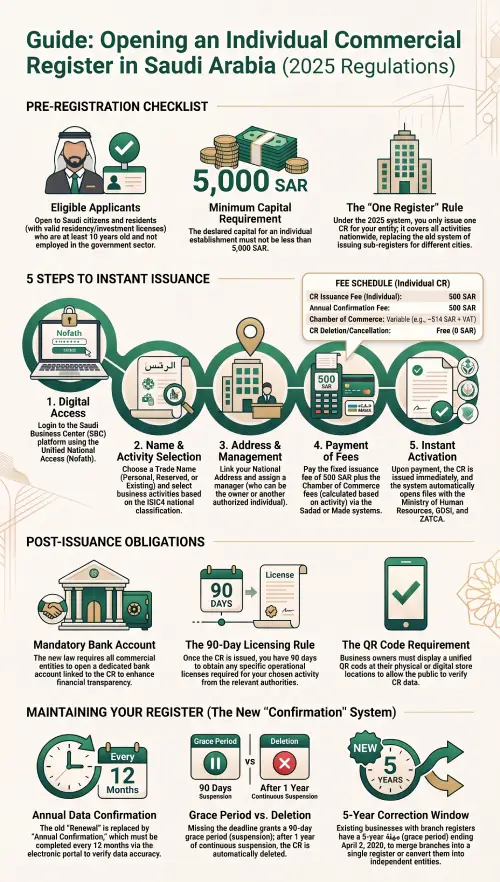
The Ministry of Commerce lists the service for registering an individual establishment as an electronic service provided through the Saudi Business Center. The same service page lists a fee of SAR 500 and immediate execution when requirements are completed.
No Hidden Partner or Undocumented Funding
The risk appears when the registration is under one person’s name, but the real situation is different. There may be a financier, an actual manager, an unregistered partner, or someone asking another person to register the establishment on their behalf.
In that situation, Sole Establishment Registration in Saudi Arabia is no longer a simple filing step. An undisclosed party may create issues around liability, management, profit sharing, contracts, and regulatory exposure.
If another person funds, manages, or controls the business, the relationship should be arranged before registration. In some cases, a written agreement, a different legal structure, or a legal review of third-party control risks may be more appropriate.
Obligations Before Sole Establishment Registration
The obligations begin before the application is submitted. The applicant confirms the data, selects the activity, enters the address, and may later become connected to several government, financial, and regulatory systems because of that registration.
Owner Liability in a Sole Establishment
The main pre-filing issue is understanding the effect of the registration on the owner. A sole establishment is not a partnership between several persons. It does not have an incorporation agreement that distributes ownership, management, and decision-making among partners.
For that reason, the owner’s position is central. Practical liability may arise through contracts, invoices, financial commitments, workers, licences, and daily commercial dealings. No person should register a sole establishment without understanding who will manage the business, who will sign contracts, and who will bear the obligations.
This point becomes more important if the establishment is being registered for another person or financed by a party who will not appear in the registration. That is not only a technical issue in an electronic platform. It is a legal responsibility and documentation issue.
Accuracy of Registration Data
The Commercial Registration Law requires business data to be updated when changes occur. It also states that the registrar does not bear responsibility for the accuracy of data submitted by the trader, and it provides penalties for submitting incorrect data or failing to comply with registration-related obligations.
Important data for a sole establishment includes the trade name, activity, address, capital, contact details, and manager details where applicable. An error in any of these items may appear later when applying for a licence, opening a bank account, signing a contract, or updating the registration.
The safer approach is to review the data before filing, not after the commercial registration is issued. Amendments may be possible, but they can cause delay or conflict with a licence, contract, or obligation that has already started.
Licensing Requirements
A commercial registration does not always replace a licence. If the activity requires approval from a licensing authority, that requirement should be handled before carrying out the activity, and sometimes before completing registration depending on the activity and the service path.
The Ministry of Commerce service page requires attaching the approval of the licensing authority where the activity requires a licence before issuance. It also requires indicating e-commerce activity where the applicant will practise e-commerce.
Before Sole Establishment Registration in Saudi Arabia, the owner should ask: Is the activity free to practise, or regulated? Does it require a municipal, health, professional, technical, or sectoral licence? Is the proposed location suitable? Can the business meet the licensing authority’s requirements?
Conditions for Sole Establishment Registration in Saudi Arabia
The main conditions relate to the applicant’s eligibility, the type of activity, the accuracy of data, and any special requirement that applies to the chosen activity.
The Ministry of Commerce service page lists key conditions for registering an individual establishment: the applicant must be at least 18 years old, must not be a government employee, and must not already own an active commercial registration for an individual establishment. The page also refers to licensing approval where the activity requires it before issuance.
| Condition | Meaning | When Review Is Needed |
|---|---|---|
| Eligibility | The applicant should meet the age and status requirements. | Review is needed for minors, non-Saudi applicants, or special employment status. |
| Trade name | The name should be suitable, clear, and not misleading. | Review is needed if the name is close to an existing name or includes sensitive wording. |
| Business activity | The selected activity should match the actual business. | Review is needed if the activity requires approval or a sector licence. |
| Address | The address should be correct and suitable for the activity. | Review is needed where the activity is linked to a site or operating licence. |
| Management data | The owner or manager details should reflect the actual operation. | Review is needed where someone else manages or controls the business. |
These conditions should not be treated as box-checking only. They affect the legal and practical position of the owner after registration.
Steps for Sole Establishment Registration Online
Sole Establishment Registration in Saudi Arabia is completed through the official electronic path, with the data reviewed before final submission.
A practical filing sequence is as follows:
- Access the official platform through Nafath or the approved service path.
- Select the service for commercial registration of an individual establishment.
- Enter applicant and contact details.
- Select or form the trade name.
- Choose the business activity accurately.
- Enter the address and business location data.
- Enter capital and management details where required.
- Review the application before submission.
- Pay the official fee through the approved payment channel.
- Print or save the commercial registration and review its data after issuance.
The Ministry service page sets out similar service steps, including entry through the Saudi Business Center via the National Single Sign-On, entering owner and contact data, choosing activities, entering e-commerce data where applicable, selecting the trade name, reviewing the application, paying the fee, and issuing the commercial registration.
The same page states that after issuance, automatic registration takes place with related authorities, including the Ministry of Human Resources, Zakat, Tax and Customs Authority, GOSI, Saudi Post for the national address, and the Chamber of Commerce.
Fees and Timing Before Registration
The Ministry of Commerce service page currently lists a service fee of SAR 500 for registering an individual establishment and shows the execution time as immediate, provided the application is complete. These details should be checked on the official service page at the time of filing because official requirements and service data may be updated.
The article should not add estimated figures for chamber fees, VAT, invoices, or other charges unless they are supported by a clear and current official source.
From a timing perspective, the Commercial Registration Law provides that commercial registration applications and procedures are submitted electronically. It also provides general rules for registration applications, updates, annual confirmation, deletion, extracts, and correction of errors.
This means the practical answer should be precise. A complete simple application may be issued immediately according to the service page. A case that requires licensing approval, correction, or completion may take a different path depending on the activity and missing requirements.
Sole Establishment vs Company Incorporation
Sole Establishment Registration in Saudi Arabia is different from company incorporation. A sole establishment is usually appropriate where the business is owned by one individual and there is no partnership, shared ownership, or joint management structure.
A company is a more structured legal form. It may require incorporation documents, shares, partners, management powers, voting arrangements, and rules for exit or transfer of ownership.
The difference becomes clear when a dispute arises. In a sole establishment, the owner is the central point of the business. In a company, the relationship between partners or shareholders should be documented under the relevant corporate structure.
This section should remain limited. The purpose is not to compete with articles on Saudi company law or company incorporation. The purpose is to help the applicant identify whether a sole establishment fits the reality of the project.
Sole Establishment Registration vs Business Licence
A commercial registration records the business. A licence authorizes the practice of a specific activity or the operation of a specific location under the requirements of the competent authority.
A person may receive a commercial registration but still be unable to operate legally until the relevant licence or approval is obtained. This is common in activities connected to a physical location, health requirements, technical conditions, municipal rules, or sector-specific regulation.
It is a mistake to begin actual operations immediately after the registration is issued if the activity requires a separate licence. The registration confirms business data, but it does not replace a licence where a licence is mandatory.
The practical rule is simple: review the activity before registration. If it is regulated, identify the competent authority, required documents, and whether approval must be attached before registration or completed after it.
Common Mistakes Before Sole Establishment Registration
One common mistake is registering the establishment under one person’s name for another person’s benefit. This may look convenient, but it can create problems in liability, management, contracts, and revenue attribution.
Another mistake is ignoring the owner’s position. Some founders treat the commercial registration as only a number, then later discover that contracts, invoices, and obligations are connected to their own data.
Choosing the wrong activity is also common. The activity should reflect the actual business and be capable of licensing where a licence is required. Selecting a close but inaccurate activity may create problems later.
Other mistakes include not checking the trade name, entering an inaccurate address, signing contracts before registration, starting operations before licensing, or ignoring post-registration obligations linked to tax, social insurance, and related authorities.
Business data should also be updated when changes occur. The Commercial Registration Law requires the trader to update registered data within 15 days of any change, and it requires annual confirmation of registered data.
What Happens After Sole Establishment Registration?
After Sole Establishment Registration in Saudi Arabia, the compliance stage begins. The owner should first review the commercial registration data: trade name, activity, address, capital, contact details, and management data.
The next step is to check whether the activity requires a licence, approval, or file with another authority. It is not enough for the registration to appear complete if the actual activity requires a separate licence.
The Ministry service page states that after the commercial registration is issued, automatic registration takes place with related authorities. This means the registration can trigger practical effects beyond the Ministry of Commerce alone.
The owner should also monitor annual confirmation. The Commercial Registration Law requires the trader to provide annual confirmation of registered data. If the trader does not provide annual confirmation within 90 days from its due date, the registration may be suspended after the required notice, and licences connected to the suspended registration may also be affected.
When Is Legal Review Needed Before Registration?
Legal review is useful before Sole Establishment Registration in Saudi Arabia when the activity is licensed, a contract exists before registration, funding comes from another party, a hidden partner is involved, workers will be hired, or an e-commerce activity needs compliance planning before launch.
Review is also important where the registration may be used for another person’s benefit. That case should not be treated as a normal online filing because it may affect liability, management, funds, and the validity of commercial dealings.
Legal review may also be needed where the business may later be converted into a company. Some founders begin with a sole establishment and later need partners, shares, or a different structure. Early planning can make that transition less difficult.
The purpose of review is not to delay registration. Its purpose is to confirm whether the sole establishment is the right structure, whether the name and activity are suitable, and whether the expected obligations can be managed after issuance.
This article is prepared for general legal awareness about Sole Establishment Registration in Saudi Arabia. It does not replace legal review of the trade name, activity, address, licence requirements, or obligations that may arise before filing or after registration.
FAQ About Sole Establishment Registration in Saudi Arabia
What does Sole Establishment Registration in Saudi Arabia mean?
It means registering an individual establishment under one owner’s name in the commercial register, linking the activity, name, address, and obligations to that owner.
When is a sole establishment suitable?
It is suitable for a simple business owned by one person where the activity is clear and there is no hidden partner, undocumented funding, or special licence issue.
What are the main conditions for registration?
The Ministry of Commerce service page states that the applicant must be at least 18 years old, must not be a government employee, and must not already own an active commercial registration for an individual establishment.
What is the official service fee?
The Ministry of Commerce service page currently lists the fee for registering an individual establishment as SAR 500. The official page should be checked at the time of filing.
How long does registration take?
The Ministry of Commerce service page lists the execution time as immediate when the application is complete and requirements are satisfied.
Does commercial registration allow immediate business operation?
Not always. If the activity requires licensing approval, the relevant approval should be obtained according to the competent authority’s requirements.
What happens after the registration is issued?
The Ministry service page states that automatic registration takes place with related authorities, including human resources, tax and customs, GOSI, Saudi Post, and the Chamber of Commerce.
What is the difference between a sole establishment and a company?
A sole establishment is linked to one individual owner, while a company usually involves a separate legal structure, incorporation documents, shares, partners, and management rules.
Who bears the debts of a sole establishment?
This should be reviewed before filing because the sole establishment is closely tied to the owner’s registered data, contracts, and commercial obligations.
Is it risky to register for someone else?
Yes. Using a registration for another person’s benefit may create legal and practical risks, especially where the actual controller is not the registered owner.
Legal Conclusion
Sole Establishment Registration in Saudi Arabia is suitable for simple businesses owned by one person, where the activity is clear, the data is complete, and no special licence, hidden party, or undocumented funding exists.
It needs review before filing when the matter moves from a simple electronic procedure to a legal obligation. This includes licensed activities, pre-registration contracts, e-commerce activity, hiring workers, third-party funding, or registering for someone else’s benefit.
The practical rule is clear: a sole establishment is not only a registration number. It is an official record connected to the owner, the business activity, and the obligations that may follow. Reviewing the file before registration is usually less costly than correcting a problem after issuance.
Official Sources.