Commercial Registration in Saudi Arabia is not just an administrative certificate issued at the start of a business. It is the official record through which a trader, establishment, or company appears before government authorities, banks, contracting parties, and the market.
The importance of commercial registration requirements begins before issuing the record. It also continues after issuance, because the registered data may affect contracts, licences, bank accounts, debts, ownership changes, updates, and cancellation procedures.
The Saudi commercial registration framework has also moved toward a more digital model. The modern record is based on updated electronic data, official inquiry tools, and annual confirmation of registration data, rather than relying only on a traditional paper certificate.
For this reason, the better question is not only: how do I obtain a commercial registration? The more important questions are: is the activity correctly recorded? Is the trade name suitable? Are the licences, address, management details, and legal obligations aligned with the real business?
Quick Answer
Commercial Registration in Saudi Arabia is the official record that identifies a business before government authorities and third parties. Its requirements usually relate to the applicant’s eligibility, accurate business data, a valid address, proper activity classification, trade name selection, and any required licences or approvals for regulated activities.
It should not be treated as an isolated online procedure. The information recorded in the commercial register may become relevant when dealing with contracts, creditors, employees, licences, banks, and ownership changes.
Are you planning to issue, update, cancel, or transfer a commercial registration and need to understand its effect on debts, contracts, licences, or ownership? A focused legal review helps assess the registration data and related obligations before taking action.
What Is Commercial Registration in Saudi Arabia?
Commercial Registration in Saudi Arabia is the official record that shows the basic data of a trader, establishment, or company. It allows third parties to identify the business, its name, legal form, activity, address, status, and other essential information made available through official channels.
Its value is not limited to proving that a business exists. Registration data may affect practical dealings, including signing contracts, opening business bank accounts, applying for licences, verifying a business before a transaction, and confirming who has authority to manage or represent the entity.
From a legal perspective, the commercial registration should be treated as a live business record. It is not a document that can be issued once and ignored. If the business activity, address, management, or contact details change, the registration may need to be updated so that it reflects the actual position of the business.
This is particularly important when contracts, financing, licensing, or disputes are involved. Inaccurate or outdated registration data may create confusion when dealing with authorities, banks, suppliers, customers, or courts.
Commercial Registration Requirements Before Issuance
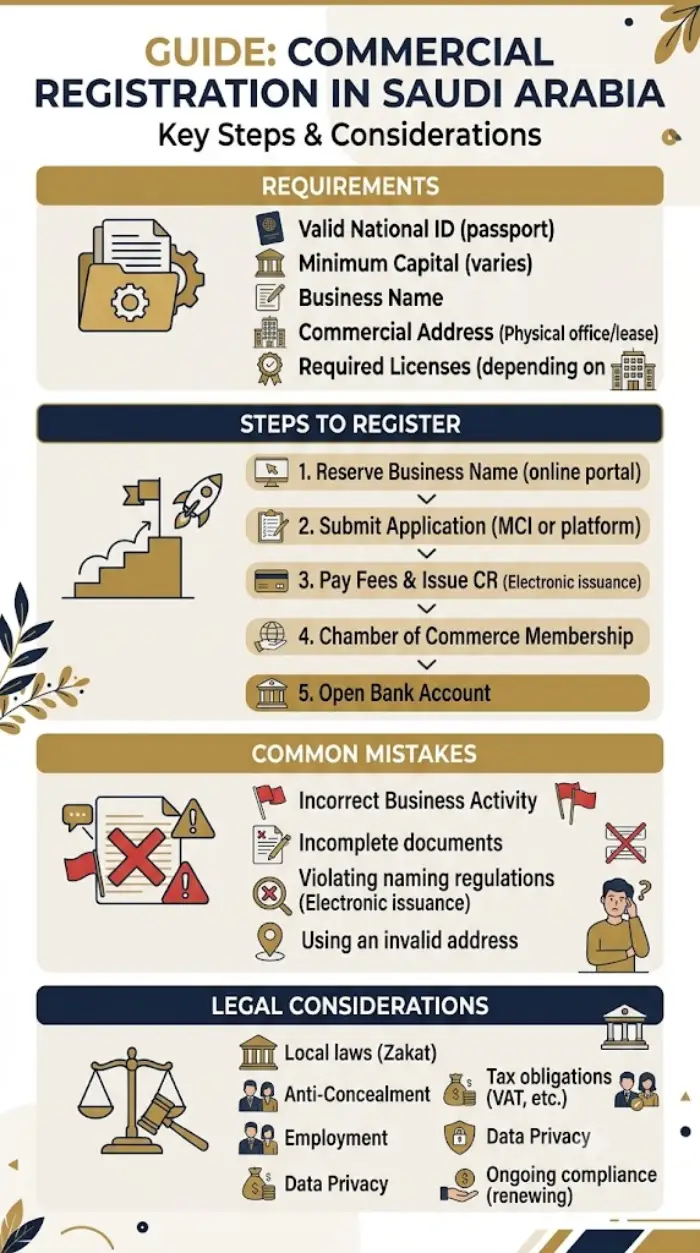
Commercial Registration in Saudi Arabia requirements generally begin with the applicant’s eligibility and the accuracy of the information submitted. They then extend to the business activity, trade name, address, licences, and any approvals required for regulated activities.
Before opening a new commercial registration, the applicant should review the intended activity, the proposed trade name, the registered address, contact details, management information, and the classification of the business activity. If the activity is regulated, a licence or prior approval may be required before the business can operate.
The activity field should not be treated as a minor detail. A mismatch between the registered activity and the real business may create difficulties when obtaining licences, opening a bank account, dealing with labour platforms, registering for tax purposes, or signing contracts.
If the applicant intends to issue a commercial registration for a company rather than a sole establishment, the relationship between the registration and the constitutional documents should also be understood. For a broader understanding of company forms and governance, see the guide to Saudi Companies Law before choosing the legal structure.
When Does a Business Need Commercial Registration?
A business usually needs commercial registration when the activity moves from a limited or occasional practice to an organised, continuous activity carried out for profit. The purpose of registration is to organise the business before the state, customers, suppliers, banks, and other stakeholders.
The need becomes clearer when the activity involves contracts with customers, issuing invoices, employing workers, opening a business bank account, leasing premises, applying for licences, or operating under a trade name.
Commercial registration also helps identify the party responsible for the activity. A customer, supplier, bank, or government entity needs clear information about the business it is dealing with. This makes the commercial register a key tool for identifying the entity, its activity, and its legal position.
However, a commercial registration alone does not replace all other requirements. A business may still need a municipal licence, a sector-specific approval, tax registration, a national address, or other operating requirements. It should therefore be reviewed as part of a wider compliance framework.
Commercial Registration, Trade Name, and Licence
Many business owners confuse commercial registration, trade name, and operating licences. This confusion may cause problems at the start of a business, during expansion, or when transferring ownership.
Commercial registration identifies the business and records its key data. The trade name distinguishes the business in the market. A licence, on the other hand, is usually connected to practising a specific activity in a particular location or regulated field.
A reserved trade name does not by itself mean that a business is legally ready to operate. Similarly, having a commercial registration does not always mean that the premises or activity meet all licensing requirements. A licence may also be tied to a specific location and may not automatically follow every change in the registration.
The practical rule is simple: the registration identifies the entity, the trade name identifies the market-facing name, and the licence regulates the actual practice of the activity. Before any major step, the three should be reviewed together.
Steps to Obtain a New Commercial Registration
Obtaining a new Commercial Registration in Saudi Arabia is generally handled through official online channels. Yet the ease of the electronic process does not make every choice inside the application simple. A mistake in the name, activity, address, or management data may later require amendment or delay a licence, bank account, or contract.
The process can be organised as follows:
- Access the official platform through the approved digital route for business services.
- Select the commercial registration service according to the type of entity or record required.
- Choose or enter the trade name in line with the applicable official requirements.
- Select the economic activity carefully so that the record reflects the actual business.
- Enter the address and contact details because they may affect notices, filings, and official communications.
- Provide owner or management data depending on the type of business structure.
- Review the application summary before submission to check the name, activity, address, and data.
- Complete payment and any additional requirements as shown on the official service page.
Before submission, review the activity, name, and address again. The objective is not merely to obtain a record. The objective is to obtain a registration that supports licensing, contracting, financing, and operations without avoidable amendments.
Inquiry About Commercial Registration Data
An inquiry about Commercial Registration in Saudi Arabia is an important step before contracting, entering a partnership, buying an establishment, or dealing with a supplier. Official inquiry services allow users to verify registration data electronically.
The practical value of inquiry is risk reduction. It may help verify the status of the registration, the business name, identification data, activity, and other basic information that helps determine who the counterparty is.
It is not enough for a business name to appear on a quotation, invoice, or proposal. Before signing an important contract, the data should be checked through the official source, especially in supply, contracting, franchising, partnership, acquisition, or ownership transfer matters.
In high-value dealings, registration inquiry should be only the starting point. Contracts, authority to sign, licences, possible debts, and existing obligations should also be reviewed when the commercial risk is material.
Updating Registration Data and Annual Confirmation
Modern commercial registration is no longer only about keeping a static certificate. The updated system relies on electronic data, official inquiry, and annual confirmation of registration information.
This means that a business owner should review the record periodically. If the address, activity, management details, or contact information changes, an official update may be required so that the commercial registration reflects the real status of the business.
Annual confirmation also supports transparency in the market. A current and confirmed registration provides a clearer picture of the business, while outdated data may create difficulties in official procedures, contracts, licensing, or banking matters.
For practical risk control, registration review should be part of the business’s annual compliance routine. The trade name, activity, address, management details, and contact information should be checked before a problem appears in a contract, licence, or government file.
Cancellation or Transfer of Commercial Registration
Cancelling a commercial registration ends its official record, but it does not necessarily eliminate debts, contracts, claims, or other obligations that existed before cancellation. It should therefore be treated as a legal and operational step, not merely an online button.
Before cancellation, the business should review existing contracts, employees, licences, tax or zakat files, supplier claims, bank accounts, and any pending disputes. The treatment may differ depending on the entity type, activity, and related authorities.
Ownership transfer requires even more caution. A buyer or transferee should not view the registration as just a business name. It may be connected to contracts, debts, licences, employees, operational commitments, or historical dealings. The transfer documents should clearly state what is transferred and what is not.
This is where legal review becomes valuable. It helps determine whether the transaction is a clean transfer, a business acquisition, a restructuring step, or a transaction that needs additional contractual protections.
Commercial Registration and Branches
The modern approach to commercial registration in Saudi Arabia has moved toward simplifying registration data and reducing fragmentation. This is relevant for businesses that previously operated through multiple branches or activities.
For business owners, the key issue is not only whether the record is described as main or branch-related. The practical issue is whether activities, locations, licences, and operating requirements are correctly reflected in the business file.
This does not remove the need for review. If the business has different activities or locations, each should be checked against licensing, labour, tax, municipal, and sector-specific requirements where applicable.
Before adding or restructuring an activity, the owner should ask: does the activity match the licences? Does it affect employment or tax obligations? Does it need approval from a specialised authority? These questions help prevent the registration from expanding into activities that have not been properly assessed.
Effect on Debts, Contracts, and Licences
Commercial registration affects how a business appears to third parties, but it does not erase obligations and does not by itself create every licence needed to operate. The record should be separated from the underlying contracts, debts, rights, and regulatory approvals.
In a sole establishment, the relationship between the owner and the activity may be closer than in some company structures. In companies, constitutional documents such as articles of association or bylaws become important for understanding management, ownership, and authority.
Existing contracts need separate review. Some may require notice if the registration data changes. Others may require consent before assignment, transfer, restructuring, name change, or change in management. Licences may also be tied to a specific location or activity and may not automatically change when registration data changes.
Before any important action, such as cancellation, transfer, adding an activity, or changing the entity structure, prepare a short checklist covering contracts, debts, licences, employees, bank accounts, tax obligations, and official contact details.
Common Mistakes in Commercial Registration
A common mistake is practising an activity that is not reflected in the registration data. This may create problems with licensing, contracting, or dealing with competent authorities.
Another mistake is neglecting contact details and address updates. These details are not merely administrative; they may affect notices, requests, official communications, and the ability to respond to issues on time.
A further mistake is confusing the commercial registration with the operating licence. A valid registration does not always mean that the business location or regulated activity has all required approvals.
Other recurring mistakes include opening a registration for another person without understanding the legal risk, transferring ownership without checking debts, cancelling the record without reviewing obligations, adding broad activities without a clear need, or relying on outdated data when signing an important contract.
When Is Legal Review Needed?
Legal review is needed when the commercial registration action may affect debts, contracts, licences, ownership, or legal responsibility. Not every simple update requires an extensive review, but some situations should not be handled through the electronic procedure alone.
The need becomes clear when transferring ownership of an existing registration, buying an establishment, cancelling a record with obligations, bringing in a partner, converting an establishment into a company, dealing with long-term contracts, or discovering that the registration is used by someone other than the actual owner.
Review is also important when the recorded data conflicts with reality. Examples include a business activity that does not match the actual operation, a licence under a different name, outdated contact details, or claims linked to the registration.
The purpose of legal review is not to complicate the process. It is to identify what should be updated, what should be documented, and what should be checked before issuance, amendment, cancellation, or transfer.
FAQ About Commercial Registration in Saudi Arabia
What is Commercial Registration in Saudi Arabia?
Commercial Registration in Saudi Arabia is the official record that identifies a trader, establishment, or company and shows key business data.
When should a business obtain commercial registration?
A business should obtain registration when it operates as an organised and continuous activity for profit, especially before contracting, licensing, or banking.
What are the main commercial registration requirements?
They usually relate to applicant eligibility, correct business data, trade name, address, activity classification, and licences or approvals where required.
How can a new commercial registration be issued?
It is issued through the official platform by entering the applicant, business activity, trade name, address, and management data, then completing the required steps.
Why is the trade name different from commercial registration?
The trade name identifies the business in the market, while the commercial registration records the business data and legal status.
Is an operating licence the same as commercial registration?
No. A licence usually relates to practising an activity at a location or in a regulated field, while the registration identifies the business itself.
How can I verify a commercial registration?
You can verify the data through the official commercial registration inquiry service provided by the Saudi Ministry of Commerce.
What does annual confirmation mean?
It means reviewing and confirming the registration data electronically according to official requirements, instead of relying only on a traditional expiry date.
Does cancellation remove old debts?
No assumption should be made. Cancellation ends the registration record, but it does not necessarily remove debts, contracts, or pending claims.
When is ownership transfer risky?
It is risky when the registration is linked to debts, employees, contracts, licences, claims, or unclear operational obligations.
This article is prepared for general legal awareness about Commercial Registration in Saudi Arabia. It is not a substitute for reviewing registration data, activity, contracts, debts, licences, or the status of the business before issuance, amendment, cancellation, or ownership transfer.
Legal Conclusion
Commercial Registration in Saudi Arabia is a legal foundation for dealing with a business. It is not just a document stored in an administrative file. Its importance appears in identifying the business, organising activity data, enabling inquiry, and connecting the business with licences, contracts, and official authorities.
Proper handling starts before issuance, through accurate data and correct activity selection. It continues through updates and annual confirmation. It becomes especially important before cancellation, ownership transfer, or any change that may affect contracts, debts, licences, or management.
The practical rule is simple: before taking action on a commercial registration, check the activity, owner, contracts, debts, licences, and whether the current data reflects the real business position. This turns the registration from a formal record into a tool for organising and protecting business activity.