To add activity to commercial registration in Saudi Arabia may be a straightforward amendment to an existing record. In other cases, the business must first deal with a licensing requirement or confirm that the new activity falls within the company’s objects.
The right starting point is therefore not the amendment form itself. First identify the activity the business will actually carry out, the type of entity involved, and any licence or approval connected to that activity.
Since April 3, 2025, Saudi Arabia’s commercial registration framework has operated on the basis of one commercial registration for each establishment across the Kingdom. New branch commercial registrations are no longer issued under the previous model, and annual confirmation has replaced the former renewal approach.
For a wider explanation of the registration framework, see Commercial Registration in Saudi Arabia.
Quick Answer: When Is an Amendment Enough?
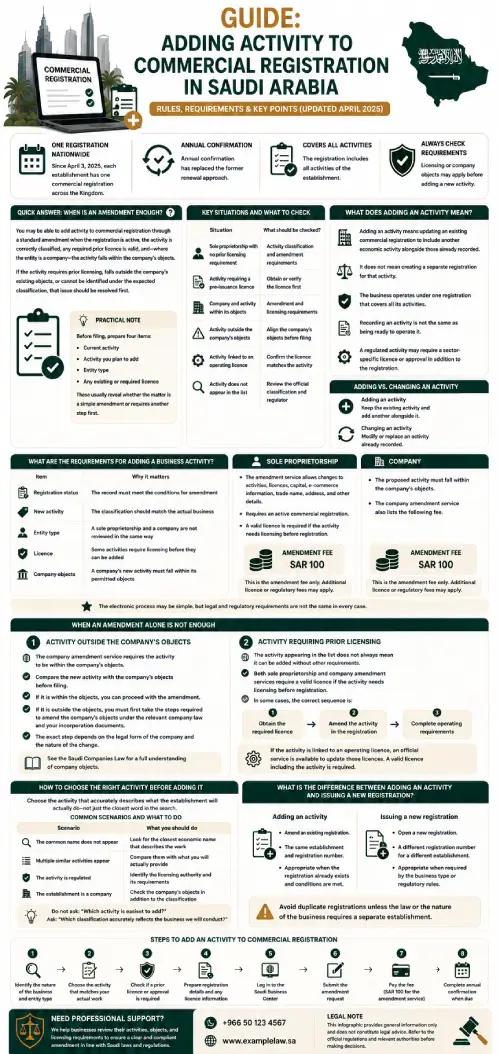
You may be able to add activity to commercial registration through a standard amendment when the registration is active, the activity is correctly classified, any required prior licence is valid, and—where the entity is a company—the activity falls within the company’s objects.
Planning to add activity to commercial registration but unsure whether the amendment alone is enough or whether licensing or company objects must be addressed first? A focused review of the current activity, proposed activity, entity type, and relevant licences can clarify the correct route before you file.
Prefer to understand the requirements first? Continue with the guide below.
If the activity requires prior licensing, falls outside the company’s existing objects, or cannot be identified under the expected classification, that issue should be resolved before treating the matter as a routine online amendment.
| Situation | What should be checked? |
|---|---|
| Sole proprietorship with no prior licensing requirement | Activity classification and amendment requirements |
| Activity requiring a pre-issuance licence | Obtain or verify the licence first |
| Company and activity within its objects | Amendment and licensing requirements |
| Activity outside the company’s objects | Align the company’s objects before filing |
| Activity linked to an operating licence | Confirm the licence matches the activity |
| Activity does not appear in the list | Review the official classification and regulator |
The official amendment service for a sole proprietorship requires an active commercial registration and a valid licence where the added activity requires licensing before registration. For companies, the Ministry of Commerce also requires the activity to fall within the company’s objectives.
Practical note: Before filing, prepare four items: the current activity, the activity you plan to add, the legal form of the business, and any existing or required licence. These usually reveal whether the matter is a simple amendment or requires another step first.
Not sure whether the amendment alone is enough? Reviewing the current activity, proposed activity, entity type, and licensing position before filing can clarify the correct route without starting the process blindly.
What Does Adding an Activity to a Commercial Registration Mean?
Adding an activity means updating an existing commercial registration so that it includes another economic activity alongside the activities already recorded.
Under the current framework, adding an activity does not automatically mean creating a separate commercial registration for that activity. The business operates under its single registration, subject to the regulatory requirements that apply to each activity.
The distinction matters because recording an activity and being legally ready to operate it are not always the same thing.
A regulated activity may require a sector-specific licence or approval. In that situation, the commercial registration forms one part of the compliance process rather than replacing the operating licence.
Adding an Activity vs. Changing an Activity
Adding an activity means keeping the existing activity and placing another activity alongside it.
Changing an activity means modifying or replacing an activity already recorded.
For example, if a business continues its existing services while entering an additional line of business, that is an addition. If it stops the existing activity and moves into a different field, the change may need to be treated differently.
This distinction becomes particularly important when a licence is tied to the current activity.
What Are the Requirements for Adding a Business Activity?
Before you add activity to commercial registration, review five points: the registration status, activity classification, entity type, licensing requirements, and the company’s objects where applicable.
| Item | Why it matters |
|---|---|
| Registration status | The record must meet the conditions for amendment |
| New activity | The classification should match the actual business |
| Entity type | A sole proprietorship and a company are not reviewed in the same way |
| Licence | Some activities require licensing before they can be added |
| Company objects | A company’s new activity must fall within its permitted objects |
For a sole proprietorship, the current amendment service allows changes to business activities, licences, capital, e-commerce information, trade name, address, and other registration details.
The service requires an active commercial registration. A valid licence is also required when the proposed activity is subject to pre-issuance licensing.
The official service currently lists a fee of SAR 100. This is the fee for the commercial registration amendment itself. It should not be treated as the total cost of entering the new activity, because a separate licence or regulatory process may involve additional fees.
For a company, there is another important test: the proposed activity must fall within the company’s objects. The company amendment service also currently lists a fee of SAR 100.
When Is a Commercial Registration Amendment Not Enough?
Two situations require particular attention before filing: the proposed activity falls outside the company’s objects, or the activity requires a licence before it can be added.
The Activity Falls Outside the Company’s Objects
For companies, finding an activity in the available classification does not by itself mean that it can be added immediately.
The Ministry of Commerce’s company amendment service requires the activity to fall within the company’s objectives. The proposed activity should therefore be compared with the company’s existing objects before the amendment is filed.
If the activity is already covered, the business can move on to the remaining amendment and licensing requirements.
If it is not covered, the company should first determine the appropriate corporate procedure for aligning its objects with the proposed activity.
The exact process should not be generalised across every company. The required corporate action or document may depend on the company’s legal form, constitutional documents, and the nature of the proposed change.
For a broader explanation of company forms, governance, and constitutional documents, see Saudi Companies Law.
The New Activity Requires Prior Licensing
An activity appearing in the classification does not always mean it can be added without further requirements.
The official amendment services for sole proprietorships and companies require a valid licence where the activity is one that must be licensed before registration.
In some cases, the correct sequence is therefore:
Required licence or approval → commercial registration amendment → remaining operating requirements
rather than:
Registration amendment → immediate operation
Where an activity is linked to an operating licence, the registration and licence should remain consistent. Saudi business services also provide procedures for updating operating licence information linked to the commercial registration.
How Do You Choose the Correct Business Activity?
Choose the activity that describes what the business will actually do, not simply the closest wording that appears in the search results.
Saudi Arabia uses the National Classification for Economic Activities (ISIC4) to classify economic activities. The classification is based on the International Standard Industrial Classification of All Economic Activities.
The practical task is to translate the commercial idea into the correct economic activity.
| Problem | Practical approach |
|---|---|
| The familiar business name does not appear | Search for the economic description of the activity |
| Several activities appear similar | Compare them with the actual product or service |
| The activity is regulated | Identify the licensing authority and its requirements |
| The entity is a company | Check the company’s objects as well as the classification |
A classification error may not cause an obvious problem at the filing stage. It can become relevant later when the business applies for a licence, updates an existing licence, or needs to show that its registered activity matches its actual operations.
The better question is not:
Which activity is easiest to select?
It is:
Which classification accurately describes what the business will actually do?
How Does the Process Differ for a Sole Proprietorship and a Company?
Both structures require a review of the activity and any applicable licensing requirements before you add activity to commercial registration. A company adds another layer: confirming that the new activity falls within the company’s objects.
| Issue | Sole Proprietorship | Company |
|---|---|---|
| Registration status | Must satisfy amendment conditions | Must satisfy amendment conditions |
| Activity classification | Required | Required |
| Prior licence | Where applicable | Where applicable |
| Company objects | Not applicable in the same way | New activity must fall within the objects |
| Constitutional documents | Less relevant to this issue | May be affected if the objects need to change |
To add activity to commercial registration for a sole proprietorship may be relatively direct where the activity is clear and all licensing conditions are satisfied.
For a company, selecting the activity from the list is not enough. The current company amendment service expressly requires the activity to fall within the company’s objectives.
This topic should also be kept separate from converting a sole proprietorship into a company. Adding an activity expands what an existing entity does. Conversion changes the legal form of the business and raises different legal and procedural questions.
What Are the Steps to Add a Business Activity?
Before using the electronic service to add activity to commercial registration, organise the review in this order:
- Identify the activity the business will actually carry out.
- Confirm the correct activity name and classification.
- Check whether the activity requires prior licensing.
- For a company, confirm that the activity falls within its objects.
- Access the commercial registration amendment service through the Saudi Business Center.
- Update the activity and any related registration information.
- Review the application before submission.
- Complete payment and any remaining licensing or operating requirements.
For sole proprietorships, the amendment service covers business activities, licence information, trade name, address, capital, e-commerce information, and other registration details.
For companies, the service allows business activities and licence information to be updated together with other commercial registration data.
Do You Need a New Commercial Registration for the Activity?
Not automatically.
Since April 3, 2025, the Saudi commercial registration system has been based on one commercial registration for an establishment across the Kingdom, covering its activities.
The current model also discontinued issuing new branch commercial registrations under the previous approach.
The practical question is therefore whether the proposed activity can be added to the existing registration after its specific requirements are satisfied—not whether every additional activity requires another registration.
Can the Business Start Operating as Soon as the Activity Is Added?
Not always.
Recording the activity in the commercial registration does not replace a separate operating or sector-specific licence where the activity is regulated.
A registration amendment may be completed while other operating requirements remain outstanding.
| Activity status | What should be checked? |
|---|---|
| No specific licence required | Other applicable operating requirements |
| Licence required | Validity and scope of the licence |
| Existing operating licence | Whether it covers the newly recorded activity |
| Company activity | Continued consistency with the company’s objects |
The key distinction is between the business being registered for the activity and the business being authorised to operate the activity where further approval is required.
Why Can an Activity Amendment Be Delayed or Blocked?
When a request to add activity to commercial registration does not proceed, the problem is not always technical.
The cause may be a requirement that was not addressed before submission.
Common points to review include:
- The commercial registration does not meet the amendment conditions.
- The activity requires a valid prior licence.
- The proposed activity falls outside the company’s objects.
- The selected classification does not match the intended activity.
- An existing licence does not cover the proposed activity.
- The activity appears under a different official classification from the name commonly used in the market.
The amendment service also distinguishes between adding and removing regulated activities. Where a sole proprietorship removes an activity that required pre-issuance licensing, the service requires evidence relating to cancellation of the associated licence.
Repeatedly submitting the same request is therefore not always the solution. The better approach is to identify what is preventing the amendment from being completed.
When Should You Review the Position Before Filing?
Not every request to add activity to commercial registration requires a separate legal review.
Review becomes more useful when the real question is what must happen before the application is submitted.
| Situation | Main issue to resolve |
|---|---|
| Clear activity for a sole proprietorship | Classification and licensing |
| Regulated activity | Requirements of the competent authority |
| New activity for a company | Consistency with the company’s objects |
| Activity outside existing objects | Required corporate step to align the objects |
| Existing operating licence | Consistency between the licence and the activity |
| Unclear activity | Correct name and classification |
Frequently Asked Questions About How to Add Activity to Commercial Registration
What are the main requirements for adding an activity?
Review the registration status, activity classification, any prior licensing requirement, and the company’s objects where the entity is a company.
Can one commercial registration include several activities?
Yes. The current framework is based on one commercial registration for the establishment, covering its registered activities.
When is a standard amendment enough?
It may be enough when the activity meets the amendment requirements, no required prior approval is outstanding, and the activity is compatible with the company’s objects where applicable.
What happens if the activity is outside the company’s objects?
The company should first determine the corporate step required to align its objects with the proposed activity before relying on the registration amendment alone
When does an activity require a prior licence?
A prior licence is required where the competent authority regulates the activity and requires licensing before it can be added to the commercial registration.
What should I do if the activity does not appear in the list?
Review the official economic classification and the description of the actual business rather than selecting a loosely related activity.
How much does the commercial registration amendment cost?
The current Ministry of Commerce services list a fee of SAR 100 for amending the registration of a sole proprietorship or company. Separate licensing or regulatory fees may still apply.
What is the difference between adding and changing an activity?
Adding keeps the existing activity and introduces another one. Changing an activity modifies or replaces an activity already recorded.
Can the business operate immediately after the activity is added?
Not in every case. A regulated activity may still require a valid licence or another approval before operations begin.
What is different when the entity is a company?
In addition to classification and licensing requirements, the proposed activity must fall within the company’s objects.
Legal Conclusion
To add activity to commercial registration may involve a simple electronic amendment, but the process does not always begin with the amendment screen.
Start by identifying and correctly classifying the actual activity. Then check whether prior licensing is required. If the registration belongs to a company, confirm that the proposed activity falls within the company’s objects.
Where these points are satisfied, the commercial registration can move to the amendment stage. Where a prior licence is required, the activity falls outside the company’s objects, or an existing operating licence does not match the proposed activity, that issue should be addressed first.
Official Sources.