Before applying for a Commercial License or starting a new business activity in Saudi Arabia, it is not enough to ask: “Do I have a commercial registration?” or “Do I have a license?” The better question is: what does each document do, and does the activity require commercial registration, an operating license, or both?
The difference between a Commercial License and commercial registration is practical, not merely linguistic. It affects how the activity starts, how contracts are signed, how invoices are issued, how a business bank account is opened, and whether the business location can be operated legally.
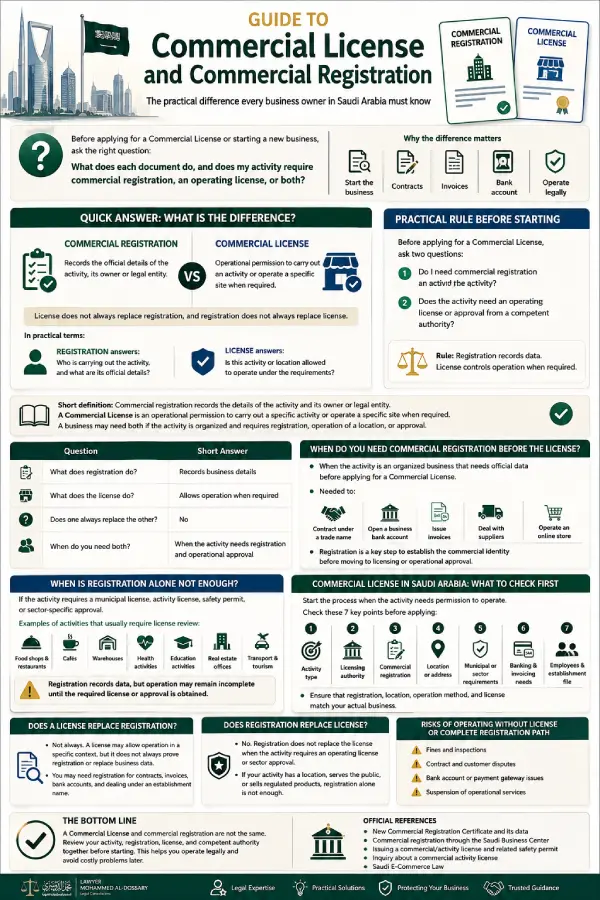
Commercial registration records the official details of the activity, its owner, or its legal entity. A Commercial License, or activity license, is usually an operational permission to carry out a specific activity or operate a specific site when such permission is required.
To understand the registration side more clearly, you may refer to our guide on Commercial Registration in Saudi Arabia. This article focuses on a different question: when do you need commercial registration, when is registration alone insufficient, and when should the licensing process begin before operating the activity?
Quick Answer: What Is the Difference Between a Commercial License and Commercial Registration?
Commercial registration records the details of the activity, its owner, or its legal entity. A Commercial License is an operational permission to carry out an activity or operate a site when licensing is required. For this reason, the license does not always replace registration, and registration does not always replace the license.
Are you applying for a Commercial License in Saudi Arabia but unsure whether commercial registration is enough, or whether your activity needs a license, municipal approval, safety permit, or sector-specific clearance before operating? A focused legal review can clarify the correct path for your activity before you sign contracts, issue invoices, open a business bank account, or start serving customers.
Or continue reading first to understand when registration is enough and when a license is required.
In practical terms, commercial registration answers: who is carrying out the activity, and what are its official details? The license usually answers: is this activity or location allowed to operate under the relevant requirements?
A business owner may therefore start with commercial registration, then still need a municipal license, activity license, safety approval, or sector-specific approval before starting operations.
The Practical Rule Before Starting
Before starting any business, ask two direct questions when applying for a Commercial License: do I need commercial registration to record the activity? And does the activity need an operating license or approval from a competent authority?
If the activity is organized, has a trade name, suppliers, invoices, a payment gateway, or a business bank account, commercial registration may become a key part of the path. If the activity has a location, shop, warehouse, safety requirements, or a sector regulator, a license may be required before operation.
The practical rule is simple: commercial registration records data, while the license controls operation when required. Decisions should not be based on one document without checking the activity type and competent authority.
Short definition: commercial registration records the details of the activity and its owner or legal entity. A Commercial License is an operational permission to carry out a specific activity or operate a specific site when required. A business may need both if the activity is organized and requires registration, operation of a location, or approval from a competent authority.
| Question | Short Answer |
|---|---|
| What does registration do? | Records business details |
| What does the license do? | Allows operation when required |
| Does one always replace the other? | No |
| When do you need both? | When the activity needs registration and operational approval |
When Do You Need Commercial Registration Before the License?
You need commercial registration before the license when the activity is, in substance, an organized business that requires official data before applying for a Commercial License. Registration is not just an administrative document. It identifies the activity before authorities, banks, contracting parties, suppliers, and customers.
This need appears when the business owner wants to contract under a trade name, open a business bank account, issue invoices, deal with suppliers, or operate a continuing online store. It also appears when a sole establishment or company wants to deal with third parties in a clear commercial capacity.
The point is not that registration always authorizes immediate operation. Rather, it helps establish the commercial identity of the activity before moving to the licensing or operational approval stage.
Cases Where Registration Is Checked First
Registration is usually checked first when there is a continuous business activity, suppliers, a business account, invoices, an organized online store, or an establishment that wants to deal under a trade name.
For example, an online store selling products repeatedly may need more than a store account on a platform. The activity may require clear commercial data first, then a license or approval depending on the type of products and method of operation.
Another example is a service office contracting with companies. In that case, commercial details may be required for contracts, invoices, and banking, while the license is later checked based on the activity and location.
When Is Commercial Registration Alone Not Enough?
Commercial registration alone is not enough if the activity requires a municipal license, activity license, safety permit, or sector-specific approval. Registration records data, but it does not remove operational requirements when they apply.
The common mistake is to treat registration as permission to operate everything listed in it. This is not always accurate. If the activity is carried out in a shop, public-facing location, food business, storage site, health-related activity, or education-related activity, the operation may remain incomplete until the proper license or approval is obtained.
Therefore, the right question is not only: do I have registration? The better question is: does my activity require a license or approval before operation?
Examples of Activities That Require License Review
Activities that often require a licensing review include food shops, restaurants, cafés, warehouses, health activities, educational activities, real estate offices, transport activities, and tourism-related activities.
These examples do not create one rule for every case. They simply show that some activities are linked to location, safety, customers, regulated products, or sector regulators. Commercial registration may be valid, but operation may still require a separate license review.
If your activity has a premises, signboard, inventory, customers, employees, or technical requirements, do not rely on registration alone. Review the license and competent authority before opening the activity to customers.
Commercial License in Saudi Arabia: When Should the Process Start?
The process for a Commercial License in Saudi Arabia starts when it becomes clear that the activity needs permission to operate, not merely commercial registration. This depends on the activity type, location, competent authority, and whether prior approval or an additional permit is required.
There is no single set of steps that applies to every activity. Licensing a shop is different from licensing a warehouse. A food activity is different from a service office. An online store is different from a public-facing physical location. The licensing path should therefore be read through the nature of the activity, not just the name of the license.
The key is not to begin with the fees or expected processing time. Start with conformity: does the registered activity match the real activity? Is the location suitable? Are the operational requirements met? Is the requested license consistent with the actual business model?
What Should You Check Before Applying?
Before applying for a Commercial License, check seven points: the activity type, the licensing authority, the commercial registration, the location or address, municipal or sector requirements, banking and invoicing needs, and employees or establishment file requirements.
For a food activity, the location and requirements are central. For an office-based activity, the location and service type matter. For an online activity, payment, delivery, invoices, and product type may affect whether registration, licensing, or other approval is required.
A practical review should confirm that the commercial registration, location, operation method, and required license all match the actual business.
Does a Commercial License Replace Commercial Registration?
A Commercial License should not be treated as an absolute substitute for commercial registration. It may allow operation when required, but it does not always prove commercial registration and may not be enough if the activity requires official business data.
The license is mainly connected to operational permission. Commercial registration is connected to recorded business data. For this reason, the license may require prior registration, clear activity details, or consistency between the registered activity and the requested license.
For example, a business owner may obtain a license to operate a specific site, then start contracting with companies, issuing invoices, and opening a business bank account under an establishment name. In that case, the registration and business data must be reviewed, not only the license.
When Is the License Not Enough?
The license is not enough when the activity requires commercial registration, dealings under an establishment name, invoices, a business bank account, or contracts with companies.
It may also be insufficient when the actual activity is broader than the licensed activity. For example, the license may cover one activity, while the actual business includes another unregistered or unlicensed activity. In that case, the issue is not the existence of a license, but the mismatch between documents and actual operation.
Does Commercial Registration Replace the License?
Commercial registration does not replace the license in every case when applying for a Commercial License or starting a new activity. Registration may be valid from a data-recording perspective, but the operation may remain incomplete if the activity requires an operating license or sector-specific approval.
This is the most important difference between a license and registration: registration records the activity, while the license relates to operation when required. If the activity receives customers, uses a location, sells regulated products, or requires safety conditions, registration alone should not be relied on before operation.
The clearer the activity becomes, the more important it is to check whether a separate license or approval is required.
When Is Operating With Registration Alone Risky?
Operating with registration alone can be risky when opening a shop, operating a warehouse, carrying out a food activity, running a health or education-related activity, carrying out an activity requiring special approval, or using a commercial location or signboard that requires licensing.
The risk may appear during inspection, a customer dispute, a contract review, a bank request, or a suspension of an operational service due to missing licensing documents.
If you already have registration and want to start operating, ask: does my activity need a license? Is my location suitable? Does the activity in the registration match the real activity? Is there a sector authority that must be consulted?
Difference Between a Commercial License and a Municipal License
A Commercial License is a broad term that may refer to the permission required to carry out a business activity. A municipal license usually relates to operating a shop, site, or activity subject to municipal requirements.
In daily use, a person may say “I need a commercial license” while actually referring to a shop license or an activity license through Balady. It is therefore better to identify the exact purpose: is the license for operating a site, carrying out a sector-regulated activity, or obtaining a permit linked to the activity?
| Item | Commercial License | Municipal License |
|---|---|---|
| Function | Permission to carry out or operate an activity when required | Permission to operate a municipal site, shop, or activity |
| Authority | May be sectoral or operational, depending on the activity | Usually the municipality or Balady |
| Relationship with registration | Does not always replace registration | Does not always replace registration |
| Risk if missing | Operational path may be incomplete | A site may operate without the proper permission |
Online Store: Does It Need Registration and a License?
E-commerce is not outside legal review simply because it operates online. An online store may need commercial registration, and it may also need a license or approval depending on product type, sales method, payment, shipping, and invoices.
Under the Saudi e-commerce framework, e-commerce is an economic activity carried out electronically to sell products, provide services, advertise them, or exchange their related data. Service provider details may include registration information if the provider is registered in a commercial register or another public register.
If the online store sells ordinary products on a limited scale, the result may differ from a store that sells regulated products, receives repeated payments, works with shipping companies and suppliers, or issues invoices under a business name.
When Does the Need for Registration or Licensing Increase?
The need increases when there are continuing sales, a payment gateway, regular shipping, regulated products, invoices, corporate customers, expansion, or employees.
The platform alone is not enough. Whether sales occur through an independent store, selling platform, or social media account, the nature of the activity must be reviewed. The platform is a sales channel, not a final legal answer on registration and licensing.
Risks of Operating Without a License or Complete Registration Path
The risk does not appear only as a fine. It may appear during contracting, invoicing, opening a bank account, a customer dispute, inspection, or communication with an official authority.
If the activity needs registration and it has not been obtained, there may be a problem with legal capacity and business data. If the activity needs a license and it has not been obtained, the problem is operational. If the activity needs both, the absence of either document may make the path incomplete.
This topic connects naturally with our article on Operating a Business Without Commercial Registration for readers who want to understand when starting without registration may become an incomplete legal path.
Risk Indicators
Risk indicators include operating a shop without a license, relying on registration alone despite licensing requirements, relying on a license without registration when registration is required, or using a payment gateway without complete documents.
Other indicators include opening a business account without clear capacity, carrying out a regulated activity without competent approval, or issuing invoices under an activity whose documents do not match reality. These are not merely formal issues. They may appear at the first dispute, review, or document request.
Practical Cases Before Starting a Business
| Case | Is Registration Enough? | Is a License Needed? | Note |
|---|---|---|---|
| Simple online store | May require review | Depends on activity | Do not rely on the platform alone |
| Physical shop | Usually no | Yes, when applicable | Licensing matters for operation |
| Food activity | No | Usually yes | Special requirements may apply |
| Warehouse | Usually no | Usually yes | Location and storage matter |
| Service office | Depends on activity | Depends on location | Check municipality and competent authority |
| Payment gateway | Registration is often important | Depends on activity | Banks may request documents |
| Home-based activity | Depends on activity | Depends on requirements | There is no single rule |
| Sector-regulated activity | Not enough | Yes | Competent authority approval is essential |
Frequently Asked Questions About Commercial License
What is the difference between a Commercial License and commercial registration?
Commercial registration records business details, while a Commercial License is operational permission to carry out an activity or operate a site when required.
When do I need a Commercial License in Saudi Arabia?
You may need it when the activity, location, or sector is subject to operational, municipal, or professional requirements before practice.
Does the license replace commercial registration?
Not always. A license may allow operation in a specific context, but it does not always prove commercial registration or replace business data.
Is commercial registration enough to start operating?
It may be enough for registration and data purposes, but not for operation if the activity requires a license or approval from a competent authority.
What is the difference between a commercial and municipal license?
A commercial license is broader, while a municipal license usually relates to operating a shop, site, or municipal activity.
When is operating with registration alone risky?
It can be risky when opening a shop, warehouse, food activity, health or education activity, or any activity requiring sector approval.
Can a license be issued without commercial registration?
This depends on the license type and competent authority. In many cases, registration or activity data may be part of the licensing path.
Does an online store need a license or registration?
It depends on products, sales method, payment, shipping, and invoicing. E-commerce does not remove the need to review registration and licensing when applicable.
What are the risks of operating without a license?
Risks may appear during inspection, contracting, invoicing, payment gateway review, bank account opening, or customer disputes.
What does a lawyer review before starting the activity?
A lawyer reviews the activity type, registration, license, authority, location, invoices, bank account, payment gateways, employees, and whether documents match the actual operation.
Legal Conclusion
A Commercial License and commercial registration are not the same document. Commercial registration records business details, while the license relates to operational permission or carrying out a specific activity when required.
Legal safety does not come from registration alone or licensing alone. It begins with reviewing the activity: does it need registration? Does it need a license? Is there sector approval? Is the location suitable? Will invoices be issued? Will there be a business bank account, payment gateway, or employees?
Before starting operations, review registration, licensing, and the competent authority together. This reduces the risk of discovering that the business path is incomplete at the first contract, invoice, inspection, or bank review.