A Trademark Search before registration starts with a practical question: is there an earlier mark that may affect the acceptance of your application? Choosing a marketable name or attractive logo is not enough if the mark is close to an existing trademark in wording, pronunciation, design, or class.
The purpose of the search is not only to find exact matches. It is to assess whether similarity may confuse the public. For that reason, the mark should be reviewed as a whole: name, logo, pronunciation, meaning, class, and the overall impression it leaves on consumers.
For the wider framework of registration, protection, and renewal, you may review Trademark in Saudi Arabia. This article focuses specifically on similarity review before filing.
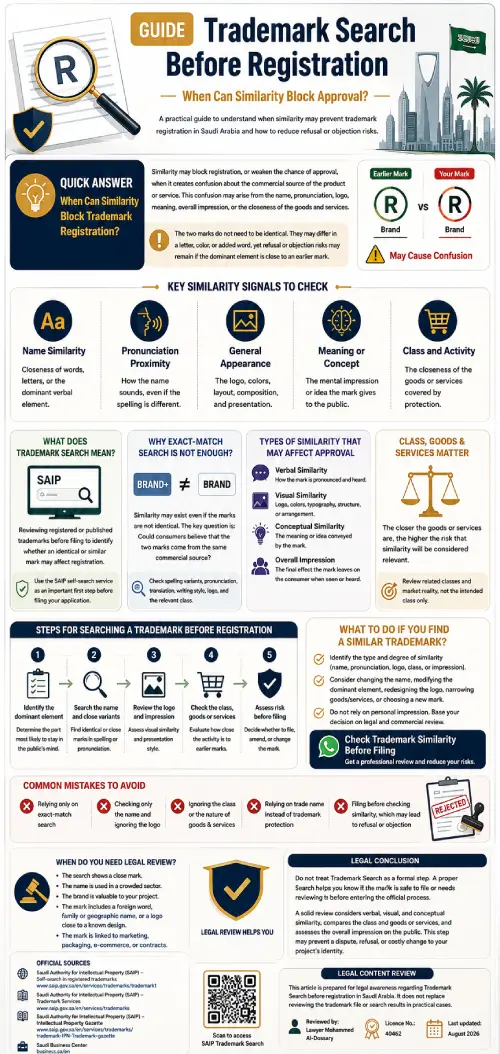
Quick Answer: When Can Similarity Block Trademark Registration?
Similarity may block registration, or weaken the chance of approval, when it creates confusion about the commercial source of the product or service. This confusion may arise from the name, pronunciation, logo, meaning, overall impression, or the closeness of the goods and services.
The two marks do not need to be identical. They may differ in a letter, color, or added word, yet refusal or objection risks may remain if the dominant element is close to an earlier mark.
| Similarity Signal | What Should Be Checked? |
|---|---|
| Name similarity | Closeness of words, letters, or the dominant verbal element. |
| Pronunciation proximity | How the name sounds, even if the spelling is different. |
| General appearance | The logo, colors, layout, composition, and presentation. |
| Meaning or concept | The mental impression or idea the mark gives to the public. |
| Class and activity | The closeness of the goods or services covered by protection. |
Have you found a name close to your mark, or are you concerned that your logo may resemble an existing trademark? A pre-filing similarity review helps assess the name, pronunciation, logo, class, and overall impression before submitting the application.
Or continue reading first to understand when similarity may prevent trademark approval.
What Does Trademark Search Mean?
Trademark Search means reviewing registered or published trademarks before filing a new application, to identify whether an identical or similar mark may affect registration.
This is not only a linguistic search. A result may show no exact match, yet the mark may still be risky if the name sounds close to an earlier mark, the logo has a similar visual structure, or the activity is commercially close to an existing brand.
The Saudi Authority for Intellectual Property provides a self-search service for registered trademarks. This is an important step before filing. However, reading the result requires understanding the difference between identical marks and similar marks. The assessment is not limited to letters; it also considers the mark’s effect in the market.
Why Is an Exact-Match Search Not Enough?
An exact-match search is not enough because similarity may exist even when the two marks are not identical. One letter may be different, a generic word may be added, or the logo color may change, while the overall impression remains close.
The main issue is often the dominant element of the mark. If the distinctive part of the name is close to an existing mark, adding descriptive or generic words may not always remove the risk of confusion. The key question is not only: “Did I find the exact same name?” The more important question is: “Could consumers believe that the two marks come from the same commercial source?”
For that reason, a proper Trademark Search should include different spellings of the name, pronunciation, translation, writing style, the accompanying logo, and the class in which the mark will be used.
Types of Similarity That May Affect Trademark Approval
Trademark similarity may be verbal, visual, conceptual, or based on the overall impression. Each type should be reviewed separately before reaching a conclusion on registrability.
Verbal Similarity
Verbal similarity relates to how the mark is pronounced and heard. The spelling may differ between Arabic and English, or between two close word forms, while the sound remains similar. This type of similarity matters because consumers may encounter the mark through advertising, conversation, or word-of-mouth recommendations.
Visual Similarity
Visual similarity appears in the logo, colors, typography, structure, or arrangement of elements. Similar color use alone does not automatically mean refusal, but the risk increases when the overall design is close to an earlier mark in the same field or a connected field.
Conceptual Similarity
Conceptual similarity concerns the meaning or idea conveyed by the mark. The words may differ, but the concept or suggestion may be close. This becomes more important when names are translated or when words carry the same commercial meaning.
Overall Impression
The overall impression is the final effect the mark leaves on the consumer when seen or heard. There may be no exact match in one isolated element, but the combination of name, design, and class may suggest a commercial link between the two marks.
How Class, Goods, and Services Affect Similarity Risk
The result of a Trademark Search is affected by the class, goods, or services for which protection is requested. A mark may be less risky where the activities are entirely unrelated, but the risk increases when the goods or services are close, connected, or commercially overlapping.
A class should not be reviewed in isolation from market reality. Some products and services may look different on paper, yet remain connected in the consumer’s mind. For this reason, the review should not stop at the class intended for filing. Related classes and nearby commercial activities may also need to be considered.
In practical terms, this review helps reduce refusal or objection risk. If a close name appears in a related activity, amending the name, logo, or scope of goods and services may be safer than filing a weak application.
Steps for Searching a Trademark Before Registration
A practical Trademark Search starts by identifying the name and the dominant element of the mark. The next step is searching registered or published marks through the official source, then reviewing the results from a similarity perspective, not only an exact-match perspective.
| Step | Purpose |
|---|---|
| Identify the dominant element | Determine the part most likely to stay in the public’s mind. |
| Search the name and close variants | Find identical or close marks in spelling or pronunciation. |
| Review the logo and overall impression | Assess visual similarity and presentation style. |
| Check the class, goods, or services | Evaluate how close the activity is to earlier marks. |
| Assess risk before filing | Decide whether to file, amend, or change the mark. |
One search result is not enough. Different name forms should be checked, especially where the name is foreign or can be written in more than one way. Published marks and marks close in activity should also be reviewed, because risks do not always appear through direct name search only.
What Should You Do If You Find a Similar Trademark?
Finding a similar trademark does not always mean that filing is impossible. It means the file needs review before submission. The first step is to identify the type of similarity: is it in the name, pronunciation, logo, class, or overall impression?
After that, you may consider changing the name, modifying the dominant element, redesigning the logo, narrowing the goods or services, or choosing a new mark if the risk is high. The decision should not be based on personal impression alone. It should be based on a legal and commercial reading of the search results.
Before filing, the search result should be linked to the applicable Trademark Requirements, because similarity may affect acceptance even where the name is only partly different.
When Do You Need Legal Review Before Filing?
Legal review is important when the search reveals a close mark, when the name is used in a crowded sector, when the brand is valuable to the project, or when the mark includes a foreign word, family name, geographic reference, or logo close to a known design.
The review becomes more important when the mark is connected to a marketing campaign, packaging, e-commerce store, or distribution contracts. The more money invested in the name or logo, the higher the cost of changing the mark after refusal or objection.
A legal review helps interpret search results, assess similarity risk, and decide whether it is better to amend the mark, file the application, or choose a safer alternative.
Common Mistakes When Checking a Trademark
One of the most common mistakes is relying only on exact-match search. A mark may not be identical, but it may still be close in pronunciation or overall impression.
Another mistake is ignoring the logo and checking only the name. Visual similarity may be relevant in some cases. The applicant may also overlook the class or the nature of the goods and services, assuming that a different activity is enough, even where a clear commercial connection exists.
Some business owners also rely on the trade name alone. A trade name does not replace trademark review as an intellectual property right. Filing before checking similarity may lead to refusal or objection that could have been avoided through early amendment.
Frequently Asked Questions About Trademark Search
What is Trademark Search before registration?
It is a review of registered or published marks before filing, to check whether an identical or similar trademark may affect registration..
When can similarity prevent trademark registration?
Similarity may affect registration when it creates confusion about the commercial source because of the name, pronunciation, logo, overall impression, or closeness of goods and services.
How can I know whether my mark is similar to another mark?
Review the name, pronunciation, design, meaning, class, and target public, then assess whether consumers may believe the marks are commercially connected.
Is one different letter enough to avoid similarity?
Not always. The two marks may remain similar if the pronunciation or overall impression is still close despite a minor spelling difference.
When is a different logo not enough?
A different logo may not be enough if the dominant verbal element remains similar and may still create confusion or objection risk.
What is the difference between similarity and identity?
Identity means the two marks are almost the same. Similarity is broader and may exist when the marks are close enough to confuse the public.
Can the same name be registered in a different class?
It may be possible in some cases, but the risk increases if the classes, goods, or services are commercially close or overlapping.
Why does class matter in a trademark review?
The class defines the goods or services covered by protection. The closer the activities are, the higher the chance that similarity may be considered relevant.
Is the official self-search enough before filing?
It is an important step, but it does not replace legal analysis of verbal, visual, conceptual similarity, class proximity, and overall impression.
What should I do if I find a similar trademark?
Assess the degree of similarity, the class, and the overall impression. Then consider amending the name or logo, choosing another mark, or requesting legal review.
Legal Conclusion
Do not treat Trademark Search as a formal step before registration. A proper search helps determine whether the mark is safer to file or needs amendment before entering the official process.
A solid review does not stop at exact matching. It considers verbal, visual, and conceptual similarity, compares the class and goods or services, and then assesses the overall impression on the public. This step may prevent a dispute, refusal, or costly change to the project’s identity.