Trademark Requirements start with a practical question before filing: is the mark actually registrable? A strong name or attractive logo is not enough if the mark is descriptive, close to an existing trademark, or filed in a class that may create confusion among consumers.
Trademark registration should not be treated as a simple electronic form. A proper review starts with checking distinctiveness, searching for similarity, selecting the right class, and then following the application, publication, objection, and post-registration protection steps.
For the wider framework of brand protection, objections, and renewal, you may review Trademark in Saudi Arabia. This article focuses specifically on the conditions, steps, and risks that should be checked before filing.
Quick Answer: What Are the Trademark Requirements?
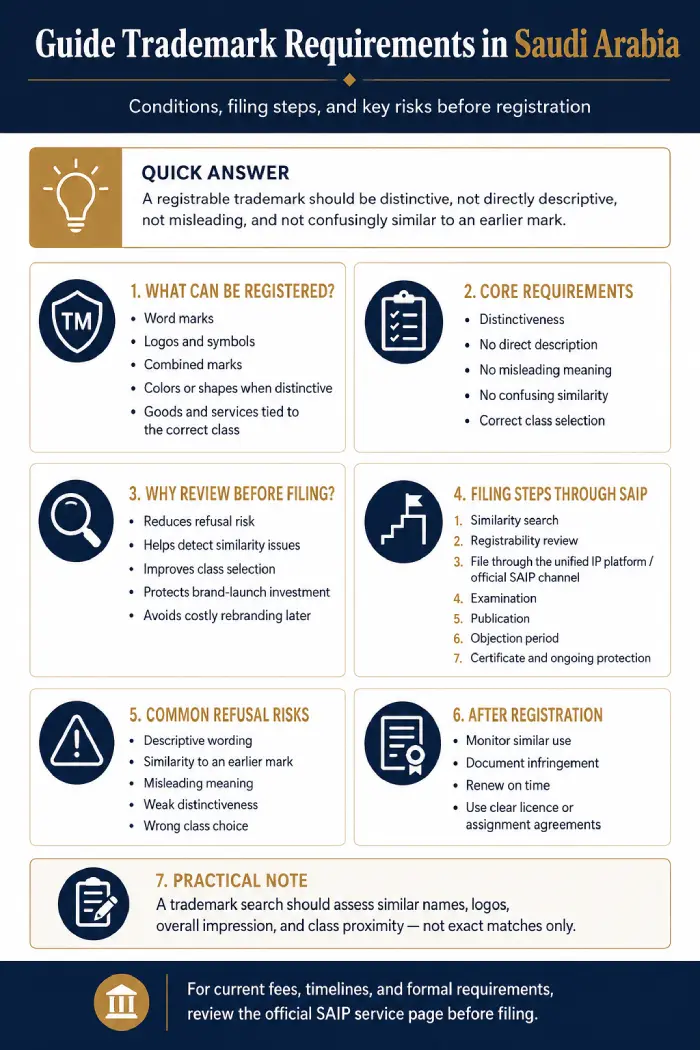
Trademark Requirements in Saudi Arabia generally require the mark to be distinctive, not directly descriptive, not misleading, not contrary to applicable rules, and not similar to an earlier mark in a way that may confuse the public.
These requirements matter before paying fees or launching the brand. A refusal or objection may force the business owner to reconsider the name, logo, class, or overall brand presentation. For this reason, pre-filing review is part of legal risk management, not a formal step.
| Requirement | Practical Meaning |
|---|---|
| Distinctiveness | Allows customers to recognize the commercial source behind the product or service. |
| No direct description | Avoids wording that only describes quality, type, function, or features. |
| No misleading meaning | Prevents confusion about origin, source, characteristics, or business connection. |
| No confusing similarity | Reduces conflict with earlier marks in wording, design, sound, or overall impression. |
| Correct class selection | Links protection to the goods or services actually covered by the filing. |
Are you planning to file a trademark and concerned about refusal due to similarity, weak distinctiveness, or the wrong class? A pre-filing review can help assess registrability, identify risks, and determine the right path before paying fees or launching the brand identity.
Or continue reading first to understand the conditions, steps, and risks.
Why Should the Review Start Before Filing?
Reviewing Trademark Requirements before filing reduces the risk of refusal or objection. A business owner may choose a name that works well from a marketing perspective, but the name may still be close to an existing mark, descriptive, or filed under a class that does not cover the actual business activity.
This review is also important from a cost perspective. Searching for trademark filing fees or the cost of trademark registration is not enough to make a decision. The main risk is not only the fee itself. The greater risk is launching the brand identity and then being forced to change it after refusal or after an objection by the owner of an earlier mark.
A better approach is to treat pre-filing review as both a legal and commercial step. It protects the name, reduces class conflicts, helps draft the mark description, and prevents confusion between the trade name registered with the Ministry of Commerce and the trademark that protects products or services in the market.
What Can Be Registered as a Trademark?
A mark may be registered if it can distinguish the goods or services of one business from those of others. It may be a name, word, letters, numbers, logo, drawing, color, shape, or a combination of these elements, provided that it performs a distinguishing function.
1. Word Marks.
A word mark depends on the name, word, or letters. It may be an invented word or a distinctive name. Generic words and direct descriptions of the product are weaker for registration because they do not provide enough distinctiveness and may be needed by competitors to describe their own products.
2. Figurative or Combined Marks.
A figurative mark is based on a symbol, drawing, or visual element. A combined mark includes both the name and the logo or design. This form is common in restaurants, e-commerce stores, applications, and consumer products because customers often remember both the word and the visual identity.
3. Trademark Class, Goods, and Services.
Trademark Requirements are closely connected to the selected class. The class defines the goods or services for which protection is requested. A name may be acceptable for one activity but risky in a related activity if it may create confusion among consumers.
Conditions for Accepting a Trademark in Saudi Arabia
One of the core Trademark Requirements is that the mark must be distinctive, not misleading, not contrary to applicable rules, and not similar to an earlier mark in a way that may confuse the public or suggest a false commercial connection.
Distinctiveness
Distinctiveness means that the mark helps consumers identify the commercial source of the product or service. If the mark simply describes the product, such as its quality, type, or function, it may be more exposed to refusal. If the word or logo creates an independent identity in the public’s mind, it is usually stronger from a protection perspective.
Novelty and No Confusing Similarity
Novelty does not mean that the mark must be completely new worldwide. It means that the mark should not conflict with an earlier mark in relation to relevant goods or services. Similarity may appear in pronunciation, appearance, overall impression, or the closeness of the business activity.
Lawfulness and No Misleading Meaning
The mark should not contain anything contrary to applicable rules or public morals. It should not mislead the public about source, quality, or characteristics. Special care is needed when the mark includes foreign words, geographic meanings, symbols, family names, or personal names, because these elements may require further review before filing.
Trademark Registration Steps Through SAIP
Trademark Requirements should be checked before moving into the filing steps through SAIP. Trademark registration is handled through an electronic path at the Saudi Authority for Intellectual Property. SAIP indicates that trademark procedures filed from 19/12/2023 are processed through the unified intellectual property platform. The official service page should be reviewed before filing to confirm current requirements, fees, and timelines.
Search and Review Before Filing
The practical process starts by searching for close marks and checking registrability. Exact matching is not enough. The review should consider similarity in sound, appearance, meaning, and class proximity. This step helps reduce the risk of refusal or objection.
Filing the Application Through the Platform
After review, the applicant’s data is prepared, the mark is uploaded, the class is selected, and the visible elements of the mark are described. The description should match the image of the mark, especially if it includes colors, drawings, foreign words, or combined elements.
Examination, Publication, and Objection
After filing, the application is examined. The result may be acceptance, a request for amendment, or refusal depending on the status of the mark. If the mark moves to publication, interested parties may object if they believe the published mark affects their earlier rights.
Certificate Issuance and Ongoing Protection
Issuing the trademark certificate does not end the legal work. The trademark owner still needs to monitor similar uses, renew protection on time, and regulate licensing, assignment, or commercial use through clear contracts.
Trademark Search Before Filing
A trademark search answers the most important question: is the mark safe to file? Reviewing Trademark Requirements at this stage means the search should not stop at the same name. It should also cover similar names, close logos, and the impression that the mark may leave on consumers.
Two marks may differ in a letter, color, or design element, but still create a close overall impression. The risk may be higher when goods or services fall within the same class or commercially connected classes. For this reason, a legal search is broader than a quick name search.
The search becomes more important when the business has already started designing the identity, packaging, or website. The later the review of **Trademark Requirements** is done, the higher the cost of changing the mark if a conflict appears.
When Can a Trademark Be Refused?
A mark may be refused if it does not satisfy the acceptance conditions, if it is close to an earlier mark, or if it is misleading, descriptive, or contrary to registration rules. A good design is not enough. The mark must also be legally protectable.
1. Descriptive or Generic Marks.
A descriptive mark directly describes the product or service. These expressions are weak because they do not identify a specific commercial source and may be needed by competitors in the market. The better approach is to choose a name or logo with a real level of creativity and distinction.
2. Similarity to an Existing Mark.
Similarity to an existing mark may lead to refusal or objection. The marks do not need to be identical. It may be enough that they create confusion because of sound, appearance, meaning, or the closeness of the business activity.
3. Misleading Meaning or Regulatory Concern.
A mark may be more exposed to refusal if it suggests an incorrect source, contains a prohibited symbol or meaning, or gives an inaccurate impression about the product or service. In these cases, legal review before filing is important.
Objection to a Similar Trademark
An objection arises when a mark is published and an interested party believes that it is close to an earlier mark or may cause confusion in the market. A proper objection is not based on general impression only. It requires comparing the elements of both marks, the classes, the target public, and the potential harm.
It is also important to distinguish between objecting to a published mark and starting a dispute after market use. Action during the publication stage may be more effective than waiting until the mark spreads in the market and then entering into a longer and more expensive dispute.
Protection After Trademark Registration
Protection does not end with the registration certificate. Registration provides an important legal basis, but preserving the value of the mark requires market monitoring, documenting any unauthorized use, and reviewing legal dealings involving the mark.
If a similar mark or unauthorized use appears, the practical first step is documentation. This may include links, photos, invoices, advertisements, online accounts, or any evidence proving use. After that, the proper action can be assessed, whether it is a notice, complaint, or legal claim depending on the facts.
Use of the mark should also be controlled through contracts, especially in distribution, franchise, or licensing arrangements. Allowing others to use the mark without quality, scope, or term controls may weaken control over the brand.
Assignment or Licensing of a Trademark
A trademark may be a commercial asset that can be sold, assigned, or licensed. The value of trademark registration is not limited to protection against imitation. It may also support investment in the brand through contracts.
1. Trademark Assignment:
Assignment means transferring the trademark right from one owner to another according to applicable requirements. The mark details, class, and scope of the right being transferred should be clear to avoid future disputes about what was sold or assigned.
2. Trademark Licensing:
Licensing allows another party to use the mark within defined limits. The agreement should specify scope, term, territory, class, quality standards, payment, and the owner’s right to monitor use. Missing these details may create a dispute between the trademark owner and the licensee.
Trademark Registration Fees and Filing Cost
Anyone searching for trademark registration fees or the cost of trademark registration should verify the official service page, because fees, technical requirements, and timelines may change according to updates by the competent authority.
In practical terms, the cost of a trademark should not be assessed by fees only. The higher cost may come from refusal, rebuilding the brand identity, a dispute with an earlier mark, or using an unsuitable class. Therefore, checking registrability before filing is part of cost control.
Where the budget is limited, the steps should be arranged carefully: similarity search, class selection, description review, and then filing. This order reduces the chance of paying fees for a weak file or a mark that may not satisfy Trademark Requirements.
Common Mistakes in Trademark Filing
The first mistake is confusing commercial registration with trademark registration. Commercial registration identifies the business, while the trademark protects the name or logo used to distinguish goods or services.
The second mistake is filing without a sufficient similarity search, choosing a class that does not cover the real activity, or using a descriptive phrase that is difficult to protect.
A third mistake appears when the mark description is inaccurate, or when the mark includes foreign words or elements that may need translation or clarification without attaching what is required under the official service requirements.
Another common issue is failing to follow up after acceptance or after registration. A mark needs monitoring, renewal, and contract management.
When Do You Need a Trademark Registration Lawyer?
You may need a trademark registration lawyer when there is potential similarity, refusal, objection, or when the mark includes a family name, geographic term, foreign wording, or an element that is important to the project’s value.
The lawyer’s role also appears when drafting a response to examiner comments, objecting to a close mark, or preparing an assignment or licence agreement. The issue is not only about filling in a form. It is about reading the risks and choosing the best path before losing time and effort.
Legal review becomes more important if the brand will be used for more than one activity, under a franchise agreement, in an e-commerce store, or in products that may expand inside or outside the Saudi market.
Frequently Asked Questions About Trademark Requirements
What are the Trademark Requirements in Saudi Arabia?
The mark should be distinctive, not directly descriptive, not misleading, not contrary to applicable rules, and not confusingly similar to an earlier mark.
When is a mark not registrable?
A mark may be more exposed to refusal if it is generic, descriptive, misleading, similar to an existing mark, or includes restricted elements.
What is the difference between a trade name and a trademark?
A trade name identifies the business in official dealings, while a trademark distinguishes goods or services in the market and protects the brand identity.
When is commercial registration not enough?
Commercial registration does not replace trademark protection. A market-facing name or logo usually needs separate trademark filing with the competent authority.
How should I search before filing a trademark?
The search should review registered or published marks and consider similarity in sound, appearance, meaning, and class proximity, not exact matching only.
What does trademark class mean?
The class defines the goods or services for which protection is requested. Choosing the wrong class may weaken protection or increase conflict risk.
What are common reasons for trademark refusal?
Common reasons include weak distinctiveness, direct description, similarity to an earlier mark, misleading meaning, or non-compliance with registration rules.
What should I do if the application is refused?
Start by identifying the refusal reason. Then assess whether a response, amendment strategy, or a different mark is more suitable.
How does an objection to a similar trademark work?
An objection is made when a published mark may conflict with an earlier right. It should explain similarity, likely confusion, and potential harm.
Can a logo be registered as a trademark?
Yes. A logo may be registered if it is distinctive, protectable, and does not conflict with an earlier mark or a legal restriction.
Legal Conclusion
Do not treat Trademark Requirements as a formal checklist before filing. The process starts with checking registrability, searching for similarity, selecting the class, and then following the application, publication, objection, and protection stages.
The more important the mark is to the project’s value, the more important pre-filing review becomes. A trademark is not only a name or logo. It is a commercial asset that needs ongoing legal management, from filing and renewal to licensing and protection against unauthorized use.