Commercial court jurisdiction in Saudi Arabia is not based only on the existence of a company or a high claim value. A claim becomes commercial when it is linked to a commercial contract, business activity, or a relationship between traders or companies.
The key review is whether the dispute arises from a commercial act, supported by the parties’ status, documents, claim subject, arbitration clause, and any required pre-filing step.
This guide explains when a claim falls within commercial court jurisdiction, when registration or invoices are not enough, and what to review before filing.
Quick Answer: When Does the Commercial Court Have Jurisdiction?
The commercial court usually has jurisdiction when the claim arises from a commercial relationship, commercial act, commercial contract, or dispute between traders or companies, provided that the subject of the claim falls within the commercial scope. A financial amount or commercial registration alone is not enough to make a claim commercial.
Two issues must be separated: having a financial right and choosing the competent court. A claimant may have a valid right but still file before the wrong court. This may delay the claim because of a procedural error. For this reason, commercial court jurisdiction should be reviewed before drafting the statement of claim or sending the final demand.
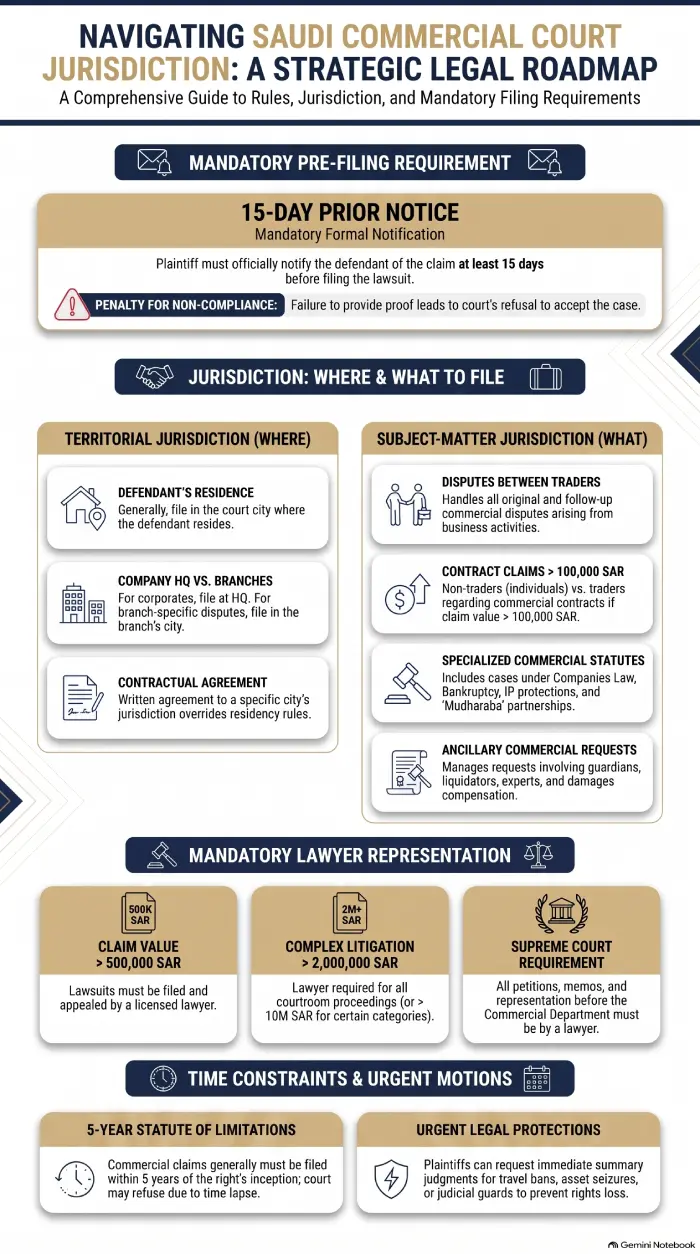
The Saudi Commercial Courts Law regulates court jurisdiction, case filing, case management, evidence, orders, objections, and prior notice in the claims specified by the implementing regulations. Article 19 states that, in the claims specified by the regulations, the claimant must notify the defendant in writing to perform the claimed right at least 15 days before filing the case.
To place this article within the content cluster, readers may first review the main guide on commercial disputes in Saudi Arabia. This page focuses specifically on identifying the competent court and when a claim becomes commercial.
What Does Commercial Court Jurisdiction Mean?
commercial court jurisdiction means determining whether the commercial court is the proper judicial forum to hear the dispute. This is not based on assumptions or the title of the contract. It is based on the legal criteria that look at the nature of the act, the subject of the claim, and the status of the parties.
This distinction matters. A claimant may have a real right to payment or compensation, but that does not always mean that the commercial court is the correct route. The claim may be employment-related if it concerns wages or an employment relationship. It may be civil if it is between individuals. It may be administrative if it is connected to a public authority or administrative decision, depending on its nature.
Jurisdiction should therefore be reviewed before drafting the statement of claim. A commercial claim is not only a narrative of facts. It must show why the commercial court is competent. Is the relationship between traders? Is the dispute based on a commercial contract? Does the claim arise under Companies Law, Bankruptcy Law, intellectual property rules, or another commercial regulation? Is there an arbitration clause that comes before the court route?
A jurisdiction error may cause serious delay. The defendant may raise an objection to jurisdiction, or the court may decide that the claim is inadmissible or outside its competence, depending on the case. In commercial disputes, delay is not only procedural. It may affect cash flow, contractual positions, settlement opportunities, and the legal leverage of each party.
When Is a Claim Commercial in Saudi Arabia?
A claim is commercial when its subject is connected to a commercial act, commercial contract, or business relationship between traders or companies, or when it arises under a commercial regulation that falls within commercial court jurisdiction. The fact that one party is a company is not enough if the reason for the dispute falls outside commercial activity.
When the Dispute Is Between Traders or Companies
A dispute between traders or companies usually leans toward commercial jurisdiction if it arises from their original or ancillary commercial activities. Original commercial acts are acts carried out for trade and profit, such as purchasing for resale, supply, distribution, or providing commercial services. Ancillary acts are actions that support the trader’s business, even if they may appear civil in form.
For example, if a company contracts with a supplier to deliver materials needed for its business, and the supplier refuses delivery or the parties disagree about quantity or price, the dispute is connected to the business activity. The claim is therefore more likely to fall within commercial court jurisdiction.
But the presence of two companies is not enough by itself. If the dispute is outside the business activity or is based on a reason that does not fall within commercial dealings, it must be reviewed carefully before filing before the commercial court.
When the Dispute Arises from a Commercial Contract
Commercial contracts are among the most common bases for commercial court jurisdiction. These include supply, distribution, agency, franchise, commercial contracting, commercial services, and contracts connected to business operations, product supply, or performance of obligations between business entities.
The legal classification does not depend only on the contract title. A document may be called a “cooperation agreement,” while in substance it is a distribution or supply contract. A relationship may be called a “service,” while it is connected to ongoing commercial activity. The contract must be read together with invoices, correspondence, purchase orders, and delivery records.
The implementing regulations state that the commercial court has jurisdiction over claims filed against a trader in commercial contract disputes where the original claim value exceeds SAR 500,000, as stated in the official published regulations.
When the Dispute Is Connected to Commercial Activity
Activity is the practical test. A commercial registration helps identify the status of the entity, but it does not prove that every dispute involving that entity is commercial. If the trader contracted for the business, the claim may be commercial. If the act was personal or outside the business, the dispute may fall outside that route.
The review should not start with: “Does the party have a commercial registration?” It should start with: “Did the claim arise from commercial activity?” “Is the contract connected to the business or establishment?” “Do invoices, bank transfers, and correspondence support that connection?”
When the Dispute Relates to a Company or Partner
Many company-related disputes fall within commercial court jurisdiction, especially where they relate to management, partner resolutions, manager liability, profit distribution, share transfers, or the application of Companies Law. This type of dispute requires reviewing the articles of association or bylaws, partner resolutions, meeting minutes, financial statements, and correspondence.
A partner dispute should not be treated as a simple financial disagreement. A claim inside a company is often connected to legal status, authority, and obligations. The legal route may differ depending on the type of company, the nature of the request, and the documents proving the relationship.
Difference Between a Commercial Claim and a Civil Claim
A commercial claim is usually connected to commercial activity, a commercial contract, or a relationship between traders or companies. A civil claim may arise from a personal relationship or an obligation that does not fall within commercial activity, even if the amount is high.
| Criteria | Commercial Claim | Civil Claim |
|---|---|---|
| Nature of relationship | Commercial activity or trade-related contract | Personal or civil relationship |
| Parties | Traders or companies, usually | Individuals or non-commercial parties |
| Basis of claim | Supply, distribution, partnership, agency, price of goods | Personal loan, civil agreement, private obligation |
| Common documents | Contract, invoices, purchase orders, delivery records | Acknowledgment, civil agreement, personal instrument |
| Likely court | Commercial court when jurisdiction is met | General court, usually |
The claim value alone does not determine the classification. A high-value claim may arise from a civil relationship. A smaller claim may still be connected to clear commercial activity. commercial court jurisdiction therefore requires linking the claim to its legal cause, not only to its amount.
For example, a company claiming the price of goods supplied to another company is different from an individual claiming a personal debt from a friend. Both involve money, but the relationship is different. The first may lean toward commercial classification if supply is proven. The second is usually civil.
Cases That May Fall Within Commercial Court Jurisdiction
The following examples help explain when a claim may be commercial. The final classification still depends on the documents and the applicable legal rules.
| Case | Does It Lean Toward Commercial Jurisdiction? | Practical Note |
|---|---|---|
| Supply contract dispute between two companies | Usually yes | The commercial relationship and performance must be proven |
| Claim for the price of goods | Usually yes | If supply, acceptance, or delivery is proven |
| Partner dispute with a company | Often yes | Requires reviewing the articles of association and claim basis |
| Agency or distribution dispute | Usually yes | Depends on the contract and relationship |
| Claim based only on an invoice | Not enough by itself | The invoice must be linked to a contract or performance |
| Employment dispute against a company | Usually no | The route is employment-related if the cause is employment |
| Administrative dispute with a public entity | Not always | It may be administrative depending on the relationship |
| Arbitration clause | Changes the route | It must be reviewed before filing |
| Pure real estate dispute | Usually no | It may fall outside commercial jurisdiction if tied to a real property right |
| Contracting or brokerage linked to commercial activity | May fall within jurisdiction | Depends on the contract and request |
These examples do not replace file review. The result may change if the status of the parties differs, if the contract includes an arbitration clause, or if the request is in substance civil or employment-related.
When the Amount or Commercial Registration Is Not Enough
One of the most common mistakes is assuming that a large financial amount makes the claim commercial. This is not correct. Money is part of the dispute, but it is not the only test for jurisdiction.
- Financial claims between individuals: if the claim between individuals arises from a personal or civil relationship, it does not become commercial only because the amount is high. It may be based on a loan, private agreement, or dealing unrelated to commercial activity.
- An invoice without a clear basis: an invoice is important, but it is not always enough. It should be linked to a contract, purchase order, delivery, performed service, or correspondence showing the other party’s acceptance. If the invoice is separate from any document proving the relationship, the claim may be weak or disputed.
- Commercial registration without a commercial relationship: commercial registration is an indicator of the business or trader’s status, but it does not make every act commercial. A person may have a commercial registration and still enter into a personal transaction unrelated to the business. The cause of the obligation matters more than the registration alone.
- Employment disputes inside a company: if the dispute is between an employee and an establishment over wages, termination, end-of-service benefits, or an employment relationship, the fact that the employer is a company does not make the claim commercial. The cause of the claim is usually employment-related.
Subject-Matter, Territorial, and Value-Based Jurisdiction in the Commercial Court
Jurisdiction in commercial claims is not a single question. The file must be reviewed by type of claim, place of filing, and sometimes claim value and procedural effects.
What Is Subject-Matter Jurisdiction?
Subject-matter jurisdiction determines whether the type of dispute falls within the cases heard by the commercial court. This is the first question: is the dispute commercial in the first place? Did it arise from a commercial act, commercial contract, or commercial regulation? Does it fall within the claims listed by law?
If the type of dispute is not commercial, choosing the commercial court or agreeing between the parties is not enough to change its legal nature.
What Is Territorial Jurisdiction?
Territorial jurisdiction determines where the claim should be filed. It is usually connected to the defendant’s domicile, the company’s office, the relevant branch, or the place of performance, depending on the legal rules and valid agreements between the parties.
In practice, the registered address, head office, branch involved in the transaction, and any contractual forum clause should be reviewed. An error here may not remove the commercial nature of the claim, but it may create a procedural objection or delay.
What Is the Effect of Claim Value and Lawyer Representation?
The claim value may affect some procedural requirements, objection routes, or legal representation requirements, depending on the type and stage of the claim. For this reason, it should not be presented as a broad rule without linking it to the applicable text.
The safer professional wording is this: some commercial claims and requests may need to be filed or pleaded by a licensed lawyer under the cases and exceptions set by the implementing regulations. The type of claim, value, stage, and exceptions should therefore be checked before filing. Judicial sources from the Ministry of Justice indicate that Article 51 of the implementing regulations relates to the requirement that some claims and requests be filed by a lawyer, with regulatory exceptions.
Effect of an Arbitration Clause on a Commercial Claim
An arbitration clause in the contract may change the route of the dispute. If the parties agreed to arbitration, the first route may not be the commercial court. The clause, mechanism, scope, and agreed institution or rules should be reviewed.
It is not accurate to say that an arbitration clause “cancels the role of the court” in all cases. The more precise view is that an arbitration clause may prevent the court from hearing the merits if the opposing party relies on it according to the legal requirements and at the proper time. If the interested party does not rely on the clause, or if the clause does not apply to the dispute, the result may differ depending on the file.
Before filing, the dispute resolution clause should be reviewed. Does it refer to the commercial court? Does it require arbitration? Does it identify a center or rules? Does it cover all disputes or only certain types? Have later communications modified the route?
Ignoring this review may result in starting the wrong process or losing time in a procedural objection that could have been anticipated before filing.
Prior Notice and Filing a Commercial Claim
Some commercial claims do not begin directly with the statement of claim. In certain cases, the law or regulations may require the claimant to notify the defendant in writing to perform the claimed right before filing the case. The Saudi Commercial Courts Law states that notice must be given at least 15 days before filing in the claims specified by the regulations.
The purpose of notice is not merely formal. It gives the other party an opportunity to pay or settle. It also helps the claimant define the claim clearly before filing. A proper notice should identify the basis of the claim, the amount or subject, the deadline, and key documents where needed.
However, notice is not required for every dispute in the same way. The type of claim must be reviewed before assuming that notice is required or not required. Safe drafting in the statement of claim should show compliance with prior notice where required, or explain why it does not apply where it is not required.
Documents to Prepare Before Filing a Commercial Claim
Organizing documents before filing helps prove both jurisdiction and the right itself. Jurisdiction does not appear from the title of the dispute alone. It appears from the relationship between the contract, parties, documents, and subject of the claim.
| Document | Why It Matters for Jurisdiction and the Claim |
|---|---|
| Commercial contract | Proves the relationship, obligations, jurisdiction clauses, or arbitration |
| Invoices | Support the claim value if linked to performance |
| Purchase orders | Prove the request, acceptance, and source of obligation |
| Delivery records | Prove supply or service performance |
| Bank transfers | Show what was paid and what remains due |
| Commercial registration | Proves entity details and commercial status |
| Correspondence | Shows acknowledgment, objection, or amendment |
| Arbitration clause | Determines whether the court route is suitable |
| Articles of association or bylaws | Important in partner and company disputes |
| Prior notice | Proves compliance with a required procedure, if applicable |
Common Mistakes in Choosing the Competent Court
- Filing before the commercial court only because the other party is a company. A company alone is not enough. The dispute must arise from a relationship or act within commercial jurisdiction.
- Treating every financial claim as a commercial claim. A financial claim may be civil, employment-related, or administrative, even if the amount is high. The cause of the debt must be reviewed, not only the number.
- Ignoring the arbitration clause. An arbitration clause may change the route and may allow the other party to object to court proceedings if relied on according to the applicable rules.
- Relying only on an invoice. The invoice should be connected to a contract, delivery, service, or correspondence proving the obligation. Otherwise, it may remain disputed.
- Drafting the statement of claim before organizing documents. A commercial claim should show the basis of commercial court jurisdiction. It should not only list the demand.
- Confusing subject-matter and territorial jurisdiction. Subject-matter jurisdiction answers: is the claim commercial? Territorial jurisdiction answers: where should the claim be filed?
When Do You Need Legal Review Before Filing?
You may need legal review before filing if jurisdiction is unclear, the claim is large, there is an arbitration clause, the dispute involves partners, the contract is unclear, or many documents need to be organized. commercial court jurisdiction is important here because choosing the wrong court may delay the claim or open the door to procedural objections.
The need becomes stronger when the claim sits between commercial and civil, commercial and employment, or commercial and administrative routes. In these cases, reading the contract title or claim value is not enough. The nature of the relationship, the request, the parties, and the documents should be reviewed.
Legal review is also important if the other party has sent a notice, if there is a risk of a jurisdiction objection, or if filing may require prior notice or legal representation at a certain stage.
If you have a commercial contract, financial claim, arbitration clause, or partner dispute, do not file before reviewing jurisdiction and documents.
commercial court jurisdiction in Saudi Arabia is not established only because there is a company, commercial registration, or financial claim. The main test is the nature of the dispute: did it arise from a commercial act? Is the relationship between traders or companies because of their business activity? Is the contract commercial? Is there an arbitration clause? Were any required pre-filing steps completed?
The correct approach to any commercial claim starts with reviewing jurisdiction before drafting the statement of claim or choosing the court. A strong claim is not only one with a large number. It is a claim with correct classification, organized documents, and the right procedural route.
This article has been prepared for legal awareness regarding commercial court jurisdiction in Saudi Arabia, with a focus on legal classification of claims, subject-matter and territorial jurisdiction, arbitration clauses, prior notice, and documents required before filing. It does not replace reviewing the contracts and documents of each specific case.
Licence No.: 40462
Last updated: September 2026
FAQs About Commercial Court Jurisdiction
متى تختص المحكمة التجارية في السعودية؟
تختص المحكمة التجارية عندما يكون النزاع ناشئاً عن علاقة أو عمل أو عقد تجاري، أو بين تجار أو شركات، متى كان موضوع المطالبة داخلاً في الاختصاص التجاري وفق النظام.
ما معنى اختصاص المحاكم التجارية؟
المقصود هو تحديد ما إذا كانت المحكمة التجارية هي الجهة القضائية الصحيحة لنظر النزاع، بحسب نوع العلاقة وموضوع المطالبة وصفة الأطراف والمستندات.
هل وجود شركة في الدعوى يكفي لاختصاص المحكمة التجارية؟
لا. وجود شركة لا يكفي وحده، بل يجب فحص طبيعة العلاقة وسبب المطالبة وما إذا كان النزاع مرتبطاً بنشاط تجاري.
هل كل مطالبة مالية تعد دعوى تجارية؟
لا. قد تكون المطالبة المالية مدنية أو عمالية أو إدارية، ولو كانت قيمتها كبيرة.
ما أثر السجل التجاري في تحديد الاختصاص؟
السجل التجاري يساعد في إثبات صفة المنشأة، لكنه لا يكفي وحده. العبرة بموضوع النزاع وعلاقته بالنشاط التجاري.
ما الفرق بين الدعوى التجارية والدعوى المدنية؟
الدعوى التجارية ترتبط بنشاط أو عقد أو تعامل تجاري، أما الدعوى المدنية فقد تنشأ عن علاقة شخصية أو غير تجارية.
متى يكون نزاع الشركاء من اختصاص المحكمة التجارية؟
قد يكون كذلك إذا كان النزاع متعلقاً بشركة أو علاقة شراكة تدخل في الاختصاص التجاري، لكن يجب فحص عقد التأسيس وموضوع الطلب.
هل الفاتورة وحدها تكفي لرفع دعوى تجارية؟
لا تكفي غالباً. يجب ربط الفاتورة بعقد أو أمر شراء أو تسليم أو خدمة منفذة أو مراسلات تثبت الالتزام.
كيف يؤثر شرط التحكيم على الدعوى التجارية؟
قد يغير شرط التحكيم المسار، وقد يمنع نظر موضوع الدعوى إذا تمسك به الخصم وفق الضوابط النظامية وفي الوقت المناسب.
ما نتيجة رفع الدعوى أمام محكمة غير مختصة؟
قد يؤدي ذلك إلى دفع بعدم الاختصاص أو عدم قبول الدعوى بحسب الحالة، مما يطيل المسار ويزيد تكلفة النزاع.
Official Sources.