Commercial disputes in Saudi Arabia do not always begin with a court claim. A dispute may start with an unpaid invoice, a delayed supply contract, a disagreement between partners, or an arbitration clause that no one reviewed before signing.
Before calling a dispute “commercial,” the parties, business activity, contract, documents, jurisdiction, and proper route must be reviewed. The right classification decides whether the matter should move to negotiation, a demand letter, arbitration, or a claim before the competent court.
This guide explains commercial disputes in Saudi Arabia from a practical legal perspective. It covers how to understand the nature of the dispute, the common types of disputes, when the commercial courts may have jurisdiction, what documents should be prepared, and when legal review is needed before escalation.
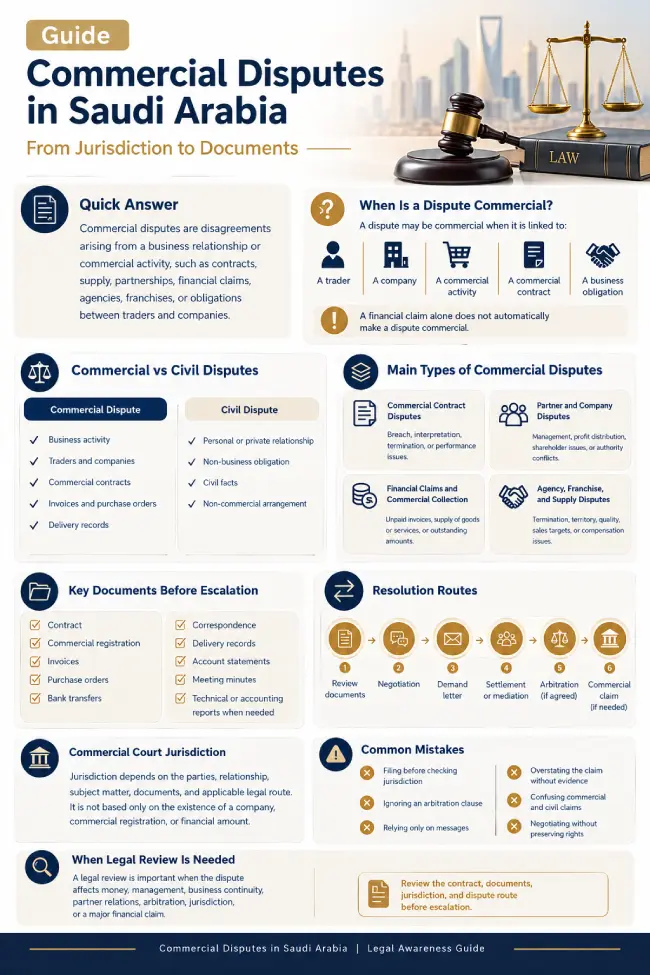
Quick Answer: What Are Commercial Disputes?
commercial disputes are disagreements arising from a business relationship or commercial activity, such as contracts, supply arrangements, partnerships, financial claims, agencies, franchises, or the performance of obligations between traders and companies.
A financial disagreement is not always a commercial dispute. A claim may be civil, employment-related, administrative, or commercial depending on the relationship, the status of the parties, the cause of the claim, and the supporting documents.
The right starting point is to ask four questions: who are the parties, what is the nature of the relationship, which document proves the obligation, and is there court jurisdiction or an arbitration clause that must be considered?
This review matters because the Saudi Commercial Courts Law regulates issues connected to jurisdiction, case filing, case management, evidence, expert review, orders, and objections. This makes choosing the right legal route a first step, not a later procedural detail.
When Is a Dispute Commercial?
A dispute is commercial when it is connected to a trader, a company, a commercial activity, or a commercial contract, provided that the subject of the dispute falls within the business relationship and is not merely an independent financial claim.
This is where the practical meaning of commercial disputes becomes important. The review must focus on the nature of the relationship, the obligation, the documents, and the appropriate legal route.
If two companies disagree over the supply of goods, the performance of a service, payment of a price, or breach of a distribution contract, the dispute will usually lean toward a commercial character. But if the dispute is between individuals in a personal or civil relationship, the presence of money alone does not make it commercial.
The review does not depend on the label used by one party. A claimant may call the matter a “commercial case,” while the documents show that it is civil, employment-related, or administrative. A business owner may also assume that the existence of a commercial registration is enough, while the nature of the relationship or claim may point elsewhere.
commercial disputes are therefore not just a broad title. They are the result of reviewing the parties, the obligation, the cause of breach, the competent authority, and whether there is an arbitration clause or prior settlement route.
Early classification protects the file from a common error: taking the wrong procedure and later discovering that jurisdiction or the proper route is different. The documents and contract should be reviewed before any formal step.
Difference Between Commercial and Civil Disputes
The difference between a commercial and civil dispute is not based on the claim value alone. A large claim may be civil, while a smaller claim may arise from a clear commercial activity.
To understand this difference, commercial disputes should be reviewed through the nature of the relationship, the commercial status of the parties, and the cause of the claim.
A commercial dispute is usually linked to a business activity, a relationship between traders or companies, or a commercial contract. A civil dispute may arise between persons who do not carry out commercial activity, or from a relationship that does not fall within ordinary commercial dealings.
For example, a claim between two companies under a supply contract differs from a personal claim between two individuals under a private arrangement unrelated to business. In the first case, documents such as the commercial registration, invoices, purchase orders, delivery records, and business correspondence may be important. In the second case, the relationship may be civil depending on the facts.
The label of the contract is not decisive. A document may be called a “cooperation agreement,” but in substance it may be a distribution, supply, or agency contract. Correspondence may be described as “understandings,” while in practice it may show a clear business obligation connected to goods, services, or commercial activity.
Main Types of Commercial Disputes in Saudi Arabia
commercial disputes in Saudi Arabia vary according to the relationship that created the disagreement. There is no single type that applies to every case. The documents and route differ according to the contract, the parties, the business category, and the protected interest.
Commercial Contract Disputes
Commercial contract disputes arise when the parties disagree over the performance, interpretation, or termination of a business contract. The dispute may relate to delayed supply, non-conforming goods, failure to perform a service, refusal to pay, or interpretation of a penalty clause or termination clause.
In many cases, the dispute begins with the interpretation or performance of commercial contracts or an alleged breach of contractual obligations.
The strength of this type of dispute does not depend on the allegation alone. It depends on reading the contract together with the later documents. The contract identifies the original obligation, while invoices, delivery records, and correspondence may show how the parties actually performed the relationship.
For example, if a company agrees to supply equipment within a specific period and then delays performance, proving the delay alone may not be enough. It is also necessary to review its impact, whether the contract contains a penalty, whether partial performance was accepted, and whether notices were sent on time.
Partner and Company Disputes
Partner and company disputes may relate to management, profit distribution, manager authority, exit arrangements, liability, major decisions, or access to company documents. In these cases, the new Companies Law may be relevant when reviewing authority, governance, and the position of the partners.
The new Saudi Companies Law and its implementing regulations came into effect on 19 January 2023. The Ministry of Commerce and the Capital Market Authority stated that the framework aims to support company growth, simplify procedures, balance stakeholder interests, and provide an effective governance framework.
In partner disputes, it is not enough to rely on impressions or isolated messages. The articles of association or bylaws, partner resolutions, manager authority, financial statements, meeting minutes, and any written side agreements should be reviewed.
The legal approach changes depending on whether the disagreement concerns company management, profit distribution, manager liability, partner exit, or sale of shares. Each situation requires a different arrangement of documents and claims.
Financial Claims and Commercial Collection
Financial claims are among the most common forms of business disputes. They may arise from an unpaid invoice, supplied goods for which the price was not paid, a completed service without payment, or accumulated accounts between two businesses.
An invoice alone does not always make the claim strong. There must be a clear link between the invoice and the contract, purchase order, delivery, or service performed. The amount must also be specific and supported by a clear basis.
Key documents may include invoices, purchase orders, payment receipts, bank transfers, account statements, delivery records, and correspondence showing acceptance, acknowledgment, or objection by the other party.
In some cases, a pre-claim demand letter may help organize the position and show the seriousness of the claim. If an amicable solution fails and the claim is supported by documents, the matter may move to a commercial claim before the competent authority.
Agency, Franchise, and Supply Disputes
These disputes often arise in continuing business relationships, such as agency, franchise, distribution, long-term supply, or repeated sales arrangements.
The dispute may concern termination, scope of obligations, territory, customers, quality of performance, sales targets, or compensation after termination. In these files, it is not enough to read one clause of the contract. The entire relationship must be reviewed.
There may be a main contract, annexes, correspondence, performance reports, invoices, notices, and changes that were not properly documented. All these elements can affect the legal assessment.
Prevention is important in these relationships. A contract that clearly states the termination method, notice requirements, scope of obligations, and dispute resolution mechanism reduces the risk of future conflict.
| Type of Commercial Dispute | Key Documents | Possible Route | Legal Note |
|---|---|---|---|
| Commercial contract dispute | Contract, correspondence, purchase orders, delivery records | Settlement, claim, or arbitration depending on the clause | Contract interpretation comes before assessing breach |
| Commercial financial claim | Invoices, transfers, account statement, receipts | Demand letter, payment order, or claim depending on the case | The amount alone is not enough without a clear basis |
| Partner dispute | Articles of association, resolutions, financials, correspondence | Settlement, claim, or Companies Law procedure | Authority and governance should be reviewed first |
| Agency or franchise dispute | Contract, annexes, reports, invoices, termination notices | Negotiation, arbitration, or claim depending on the contract | Continuation or termination changes the dispute strategy |
Why Do Commercial Disputes Arise?
commercial disputes often arise from weak documentation before they arise from bad faith. The parties may have actually agreed, but failed to write down payment details, delivery terms, scope of service, delay consequences, or termination methods.
The first cause is weak contract drafting. A very short contract may leave key questions unanswered. When is performance complete? What is the standard for accepting goods? What is the effect of delay? When can termination occur? How is the claim calculated? Where will the dispute be resolved?
The second cause is failure to document changes. A contract may begin with a specific price and period, then quantities, deadlines, or the service scope change through scattered messages. If these changes are not clearly documented, the later dispute may focus on which version of the agreement controls.
The third cause is failure to check the other party before contracting. Verifying commercial registration details, authorized signatory capacity, and entity status is not a formality. The Commercial Registration Law regulates registration and supports the business environment through reliable commercial entity data.
However, a commercial registration does not prove the validity of every claim by itself. Its role is to support verification of the entity and its details, while the claim is usually proven through the contract, invoices, correspondence, and performance records.
How Are Commercial Disputes Resolved?
Resolving a commercial dispute does not always mean filing a lawsuit. In many files, settlement, reconciliation, rescheduling the obligation, or partial performance may be the better route, especially where the business relationship is still active.
The practical path often begins with direct negotiation. But negotiation should be controlled, because some statements may be understood as an admission or waiver. Correspondence should be clear, preserve rights, and show whether the offer is amicable, final, or conditional.
A demand letter or legal notice may then follow. Its purpose is not always escalation. It may be used to organize the claim, state the basis, amount, deadline, and supporting documents.
Settlement or mediation may be suitable if the dispute can be resolved without a judgment. If the contract contains an arbitration clause, the clause must be read before going to court. If the amicable route fails or the other party refuses performance, a commercial claim may be the proper step.
Practical rule: before choosing the route, ask: which document proves the relationship, what evidence proves breach, is there an arbitration clause, and is there a realistic chance of settlement before escalation?
When Do Commercial Courts Have Jurisdiction?
Jurisdiction of the commercial court depends on the nature of the relationship, subject matter, parties, and applicable legal jurisdiction. It is not established merely because there is a company, a commercial registration, or a financial amount.
The Saudi Commercial Courts Law is the key reference when reviewing the judicial route for a commercial matter. It addresses rules related to jurisdiction, case filing, case management, and related issues such as territorial jurisdiction and filing requirements.
Before filing a claim, three elements should be reviewed: the status of the parties, the nature of the relationship, and the subject of the claim. Is the dispute between traders? Did it arise from a commercial contract? Does it relate to a company, partners, or management? Is there a clear commercial claim? Is there another authority or route that is more appropriate?
The arbitration clause must also be reviewed. If the parties agreed to arbitration in the contract, court may not be the first route. If one party ignores the arbitration clause and files a claim, it may face a procedural objection that affects the file.
This point is central to commercial disputes, because wrong legal classification does not only create a formal issue. It may also delay reaching an effective solution.
Role of Arbitration and Mediation in Commercial Disputes
Arbitration and mediation are important tools for resolving business disputes, but they do not fit every file in the same way. Arbitration requires an agreement or arbitration clause, while mediation and settlement depend on the parties’ willingness to resolve the matter amicably.
Arbitration may be suitable for large contracts, relationships that require confidentiality, technically complex matters, or long-term contracts. The Saudi Center for Commercial Arbitration has adopted arbitration rules that provide an institutional framework for administering arbitration cases under its rules.
If the contract contains an arbitration clause, the first route may not be court. The proper step may be to review commercial arbitration and its effect on the way the dispute should be managed.
Mediation and settlement may be suitable where the parties want to reduce losses or preserve the business relationship. A good settlement is not drafted in broad wording. It should define the amount, deadlines, method of performance, consequences of breach, and whether it ends the entire dispute or only part of it.
Not every dispute needs arbitration. Some clear financial claims may require a different practical route. Some smaller disputes may not justify a long or costly process.
What Documents Matter Before Starting a Dispute?
The most important documents in a commercial dispute are the contract, commercial registration, invoices, purchase orders, bank transfers, correspondence, delivery records, and account statements. These documents help prove the relationship, obligation, breach, and damage.
The commercial contract is the starting point if it exists. It identifies the parties, obligations, performance period, price, payment terms, termination method, jurisdiction, and arbitration clause.
Invoices, purchase orders, and delivery records prove performance. Bank transfers, receipts, and account statements help identify what was paid and what remains due.
Commercial correspondence is also important, especially if it includes acknowledgment, objection, extension requests, acceptance of performance, or agreement to amend. Emails or WhatsApp messages may be useful if they are clear, connected to the business relationship, and supported by other documents.
The commercial registration should not be ignored, but it should not be used alone to prove the debt. Its main role in the dispute is to verify the entity status and connect the dealing to a specific business.
Where accounts are complex or performance is difficult to assess, the file may need an accounting or technical report. This may help in disputes involving quantities, defects, completion percentages, or accumulated amounts.
Common Mistakes in Handling a Commercial Dispute
The first mistake is filing a claim before reviewing jurisdiction. A claimant may think the route is obvious, then discover that the dispute requires arbitration, the documents are insufficient, or the chosen route does not fit the relationship.
The second mistake is ignoring the arbitration clause. An arbitration clause may change the entire route of the dispute. The contract should therefore be read before sending a notice or filing a claim.
The third mistake is relying on correspondence without the contract or performance documents. Messages may help, but they do not always replace the contract, invoices, transfers, and delivery records.
Another mistake is overstating the claim value without evidence. A strong commercial claim is not the largest figure. It is the clearest claim supported by documents. The amount should be explainable through records and calculations.
Some parties also confuse commercial and civil claims, partner disputes and management disputes, or debt collection and compensation claims. This confusion makes the requested relief unfocused.
A further mistake is negotiating without preserving rights in writing. A party may send a general statement that unintentionally admits part of the liability or waives a right. Correspondence should therefore be controlled before and during the dispute.
When Do You Need a Commercial Disputes Lawyer?
You may need a commercial disputes lawyer when the disagreement affects money, management, or continuity of the relationship, or when the next decision may determine the direction of the whole file.
The need is clear when there is a large financial claim, breach of a commercial contract, partner dispute, arbitration clause, uncertainty over jurisdiction, or a notice from the other party.
The need is also clear when documents are extensive or disorganized. A lawyer does not only read the contract. The legal review connects the contract with invoices, correspondence, transfers, and delivery records, then identifies strengths and weaknesses.
In commercial disputes, a rushed response can cause harm. An admission, threat, or settlement offer should not be sent before understanding its legal effect. Proper legal review helps choose the lower-risk route: settlement, notice, arbitration, or claim.
This is the practical value of understanding commercial disputes for business owners. The goal is not only to know the definition, but to know when the procedure should begin, which route is suitable, and how to take the first step without weakening the position. If the file requires review of the contract and documents before escalation, an initial legal review can be arranged through professional contact.
This article has been prepared for legal awareness regarding commercial disputes in Saudi Arabia, with a focus on legal classification, jurisdiction, documents, settlement, arbitration, and commercial claims. It does not replace reviewing the contracts and documents of each specific case.
Licence No.: 40462
Last updated: September 2026
FAQs About Commercial Disputes
ما المقصود بالمنازعات التجارية في السعودية؟
المنازعات التجارية هي خلافات تنشأ عن علاقة أو نشاط تجاري، مثل العقود، التوريد، الشراكات، المطالبات المالية، أو تنفيذ الالتزامات بين التجار والشركات.
متى يتحول الخلاف التجاري إلى نزاع قانوني؟
يتحول الخلاف إلى نزاع قانوني عندما توجد مطالبة محددة، أو إخلال بالتزام، أو ضرر محتمل، أو رفض للتسوية، مع وجود مستندات يمكن الاستناد إليها.
هل كل مطالبة مالية تعد نزاعاً تجارياً؟
لا. يجب فحص طبيعة الأطراف، العلاقة، النشاط، والمستندات لمعرفة ما إذا كانت المطالبة تجارية أو مدنية أو من نوع آخر.
كيف أعرف أن النزاع من اختصاص المحكمة التجارية؟
يفحص الاختصاص من خلال طبيعة العلاقة، صفة الأطراف، موضوع النزاع، العقد، والأنظمة ذات الصلة، ولا يكفي وجود شركة أو مبلغ مالي وحده.
ما الفرق بين النزاع التجاري والنزاع المدني؟
النزاع التجاري يرتبط بنشاط أو علاقة تجارية، بينما النزاع المدني قد ينشأ بين أشخاص دون صفة تجارية أو دون ارتباط بعمل تجاري.
ما أبرز أنواع المنازعات التجارية؟
تشمل منازعات العقود، الشركاء، الشركات، التوريد، الوكالات، الامتياز، الأوراق التجارية، المطالبات المالية، والتحصيل التجاري.
ما المستندات المطلوبة قبل بدء نزاع تجاري؟
أهم المستندات: العقد، السجل التجاري، الفواتير، أوامر الشراء، التحويلات البنكية، المراسلات، محاضر التسليم، وكشوف الحساب.
هل رسائل الواتساب تفيد في إثبات نزاع تجاري؟
قد تفيد إذا كانت واضحة، مرتبطة بالعلاقة التجارية، وتدعمها مستندات أخرى مثل عقد أو فاتورة أو تحويل أو محضر تسليم.
متى يكون التحكيم هو المسار الصحيح؟
يكون التحكيم مطروحاً عند وجود شرط تحكيم أو اتفاق تحكيم صحيح، خاصة في العقود التجارية التي اختار أطرافها هذا المسار بدلاً من المحكمة.
هل يمكن حل النزاع التجاري دون دعوى؟
نعم. يمكن اللجوء إلى التفاوض، الصلح، الوساطة، أو التسوية، وقد يكون ذلك أفضل إذا كانت العلاقة مستمرة أو كان الحل السريع ممكناً.
commercial disputes do not always begin in court. In many cases, the file starts with a simpler question: is this only a disagreement over contract performance, or a commercial dispute that needs settlement, arbitration, or a claim?
Correct classification comes before action. The relationship, jurisdiction, arbitration clause, contract, invoices, correspondence, and documents should be reviewed before any step is taken.
A strong commercial file is not based on impressions or threats. It is based on organized documents, a clear claim, the right route, and an accurate understanding of each party’s legal position. For this reason, reviewing the dispute before escalation may be the difference between a rushed step and a structured legal decision.