Franchise vs Agency is an important distinction to understand before entering a commercial relationship in Saudi Arabia. The choice affects how the business operates, what rights each party receives, the level of control involved, and how responsibilities are allocated under the agreement.
A franchise generally allows one party to operate under an established business model, brand, and defined operating standards. A commercial agency, by contrast, usually focuses on representing, marketing, or distributing another party’s products or services within an agreed scope.
The correct structure should therefore be determined by the actual commercial relationship, not by the title placed on the contract. Before signing, the parties should examine the rights granted, operational obligations, financial arrangements, authority, and termination terms to ensure that the agreement reflects the business model they genuinely intend to use.
quick answer
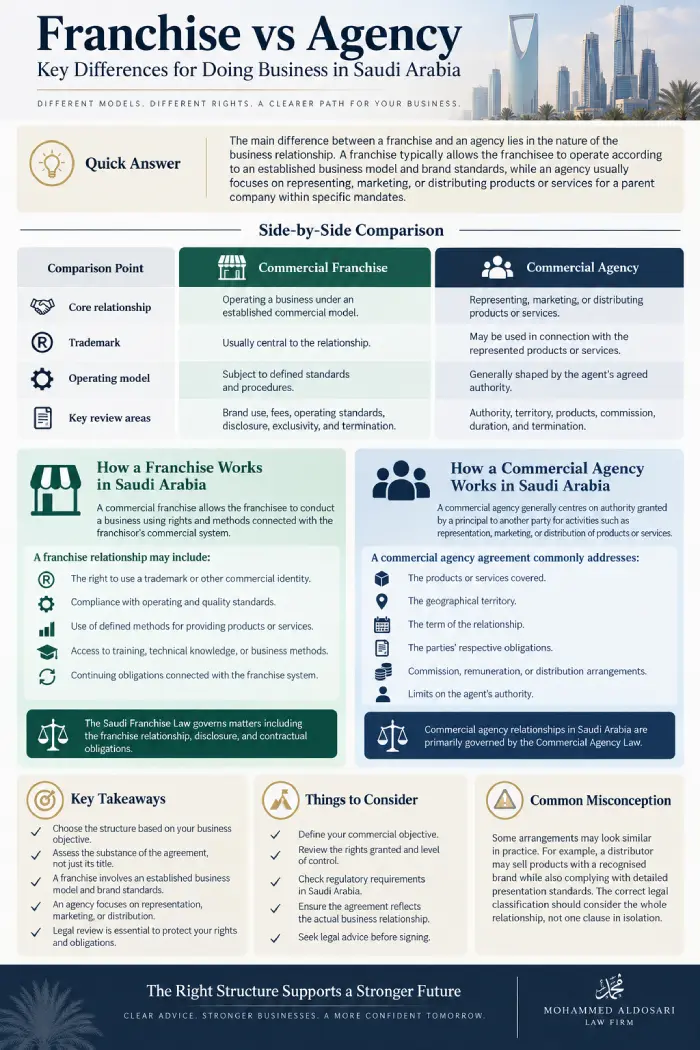
The main difference between a franchise and an agency lies in the nature of the business relationship. A franchise typically allows the franchisee to operate according to an established business model and brand standards, while an agency usually focuses on representing, marketing, or distributing products or services for a parent company within specific mandates.
What is the difference between a franchise and an agency?
In a franchise agreement, the franchisor grants the franchisee rights to operate a specific business concept. Depending on the agreement, this may include the brand, operating procedures, quality requirements, training, technical know-how, and methods developed by the franchisor.
Commercial agency has a different focus. The agent generally represents, markets, or distributes products or services on behalf of the principal within an agreed territory and scope of authority.
Some arrangements may look similar in practice. For example, a distributor may sell products carrying a recognised brand while also complying with detailed presentation standards. The correct legal classification should therefore consider the whole relationship, not one clause in isolation.
| Comparison Point | Commercial Franchise | Commercial Agency |
|---|---|---|
| Core relationship | Operating a business under an established commercial model. | Representing, marketing, or distributing products or services. |
| Trademark | Usually central to the relationship. | May be used in connection with the represented products or services. |
| Operating model | Usually subject to defined standards and procedures. | Generally shaped by the agent’s agreed representation or distribution authority. |
| Key review areas | Brand use, fees, operating standards, disclosure, exclusivity, and termination. | Authority, territory, products, commission, duration, and termination. |
How Does a Franchise Work in Saudi Arabia?
In Franchise vs Agency, a commercial franchise allows the franchisee to conduct a business using rights and methods connected with the franchisor’s commercial system. The exact scope depends on the agreement and the applicable Saudi regulatory framework.
A franchise relationship may include:
- The right to use a trademark or other commercial identity.
- Compliance with operating and quality standards.
- Use of defined methods for providing products or services.
- Access to training, technical knowledge, or business methods.
- Continuing obligations connected with the franchise system.
Saudi Arabia has a specific regulatory framework for commercial franchises. The Saudi Franchise Law governs matters including the franchise relationship, disclosure, and contractual obligations.
A franchise does not normally transfer ownership of the franchisor’s trademark or entire business to the franchisee. Instead, it creates contractual rights to use specified elements of the commercial system within agreed and statutory limits.
operating under another party’s complete business system is different from simply being authorised to sell or distribute that party’s products.
How Does a Commercial Agency Work in Saudi Arabia?
A commercial agency agreement commonly addresses:
- The products or services covered.
- The geographical territory.
- The term of the relationship.
- The parties’ respective obligations.
- Commission, remuneration, or distribution arrangements.
- Limits on the agent’s authority.
Commercial agency relationships in Saudi Arabia should also be assessed under the Saudi Commercial Agencies Law and the regulatory framework applicable to the particular arrangement.
The agent’s position therefore differs from that of a franchisee. The agent does not necessarily receive a complete operating system or the right to reproduce the principal’s business model. The central question is usually what the agent has been authorised to represent, market, distribute, or conclude.
What Should Be Reviewed Before Choosing Between the Two?
Choosing between a franchise and an agency should begin with the commercial purpose of the relationship. The contract title should come after that analysis, not before it.
The Business Objective
The parties should first identify what they are trying to achieve. If the objective is to reproduce an existing business concept using a brand, operating standards, and continuing commercial methods, the relationship may be closer to a franchise.
If the objective is primarily to sell, distribute, or represent another party’s products or services within agreed limits, an agency structure may be more appropriate.
This distinction is central to Franchise vs Agency because the legal and financial consequences depend on the substance of the arrangement rather than its marketing description.
Rights Granted to the Other Party
The agreement should state clearly whether the other party receives rights relating to:
- Trademark use.
- Product sale or distribution.
- A particular geographical territory.
- Operating methods or know-how.
- Exclusivity.
- Competition restrictions.
The combination of these rights often reveals more about the true legal relationship than the heading of the agreement.
Financial Structure
A franchise may involve initial or continuing fees connected with the franchise rights, brand, commercial system, or support provided. A commercial agency may instead rely on commissions, margins, or another form of remuneration linked to sales or distribution.
The important point is consistency: the financial model should correspond with the rights granted and the work expected from each party.
Control and Operational Requirements
Operational control is another important indicator. A franchise may impose extensive standards concerning premises, quality, branding, customer experience, or business methods.
An agency can also contain significant obligations, but the focus usually remains on the scope of representation or distribution rather than replication of an entire business system.
How Should Termination Be Reviewed?
A commercial agreement should regulate the end of the relationship as carefully as its beginning. This is particularly important where one party relies on another party’s trademark, products, territory, or distribution network.
Before signing, the parties should review:
- The duration of the agreement.
- Ordinary and early termination rights.
- Notice requirements.
- The effect of termination on trademark use.
- Treatment of remaining inventory or products.
- Confidentiality and post-termination obligations.
- Any surviving dispute-resolution provisions.
When termination rights are an essential part of the deal, the broader principles of commercial contract termination in Saudi Arabia are discussed .
What are the risks of confusing a franchise with an agency?
Using an agency agreement for a franchise-type relationship
If one party operates according to a complete business system, uses the other party’s brand, receives operational knowledge, and must comply with detailed ongoing standards, the relationship may require an analysis that goes beyond drafting an agency agreement.
Therefore, the rights and obligations that have been created in practice should be compared with the legal framework applicable to commercial franchises.
Ignoring operational obligations
In some transactions, the business value lies not only in selling products, but also in the methods used to manage the business and maintain brand identity.
If those commitments are not clearly documented, disputes may arise regarding training, quality standards, support, permitted changes, or liability for non-compliance.
Lack of defined authority and control
The more power or operational control a party has, the more important it is to define its limits.
Unclear authority may lead to disputes over whether someone has the right to agree to terms, make commitments, change operating practices, or represent the other party before third parties.
When should the agreement be reviewed before signing?
Legal review becomes more important in Franchise vs Agency when the business structure is not clear from the agreement or when the parties are granted significant rights relating to a trademark, territory, operating model, exclusivity, or authority.
Special attention may be required in the following cases:
- It is unclear whether the relationship is one of privilege or agency.
- The use of trademarks is an essential part of the deal.
- The agreement imposes detailed operational requirements.
- One party obtains exclusive rights to land distribution or distribution rights.
- Fees, commissions, and ongoing payments are complicated matters.
- Termination of service will affect inventory, customers, and ongoing business operations.
The pre-signing review aims to determine the legal effect of the agreement before the parties become commercially dependent on it.
If the actual agreement requires individual review or if the discussion will involve confidential documents, the appropriate channel can be determined through professional communication.
Professional note
The correct classification between a franchise and an agency depends not only on the name of the contract, but also on the rights granted, how the business is managed, the level of control exercised, the financial structure, and the obligations borne by each party.
Frequently Asked Questions About Franchise vs Agency
What is the main difference between a franchise and an agency in Saudi Arabia?
A franchise typically allows one party to operate within an established business model, brand identity, and defined operational standards. An agency, on the other hand, usually focuses on representing, marketing, or distributing another party's products or services. The actual contractual rights and obligations determine the legal analysis.
Is a franchise the same as a commercial agency?
No. Both may support business expansion, but the business structures are different. Franchising typically involves using an established business model and brand standards, while agency focuses directly on representation or distribution within the agreed-upon terms with the principal.
What law regulates commercial franchises in Saudi Arabia?
Franchise relationships are governed by the Saudi Franchise Law and its related regulatory framework. The law addresses matters including the franchise relationship, disclosure, and contractual obligations. Therefore, the agreement should be reviewed within this legal framework rather than being considered simply a general commercial contract.
What should be checked before signing either agreement?
Review the business purpose, granted rights, trademark use, operational requirements, geographic scope, financial obligations, powers, exclusivity, duration, and termination consequences. The agreement should clearly outline how the relationship will actually operate, rather than relying on a franchise or general agency agreement.
Can the agreement be considered a privilege even if it is called an agency?
The name is not the only factor. The rights, obligations, and actual operational requirements, the business model, and the implementation of the relationship must all be examined. When the content differs from the label, a thorough review of the legal framework applicable to the actual arrangement is necessary.
Does franchising transfer ownership of the brand?
A franchise typically grants the franchisee contractual rights to use specific trademarks and other elements of the franchise system under agreed-upon terms. This differs from transferring ownership of the trademark itself. The scope of permitted use should be precisely defined in the agreement.
Legal Summary
Understanding Franchise vs Agency before entering into a business relationship helps the parties choose a contractual structure that matches the transaction they actually intend to undertake.
Commercial franchising generally involves operating within a defined business model and brand identity, while commercial agency generally focuses on representation, marketing, or distribution within an agreed scope.
The crucial point is not the title of the agreement. The rights granted, the operating requirements, the financial structure, the authority, the control, and the consequences of termination should all point to the same business model.
Disclaimer
This content is provided for general legal awareness purposes only. It does not constitute legal advice for any specific transaction, nor does it create a lawyer-client relationship. Legal assessments may vary depending on the agreement, parties, business structure, execution, facts, and applicable regulations.
About the author
Mohammed Aboud Al-Dossari
Licensed lawyer in Saudi Arabia – License number 40462
This article was published on the personal website of lawyer Mohammed Aboud Al-Dossari, and is based on the relevant Saudi legal framework and official regulatory sources.