Commercial Contracts in Saudi Arabia should clearly define who is bound, what each party must perform, when payment becomes due, how changes are approved, and what evidence will matter if a disagreement arises. A practical contract review therefore focuses on the terms that affect performance and risk, not simply on the length of the document.
A strong commercial contract reduces uncertainty before signing and during performance. Clear provisions on scope, acceptance, payment, notices, breach, termination, liability, and evidence make it easier to identify each party’s position and deal with problems before they develop into commercial disputes in Saudi Arabia.
The legal framework for Commercial Contracts in Saudi Arabia depends on the transaction, the parties, and the subject matter. Under the Royal Decree approving the Civil Transactions Law, its provisions apply to commercial transactions where no specific commercial rule governs the issue, provided this does not conflict with the nature of the commercial transaction.
Official legal reference:
Royal Decree No. M/191 approving the Civil Transactions Law.
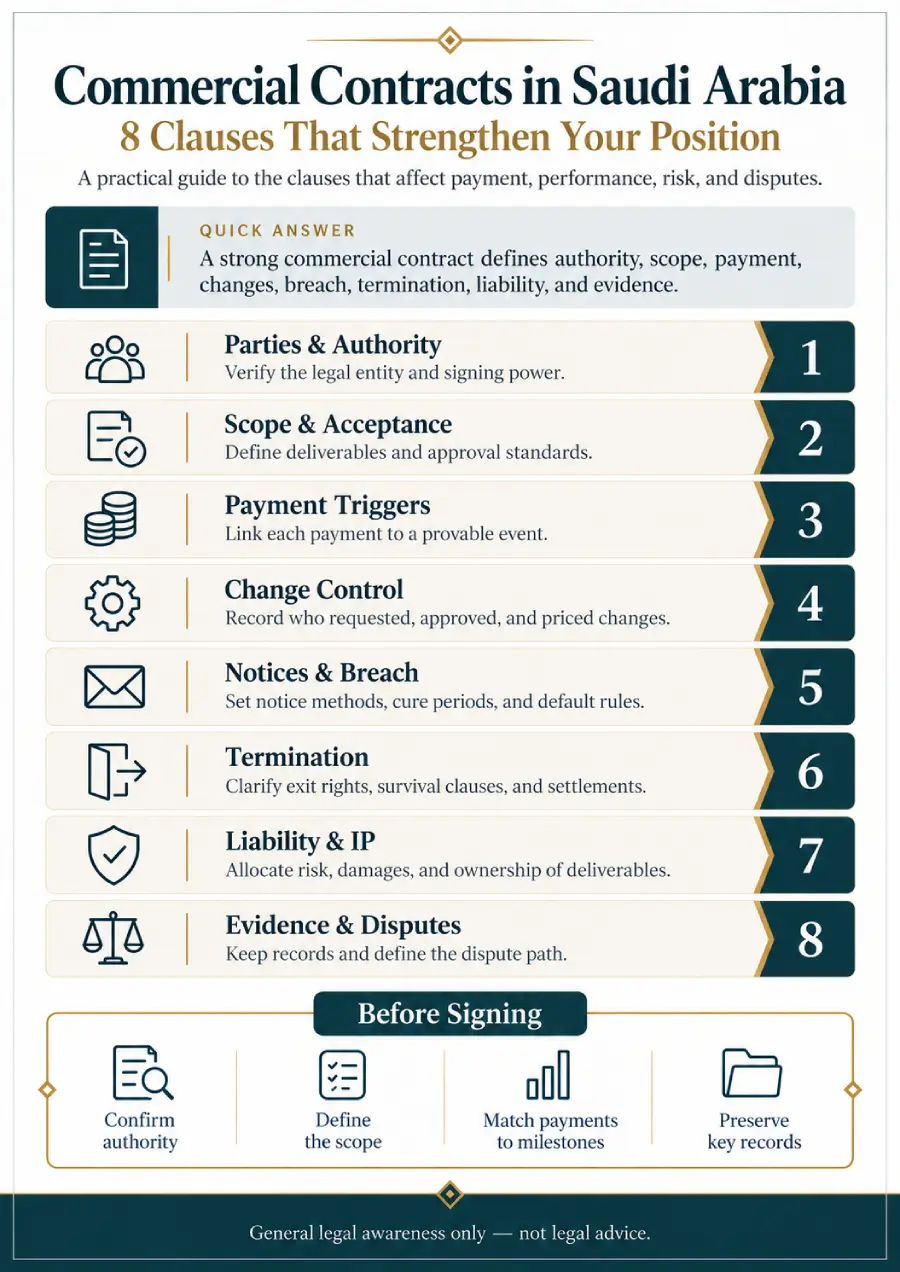
A strong commercial contract identifies the parties and signing authority, defines scope and acceptance criteria, links payment to provable milestones, controls amendments, regulates notices and breach, explains how the relationship ends, allocates liability, and preserves evidence. The aim is to turn each important obligation into something that can be identified, measured, and proved.
These elements do not mean every transaction should use the same structure. A supply agreement is different from a software development contract, and a long-term operating agreement is different from a limited professional services engagement. The practical test is simple: does the contract answer the questions that will arise if the deal does not proceed as planned?
| If the dispute concerns | Review this clause first |
|---|---|
| Who bound the company | Parties and signing authority |
| Work said to be additional | Scope and change control |
| Rejected deliverables | Acceptance criteria |
| Whether a payment is due | Payment and supporting documents |
| A notice said not to have arrived | Notices |
| Failure to perform | Breach and cure period |
| Ending the relationship | Termination and consequences |
| Proving a claim | Evidence and dispute resolution |
1. Verify the Parties and Signing Authority
The first issue to check is not price or liquidated damages. It is who will be bound and who has authority to bind that party. When contracting with a company, the trading name or brand used with customers is not enough. The legal entity and the person signing on its behalf should be identified separately.
The new Commercial Registration Law took effect on 3 April 2025 and introduced a single commercial registration for an establishment across the Kingdom, covering its activities and updated registration data. Verifying the counterparty’s registration details is therefore a practical step before relying on its contractual commitment.
Official legal reference:
Saudi Ministry of Commerce – entry into force of the Commercial Registration and Trade Names Laws
.
For a limited liability company, Article 162 of the Companies Law provides that the manager represents the company before the courts, arbitration tribunals, and third parties. It also regulates the effect of appointing or changing a manager, or restricting the manager’s powers, in relation to commercial registration.
Official legal reference:
Companies Law – Bureau of Experts at the Council of Ministers, Article 162
.
Before signing, review the legal name, commercial registration details, company form, representative’s name and title, the basis of any delegation, and any internal approval required for the transaction. A contract may define the scope perfectly and still face a more basic question later: did the signatory have authority to create the obligation in the first place?
2. Define Scope and Acceptance Criteria
Unclear scope is not only a drafting problem. It becomes an evidence problem.
A clause stating that “the second party shall provide all services required for the project” does not explain what is included in the price, what is excluded, or when performance is complete.
A clearer contract should identify, where relevant, the product or service, quantities, technical specifications, phases, deliverables, each party’s responsibilities, exclusions, information or materials to be supplied by the customer, and deadlines affecting later stages.
When reviewing Commercial Contracts in Saudi Arabia, the scope should also be linked to a clear acceptance mechanism. Knowing what must be delivered is not enough if the contract does not explain when the deliverable becomes accepted and whether the next payment has become due.
When Is a Deliverable Accepted?
The contract should address the delivery method, who may approve the work, the inspection period, acceptance criteria, how defects or comments are recorded, the cure period, resubmission, partial acceptance where appropriate, and final acceptance.
The more clearly acceptance is tied to a defined event or document, the less room there is for conflicting recollections after performance.
3. Link Payments to a Provable Entitlement
The value of Commercial Contracts in Saudi Arabia may be clear while the trigger for each payment remains uncertain. That creates a practical problem: is payment due simply because a date has passed, after a phase is completed, after a deliverable is accepted, or only after a compliant invoice is issued?
Payment clauses work better when they state the amount or calculation method, the due date, the event that creates entitlement, the document proving that event, invoice requirements, consequences of delay, applicable tax treatment, and any circumstances in which the price may change.
The Civil Transactions Law provides that performance is due once the obligation arises unless the contract or a legal provision states otherwise. It also regulates cases where an obligation is deferred but the parties have not fixed the time for performance.
A clear sequence of performance → evidence → payment entitlement reduces later arguments about why a payment became due and when the right to claim it arose.
Legal reference: Civil Transactions Law, Articles 275 and 276, Bureau of Experts at the Council of Ministers.
4. Create a Clear Change-Control Process
Many Commercial Contracts in Saudi Arabia begin with a defined scope and then change during performance. A party may request extra quantities, new functionality, revised specifications, an accelerated deadline, a delayed phase, or a new deliverable.
The problem is not that change happens. The problem is allowing it to happen without a process that records who requested it, who approved it, and how it affects price and time.
A useful change-control clause should identify:
- the requested change;
- who requested it;
- who has authority to approve it;
- its financial effect; and
- its timing effect and effective date.
The Law of Evidence recognises and regulates digital evidence, including digital correspondence, email, and other electronic communications. But the fact that digital communications may be evidence does not make scattered messages a good substitute for a structured change order.
Official legal reference:
Law of Evidence – Bureau of Experts at the Council of Ministers
Practical rule: material change = clear description + provable approval + defined financial and timing impact.
5. Regulate Notices, Breach, and Cure Periods
A breach clause should do more than say that the injured party may “take all legal measures.” That wording does not explain how the parties should deal with the first failure in performance or when contractual consequences begin.
The contract should make clear which obligations are material, what conduct constitutes breach, how notice must be given, where notice must be sent, when notice is deemed received, whether a cure period applies, and what happens if the breach is not cured.
Article 107 of the Civil Transactions Law addresses non-performance in bilateral contracts and the right, after notice where required, to seek performance or rescission, with compensation where appropriate. Articles 176 and 177 address cases in which notice is not required and the methods by which notice may be given.
A well-drafted notice clause can therefore be as important as the breach clause itself. It helps establish how and when the other party was formally required to perform or remedy the default.
Legal reference: Civil Transactions Law, Articles 107, 176 and 177, Bureau of Experts at the Council of Ministers.
6. Plan for Termination and What Survives It
Not every contract ends in the same way. A contract may expire at the end of its term, not be renewed, be terminated under an express contractual right, end by agreement, or be rescinded because of breach. The financial and operational consequences do not have to be the same.
A termination clause should address the contract term, automatic renewal, notice of non-renewal, termination events, ongoing work, final payment and settlement, return of documents and data, and obligations intended to survive termination.
When the issue moves from drafting to forum selection, the separate guide on commercial court jurisdiction
is more useful than assuming that calling a document a “commercial contract” automatically determines the competent forum.
7. Allocate Liability and Intellectual Property Clearly
A large liquidated damages figure does not fix an unclear contract. In Commercial Contracts in Saudi Arabia, the starting point is still the underlying obligation: what had to be performed, when it was due, whether breach occurred, what impact followed, and what can be proved.
The Civil Transactions Law allows parties to agree compensation in advance under Article 178. Article 179 regulates issues including absence of loss, excessive agreed compensation, partial performance, fraud, and gross fault.
Legal reference: Civil Transactions Law, Articles 178 and 179, Bureau of Experts at the Council of Ministers.
The contract should distinguish between delay damages, overall liability caps, exceptions to those caps, confidentiality breaches, third-party claims, and intellectual property exposure.
Contractual liability between the parties should also not be confused with statutory responsibilities within a company. For that separate issue, see partner liability in companies and liability claims under the Companies Law.
Who Owns the Deliverables?
In technology, design, marketing, and licensing contracts, a statement such as “all deliverables belong to the customer” may be too broad.
The contract may need to distinguish between pre-existing materials, supplier tools, third-party licensed content, newly created deliverables, the time at which rights transfer, the effect of payment, and the difference between an assignment of ownership and a licence to use the material.
8. Build an Evidence Record and Choose the Dispute Path
A sound approach to Commercial Contracts in Saudi Arabia does not stop with the written contract. It also considers the performance record. A person reviewing the dispute later should be able to understand what happened from the documents, not from memory alone.
| Event | Possible Supporting Evidence |
|---|---|
| Work started | Work order or commencement record |
| A phase was completed | Delivery record or correspondence |
| A deliverable was rejected | Inspection report or recorded comments |
| Scope changed | Change request and approval |
| Payment became due | Contract, invoice, and completion evidence |
| Delay occurred | Schedule and correspondence |
| A claim was sent | Notice and proof of delivery |
| A technical issue arose | Technical report or expert evidence |
Article 66 of the Law of Evidence requires certain transactions exceeding SAR 100,000, or of an unspecified value, to be proved in writing, subject to the rules and exceptions set out in the Law. That makes document retention part of risk management, not merely administration.
Legal reference: Law of Evidence, Article 66, Bureau of Experts at the Council of Ministers.
If the parties agree to arbitration, the arbitration clause should be treated as a separate part of the dispute architecture. The Arbitration Law defines an arbitration agreement as an agreement to submit all or certain disputes arising from a defined legal relationship to arbitration, and Article 9 requires the arbitration agreement to be in writing.
Official legal reference:
Arbitration Law – Bureau of Experts at the Council of Ministers, Articles 1 and 9
.
A Practical Contract Review Before Signing
- confirm each party’s legal identity and representative;
- identify each party’s core obligation;
- link every important obligation to a measurable deliverable or standard;
- define when delivery becomes accepted;
- link each payment to an event and supporting document;
- trace how scope, price, and time may change;
- identify notice, breach, cure, and exit rules; and
- organise the evidence record and dispute path.
Time Periods That Should Not Be Left Unclear
For Commercial Contracts in Saudi Arabia, there is no single timeline that applies to every transaction. The contract should instead define the specific periods that matter to its performance, payment, review, notice, and termination.
| Time Period | Question to Answer |
|---|---|
| Performance period | When does performance start and end? |
| Inspection period | How long does the customer have to review the deliverable? |
| Cure period | When must defects or comments be addressed? |
| Payment period | Which event starts the payment clock? |
| Termination notice | When does termination take effect? |
| Confidentiality period | Does confidentiality survive the contract? |
Warning Signs That Call for Further Review
- The counterparty’s name does not match its official registration.
- The signatory’s title or authority is unclear.
- The scope does not define deliverables or exclusions.
- Delivery has no acceptance standard or review period.
- A payment is not linked to a clear event or record.
- Changes can be approved by anyone without defined authority.
- Notice methods conflict across different parts of the contract.
- Termination does not explain what happens to ongoing work or unpaid amounts.
- Intellectual property language does not distinguish existing rights from newly created rights.
- The dispute clause conflicts with another term.
Professional note: These are general review indicators. They are not presented as facts from identifiable client matters or transactions. Any future reference to recurring patterns “from practice” should be based on actual professional experience and fully anonymised.
How to Review Commercial Contracts in Saudi Arabia: 8 Questions
- Who is bound? Is the party correctly identified, and is the representative authorised?
- What must be performed? Is the scope specific enough to measure?
- When is performance complete? Are the acceptance criteria clear?
- When is payment due? Which event and document create the entitlement?
- How can the contract change? Who may approve a change?
- What happens after breach? How is notice given, and is there a cure period?
- How does the relationship end? Which obligations survive termination?
- How will a right be proved and enforced? What evidence exists, and what dispute forum applies?
The first question is not “How large is the liquidated damages clause?” Compensation only matters after a more basic issue is clear: can the contract and the performance record show what was supposed to happen in the first place?
This article is for general legal awareness only. It does not assess a specific contract or set of facts, does not constitute legal advice, and does not create a lawyer-client relationship. The legal position may vary depending on the contract type, facts, documents, applicable special rules, jurisdiction, and the terms agreed by the parties.
Frequently Asked Questions About Commercial Contracts in Saudi Arabia
What should I check first before signing a commercial contract?
Start with the legal identity of each party, the authority of the signatory, and the core scope of work. Before focusing on damages or termination rights, you need to know who is actually bound, what that party must do, and whether performance can later be measured and proved from the contract and supporting records.
How can I tell whether the scope of work is clear?
A clear scope identifies the product or service, specifications, stages, deliverables, responsibilities, exclusions, and the standard for completion. If the reader still has to guess whether a requested task is included in the original price, the scope is probably not precise enough and should be revised before signing.
How should contract changes be documented?
Record the change in writing, identify what is being changed, state who has authority to approve it, and define the effect on price and time. Digital correspondence may be relevant evidence under the Law of Evidence, but a structured change process reduces disputes over whether extra work was approved and on what terms.
Why does the notice clause matter?
The notice clause becomes important when one party demands performance, records a breach, starts a cure period, or terminates the relationship. It should state the permitted delivery method, the correct recipient or address, and when notice is deemed received. This reduces later arguments over whether formal notice was properly given.
Which documents can strengthen a contractual claim?
Relevant records may include the signed contract, schedules, work orders, change orders, invoices, delivery and acceptance records, correspondence, notices, and technical reports. In many disputes, the signed contract alone does not prove what happened during performance, so maintaining an organised evidence record throughout the relationship is important.
Does calling an agreement a commercial contract determine the competent court?
No. The competent forum depends on the nature of the dispute, the status of the parties, the applicable jurisdictional rules, and whether there is a valid arbitration agreement. The title of the document alone does not determine jurisdiction, so the dispute-resolution clause should be reviewed together with the relevant facts and Saudi legal rules.
Conclusion
The strength of Commercial Contracts in Saudi Arabia does not come from the number of clauses. It comes from reducing the issues that may later require competing interpretations.
A useful review sequence is:
Before signing, the focus is on ambiguity and risk allocation. During performance, the focus shifts to changes, delivery, and payment entitlement. Once a breach appears, notices, evidence, and the dispute path become more important.
For the broader professional approach behind this analysis, see the lawyer’s professional vision.