Legal content prepared by: Lawyer Mohammed Aldosari
Licensed lawyer in the Kingdom of Saudi Arabia — License No. 40462 — Professional practice since 2013.
Published: 30 September 2026
Last updated: 30 September 2026
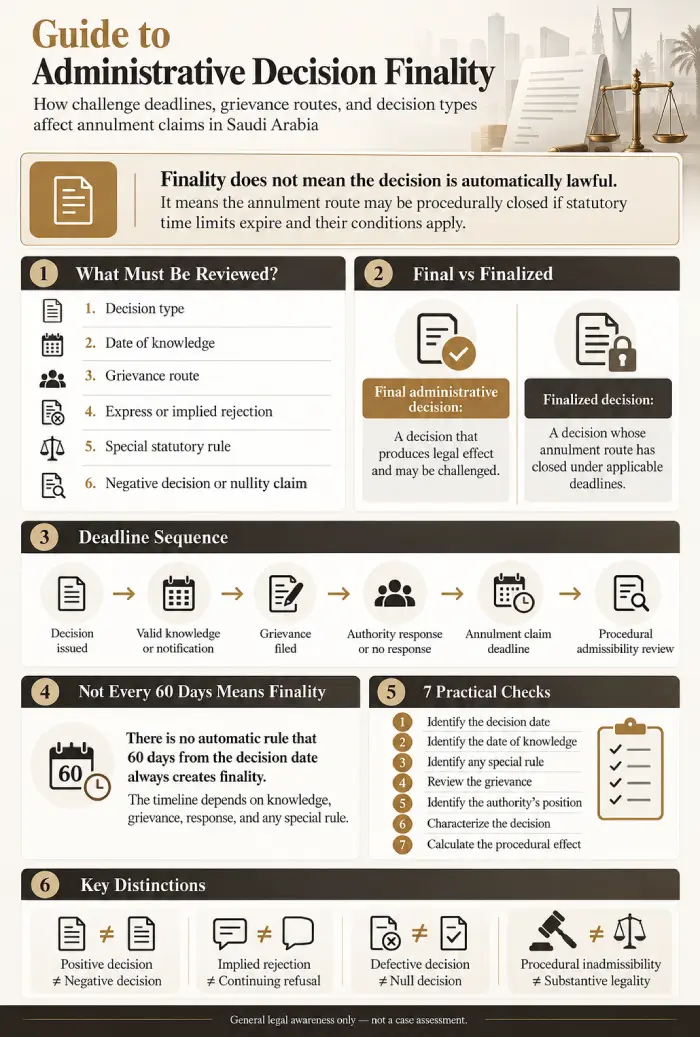
Administrative Decision Finality does not mean that an administrative decision becomes substantively lawful merely because time has passed. It means that the route of annulment challenge may become procedurally closed if statutory time limits expire and their conditions apply. The review should not start from the decision date alone. It must examine the type of decision, the date of knowledge, the grievance route, any special statutory rule, and the nature of the alleged defect.
Quick Answer
Administrative Decision Finality is the procedural stability of an administrative decision against an annulment claim after statutory challenge periods have expired, where their conditions apply. It does not always mean the decision is substantively lawful. The result depends on the decision type, date of knowledge, grievance, express or implied rejection, negative decision, and any claim of nullity.
Extractable Definition
Administrative Decision Finality is a procedural description showing that an administrative decision has become stable against an annulment claim after the statutory grievance and challenge periods have expired, where the decision is subject to those periods, without necessarily proving that the decision is lawful on the merits.
This article is limited to the effect of missing the challenge deadline on an annulment claim. It does not cover all grounds for challenging administrative decisions, the legal elements of an administrative decision, or suspension of execution. This limitation matters because the Saudi Board of Grievances Law grants administrative courts jurisdiction over annulment claims against final administrative decisions where the challenge is based on lack of jurisdiction, form, cause, violation of laws or regulations, error in application or interpretation, or abuse of power.
What Does Administrative Decision Finality Mean?
Finality in this context relates to the procedural stability of the decision. In practice, the court may stop at the timing requirement before it examines the legality of the decision itself. The concerned person may have had a ground that could have been raised in an annulment claim, but the grievance and lawsuit route was not taken within the statutory time.
Two questions must therefore be separated. First: is the decision lawful or unlawful in terms of jurisdiction, form, cause, subject matter, or purpose? Second: is the annulment claim still open for the court to examine those defects? Confusing these questions leads to an inaccurate result, because procedural inadmissibility does not always mean that the decision was substantively lawful.
| Issue | What Is Reviewed? | Practical Effect |
|---|---|---|
| Legality of the decision | Jurisdiction, form, cause, law, abuse of power | Reviewed if the claim is procedurally admissible |
| Administrative Decision Finality | Expiry of time limits or defect in grievance route | May prevent hearing the annulment claim |
| Null decision | A grave defect affecting the existence of the decision | Requires careful characterization and is not presumed |
A Final Administrative Decision Is Not the Same as a Finalized Decision
A final administrative decision is a decision issued in a form that produces legal effect and may, in principle, be challenged through an annulment claim. A finalized decision is different. It is a decision whose annulment route has closed under the applicable time limits and conditions. A decision may therefore be final and challengeable, but not yet procedurally finalized because the deadline remains open.
Describing a decision as final is also not enough to calculate the deadline. The analysis must identify the date of knowledge, the method of notification, whether a mandatory grievance exists, whether there was an express rejection, whether the authority remained silent until the decision period expired, and whether a special statutory rule applies. These elements determine the effect of missing the deadline, not the label “final decision” alone.
How Does Missing the Deadline Lead to Administrative Decision Finality?
There is no accurate rule stating that once a decision is issued and 60 days pass, Administrative Decision Finality always follows. Article 8 of the Law of Procedure Before the Board of Grievances sets, where no special provision applies, a timed route that begins with filing a grievance with the issuing authority within 60 days from the date of knowledge in annulment claims against final administrative decisions not related to civil service matters.
The matter does not end with filing the grievance. The authority must decide on it within the statutory period. The stage of filing the annulment claim then begins after express rejection or after the decision period expires without a response, according to the applicable rule. The issue is therefore not a single number, but a sequence that must be arranged before concluding that the decision has become final.
| Stage | Practical Question | Effect on Finality |
|---|---|---|
| Issuance of decision | Was the decision issued in final form? | Does not alone determine the deadline |
| Knowledge or notification | When did valid knowledge occur? | May start the grievance period |
| Grievance | Was it filed with the correct authority on time? | Affects admissibility of the annulment claim |
| Authority response | Was there an express rejection? | May start the claim period |
| No response | Did the decision period expire without reply? | May create implied rejection under the law |
When Does the Deadline Start: Decision Date or Knowledge Date?
Under the general route in Article 8/4 of the Law of Procedure Before the Board of Grievances, the starting point is linked to knowledge of the decision. Knowledge occurs through notifying the concerned parties or by publication in the Official Gazette if notification is not possible. Therefore, the date printed at the top of the decision is not enough unless it is also the legally relevant date of knowledge.
The date on which the authority issued the decision may differ from the date on which the concerned person received it. This difference matters when calculating the grievance and lawsuit periods, because a single day can change the procedural result. For that reason, proof of notification, receipt, official electronic communication, or any evidence showing the date of knowledge should be preserved.
Practical Note
Before concluding that the decision has become final, do not start from the decision date alone. Collect the decision, proof of knowledge or notification, any grievance filed, the authority’s response or expiry of the decision period, and then identify the statutory rule governing that type of decision.
What Is the Effect of Grievance and Implied Rejection?
A grievance is not a secondary formality in claims governed by Article 8. If a grievance is required, it must be filed with the issuing authority within the statutory period. The authority must then decide on it within the prescribed period. If an express rejection is issued, or if the decision period expires without response, the matter moves to the lawsuit filing stage.
The term implied rejection should be used only where the law gives legal effect to the authority’s silence after the decision period expires. This differs from a negative administrative decision. A negative decision concerns a continuing failure by the administration to make a decision it was legally required to make, while implied rejection is a procedural consequence of failing to respond to a grievance within a specified period.
Does a Negative Administrative Decision Become Final Like a Positive Decision?
A negative administrative decision has a different nature when the issue is a continuing failure by the administration to make a decision that the law requires it to make. The Board of Grievances Law treats the administration’s failure to take a required decision as an administrative decision, but this does not always mean it is treated like a positive decision for finality purposes.
Materials published by the Board of Grievances indicate that challenge periods for negative decisions are linked to the continuation of the refusal or abstention, while distinguishing them from implied decisions where the law attaches an effect to silence after a defined period. The characterization is therefore critical: is this a continuing refusal to perform a statutory duty, or is it simply failure to respond to a grievance whose period has expired? The Board’s published material on negative decisions and continuing challenge periods may be reviewed when examining this point.
What Is the Effect of Missing the Deadline on an Annulment Claim?
The main effect of missing the deadline is that the court may find the annulment claim procedurally inadmissible before it examines the alleged illegality. This means the dispute stops at a procedural condition, not at a final assessment of the substantive legality of the decision.
It is therefore inaccurate to say that the decision became lawful merely because the annulment claim was not admitted due to lateness. The more precise formulation is that the decision became protected from the annulment route in the specific case, if the conditions of Administrative Decision Finality are met, while substantive legality remains a different concept.
Quotable Summary
Missing the challenge deadline may prevent the court from examining the legality of the decision in an annulment claim. Procedural inadmissibility does not equal a ruling that the decision is lawful on the merits; it indicates a procedural bar in that specific case.
Does Every Defective Decision Become Final Over Time?
No. It is also inaccurate to say that every defect prevents finality. Article 13 of the Board of Grievances Law identifies grounds for challenging final administrative decisions, such as lack of jurisdiction, defect in form or cause, violation of laws, error in applying the law, and abuse of power. However, the existence of one of these defects does not automatically turn the decision into a null decision.
This is where excessive use of nullity becomes risky. Nullity is not used merely because there is an ordinary legal defect or a different interpretation of the law. It is linked to a grave defect affecting the existence and administrative character of the decision. The seriousness of the defect must therefore be reviewed before using nullity as an exception to the effect of time limits.
| Element | Defective Decision | Allegedly Null Decision |
|---|---|---|
| Nature of defect | Defect in legality | Grave defect affecting existence |
| Effect of deadline | Time limits may apply | Effect is not presumed without careful characterization |
| Common error | Assuming every defect prevents finality | Using nullity to bypass the deadline |
Situations Where Time Lapse Alone Is Not Enough
The Administrative Development Journal of the Institute of Public Administration published material on administrative decisions excluded from the principle of finality. It referred to judicial applications identifying seven descriptions where finality should not be invoked in that context, including null decisions, decisions based on fraud or deceit, decisions not published or notified to the concerned parties, decisions that the law permits to be withdrawn or cancelled without a time limit, execution decisions dependent on their original decision, decisions conflicting with res judicata, and errors related to salary settlement and similar matters.
This list should not be turned into an automatic rule. Its value is that it shows that Administrative Decision Finality is not a purely mathematical result. It depends on the nature of the decision, the special statutory rule, and the facts. The key question after the deadline appears to have passed is therefore: what type of decision is being described as final, and is there a fact or rule that prevents reliance on finality? The material published by the Institute of Public Administration on administrative decisions excluded from finality may be reviewed as explanatory administrative material, not as a substitute for statutory text or judicial characterization.
Can the Administration Withdraw a Decision After Finality?
Withdrawal is different from prospective cancellation. Withdrawal concerns removing the effects of the decision from the beginning, while prospective cancellation stops future effects according to its nature and scope. It is therefore inaccurate to state a single rule that every finalized decision can never be withdrawn, or that the administration may withdraw any decision whenever it wishes.
The more accurate question is this: did the decision create a legal position and become stable after the deadline passed? Or is the decision null, based on fraud or deceit, or governed by a special rule allowing withdrawal or cancellation? This keeps the analysis tied to the law and the facts, not to a broad phrase applied to every case.
Practical Evidence Block: 7 Checks for Administrative Decision Finality
The review of Administrative Decision Finality does not start from the impression that the deadline has passed. It starts by building a clear timeline of the decision, notification, grievance, and lawsuit. The review can be arranged through seven checks:
- Identify the decision date: it proves issuance, but it is not always the start of the deadline.
- Identify the date of knowledge: review notification, publication, or evidence of valid knowledge.
- Identify any special rule: the general rule does not apply if a special statutory rule governs the decision.
- Review the grievance: check filing date, authority, and content of the grievance.
- Identify the authority’s position: was there an express rejection, or did the decision period expire without response?
- Characterize the decision: is it positive, negative, implied, execution-related, or allegedly null?
- Calculate the effect: only then assess whether the annulment claim may still be heard or is procedurally barred.
What May Change the Result?
The result may change because of a special statutory rule, a dispute over the date of knowledge, filing the grievance with the wrong authority, a continuing negative decision, a serious nullity claim, or fraud or deceit. The phrase “60 days have passed” is not enough without reviewing these elements.
What Remains After the Annulment Route Is Missed?
Missing the deadline for an annulment claim does not automatically mean that every other claim remains admissible. It also does not mean that compensation claims or financial demands remain open without independent conditions. Each claim has its own basis, deadlines, requirements, and jurisdictional rules.
The Board of Grievances Law distinguishes between annulment claims, compensation claims for decisions or acts of administrative authorities, and other administrative disputes. The Law of Procedure Before the Board of Grievances also provides specific time limits for certain claims. Therefore, a compensation claim should not be used as an automatic method to bypass a finalized decision. It must have independent elements: fault, damage, causation, time limit, and jurisdiction.
Trust and Legal Reference
This content is published on the personal website of Lawyer Mohammed Aldosari, a licensed lawyer in the Kingdom of Saudi Arabia, License No. 40462, and is based on published Saudi statutory and official sources.
You may review the methodology for documenting legal information to understand how sources are selected and how published content is limited.
Frequently Asked Questions About Administrative Decision Finality
What does Administrative Decision Finality mean?
Administrative Decision Finality means that the decision may become procedurally stable against an annulment claim after statutory time limits expire, where the conditions apply. It does not necessarily mean the decision is lawful on the merits; the court may simply stop at a procedural bar before reviewing legality.
Does the challenge period start from the decision date?
Not always. Under the general Article 8/4 route, the relevant starting point is knowledge of the decision, achieved through notification or publication in the Official Gazette where notification is not possible. The internal issuance date is not enough unless it is also the legally relevant date of knowledge.
What happens if the authority does not respond to the grievance?
If the law gives effect to silence after a specific decision period, implied rejection may arise once that period expires. The stage of filing the annulment claim then begins according to the applicable rule. A complainant should not wait indefinitely where the law fixes a time for response.
What is the difference between a negative decision and implied rejection?
A negative decision is a continuing failure by the administration to make a decision it was legally required to make. Implied rejection is a procedural effect resulting from failure to respond to a grievance within a fixed period. Confusing the two may lead to an incorrect calculation of time limits.
Does every defect make an administrative decision null?
No. A null decision is linked to a grave defect that deprives the decision of its administrative character. Defects in jurisdiction, form, cause, or legal application do not automatically become nullity. The seriousness of the defect and its effect on the decision’s existence must be reviewed.
Can compensation be claimed after missing the annulment route?
A compensation claim has an independent legal basis and is not automatically admissible just because the annulment route was missed. The claimant must still establish fault, damage, causation, applicable time limits, and jurisdiction. Compensation is not an automatic workaround for Administrative Decision Finality.
Conclusion
Administrative Decision Finality cannot be decided by looking at the decision date alone. It requires arranging the decision type, date of knowledge, grievance, authority response or expiry of the decision period, and any special rule or different classification such as a negative decision or an allegedly null decision. Missing the deadline may lead to procedural inadmissibility of the annulment claim, without necessarily proving that the decision is lawful on the merits.
The more accurate reading starts from the full timeline, not from a single number. If the decision is an ordinary positive decision, grievance and challenge periods may apply. If the dispute concerns a continuing negative decision, nullity, fraud, a special statutory rule, or an independent compensation route, separate characterization is required before saying that the decision has become final.
Disclaimer
This content is for general legal awareness only. It is not an assessment of any specific case, and it does not replace review of the decision, notification, grievance, documents, and competent authority. You may review the limits of published legal content before relying on any information in a specific matter.