Legal content prepared by: Lawyer Mohammed Aldosari
Licensed lawyer in the Kingdom of Saudi Arabia — License No. 40462 — Professional practice since 2013.
Published: 27 September 2026
Last updated: 27 September 2026
Contradictory Accused Statements are assessed by looking at the substance of the inconsistency, not merely at a change in wording between one record and another. An inconsistency may be minor if it concerns a side detail, but it may be material if it affects the incident, the accused’s role, or the link between the accused and the alleged act. A contradiction does not, by itself, prove guilt or defeat the case. It must be tested against the arrest record, investigation records, witness testimony, confession, and technical or digital evidence.
Quick Answer
Contradictory Accused Statements do not automatically lead to conviction or dismissal in Saudi Arabia. Their effect depends on what actually changed, whether the change concerns a material fact, and how the statement compares with the arrest record, investigation record, witness testimony, confession, and technical or digital evidence.
Extractable Definition
Contradictory Accused Statements are material differences between two or more accounts given by an accused person about a fact under investigation or trial. The key issue is not the mere existence of a difference, but whether it relates to a central fact, conflicts with other evidence, or affects attribution of the alleged act.
This issue matters because a weak account by the accused is not the same as proof of guilt. If the accused denies the allegation, the statement must be read with the evidence as a whole. The Saudi Criminal Procedure Law regulates questioning, confrontation, hearing statements, and the court’s examination of evidence. The practical question is therefore clear: does the inconsistency change the meaning of the evidence or attribution of the act, or can it be explained without undermining the main account?
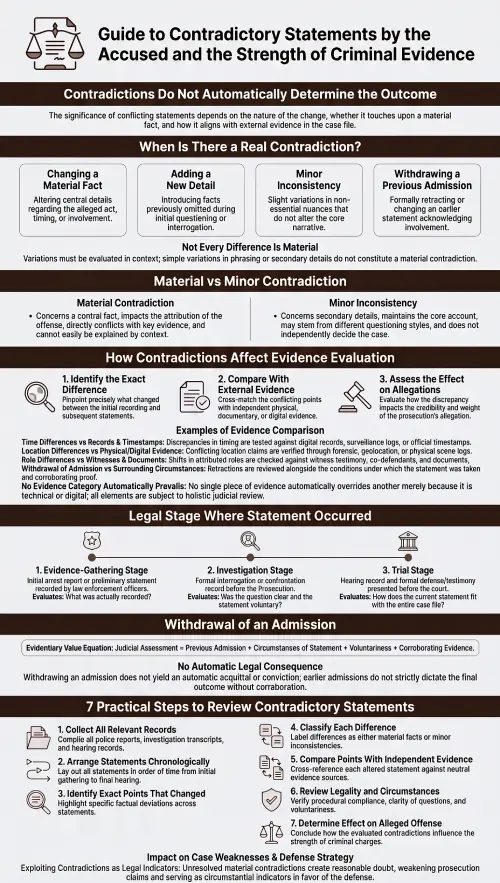
What Are Contradictory Accused Statements?
The Saudi Criminal Procedure Law does not provide a standalone statutory definition for Contradictory Accused Statements. The term is therefore used here as an analytical description, not as an independent legal rule. It refers to a meaningful difference between two or more accounts given by the accused about the incident under investigation or trial, where the accounts cannot easily be reconciled on a material point.
Not every added detail, corrected date, or clarified answer should be treated as a material contradiction. The distinction is important because the Implementing Regulations of the Criminal Procedure Law give weight to how questions are asked, how answers are heard, and how statements are recorded. This makes the actual record the starting point before describing a statement as contradictory.
This method is consistent with the site’s professional approach to reading facts and documents before choosing a legal path. The effect of an inconsistency cannot be separated from the sequence of events, the document in which it was recorded, and the procedural stage in which it appeared. A strong analysis identifies the exact point of inconsistency, its context, and the external evidence that supports or weakens it.
How Do Contradictory Statements Affect Evidence Strength?
The real effect of Contradictory Accused Statements appears when the inconsistency concerns a fact that matters. If the accused changes the account about location, timing, role, or the source of knowledge about a key fact, the inconsistency may become important when compared with records, witnesses, technical reports, or digital data.
However, a weak defence account does not by itself prove the charge. Conviction is not inferred merely because the accused gave a shifting explanation. It must rest on evidence that proves the incident and links it to the accused. The opposite is also true: a minor inconsistency does not automatically destroy the whole account if it concerns a side detail that does not affect the main facts.
| Type of Inconsistency | Compared Against | Practical Question |
|---|---|---|
| Timing | Records, timestamps, and timelines | Does it change the sequence of events? |
| Location | Physical, digital, or inspection evidence | Does it prove or disprove presence? |
| Role | Witnesses, co-accused statements, documents | Did attribution of the act change? |
| Withdrawal of confession | Circumstances of confession and supporting evidence | Does the confession remain reliable? |
No general rule makes technical or digital evidence superior merely because it is labelled technical. A technical report may be decisive on one point, but it may also need interpretation or connection to other facts. The Saudi Evidence Law provides the general evidentiary framework where it does not conflict with the nature of criminal proceedings. The value of each item therefore depends on its reliability, relevance, and the precise point it proves.
When Are Contradictory Accused Statements Material?
Contradictory Accused Statements are not material simply because wording changed between one record and another. “Material contradiction” is not a closed statutory category. It is an analytical description. It usually refers to a difference that affects a central fact, the attribution of the act, or an element of the alleged offence. A minor inconsistency, by contrast, concerns a side detail that does not change the core account.
Five questions help test materiality: Does the inconsistency concern a central fact or a side detail? Did it appear once or across several stages? Does it conflict with independent evidence? Can it be explained by unclear questioning or incomplete wording? Does it change the link between the accused and the alleged act?
| Test | Material Contradiction | Minor Inconsistency |
|---|---|---|
| Subject of difference | Affects the incident or attribution | Concerns a side detail |
| Relation to evidence | Conflicts with material evidence | Does not conflict with independent evidence |
| Possible explanation | Difficult to explain from context | May be explained by the question asked |
What Happens If Statements Change Between Stages?
Statements by the accused do not all arise in the same procedural setting. The stage of evidence collection differs from the investigation stage before the Public Prosecution, and both differ from examination before the court. Each statement must therefore be linked to the body that recorded it, the question asked, the document in which it appears, and the procedural safeguards surrounding it.
At the evidence-collection stage, the starting point is the arrest or inquiry record prepared by the criminal investigation officer. At the investigation stage, the focus shifts to clarity of questioning, voluntariness, method of recording, and the presence of counsel where relevant. At trial, the statement is read together with the current confession or denial and the evidence presented to the court.
| Stage | Usual Document | What Is Tested? |
|---|---|---|
| Evidence collection | Arrest record or statement record | What was actually recorded? |
| Investigation | Questioning or confrontation record | Was the question clear and voluntary? |
| Trial | Hearing record and submitted evidence | How does the current position fit the file? |
A changed account has no automatic result. It may be a later explanation, a material withdrawal, or a contradiction affecting the main incident. It is therefore unsafe to isolate one stage from its context, or to assume that the latest statement always cancels or proves what came before.
What Is the Effect of Withdrawing a Confession?
Withdrawing a confession is different from changing a minor detail. In an ordinary inconsistency, the main account may remain the same while one part changes. Withdrawal means that the accused retracts an earlier admission of responsibility or a central fact. It is not accurate to say that the earlier confession automatically disappears once withdrawn, nor that it remains decisive regardless of its circumstances.
If the accused confesses before the court, the Saudi Criminal Procedure Law regulates the hearing and discussion of that confession. If the accused later denies or changes position, the court examines the evidence in light of the law. The value of withdrawal therefore depends on where the confession was made, the circumstances in which it was made, its content, voluntariness, and its consistency with other evidence.
If a confession conflicts with a technical report, digital record, or witness testimony, there is no shortcut rule that one item always prevails. The correct method is to identify the point of conflict first. Does the technical report actually prove that point? Is the witness testimony direct or inferential? Does the confession contain details that can be tested independently?
How Are Statements Compared With Other Evidence?
In an arrest or inquiry record, the first step is to separate what the officer observed or recorded from conclusions or reported statements. If the accused disputes a statement attributed to him, the record, its context, and the path by which the case moved into investigation should be reviewed, rather than relying only on which document came first.
With witness testimony, the question is whether the contradiction concerns what the witness personally observed. Does the testimony match the objective facts? Did the witness change a central point or a side detail? With technical or digital evidence, the source, collection method, meaning, and connection to the incident must be identified before using it to reject the accused’s account.
A medical report, test result, or digital record may be highly relevant on a specific point, but it is not conclusive merely because it is technical. It may prove that an event occurred without proving who caused it, or connect a device to a location without proving who used it. Every technical conclusion must therefore be tied to the actual point in dispute.
Practical Evidence Block: 7 Steps for Review
The practical value of reviewing Contradictory Accused Statements does not come from counting inconsistencies. It comes from turning the file into a chronological map that can be tested. The following steps provide a structured review method, not a guarantee of any judicial result:
- Collect available records: arrest records, statement records, questioning records, confrontation records, hearing records, and related documents.
- Arrange statements chronologically: place each statement beside its date and recording authority.
- Extract only the changed points: identify the exact sentence or fact that changed.
- Classify the difference: decide whether it concerns a central fact, an added detail, a correction, or full withdrawal from a confession.
- Link each point to independent evidence: compare it with witnesses, documents, reports, recordings, or digital data.
- Check procedural integrity: review clarity of questioning, recording of the answer, voluntariness, and safeguards.
- Define legal effect: ask whether the inconsistency affects attribution, an offence element, or only weakens part of the account.
Practical Note
A general statement such as “the statements are contradictory” is rarely enough for strong analysis. The better method is to isolate each statement in a table: first statement, second statement, recording authority, related external evidence, and effect on attribution or an element of the allegation.
When Does Reliance on Contradiction Become Weak?
Reliance on Contradictory Accused Statements becomes weak when the inconsistency concerns a detail that does not affect the allegation, when it can be explained by a differently worded question, or when independent evidence remains consistent with the main account despite a secondary change. In such cases, the inconsistency may still be noted, but it does not carry the case by itself.
Reliance also becomes weak when a sentence is taken out of context. A statement may appear contradictory when separated from the question that preceded it or from the stage in which it was recorded. Reading the whole record may show that the accused was adding detail, correcting wording, or answering a different question.
| Situation | Possible Effect |
|---|---|
| Approximate timing difference | May remain minor if it does not affect the incident |
| Different account of presence | May be material if linked to attribution |
| Denial after earlier admission | Requires review of confession and denial circumstances |
| Confession conflicts with a technical report | Does not decide the issue without identifying the conflict point |
When Are Contradictions Linked to Insufficient Evidence?
Three levels must be kept separate: an inconsistency in the accused’s statement, weakness in a specific item of evidence, and insufficiency of the entire case file. An inconsistency affects the value of an account. It may weaken a defence position or raise doubts about an explanation, but it does not automatically collapse all evidence in the case.
A weak item of evidence may mean that a witness, report, or record does not prove the point it is expected to prove, while other evidence may still exist. Conversely, several weak or conflicting elements may together make the file insufficient to proceed or prove attribution. The effect depends on the whole evidentiary picture.
For this reason, Contradictory Accused Statements may form part of a broader insufficiency analysis, or they may have limited effect if independent evidence remains strong. A disciplined review avoids three shortcuts: contradiction means conviction, contradiction means acquittal, and withdrawal of confession means the case disappears.
Trust and Legal Reference
This content is published on the personal website of Lawyer Mohammed Aldosari, a licensed lawyer in the Kingdom of Saudi Arabia, License No. 40462, and is based on official Saudi legal sources.
You may review the methodology for documenting legal information to understand how sources are selected and how published content is limited.
Frequently Asked Questions About Contradictory Accused Statements
Are Contradictory Accused Statements enough to prove guilt?
No. Contradictory Accused Statements do not automatically prove guilt. They must be read with investigation records, witness testimony, technical evidence, and the rest of the file. A contradiction may affect credibility or the weight of an account, but it does not replace proof of the elements of the alleged offence.
When is an inconsistency material?
An inconsistency is more likely to be material when it concerns a central fact, such as the accused’s location, role, or connection to the alleged act. A side detail or approximate timing difference is usually weaker unless it is linked to independent evidence that changes the meaning of the incident.
What if the accused changes the account between investigation and trial?
Each statement must be read within the stage in which it was made. A later change may be clarification, correction, withdrawal, or a material contradiction. The analysis should compare the exact wording, the surrounding circumstances, and any new evidence that appeared between the two stages.
What is the value of a withdrawn confession?
A withdrawn confession does not produce one automatic result. Its value depends on where it was made, whether it was voluntary, how it was recorded, what it contained, and whether other evidence supports or contradicts it. The withdrawal must be tested against the entire file.
How is conflict with technical evidence reviewed?
The review starts by identifying what the technical evidence actually proves. Its source, collection method, reliability, and connection to the incident must then be checked. Only after that can it be compared with the changed statement to determine whether the inconsistency is material.
When are contradictions linked to insufficient evidence?
Contradictions are linked to insufficient evidence when they form part of a wider weakness in the file. A single inconsistency may have limited effect if independent evidence remains strong. The correct approach is to assess the full evidentiary picture, not one changed statement in isolation.
Conclusion
The effect of Contradictory Accused Statements on criminal evidence in Saudi Arabia is not measured by the number of changes in the account. It is measured by the subject of the change and its value when compared with the rest of the file. An inconsistency may be minor, material, or important only when tested against a witness, report, digital record, or procedural safeguard.
The proper practical step is to collect the records, arrange statements chronologically, isolate the changed points, and test each point against independent evidence and procedural integrity. This method does not guarantee a judicial result, but it prevents conclusions based on incomplete impressions and keeps a clear line between general legal information and assessment of a specific case.
Disclaimer
This content is for general legal awareness only. It is not an assessment of any specific file or case, and it does not replace review of the facts, documents, and competent authority. You may review the limits of published legal content before relying on any information in a specific matter.