electronic messages and marital harm are increasingly connected in Saudi family disputes, but a chat or screenshot does not prove harm simply because it exists. A message may establish a statement or a specific fact. Its legal weight still depends on where it came from, whether it can be attributed to the sender, whether the context is complete, when it was sent, and what it actually proves.
This article focuses only on the evidentiary role of digital messages in a marital-harm dispute. It does not explain how to file a case, use Najiz, or obtain legal services. The wider legal framework belongs to marital dissolution in Saudi Arabia, while this page stays limited to digital-message evidence.
electronic messages and marital harm should be analysed in separate steps. Saudi law recognises digital evidence, but proving that a message exists is not the same as proving marital harm. The analysis should move from attribution and context to the fact proved by the message, then to whether that fact meets the relevant legal standard.
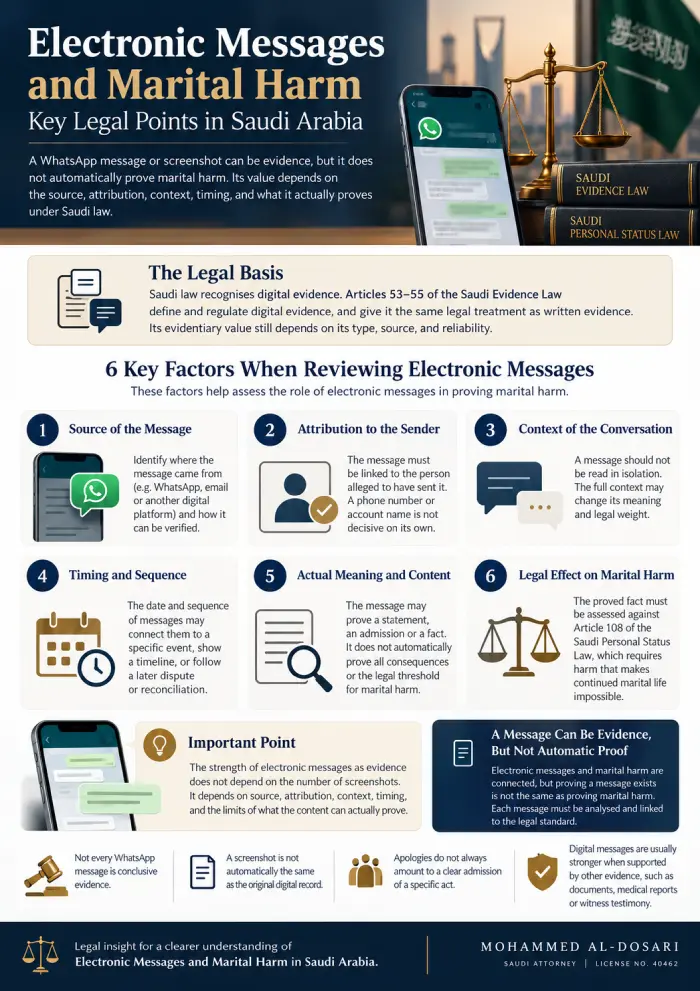
What Is the Legal Basis for Electronic Message Evidence?
To understand electronic messages and marital harm, it is necessary to start with the rules governing digital evidence in Saudi Arabia. Article 53 of the Saudi Evidence Law defines digital evidence as evidence derived from data created, issued, received, stored, or communicated by digital means and capable of being retrieved in an understandable form. Article 54 includes digital records, digital documents and signatures, digital correspondence, email, communication systems, and other digital media.
Article 55 provides that proof by digital evidence has the same legal treatment as proof in writing. This does not mean that every WhatsApp message is automatically conclusive. It means that digital material is a recognised form of evidence and must then be assessed under the rules that apply to its type, source, and evidentiary value.
The Procedural Guide to the Evidence Law also applies the Evidence Law to personal-status matters where no special rule provides otherwise. The correct question is therefore not simply, “Is the message admissible?” The better questions are: What type of digital evidence is it? Can it be linked to the person alleged to have sent it? And is its content relevant to the disputed fact?
Analytical Rule
The existence of a message does not by itself prove who sent it. Proving the sender does not automatically prove the meaning claimed for the message. And proving an offensive statement does not automatically establish the legal threshold for marital harm.
WhatsApp Messages: From Existence to Attribution
When electronic messages and marital harm are examined through WhatsApp conversations, the first distinction is between the existence of a chat and the attribution of that chat to a specific person. If non-official digital evidence falls within one of the situations described in Article 57 of the Saudi Evidence Law, it may have evidentiary force against the parties to the relevant dealing unless the contrary is proved. Article 58 addresses the burden of proving that such digital evidence is inaccurate.
If the digital evidence does not fall within Articles 56 or 57, Article 59 gives it the evidentiary value assigned to an ordinary written instrument under the Evidence Law. This distinction matters because a dispute over a message cannot be analysed under one single rule in every case.
What If One Spouse Denies Sending the Message?
A denial must be read in light of the legal classification of the digital evidence. If the conversation falls within Article 57, the dispute is considered together with Article 58. In other cases, the rules governing ordinary written instruments may apply to the extent that they are compatible with digital evidence.
Where technical verification becomes necessary, the procedural rules allow the court to rely on expert assistance. A screenshot stored on one spouse’s device may prove that a particular image exists. It may still leave a separate question about the account that sent the message, the person using that account, or whether the screenshot shows the full exchange.
What Matters If the Account or Phone Number Is Disputed?
No single fact makes an account name or phone number decisive in every case. The relevant issue is whether the material in the file connects the conversation to the alleged sender.
Useful indicators may include an admission that the account belongs to the party, the continuity of the conversation with other established facts, information visible in the original chat, or the outcome of technical verification where attribution is disputed. The weaker the connection between the digital material and the alleged sender, the more important verification becomes.
Screenshots: Original Digital Evidence vs Extracts
Screenshots are common because they are easy to save and share. They are not automatically the same thing as the original digital record.
Article 60 of the Saudi Evidence Law addresses the presentation of digital evidence in its original form or through another digital means. Article 63 gives extracts of digital evidence the evidentiary force of the underlying evidence to the extent that the extract matches its digital record.
The procedural rules also address what happens when the accuracy of an extract is disputed. In that situation, comparison with the digital record or access to the original form may become important.
So, can a WhatsApp screenshot be enough? There is no universal answer. A clear screenshot that is not disputed may serve a defined evidentiary purpose. If authenticity, completeness, or attribution is challenged, the original record or a verifiable digital source may become much more important.
| Form of Digital Material | What It May Show | What It Does Not Prove by Itself |
|---|---|---|
| Clear screenshot | Visible content, date, or account details shown in the image | Attribution or full context when disputed |
| Original conversation | A broader sequence and more information for verification | The legal existence of marital harm automatically |
| Extract matching the digital record | Evidentiary value to the extent of the match | A legal conclusion beyond what the content supports |
Context and Timing: Why a Message Should Not Be Read in Isolation
electronic messages and marital harm
can be misunderstood if a message is removed from its context. A short phrase may be an admission, an answer to a question, a general apology, or part of a conversation unrelated to the alleged harm. That is why authenticity and meaning should be treated as separate issues.
Saudi law does not create a general rule requiring every case to include the entire history of communications between spouses. But selective screenshots can weaken an argument if they hide the surrounding exchange or change the apparent meaning of the words.
Timing also matters. The date of a message may connect it to a specific event, place it before or after a reconciliation, or show that it followed a later dispute.
Reconciliation or continued married life after an earlier incident does not, by itself, prove acceptance of harm or automatically remove the right to seek judicial annulment. Later conduct is part of the factual timeline and should be read together with the reason for continuing the relationship and what happened afterwards.
Key Point
The strength of digital evidence does not depend on the number of screenshots. It depends on source, attribution, context, timing, and the limits of what the content can actually prove.
How Do Electronic Messages and Marital Harm Connect Legally?
This is the central issue in electronic messages and marital harm. After the digital material has been verified and attributed, the next step is to identify the fact proved by the message. Only then should that fact be tested against the legal standard that governs the dispute.
Under Article 108 of the Saudi Personal Status Law, the court may annul the marriage at the wife’s request if harm by the husband is proved and that harm makes continued marital life in a proper manner impossible.
Article 108 does not require a fixed number of incidents. It also does not make repetition an independent legal requirement. One message may prove a highly significant fact, while many messages may show conflict without proving the statutory form of harm.
This is why electronic messages and marital harm should not be reduced to a counting exercise. The real question is what the message proves, whether the message is reliably attributed, and what effect the proved fact has on the continuation of married life.
A message may prove an admission, a sequence of events, or the content of a communication. It does not automatically prove the cause of every event, all consequences of the conduct, or every disputed element in the case. This limit is essential to avoid over-reading valid digital evidence.
| Stage | Main Question |
|---|---|
| Existence | Is there digital material that can be examined? |
| Attribution | Can it be linked to the person said to have sent it? |
| Context | Is the meaning clear, or is the message taken out of context? |
| Fact proved | What does the message actually establish? |
| Meaning | Does the wording have one clear meaning or several possible meanings? |
| Legal effect | How does the proved fact relate to the harm required under Article 108? |
Apologies and Admissions in Digital Messages
Spouses often use apologies or conciliatory phrases in personal conversations. Not every “I am sorry” or “forgive me” should be treated as an admission of a specific harmful act.
The Saudi Evidence Law distinguishes judicial and non-judicial admissions. It also allows an admission to be made expressly or by implication and in writing. The conclusive evidentiary effect in Article 17 relates specifically to a judicial admission.
A statement made outside court may, where the legal requirements are met, amount to a non-judicial admission. Its proof and legal effect are assessed under the Evidence Law.
“I am sorry for what happened” may require further context before it proves any specific act. A message that clearly acknowledges a defined act at a defined time is more precise. Even then, attribution, context, and the rest of the evidence remain relevant.
How Are Digital Messages Read with Other Evidence?
electronic messages and marital harm
are often easier to assess when the messages are read with the rest of the evidence rather than on their own. A message may be the central evidence for one fact. In another file, it may sit alongside an official document, medical report, witness testimony, admission, or other circumstantial evidence.
Different forms of evidence perform different functions. A medical report may establish an injury without identifying who caused it. A message may establish that a particular statement came from a specific person. Witness testimony may address a material event that does not appear in the messages.
The better approach is therefore to ask what each item proves instead of simply collecting the largest number of attachments.
If the authenticity of digital evidence cannot be verified for a reason not attributable to the parties, the Saudi Evidence Law leaves its evidentiary value to the court in light of the circumstances of the case. This reinforces the point that digital evidence is not always reduced to a simple “accepted” or “rejected” label.
Practical Analysis Matrix: 6 Questions for Reviewing a Message
The following matrix helps structure digital-message evidence in marital-harm disputes without turning the issue into an automatic legal test. It is an educational analysis tool, not a statutory checklist and not a guarantee of any outcome.
| Factor | Question | Why It Matters |
|---|---|---|
| Source | Where did the message come from? | Identifies the type of digital evidence and how it may be checked. |
| Attribution | Can the message be linked to the other party? | A message cannot be fully assessed if the sender is uncertain. |
| Context | Is the meaning clear, or was the message taken from a wider conversation? | Prevents a phrase from being given a meaning it does not support. |
| Timing | Does the date connect the message to the disputed event? | Places the message within the factual timeline. |
| Meaning | What does the message actually prove? | Separates the text from the conclusion drawn from it. |
| Legal Effect | How does the proved fact relate to the alleged marital harm? | Prevents the analysis from jumping directly from evidence to outcome. |
Legal Summary
electronic messages and marital harm
should never be analysed through the shortcut, “the message exists, therefore the harm is proved.” Saudi law recognises digital evidence and gives it the legal treatment of written evidence, but separate rules govern attribution, authenticity, presentation, and evidentiary value.
In a judicial annulment claim based on harm, Article 108 does not require a fixed number of harmful incidents and does not make repetition a standalone condition. The sounder approach is to move from the message, to attribution and context, to the fact proved, and finally to the legal effect of that fact on the continuation of married life.
FAQs About Electronic Messages and Marital Harm
Can WhatsApp Messages Alone Prove Marital Harm?
A WhatsApp message may prove a specific statement or fact if its attribution and authenticity are established. It does not automatically prove the statutory level of marital harm. The court still needs to consider what the message actually proves and how that fact relates to the legal standard governing the dispute.
What Happens If One Spouse Denies the Chat?
The answer depends on the legal classification of the digital evidence. In some situations, Article 58 places the burden on the party alleging that the digital evidence is inaccurate. In other situations, rules governing ordinary written instruments may apply, subject to the nature of digital evidence.
When Does a Screenshot Need to Be Checked Against the Original?
If the accuracy, completeness, or attribution of a screenshot is disputed, checking it against the original digital record may become important. The evidentiary value of an extract depends on its match with the underlying digital record.
Does an Apology in a Message Count as an Admission?
Not every apology proves a specific harmful act. A general phrase such as “I am sorry for what happened” may have several meanings. A message that clearly acknowledges a defined act is more precise, but its legal effect still depends on attribution, context, and the rest of the evidence.
Does Reconciliation After the Messages Remove Their Evidentiary Value?
Reconciliation or continued married life does not automatically erase the evidentiary value of earlier messages or remove a right to seek annulment. Later conduct is part of the timeline and should be considered together with the reason for reconciliation and any later events.
When Should Messages Be Assessed with the Full Case File?
A full-file assessment becomes especially important where attribution is disputed, screenshots are incomplete, medical records or witnesses address related events, or the timeline includes reconciliation and later incidents. In those situations, the value of each message depends on how it fits with the rest of the evidence.
Disclaimer
This content is for general legal education under Saudi law. It is not individual legal advice and does not create an attorney-client relationship. The legal analysis may vary depending on the facts, documents, evidence, and nature of the dispute.
Sources & Methodology
This article is based on official Saudi legal sources, including the Saudi Evidence Law, the Procedural Guide to the Evidence Law, and the Saudi Personal Status Law. It separates statutory rules from analytical explanation.
For the website’s sourcing and review approach, see Sources & Methodology
.