Legal content prepared by: Attorney Mohammed Al-Dossary
Licensed Attorney in the Kingdom of Saudi Arabia — License No. 40462 — Practicing since 2013.
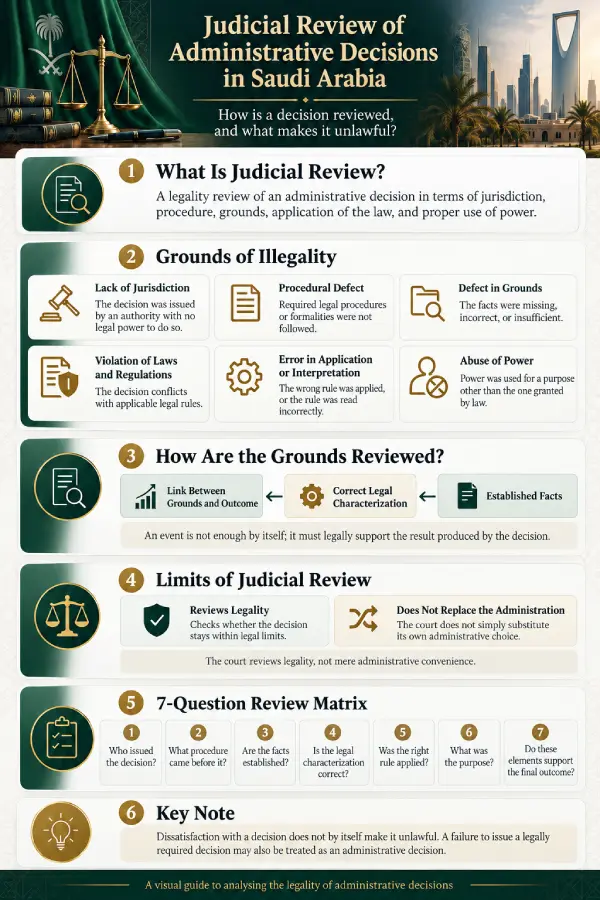
Judicial review of administrative decisions in Saudi Arabia focuses on whether an administrative decision stays within the limits of legality. The question is not simply whether the affected person considers the decision fair, reasonable, or preferable.
The analysis begins with the authority that issued the decision. It then moves to the required procedure, the facts relied on, the applicable legal basis, and the purpose for which the administrative power was used. The final question is whether those elements legally support the effect created by the decision.
Article 13 of the Board of Grievances Law identifies grounds on which final administrative decisions may be challenged, including lack of jurisdiction, defects in form or cause, violation of laws or regulations, errors in applying or interpreting them, and abuse of power.
That makes the correct starting point clear: identify the legal defect in the decision rather than simply describing the outcome as unfair.
Have you received an administrative decision and are unsure whether the facts or legal basis support it? A structured review of jurisdiction, procedure, factual grounds, and the applicable rules can help identify the issue before you decide what to do next.
Discuss the Administrative Decision
Prefer to understand the legal framework first? Continue with the guide below.
Quick Answer
Judicial review of administrative decisions tests whether a decision is legally sound in terms of jurisdiction, procedure, factual and legal grounds, application of the law, and proper use of administrative power. The court does not simply remake the administrative choice. It examines whether the authority acted within the legal limits governing its powers and whether the decision rests on a valid factual and legal foundation.
What Does Judicial Review of Administrative Decisions Mean?
Judicial review of administrative decisions rests on a basic rule: an administrative authority may exercise only the powers granted to it by law.
A valid administrative decision therefore requires several elements to work together. The decision must come from a competent authority. Required procedures must be followed. The factual basis must exist. The applicable legal rule must support the legal effect. Finally, the power must be used for the purpose for which it was granted.
This is why legality review differs from a review of administrative convenience. An authority may have several lawful options, and choosing between them can remain within its discretion.
The position changes when the decision conflicts with an applicable rule, relies on facts that are not established, applies the wrong provision, or uses a statutory power for an improper purpose.
This article does not explain how to file an annulment action or how to submit an administrative grievance before the Board of Grievances. Those are separate procedural issues.
The focus here is more fundamental: how should the decision itself be analysed to identify a possible legal defect?
Analytical Rule
Dissatisfaction with an administrative decision does not automatically make it unlawful.
A legal analysis begins when a specific defect can be identified and connected to the facts, documents, and legal rule governing the decision.
When Does Administrative Legality Review Apply?
Within judicial review of administrative decisions, the first issue is whether the administrative act is the type of final decision that can be reviewed for legality.
Article 13 of the Board of Grievances Law addresses actions seeking the annulment of final administrative decisions. Before analysing defects, it is therefore necessary to identify the legal nature of the act itself.
Did the authority adopt a final position that produced a legal effect? Or is the document only a recommendation, internal study, preliminary step, or preparatory measure that has not yet created a final legal consequence?
The title of the document is not decisive by itself. A document with a general administrative title may directly alter a person’s legal position. Another document may simply form part of an internal process leading to a later decision.
The same official provision states that an authority’s refusal or failure to make a decision is treated as an administrative decision where the authority was legally required to act under the applicable laws or regulations.
For that reason, saying that an authority “did not respond” is not enough. The analysis must first identify the legal duty that required a decision.
Questions concerning standing, legal interest, grievance procedures, and filing deadlines are intentionally not examined in detail here. They belong to separate topics within the administrative-law content cluster.
What Makes an Administrative Decision Unlawful?
Within judicial review of administrative decisions, the Board of Grievances Law identifies several grounds that may support a challenge to a final administrative decision. Instead of treating them as abstract labels, they can be turned into practical review questions that help identify where the legal defect may lie.
| Ground of Illegality | Key Review Question |
|---|---|
| Lack of jurisdiction | Did the person or authority issuing the decision legally have this power? |
| Defect in form or procedure | Were the procedures and safeguards required by the governing rules followed? |
| Defect in the grounds | Were the factual or legal grounds on which the decision was based correct? |
| Violation of laws or regulations | Is the result consistent with the applicable legal rule? |
| Error in application or interpretation | Was the correct rule applied and interpreted within its proper scope? |
| Abuse of power | Was the power used for the purpose for which it was legally granted? |
It is useful to distinguish the statutory grounds of challenge from the analytical classification commonly used to examine jurisdiction, form, grounds, subject matter, and purpose.
That classification helps organise the analysis, but it should not be presented as though the phrase “five elements of an administrative decision” appears literally in Article 13.
Jurisdiction and Procedure: Where Can the Defect Arise?
In judicial review of administrative decisions, jurisdiction concerns who has the legal authority to issue the decision and the limits of that authority.
Depending on the governing law or regulation, the question may involve subject-matter authority, territorial scope, timing, the level of the official authorised to act, or the limits of a lawful delegation.
A procedural or formal defect concerns the way the decision was made. The analysis may involve mandatory investigations, approvals, committees, hearings, notices, or other safeguards required before the decision can lawfully be issued.
Not every formal irregularity should automatically be treated as having the same effect. The better approach is to identify the requirement that was breached, its legal source, and why that procedure was required.
Violating the Law Is Not Always the Same as Misapplying It
An administrative decision may directly contradict a binding legal rule.
A different problem arises where the authority identifies the correct provision but applies it to facts that do not fall within its scope. There may also be an error in interpreting the rule itself.
For this reason, citing a legal provision inside the decision does not complete the legality analysis.
The relevant questions are whether it is the correct provision, whether its conditions were satisfied, whether the facts fall within its scope, and whether it permits the legal consequence imposed.
How Do Courts Review the Grounds of an Administrative Decision?
One of the most important areas within judicial review of administrative decisions concerns the factual and legal grounds supporting the decision.
A decision may appear formally valid while relying on a fact that was never established, an incorrect legal characterisation, or a factual basis that cannot legally justify the result.
The analysis should therefore go beyond asking whether an event happened.
1. Establishing the Facts
Did the event or conduct relied on by the authority actually occur?
What documents, reports, correspondence, records, or other material in the administrative file support that conclusion?
The factual basis should be identified before its legal significance is assessed.
2. Correct Legal Characterisation
Even where the facts are established, the next question is different: did the authority give those facts the correct legal characterisation?
A proven event does not automatically fall within every legal category that an authority may assign to it.
The factual record may therefore be accurate while the legal description applied to it is wrong.
3. Connection Between the Grounds and the Outcome
A third question remains even after the facts and their legal characterisation have been established: does the applicable legal rule permit the result imposed by the authority?
Established facts → correct legal characterisation → applicable legal rule → legally permitted outcome
Each stage performs a different function. A correct answer at one stage does not cure a defect at the next.
A Proven Fact Does Not Always Mean Correct Legal Characterisation
In some cases, judicial review of administrative decisions does not focus on whether an event occurred, but on what that event legally means under the applicable Saudi law or regulation.
Documents may establish the conduct itself, while the real question is whether that conduct legally falls within the breach, condition, or category relied on by the administrative authority.
This is the difference between proof and legal characterisation. Proof asks whether the event occurred. Legal characterisation asks what legal meaning should be attached to that event.
Valid Grounds Must Support the Outcome
Even where the facts are established and correctly characterised, the analysis is not complete. A core part of judicial review of administrative decisions is determining whether the applicable rule authorises the consequence imposed by the authority.
A decision may therefore fail not because the underlying event was false, but because the legal rule does not permit the particular result that followed from it.
The Grounds of a Decision Are Not the Same as Its Statement of Reasons
The grounds of an administrative decision are the factual and legal circumstances on which the decision depends.
A statement of reasons is the authority’s written explanation of why it reached that decision.
These concepts should not be treated as identical.
A decision is not automatically unlawful merely because its reasons were not stated in writing. Whether reasons must be given, and what legal effect follows from inadequate or missing reasons, depends on the applicable rule and the nature of the decision.
This issue is intentionally kept separate so that the dedicated article on reasoning in administrative decisions can own that distinct search intent without competing with this page.
How Is Abuse of Power Assessed?
A decision may sometimes appear regular in several respects. The issuing authority may have jurisdiction. The required procedure may appear to have been followed. There may even be facts in the administrative file supporting action.
The remaining question may concern why the power was used.
An administrative power is granted for a defined legal purpose. It should not be used to pursue an unrelated objective.
Abuse of power can be difficult to assess because an improper purpose is rarely stated openly in the decision. The analysis therefore often requires examining the circumstances surrounding it.
| Factor | What It May Reveal |
|---|---|
| Sequence of events | Whether the timing of the decision is connected to an earlier event. |
| Earlier documents | Whether the stated basis is consistent with the previous record. |
| Comparable cases | Whether different treatment requires a factual or legal explanation. |
| Manner of implementation | Whether enforcement is consistent with the stated purpose. |
None of these indicators proves abuse of power by itself. Their significance depends on the full administrative record and their connection to the statutory purpose of the power.
How Far Does Judicial Review Extend to Administrative Discretion?
Some Saudi laws and regulations give administrative authorities discretion to choose between several lawful options. That discretion does not place a decision outside judicial review of administrative decisions.
At the same time, judicial review does not mean that the court simply chooses the option it considers more suitable and substitutes that choice for the authority’s decision.
The distinction is important.
Administrative discretion concerns the choice between options that remain legally available.
Legality review asks whether the authority remained within the boundaries established by law.
If the decision relies on incorrect facts, applies the wrong rule, or uses statutory power for an improper purpose, the issue is no longer merely a disagreement about administrative preference.
Proportionality may also appear in some cases when assessing the relationship between the factual basis and the effect of the decision.
It should not automatically be presented as a separate statutory ground of annulment. The analysis should identify the legal defect that the lack of proportionality may reveal.
Quotable Summary
Administrative discretion gives a public authority room to choose between lawful options. It does not place the decision beyond legality review. A court does not simply remake the administrative choice; it examines whether jurisdiction, grounds, application of law, and use of power remained within lawful limits.
A 7-Question Administrative Decision Review Matrix
The following matrix can help structure judicial review of administrative decisions before reaching a conclusion on legality. It is an analytical tool designed to organise the review; it is not a separate statutory test created by the Board of Grievances Law.
| Review Area | Key Question | Evidence to Examine |
|---|---|---|
| Jurisdiction | Who issued the decision? | Law, regulation, delegation, or instrument identifying the competent authority. |
| Procedure | What had to happen before the decision? | Investigations, approvals, committees, notices, and procedural safeguards. |
| Facts | Are the factual grounds established? | Reports, records, correspondence, minutes, and documents predating the decision. |
| Legal characterisation | Were the facts given the correct legal description? | Conditions of the provision relied on by the authority. |
| Applicable rule | Was the correct law or regulation applied? | Rules in force when the decision was issued. |
| Purpose | Why was the power exercised? | Statutory purpose and surrounding circumstances. |
| Effect | Do these elements legally support the final result? | Relationship between facts, characterisation, legal rule, and legal consequence. |
Practical Evidence Checklist: What Should Appear in the Administrative File?
Do not stop at the label of the alleged defect.
Connect each issue to evidence that can actually be reviewed.
- Jurisdiction:
the law, regulation, delegation, or instrument identifying the decision-maker’s authority. - Procedure:
notices, approvals, investigations, committee records, or other required steps. - Factual grounds:
reports, correspondence, minutes, and records that existed before the decision. - Legal characterisation:
the conditions of the rule relied on by the authority and whether the proven facts satisfy them. - Purpose:
chronology, earlier correspondence, comparable treatment, and implementation where relevant to the alleged misuse of power.
Published judicial material from the Board of Grievances also illustrates the importance of moving from the name of a legal defect to the facts and documents that reveal it in the decision being reviewed.
For official English-language judicial material, see the Board of Grievances judicial collection.
How Does Judicial Review Relate to Administrative Decision Finality and Time Limits?
Judicial review of administrative decisions should be separated from a different procedural question: is the alleged illegality still open to challenge through an annulment action?
The first issue concerns the legality of the decision itself, including jurisdiction, procedure, grounds, application of law, and use of power.
The second concerns procedural requirements such as time limits, administrative grievances, and the date on which the affected person became aware of the decision.
A legal defect may therefore be identified while a separate analysis is still required to determine whether that defect can be raised through an annulment action at the relevant stage.
For a focused discussion of that issue, see the related guide on administrative decision finality and the effect of missing the challenge deadline.
Legal Conclusion
Judicial review of administrative decisions is most useful when a decision is read as a chain of connected legal questions rather than as a single document.
Who issued it? What procedure preceded it? What facts were relied on? Were those facts established? How were they legally characterised? Which law or regulation was applied? Did that rule permit the outcome? For what purpose was the power used?
A fact may be proven but legally mischaracterised.
The characterisation may be correct while the authority applies a provision that does not govern the case.
The factual basis may appear valid while surrounding evidence raises a separate question about the purpose for which the power was exercised.
The value of the analysis therefore lies in locating the precise link in the decision-making chain where the legal defect may have occurred.
Standing and legal interest in annulment actions, the duty to provide reasons, filing deadlines, grievance procedures, and litigation steps each have separate search intent and should be addressed in their own articles rather than absorbed into this page.
This approach also reflects the professional approach of Attorney Mohammed Al-Dossary: understand the facts, review the documents, identify the legal position, and then assess the appropriate path.
Frequently Asked Questions
What is judicial review of administrative decisions in Saudi Arabia?
Judicial review of administrative decisions is the court's examination of whether an administrative decision complies with the legal limits governing jurisdiction, procedure, factual and legal grounds, application of laws and regulations, and proper use of administrative power. It is a legality review, not simply a reconsideration of whether the authority made the most convenient choice.
What are the main grounds for challenging a final administrative decision?
Article 13 of the Board of Grievances Law identifies grounds including lack of jurisdiction, defects in form or cause, violation of laws and regulations, errors in their application or interpretation, and abuse of power. The precise ground should be linked to the facts and documents in the administrative record.
Can an authority's failure to act be treated as an administrative decision?
Yes, where the authority was required by the applicable laws or regulations to make a decision. The analysis must identify the legal duty to act; a delayed or absent response by itself does not establish the necessary legal basis.
Does every procedural defect make an administrative decision unlawful?
Not automatically. The relevant question is which procedure was required, where that requirement comes from, and what role it plays in the legality of the decision. The effect of a procedural defect depends on the applicable rule and the circumstances of the case.
Can the administrative court replace the authority's discretionary choice?
The court's role is not simply to make a new administrative choice because another option appears preferable. The review focuses on whether the authority stayed within lawful limits, relied on valid grounds, applied the correct rules, and used its power for the legally intended purpose.
What is the difference between the grounds of a decision and its statement of reasons?
The grounds are the factual and legal basis on which the decision depends. A statement of reasons is the authority's written explanation of why it reached the decision. Whether written reasons are legally required depends on the applicable rule and the type of decision.
Disclaimer
This content is provided for general legal education only. It does not constitute legal advice for any individual matter, and reading it does not create an attorney-client relationship. The legal assessment of an administrative decision may differ depending on the issuing authority, the facts, the available documents, the applicable Saudi law or regulation, the procedural stage, and any relevant statutory time limits.