Limited Liability Company Formation in Saudi Arabia is not merely an online procedure for issuing a commercial registration. It is a legal decision that determines the relationship between partners, the scope of liability, management authority, and the future transfer of quotas.
This company type becomes particularly important when a founder wants to create an entity that is separate from personal financial liability, or when more than one partner needs a clear articles of association document and written management powers. The ease of filing does not mean that the legal effects of the articles, management authority, and ownership quotas are automatically settled.
The practical risk usually does not arise from filling in the online application itself. It arises from the details that should be reviewed before submission: who manages the company? what are the limits of signing authority? how are quotas distributed? when may a partner transfer a quota? and what happens if a new partner joins or an existing partner exits?
For this reason, the right question is not only: how do I establish the company? The more important question is: what legal consequences will this structure create before the application is submitted?
Quick Answer: Limited Liability Company Formation in Saudi Arabia
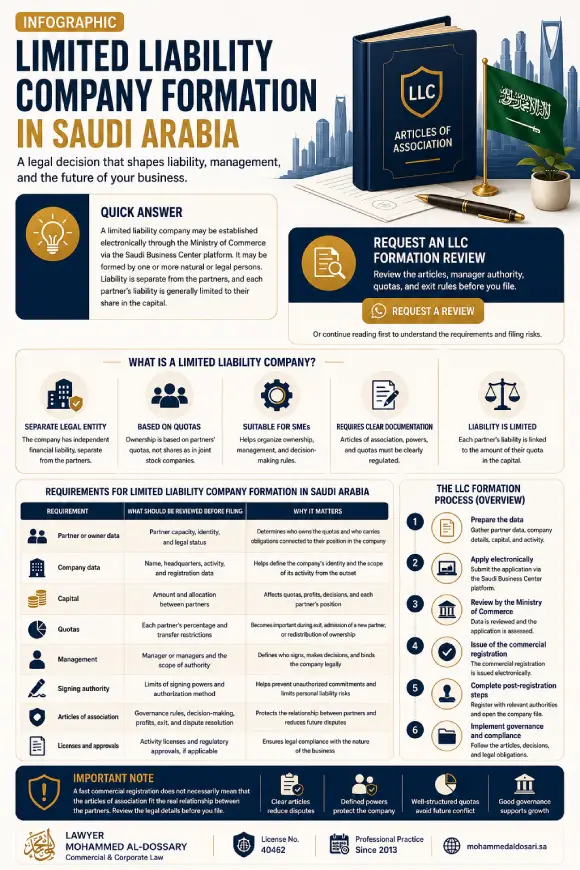
A limited liability company may be established electronically through the Ministry of Commerce via the Saudi Business Center platform. It may be formed by one or more natural or legal persons. This company is characterized by having financial liability separate from its partners or owner, while each partner’s or owner’s liability is generally limited to their share in the capital.
Preparing for Limited Liability Company Formation in Saudi Arabia but unsure whether the articles of association, manager authority, partner quotas, or exit rules are clear enough before filing? A focused professional review can help identify the legal points that may affect liability, signing powers, ownership transfer, and future partner disputes before the application is submitted.
Or continue reading first to understand the requirements and filing risks.
Preparing for Limited Liability Company Formation in Saudi Arabia and concerned that the articles of association or manager authority may later create disputes between partners? Reviewing quotas, powers, exit mechanisms, and transfer restrictions before filing can make the incorporation step clearer and reduce avoidable conflict.
Professional review before filing the incorporation application
Or continue reading the guide first to understand the requirements, risks, and practical considerations before making a decision.
This quick answer is not enough on its own. The online application addresses the filing process, while the legal effect appears in the articles of association, quota distribution, manager authority, transfer restrictions, and decision-making rules.
A company may be issued quickly when the data is complete, but weak articles of association may create a long dispute between partners after the business begins operating. Incorporation should therefore be treated as a combined process: an electronic filing procedure and a professional review of the corporate documents.
Professional note: a fast commercial registration does not necessarily mean that the articles of association fit the real relationship between the partners.
What Is a Limited Liability Company?
A limited liability company is a separate commercial entity based on partners’ quotas, not shares as in joint stock companies. Its main legal effect is that the company has independent financial liability, while a partner’s liability is generally linked to the amount of their quota in the capital.
This makes the structure suitable for many small and medium-sized businesses, as well as commercial relationships involving more than one party. It helps organize ownership, define management, identify quotas, and document decision-making rules.
However, the term “limited liability” does not mean that the articles of association are unimportant. It does not mean that the manager carries no responsibility, nor does it mean that a partner can ignore the obligations signed in the company’s name or for its benefit. Contracts, guarantees, management decisions, and separation between company funds and partner funds all remain important.
A limited liability company should therefore be understood as a legal structure that requires clear documentation, not as an automatic solution for every business. The type may be suitable, but poor regulation of the relationship between partners may turn it into a source of dispute.
Requirements for Limited Liability Company Formation in Saudi Arabia
The requirements for Limited Liability Company Formation in Saudi Arabia begin with identifying the parties to the company and reviewing its essential data before submission. It is not enough to know that the procedure is electronic, because every item entered in the application may later affect management, quotas, powers, and partner liability.
| Requirement | What Should Be Reviewed Before Filing | Why It Matters |
|---|---|---|
| Partner or owner data | Partner capacity, identity, and legal status | Determines who owns the quotas and who carries obligations connected to their position in the company |
| Company data | Name, headquarters, activity, and registration data | Helps define the company’s identity and the scope of its activity from the outset |
| Capital | Amount and allocation between partners | Affects quotas, profits, decisions, and each partner’s position |
| Quotas | Each partner’s percentage and transfer restrictions | Becomes important during exit, admission of a new partner, or redistribution of ownership |
| Management | Manager or managers and the scope of authority | Determines who signs, who represents the company, and when partner approval is required |
| Articles of association | Management, profits, losses, transfer, exit, and decisions | Serves as the practical reference during disputes or future amendments |
| Special licenses | Any approval or license connected to the business activity | Some activities require more than a commercial registration before actual operation |
If a partner is a natural person, their eligibility and legal capacity should be verified. If a partner is a legal entity, its legal status should be reviewed, including whether its commercial registration is active and not suspended or cancelled. If the business activity requires a license or preliminary approval, this must be addressed before assuming that incorporation alone is enough to start operations.
Capital and quotas are no less important than the rest of the data. A quota is not only a number in the application form. It affects profit allocation, decision-making, the partner’s position inside the company, and may later affect transfer or the admission of new partners.
Professional note: the larger the number of partners, or the broader the manager’s authority, the more important it becomes to review the articles of association before filing.
What Should Be Reviewed Before Filing the Application?
The following table highlights the main points that should be reviewed before submitting the application:
| Item | What Should Be Reviewed Before Filing |
|---|---|
| Partners | Number of partners, capacity of each partner, and legal status |
| Activity | Compatibility of the activity with required licenses or approvals |
| Capital | Amount of capital and method of quota distribution |
| Management | Manager or managers, scope of authority, and signing limits |
| Articles of association | Profits, losses, transfer, admission of partners, exit, and decisions |
| Outputs | Commercial registration, publication, and post-incorporation files with related authorities |
Articles of Association for a Limited Liability Company: The Most Important Document
The articles of association of a limited liability company regulate the relationship between partners. They define company data, capital, quotas, management, profit and loss distribution, transfer restrictions, and decision-making mechanisms.
Relying on a generic template may be suitable for some simple cases, but it is not always enough. A relationship between two partners where one provides funding and the other manages the business is not the same as a relationship between partners who are equal in funding and management. A family business with expansion potential is not the same as a limited venture between two parties.
The most important clauses to review include manager authority, signing limits, loans or significant obligations, profit distribution, quota transfer, admission of a new partner, exit of an existing partner, quota valuation, and decisions requiring partner approval.
Errors in these clauses usually do not appear on the day of incorporation. They appear when a partner wants to exit, when partners disagree over management, when the manager signs a major obligation, or when a new party enters the company.
Professional note: strong articles of association do not prevent every dispute, but they reduce ambiguity when a dispute occurs.
Partner Liability and Independent Financial Liability
A limited liability company is based on an important principle: the company has financial liability separate from its partners or owner. This means that the company is liable for its debts and obligations arising from its activity, while a partner is generally liable only to the extent of their quota in the capital.
This principle makes it important to distinguish between company assets and partner assets. Independent financial liability does not mean that transactions may be mixed without controls. Accounts, contracts, invoices, obligations, and financial decisions should reflect that the company is a separate entity.
This becomes especially important in debts, major contracts, financing, or personal guarantees. If a partner signs a personal guarantee for a company obligation, a separate effect may arise outside their position as a partner.
Limited liability should therefore not be understood as absolute protection against every obligation. The more accurate approach is that the company has independent financial liability, and the limits of liability must be read together with the law, the articles of association, the facts, and any special obligations signed by the partner or manager.
Company Management and Manager Authority
Company management is one of the most influential issues after incorporation. The manager conducts the company’s business and represents it within the limits set by the articles of association or partner decisions.
The practical problem begins when powers are granted too broadly without controls. A manager may need sufficient authority to run day-to-day operations, but this does not necessarily mean having sole authority over every major decision.
Powers that should be reviewed include signing on behalf of the company, opening bank accounts, contracting with third parties, borrowing or financing, selling assets, hiring employees, amending key contracts, and representing the company before authorities.
The articles of association should answer practical questions: may the manager sign alone? are there financial limits? when is partner approval required? how are decisions documented? and what happens if the manager exceeds their authority?
The clearer the written authority, the lower the risk of dispute. Very broad powers may seem convenient during incorporation, but they may become a point of conflict when the first major decision is made.
Quotas and the Admission or Exit of Partners
Quotas in a limited liability company represent the partner’s position in the capital. They affect profits, decisions, transfers, and exit. They should not be treated merely as numbers distributed between partners.
During incorporation, quotas should be defined precisely, including the capital value attached to each quota and their effect on profits, losses, and decisions. The articles may require special drafting if one partner contributes more funding, manages the business, or provides expertise or commercial relationships that materially affect the company.
Quota transfer is one of the most sensitive issues. The admission of a new partner is not merely a financial transfer. It may bring a new party into decision-making, management, and company information. The articles of association should therefore regulate transfer restrictions, partner pre-emption, valuation, and required procedures.
Partner exit requires even greater care. The dispute is not always about the principle of exit, but about quota value, payment timing, company continuity, and protection of confidential information and commercial relationships. The clearer the exit mechanism from the beginning, the more controlled the process becomes if disagreement arises.
Single-Person Limited Liability Company
A limited liability company may be owned by one person. This makes it an important option for someone who wants to operate through a separate legal entity rather than relying only on an individual structure. However, this option does not remove the need for proper organization.
In a single-person company, the focus is usually on clear management, separation between company funds and owner funds, documentation of decisions, and understanding post-incorporation obligations. Having one owner does not make the company a mere personal extension of that owner. It remains an entity with independent financial liability and its own obligations.
This structure may suit an individual business with expansion potential, or an activity where the owner wants to begin through a company and later allow partners or investors to enter. However, admitting partners later may require amendments to the articles, management structure, and quota distribution.
Professional note: a single-person company may simplify the start, but it does not remove the need to separate the owner’s decisions from the company’s decisions.
Difference between a Sole Establishment and a Limited Liability Company
The difference between a sole establishment and a limited liability company is not only a matter of name. A sole establishment is usually closer to its owner in terms of management and ownership, while a company creates a separate entity based on articles of association, quotas, management, and authority.
A sole establishment may be suitable for some simple individual activities, especially where there is no relationship between partners and no need to regulate quotas. However, where more than one party is involved, or where there is a plan to admit an investor, or where management, exit, and transfers must be organized, a company provides a clearer framework.
In a company, capital, quotas, manager authority, decision-making mechanisms, and quota transfers can be defined. A sole establishment does not usually provide the same structure for a multi-party relationship.
For a broader comparison between different legal structures, the article on Types of Companies in Saudi Arabia may be reviewed.
Fees and Duration for Limited Liability Company Formation in Saudi Arabia
The official service page displays the commercial registration fee, publication fee, and value-added tax, and indicates that the service may be completed instantly when the requirements are satisfied through the electronic channel. However, the official service page should be reviewed at the time of filing before relying on any figure, because fees or service details may change.
The practical duration may also be affected by completeness of data, the capacity of partners, the presence of a legal-entity partner, or a business activity requiring a license or preliminary approval. Even where the electronic process is fast, the founder may need more time if the data is incomplete or the activity requires a prior procedure.
Professional note: do not measure company readiness only by how quickly the commercial registration is issued. Readiness also depends on the articles of association, data, licenses, and related post-incorporation files.
Common Mistakes and Risks Before Filing
Choosing a limited liability company only because it is familiar. A common structure is not necessarily the suitable structure. It may fit one project and not another.
Relying on a generic articles of association template without reviewing it against the real relationship between partners. A generic document may complete the procedure, but it does not always answer the questions that appear later: who has signing authority? how is a quota valued? when does the manager need partner approval? how does a partner exit?
Many articles of association become weak because they do not regulate quota transfer or the admission of new partners. These issues may seem remote on the day of incorporation, but they appear during expansion, disputes, or investor entry.
A practical mistake is confusing electronic incorporation with legal review. The platform creates the entity, while professional review examines the effect of the data and documents on the relationship between partners.
The conclusion is that proper incorporation does not only mean completing the application. It means reducing the likelihood of disputes before the business begins.
When Is Professional Review Needed?
Professional review becomes important in Limited Liability Company Formation in Saudi Arabia when the decision involves more than one partner, a funding partner and a managing partner, broad manager authority, future investor admission, or the need to regulate partner exit and quota transfer.
Review is also important when converting an existing sole establishment into a company, when there is a legal-entity partner, when the activity requires a license, or when a family business needs to define the relationship between ownership and management.
Professional review does not mean complicating the procedure. It means reading the articles and data before submission and identifying points that may later become disputes. This includes manager authority, signing limits, quota valuation mechanisms, partner rights, and decision-making rules.
Company incorporation and the regulation of partner relationships fall within professional areas related to contracts, companies, and governance.
Professional Conclusion
Limited Liability Company Formation in Saudi Arabia is electronic in terms of filing, but it is a long-term legal decision in terms of consequences. A company does not begin with the commercial registration alone. It begins with the articles of association, management authority, quota distribution, and the regulation of partner entry and exit.
The right choice should not be based only on the fact that this company type is common or quick to register. It should be based on its suitability for the business nature, number of partners, size of obligations, and expansion plan.
The best starting point is not asking about the fastest way to incorporate. It is reviewing whether the articles of association, manager authority, quotas, and restrictions are sufficient to protect the company’s stability during disputes or expansion.
To understand the broader legal framework that includes the limited liability company, the article on Saudi Companies Law may be reviewed.
Frequently Asked Questions about Limited Liability Company Formation
What is Limited Liability Company Formation in Saudi Arabia?
Limited Liability Company Formation in Saudi Arabia is the process of establishing a separate commercial entity with its own financial liability, articles of association, capital, quotas, management structure, and commercial registration.
Who can establish a limited liability company in Saudi Arabia?
A limited liability company may be established by one or more natural or legal persons, subject to the requirements of the Saudi Companies Law and the applicable procedures through the relevant electronic platform.
What is the main advantage of a limited liability company?
The main advantage is that the company has financial liability separate from its partners or owner. In general, each partner’s liability is connected to the value of their quota in the company’s capital.
Why are the articles of association important before filing?
The articles of association define the relationship between partners, capital, quotas, manager authority, profit and loss distribution, quota transfer, partner exit, and decision-making rules. They become the main reference if a dispute arises later.
Can a limited liability company be owned by one person?
Yes. A limited liability company in Saudi Arabia may be owned by one person. This structure may suit a founder who wants to operate through a separate legal entity while keeping ownership under one person.
What should be reviewed before Limited Liability Company Formation in Saudi Arabia?
The key points include partner data, company activity, capital, quotas, manager authority, signing limits, transfer restrictions, exit mechanisms, required licenses, and the articles of association before filing.
Is commercial registration enough to start business activity?
Not always. Some activities may require additional licenses, approvals, or regulatory steps before actual operation. The founder should review the nature of the activity before assuming that commercial registration alone is sufficient.
How does manager authority affect a limited liability company?
Manager authority determines who may sign, represent the company, open bank accounts, enter contracts, borrow funds, hire employees, and make operational or major decisions. Broad powers without controls may create disputes between partners.
What are quotas in a limited liability company?
Quotas represent each partner’s ownership position in the capital. They affect profits, decisions, transfer rights, exit arrangements, and the admission of new partners or investors.
What is the difference between a sole establishment and a limited liability company?
A sole establishment is usually closer to its owner in ownership and management, while a limited liability company creates a separate entity based on articles of association, quotas, management powers, and a clearer corporate structure.
How long does it take to establish a limited liability company?
The electronic process may be fast when the requirements are complete, but the practical duration may vary depending on partner status, activity type, required licenses, legal-entity partners, and the completeness of the submitted data.
Official Sources: