Legal Content Review
Prepared and reviewed by:
Lawyer Mohammed Aboud Al-Dossary
Saudi-licensed lawyer — License No. 40462 — in legal practice since 2013.
Scope of review:
Saudi Personal Status Law, the Ministry of Justice explanation of the law, and the Saudi Evidence Law.
Last legal source review:
16 October 2026
This page focuses on establishing income, assessing the payer’s financial capacity, and reading financial records correctly. It does not explain how to file an alimony claim or establish a fixed percentage of maintenance.
Proof of income for alimony is not limited to identifying a salary figure. Under Saudi law, the payer’s financial capacity is relevant when maintenance is assessed, and the available documents may reveal employment income, returns generated by assets, or other relevant financial resources. At the same time, a bank transfer or ownership of an asset should not automatically be treated as income without evidence explaining its nature.
This is why this page serves a different purpose from pages that answer the question, “How much alimony is payable?” The aim here is not to calculate a percentage of salary or predict the amount of a court award. Instead, the analysis addresses an earlier question: What financial position can actually be established from the available documents?
This distinction becomes particularly important where income is irregular, several financial resources exist, bank activity differs from employment records, or a dispute arises over a business activity or property owned by the payer.
The more reliable approach is to connect each financial resource to the document that supports it, then determine the limits of that document before drawing any conclusion about financial capacity. This reflects the methodology adopted on this website of reviewing the facts and documents before reaching a legal conclusion.
Quick answer:
Proof of income for alimony involves building an evidence-based picture of the payer’s financial capacity rather than relying on salary alone. Employment records may be the starting point, but documented asset income, other resources, and relevant periodic obligations may also need to be considered. Each document must be read according to what it proves and what it cannot establish on its own.
What Does Proof of Income for Alimony Mean?
Proof of income for alimony means establishing the facts and documents that help identify financial resources relevant to the payer’s financial capacity. The purpose is not to reach a number by any available means, but to determine which financial resources are actually supported by evidence.
A resource may be salary from employment, a recurring return generated by an asset, another documented source of fixed income, or another financial resource supported by appropriate records.
Article 46 of the Saudi Personal Status Law provides that the assessment of maintenance takes into account the circumstances of the person entitled to maintenance and the financial capacity of the person required to provide it.
Income is therefore not separate from the maintenance claim. It is one of the factors that may help establish the payer’s financial capacity.
Two stages should nevertheless remain separate.
The first is establishing financial resources: what can actually be proved about the payer’s income and financial means?
The second is assessing the amount of maintenance: that stage considers the circumstances of the person entitled to maintenance, the payer’s financial capacity, and the other legally relevant factors.
The Payer’s Financial Capacity Is Broader Than Salary
When examining proof of income for alimony, the payer’s financial capacity should not automatically be reduced to one salary figure.
The Ministry of Justice Research Center’s explanation of Article 46 gives useful practical meaning to this concept. It refers to fixed income, including income generated from fixed and movable assets, and also refers to periodic obligations borne by the payer.
The official explanation can be reviewed through the Saudi Ministry of Justice explanation of the Personal Status Law.
This prevents financial capacity from being reduced to one category.
Salary may be the principal financial resource in one case. In another case, separate records may establish rental income or another recurring financial resource.
Financial capacity does not, however, mean adding the value of everything the payer owns and describing the total as income.
An asset that has not been shown to generate a return is different from the income produced by that asset. Likewise, the capital value of real estate is different from rental income generated by that property.
Analytical rule:
Financial capacity is not the same as salary alone, but neither is it the total value of the payer’s assets. A more accurate analysis identifies the resources, returns, and relevant obligations supported by the documents and separates ownership of an asset from income generated by that asset.
What Does Each Financial Document Prove and What Are Its Limits?
In proof of income for alimony, the value of a document depends on the fact it can establish, not simply on the document’s title.
A salary certificate has a different evidentiary function from a bank statement. Likewise, the existence of a commercial registration is different from evidence showing how much income actually reaches the owner of the business.
The Saudi Evidence Law sets general rules concerning the relevance of facts to a dispute and the assessment of evidence where different items of evidence are considered together or appear to conflict.
A single financial record therefore should not automatically be treated as proof of the payer’s entire financial capacity.
Salary Certificates and Employer Records
A salary certificate is one of the most direct records where the payer is employed. It may help establish the employment income recorded by the employer and the salary components expressly stated in the document.
Its evidentiary value, however, remains limited to what the document actually contains.
If it identifies only employment salary, the absence of another resource from that certificate does not by itself prove that no other financial resource exists.
The reverse is also true. Allowances, commissions, bonuses, or other payments should not be assumed where no evidence establishes their existence.
Bank Statements and Account Activity
A bank statement, where it forms part of the evidence in accordance with the applicable procedures, may reveal patterns in financial activity such as recurring deposits, periodic transfers, and sources that appear regularly.
The total amount deposited into an account is not automatically equal to income.
A payment may represent a loan, proceeds from selling an asset, a transfer between accounts belonging to the same person, repayment of a previous amount, or another transaction that does not recur.
The more useful questions are:
Where did the money come from? Why was it paid? Does it recur?
Business Activity and Income Generated by Assets
When assessing proof of income for alimony, a commercial registration may establish the existence of a registered business activity. It does not, by itself, determine the payer’s personal profit.
Substantial amounts may move through a business account as business revenue and expenditure without those amounts being equivalent to the owner’s personal income.
The same distinction applies to real estate and other assets.
Ownership of property establishes the existence and ownership of the asset. Treating that property as an income source requires evidence connecting it to an actual return, such as a lease, financial records, or another document appropriate to the nature of the resource.
| Document | What it may help establish | What it does not establish on its own |
|---|---|---|
| Salary certificate | Employment income and the salary components stated in the document | That no other financial resource exists |
| Bank statement | Financial activity, transfer sources, and recurring patterns | That every deposit is new or net income |
| Commercial registration | Existence of a registered economic activity | The owner’s personal profit from that activity |
| Proof of asset ownership | Existence and ownership of the asset | That the asset generates income or the amount of any return |
| Lease or income document | A specific financial resource within the scope of the document | That the resource will continue if it is temporary or exceptional |
| Admission | Matters admitted by the person within the scope of the admission | Facts or resources not covered by that admission |
How Should Variable Income and Conflicting Financial Records Be Read?
Some of the most difficult issues in proof of income for alimony arise where there is no stable financial picture: a self-employed professional, a business owner, income that changes from month to month, or bank activity that does not appear to match salary records.
In these situations, the answer is not to select the highest figure shown in the documents or the lowest one.
The more important questions are whether the resource is recurring and independent, whether it belongs to the payer personally, and whether the amount represents actual income rather than financial movement for another purpose.
Irregular Income Should Not Be Measured by the Highest Month
Business income may rise in one period and fall in another. A business account may also receive revenue that does not all become a personal financial resource for the owner.
The Saudi Personal Status Law does not establish a fixed mathematical formula for converting business activity into assumed monthly personal income.
A more evidence-focused analysis therefore looks for a pattern that can actually be established: recurring resources, distributions, regular transfers to a personal account, asset income, or another recurring source supported by documents.
This avoids turning an exceptional financial event into a permanent income figure.
This article does not expand further into irregular income so that this distinct search intent can remain available for a dedicated analytical article within the same content cluster.
A Difference Between Salary and Bank Activity Requires Explanation, Not Addition
If a salary certificate shows one figure while additional transfers appear in the account, the difference does not by itself establish “hidden income.”
It may indicate that another financial resource should be examined, but the funds must first be connected to their source and nature.
Three elements are especially useful:
source, frequency, and nature.
A recurring monthly transfer from an identifiable source is different from a one-time deposit resulting from the sale of an asset. Both are different again from moving the same money between accounts belonging to the same person.
Practical rule:
When bank activity differs from salary records, do not begin by adding the difference to income. First determine the source and nature of each recurring amount, then assess whether it represents an independent financial resource or merely financial movement that creates no new income.
What Does Not Become Income Simply Because It Appears in the File?
When assessing proof of income for alimony, careful financial analysis serves an important purpose: preventing conclusions that go beyond what the evidence actually establishes.
Some facts, assets, or transactions may justify further examination without establishing a specific amount of income on their own.
A loan:
Money entering an account does not become a recurring financial resource merely because it appears as a deposit where the amount represents an obligation that must be repaid.
Sale of an asset:
The proceeds from selling real estate, a vehicle, or another asset may explain a substantial one-time deposit, but they do not establish fixed monthly income.
Transfers between accounts:
Moving money between accounts linked to the same person does not create new income each time the funds move.
Mere ownership of an asset:
Ownership of property, shares, or another asset does not establish income unless evidence shows that the asset produces a return.
Lifestyle alone:
Lifestyle may justify asking additional questions, but it does not automatically become a verified income figure.
The same approach applies to financial obligations.
The Ministry of Justice explanation refers to periodic obligations when discussing financial capacity, but this does not create a formula under which every debt or loan must automatically be deducted from income.
The obligation should first be established, together with its recurring nature, character, and relevance to the financial position being reviewed.
This issue remains deliberately limited here so that a future page addressing the effect of debts and periodic obligations on financial capacity can retain its own search intent.
How Can Financial Information Held by a Public Authority Be Requested?
A practical issue in proof of income for alimony may arise where a useful financial record is held by a public authority or is not in the possession of the party who needs it.
Saudi Evidence Law provides a more structured route than filling the evidentiary gap through assumptions.
Subject to the statutory requirements, the court may request a document or certified copy from a public authority where a party is unable to obtain it. Relevant information may also be requested from a public authority in accordance with the applicable rules.
The Ministry of Justice explanation of the Evidence Law indicates that the request should identify the document sought, explain why it could not be obtained directly, show its connection to the case, and identify the fact intended to be established.
This point is important. Financial information is not relevant merely because it exists. It should relate to a material issue in the dispute and serve a defined evidentiary purpose.
The Evidence Law also permits the court to appoint one or more experts where resolving an issue requires technical expertise.
This is consistent with the Ministry of Justice explanation of the Personal Status Law, which refers to expert assistance when assessing maintenance where the parties have not agreed on a specific amount.
Expert opinion does not replace the court’s authority. Under the Evidence Law, an expert’s opinion does not bind the court, and where the court does not adopt all or part of it, the reasons must be addressed in accordance with the applicable rules.
Important evidentiary point:
If a financial document is not in the party’s possession, the question is not only “How can I obtain it?” It is also: What fact will the document establish? How is that fact connected to the dispute? Why could the document not be obtained directly? Defining these points gives the requested evidence a clearer legal purpose.
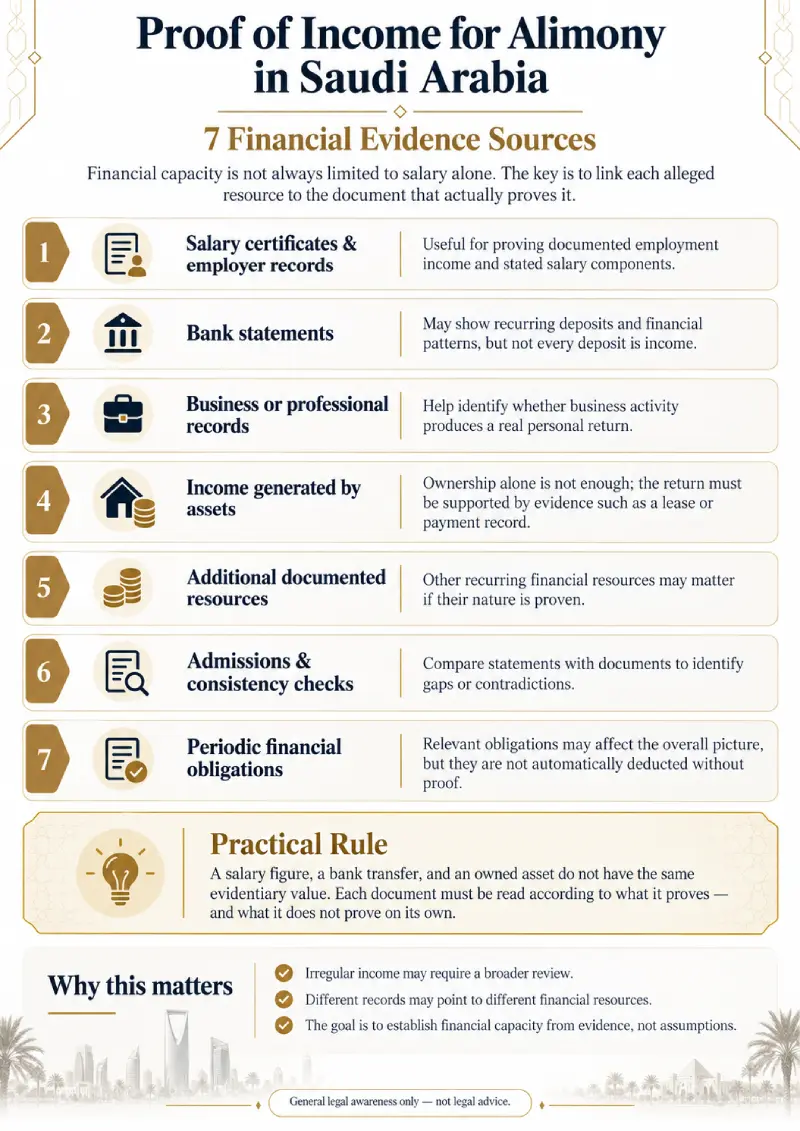
7 Financial Evidence Sources That Help Establish Financial Capacity
These are not seven mandatory legal requirements, nor must all seven exist in every case.
They are a practical framework for organising proof of income for alimony according to the circumstances of the case and the evidence actually available.
- Employment and salary records:
These show documented employment income and the salary components stated in the relevant record. - Relevant bank activity:
This may reveal patterns and sources of financial inflows, while loans, internal transfers, and exceptional amounts should be separated from actual income. - Business or professional records:
These may help connect business activity to an actual return rather than equating the existence of a commercial registration with income. - Income generated by assets:
These records may establish returns from property or another asset where the evidence connects ownership to an actual financial resource. - Documented additional resources:
These may include a recurring independent financial resource outside employment salary whose nature can be identified from the documents. - Admissions and comparison between records:
These may reveal differences between what a party states and what the documents show, without assuming the conclusion before the inconsistency is explained. - Evidence of periodic obligations:
These documents may help complete the picture of financial capacity where a relevant recurring obligation is established, without automatically treating it as a mathematical deduction from income.
| Question | Most relevant evidence | Error to avoid |
|---|---|---|
| What is the payer’s employment income? | Salary certificate or employer records | Assuming it represents all financial resources without further review |
| Are there other financial resources? | Records showing the resource or related transfers | Relying on assumption rather than evidence |
| Does a business generate income for the payer? | Relevant return or distribution records | Equating business registration with personal profit |
| Does an asset generate a return? | A document showing actual income from the asset | Equating ownership with income |
| Is a financial obligation relevant? | Evidence of the obligation and its recurring nature | Automatically deducting every debt from income |
A Quick Test Before Relying on Any Financial Record
Before relying on any document as proof of income for alimony, ask four questions:
- What fact does the document actually establish?
- Is the financial resource recurring or exceptional?
- Does the money belong personally to the payer, or does it belong to a separate business activity?
- What conclusion can this document not establish on its own?
These questions reduce the risk of turning financial information into a conclusion that exceeds the evidentiary value of the document
Frequently Asked Questions About Proof of Income for Alimony
Is a Salary Certificate Enough to Establish the Payer’s Full Income?
Not necessarily. A salary certificate may provide direct evidence of the employment income stated in it, but its scope depends on its contents. If other financial resources are independently documented, they may also be relevant to the payer’s financial capacity.
What If the Payer Has No Fixed Salary?
The analysis shifts toward the financial resources that can actually be established. Business returns, recurring transfers, professional income, or income generated by assets may become more relevant where supported by evidence. The absence of a salary certificate does not itself establish either financial capacity or inability to pay.
When Can a Bank Statement Help Establish Additional Income?
A bank statement becomes more useful when recurring amounts can be connected to an identifiable financial source. A total amount of deposits exceeding salary does not, by itself, establish additional income because the account may include loans, internal transfers, asset-sale proceeds, or other non-recurring amounts.
Does a Commercial Registration Prove How Much the Payer Earns?
No. A commercial registration may establish the existence of a registered business activity, but it does not by itself establish the owner’s personal profit. Its evidentiary value becomes stronger when other records show that the business generates an actual return received by the payer.
If Bank Transfers Exceed the Declared Salary, Does That Prove Hidden Income?
Not necessarily. The difference may justify further examination, but it does not by itself establish concealed income. The source of the transfers, their frequency, and whether they represent an independent financial resource should be identified before reaching a conclusion.
When Does Proof of Income for Alimony Require More Detailed Financial Review?
A more detailed review may be useful where there are several income sources, irregular self-employment or business income, significant differences between salary records and banking activity, disputes over income generated by assets, or inconsistencies between a party’s statements and the financial documents.
Conclusion: Start With the Evidence, Not the Income Figure
Proof of income for alimony should not become an exercise in automatically adding salary, bank deposits, business activity, and assets into one assumed financial figure.
Saudi family law makes the payer’s financial capacity relevant to the assessment of maintenance, while the official explanation indicates that the analysis may extend to fixed income, income generated by assets, and relevant periodic obligations.
The strength of the financial file lies in connecting each financial resource to the document capable of establishing it.
A salary certificate establishes what it records about employment income. A bank statement reveals financial activity that may still require explanation. A commercial registration establishes business activity but does not independently determine the owner’s personal profit. Ownership of an asset is different from evidence that the asset generates income.
The most useful starting point is therefore to build a clear financial map:
Identify the financial resource → identify the supporting document → define what the document proves → identify the limits of its evidentiary value → explain any inconsistency with other evidence.
This approach keeps proof of income for alimony closer to established facts and further away from assumptions.
About the Author
Lawyer Mohammed Aboud Al-Dossary is a lawyer licensed in the Kingdom of Saudi Arabia under License No. 40462 and has been in legal practice since 2013.
Professional licensing information can be reviewed through the Licensing and Membership page.
You can also review the lawyer’s professional areas of practice through Practice Areas and Professional Interests.
Disclaimer:
This content is provided for general legal information only. It does not constitute an assessment of any particular alimony claim or financial document, does not constitute legal advice, and is not a substitute for reviewing the specific facts, documents, applicable legal provisions, and procedures of an individual case. Reading this content does not create a lawyer-client relationship.