Trademark Renewal is an important step for keeping brand protection active in Saudi Arabia. A trademark is not only a name or logo. It is a business asset connected to reputation, customer trust, and market recognition.
For that reason, the renewal date should not be treated as a routine administrative deadline. It should be part of how a business manages its intellectual property.
Renewal becomes more important when the mark is used on active products, linked to a marketing campaign, licensed to another party, used in a franchise arrangement, or connected to business expansion. In these cases, the owner should not only know that the mark is registered. The owner should also know when protection expires, whether the owner’s details are correct, and whether the registered classes still match the business activity.
For the broader framework of registration, protection, and related rights, you may review Trademark in Saudi Arabia. This article focuses only on renewal before expiry and the possible effects of late action.
Quick Answer: When Should a Trademark Be Renewed?
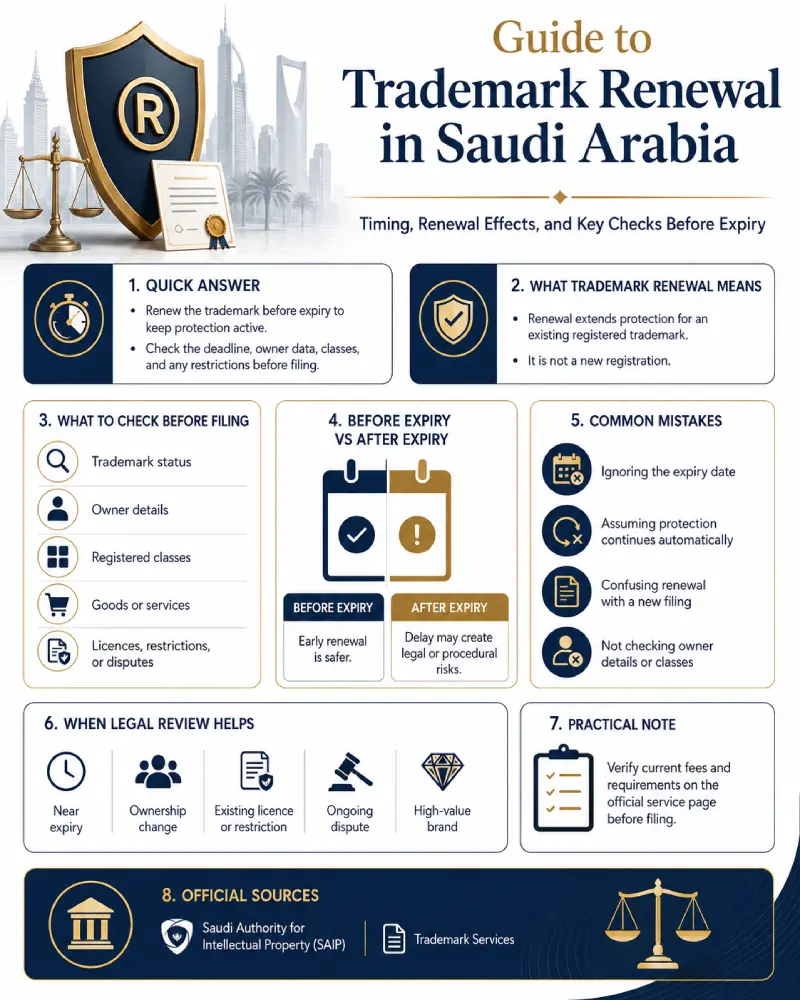
A trademark owner who wants to keep protection active should monitor the renewal date during the final year of the protection term. Saudi trademark rules also allow renewal within the period following expiry, subject to the applicable requirements and procedures.
Is your trademark close to expiry, or are you unsure whether your brand protection is still active in Saudi Arabia? A focused renewal review can help you check the expiry date, owner details, registered classes, official requirements, and any licences, restrictions, or risks before filing.
Prefer to understand the renewal rules first? Continue reading the guide.
Trademark protection generally runs for ten years and may be renewed for similar periods. Waiting until the last moment is not a sound practical approach, especially when the mark is commercially valuable or widely used in the market.
Early review before filing helps the owner check three key points: the status of the mark, the owner’s details, and the registered classes, goods, or services. It also helps identify any licence, restriction, or dispute that may affect the renewal process.
What Does Trademark Renewal Mean?
Trademark Renewal is the procedure used to continue protection for an already registered trademark. It keeps the protection active when renewal is completed according to the official requirements.
It is important to distinguish renewal from registration. Registration creates protection for a new trademark after examination and approval. Renewal applies to a trademark that is already registered and focuses on keeping the existing protection in force.
Renewal does not automatically change the trademark design, add new classes, or transfer ownership to another person. These matters may require separate procedures. A trademark owner should not treat renewal as a way to change the substance of the mark or expand its scope without reviewing the official process.
The practical value of renewal becomes clear when the mark is actually used in the market. Customers recognize products or services through it. Competitors may monitor its status. Commercial partners may also request proof that protection remains active before entering into distribution, licensing, or franchise arrangements.
Trademark Protection Period and Why It Should Be Monitored
The trademark protection period is the period during which the owner benefits from legal protection for the registered mark. Monitoring this period is not a formality. It is part of risk management for any business that relies on its brand.
Trademark rules applicable in Saudi Arabia provide that protection lasts for ten years and that the owner may request renewal if continued protection is required. This makes the expiry date one of the most important details that should not be left to memory or informal follow-up.
| Item | What Should Be Reviewed? | Why It Matters Before Renewal |
|---|---|---|
| Filing or registration date | The date recorded in the trademark data | Helps estimate expiry and plan renewal follow-up |
| Expiry date | The last date shown in the official record or service | The main risk point if renewal is delayed |
| Classes | The class or classes covering the goods or services | Defines the scope of protection and should not be assumed to cover new activities |
| Owner | The person or entity recorded as the owner | Any change in ownership or details may need to be addressed before filing |
| Restrictions and licences | Any licence, restriction, or visible dispute | May affect trademark management or the need for legal review |
| Trademark status | Registered, close to expiry, expired, or under procedure | Determines the practical path before filing |
This review helps the business owner, legal manager, or adviser understand the file before taking action. A successful renewal does not begin with payment. It begins with reading the trademark status and confirming that the data still matches the current business position.
What Happens If Trademark Protection Expires?
If protection expires and no proper action is taken, the owner’s legal position may become weaker. The ability to maintain effective protection may also become more difficult, especially if the additional period allowed for renewal passes without filing the request.
Saudi trademark rules allow the owner to renew within a specified period after expiry. They also provide that the competent authority may remove the mark from the register if that period passes without a renewal request. For this reason, expiry should not be treated as a minor issue that can be handled at any time.
The practical effect is not limited to the trademark register. A company using the mark on products, stores, advertising, or commercial documents may face risks connected to weaker protection, disruption in contracts, or the need for urgent action before launching a product or signing an agreement.
At the same time, expiry does not always lead to one automatic outcome in every dispute. Each file must be reviewed based on the trademark status, expiry date, actions taken, actual use, licences, restrictions, and any existing disputes. Legal review becomes more important when the mark has commercial value or wide market use.
Trademark Renewal Before and After Expiry
Trademark Renewal before expiry is usually the more stable practical path. Waiting until after expiry makes the file more sensitive in terms of time, cost, and procedural risk.
The first path is renewal during the final year of protection. This gives the owner time to prepare documents and review the file before the registration period ends. This is especially useful when the mark is linked to an online store, a distribution agreement, a licence, or a marketing campaign that cannot tolerate uncertainty around protection.
The second path is renewal during the period following expiry. The Saudi Authority for Intellectual Property’s renewal service distinguishes between renewal during the final year of protection and renewal within the period after expiry, in addition to publication fees. The owner should therefore avoid leaving the matter to this stage unless there is a clear practical reason.
From a risk-management perspective, early renewal reduces time pressure. It gives the owner an opportunity to correct issues in data, authorization, or trademark status before timing becomes a problem. This is more important for marks with high commercial value or marks used in active advertising and product lines.
What Should Be Checked Before Filing a Renewal Request?
Before filing the request, the owner should review the trademark status, recorded details, and scope of protection. The process may look simple, but an error in ownership details or an ignored restriction may turn the renewal into a file requiring further action.
Before filing, a Trademark Search can help confirm the mark’s status, ownership data, and registered classes. That internal link supports the search and verification intent, while this article remains focused on renewal and the effects of expiry.
Owner Details and Trademark Status
The first point to review is the owner’s name, legal capacity, and recorded details in the trademark register. If the business structure has changed, if a merger occurred, or if the mark was transferred to another owner, the renewal request should not ignore that change.
A mismatch between the actual business position and the trademark record may create confusion in managing the file. The owner should confirm the trademark number, status, owner name, and representative or agent details before filing.
Registered Classes, Goods, and Services
Classes define the scope of protection. The owner should review the goods or services covered before renewal, especially if the business has expanded during the previous years.
Renewal does not mean that every new activity is automatically protected. If the mark was registered in one class and the business later expanded into new goods or services, a separate procedure may be needed to extend protection or file a new application in another class, depending on the official requirements.
Restrictions, Licences, and Existing Disputes
The mark may be subject to a licence, restriction, dispute between partners, or claim by a third party. These situations do not always prevent renewal, but they make the file more sensitive and require document review before filing.
A licensed mark requires checking the licence terms, duration, and scope. A disputed mark requires review of the dispute and its effect on future trademark management. If ownership has changed, the owner should confirm that the transfer has been completed and that the record has been updated before relying on any later procedure.
Trademark Renewal Procedures Before the Competent Authority
Trademark Renewal is filed through the official trademark services of the Saudi Authority for Intellectual Property. The applicable channel may depend on the filing date and the service route available for the mark.
The renewal service page explains that the unified intellectual property platform applies to certain trademark services, while other marks may continue through the service link assigned to them. For this reason, the applicant should not rely on unofficial links or outdated explanations.
In practical terms, the process begins with identifying the mark to be renewed, reviewing the requirements and attachments, filing through the official channel, paying the required fees, and then following the request until completion. If the application is filed by a representative, an appropriate power of attorney or authorization may be required.
The more important point is that the request should not be filed before reviewing the file. Correcting an issue in owner details, authorization, or trademark status before filing is usually easier than discovering it after the official process has started or after the deadline has become close.
Trademark Renewal Fees and How to Verify Them
Trademark Renewal fees should be taken from the official service page at the time of filing. Relying on circulated or outdated figures may lead to an inaccurate cost estimate.
According to the renewal service of the Saudi Authority for Intellectual Property, the page refers to fees for renewal during the final year of protection, different fees for renewal within the period after expiry, and publication fees. These figures should be checked directly from the official page before making a decision or issuing a cost estimate to a client.
The official fees and amounts are determined according to the service page at the time of filing. It is therefore not advisable to rely on informal figures without checking the official source.
From a practical perspective, a business should not view fees as a separate administrative cost only. They are part of protecting an intangible asset connected to sales, reputation, and contracts. Late renewal may therefore cost more than the fee difference, because it can raise questions about the stability of protection and the continued use of the mark.
The Link Between Renewal, Assignment, and Licensing
Trademark renewal may intersect with assignment or licensing, but it does not replace either procedure. Each procedure has its own purpose, effect, and documents.
If the trademark owner has changed before the renewal date, the parties should confirm that the Trademark Assignment has been completed and that the record has been updated, so that no issue appears in the applicant’s details. If the mark is licensed to another party, the licence agreement should be reviewed to understand its duration, scope, and whether continued protection is a contractual requirement.
In franchise, distribution, or trademark licensing arrangements, the other party may ask for evidence that protection remains active before signing or renewing the contract. In this context, renewal becomes part of managing the commercial relationship, not just an electronic filing step.
A pledge, restriction, or dispute may also affect how the file should be handled. In these situations, the application should not be filed in isolation from the documents, because the technical procedure should match the actual legal status of the mark.
Common Mistakes When Renewing Trademarks
Most renewal errors do not result from the difficulty of the process. They result from assuming that protection continues automatically or that trademark data does not need review.
- Ignoring the expiry date: relying on memory or an outdated internal file may cause an important deadline to be missed.
- Confusing renewal with registration: renewal continues existing protection and does not create a new mark or add classes automatically.
- Neglecting owner details: changes in the entity, name, or representative may affect the process if not addressed.
- Failing to review classes: the mark may be protected in a class that does not cover a new activity launched by the business.
- Relying on circulated fees: the official service page should always be checked.
- Ignoring licences and restrictions: a licence, dispute, or restriction may affect how the file is handled.
- Confusing it with commercial registration: trademark renewal is not the same as commercial registration renewal. Each has a different purpose and legal framework.
These errors can usually be avoided through a simple review before filing, especially for marks that have clear commercial value or are connected to clients, distributors, or licensees.
When Do You Need Legal Review Before Renewal?
You need legal review before renewal when the mark is more than a registered name. This is the case when it is linked to commercial value, a dispute, a contract, or a change in ownership.
Review becomes especially important if the expiry date is close and the file status is unclear. It also matters if the mark is used in a competitive market, appears on active products, or is part of a licence, franchise, or distribution agreement.
Legal review is also important if ownership has changed, the business structure has changed, or there is a dispute between partners, an objection, or a third-party claim. In these situations, the question is not only “how do I renew?” but also “is the mark ready for safe renewal, and what document should be corrected before filing?”
A proper legal review does not repeat what appears on the service page. It reviews the mark in light of actual use, the current owner, the classes, restrictions, and potential risks after renewal.
This article is prepared for legal awareness regarding Trademark Renewal in Saudi Arabia. It focuses on the protection period, renewal timing, owner details, classes, restrictions, licences, and possible effects of late action. It does not replace reviewing the trademark file and supporting documents in practical cases.
Licence No.: 40462
Last updated: August 2026
Frequently Asked Questions About Trademark Renewal
When Should You Start Thinking About Trademark Renewal?
The practical review should begin well before the protection period expires, so the trademark status, owner details, classes, and restrictions can be checked before filing the request.
What Does Trademark Renewal Mean?
It is a procedure intended to keep a registered trademark protected according to the official requirements. It is not a new registration for a different mark.
What Is the Difference Between Registration and Renewal?
Registration creates protection for a new trademark after examination, while renewal keeps an existing registered trademark protected within its current registered scope.
How Can I Know the Trademark Expiry Date?
The expiry date can be checked through the trademark data, the registration certificate, or the official trademark status inquiry service of the competent authority.
What Happens If Renewal Is Delayed?
Delay may complicate the continuation of protection or weaken the owner’s position, especially if the prescribed periods expire without filing the request.
What Is the Grace Period After Registration Expires?
Trademark law allows the owner to renew the registration within the six months following expiry, subject to the applicable requirements and procedures.
How Much Are the Renewal Fees?
The Saudi Authority for Intellectual Property’s renewal service page lists the renewal fees according to the timing of the request and publication fees, so they should be checked at the time of filing.
What Should Be Checked Before Filing?
The owner should check the trademark status, owner details, classes, goods or services, licences, restrictions, and any existing or potential dispute.
Does Renewal Allow Adding New Classes?
Renewal relates to continuing protection for the registered trademark. Adding classes or expanding the scope of protection may require a separate procedure.
Can a Change in Owner Details Affect Renewal?
It may affect renewal if the trademark register details are not updated or do not match the current position. They should therefore be reviewed before filing the request.
Legal Conclusion
Trademark renewal is not a formal step only. It is a way to protect an intangible asset that may represent an important part of the business’s value and market reputation.
An owner who monitors the protection period early is in a better position than an owner who waits until expiry and then looks for an urgent solution. Early review reveals the mark’s status, owner details, classes, restrictions, licences, and any dispute that may affect the request.
If the mark is linked to an active product, a marketing campaign, or a licence agreement, do not delay review of the renewal date. Checking the file before expiry reduces the risk of disruption and dispute, and makes the process part of organized legal management rather than late corrective action.