Understanding the Saudi Companies Law helps founders, partners, and managers assess the legal impact of choosing a company structure before incorporation and during management. A company is not merely a commercial registration; it is a legal entity with a specific form, financial liability, management powers, and obligations that become important during growth, disputes, restructuring, or liquidation.
The importance of the new Saudi Companies Law lies in the fact that it regulates the company’s lifecycle: choosing the legal form, preparing the articles of association or bylaws, managing the company, documenting decisions, and defining the liability of partners, shareholders, managers, and directors. Reviewing the law before signing company documents is not a theoretical step. It is a practical legal measure that may reduce future risks.
This guide provides a general legal overview of the Saudi Companies Law. It does not replace reviewing the facts, contracts, corporate documents, and decisions of each specific case.
Quick Answer: What Is the New Saudi Companies Law?
The new Saudi Companies Law is the legal framework that regulates the incorporation, forms, management, partner and manager liability, transformation, merger, and liquidation of companies in Saudi Arabia. Its importance is not limited to registration. It also affects internal decision-making, the scope of managerial authority, partner rights, and the liability of each party when obligations or disputes arise.
Planning to incorporate, amend, or manage a Saudi company but unsure which structure, liability limits, or authority rules apply? A focused review of the company type, articles of association, bylaws, management powers, and partner liability can help you move forward with clearer legal footing before signing, filing, or making a major company decision.
Or continue reading first to understand company types, liability, and management rules.
Thinking of incorporating a company or amending its articles before understanding liability and authority limits? Reviewing the company type and constitutional documents before taking action helps clarify the legal impact and reduces the risk of future disputes between partners or operational complications.
Professional guidance on Saudi Companies Law
You may continue reading the article first if you prefer to understand company types, liability, and management rules before seeking professional review.
In practice, the law matters before incorporation in three main areas. First, selecting the appropriate company type, because a general partnership differs significantly from a limited liability company or a joint stock company in terms of liability. Second, drafting the articles of association or bylaws, because weak documentation may create disputes over exit rights, share transfers, profit distribution, and management powers. Third, company management, because the manager’s name in the commercial register or constitutional document is not merely formal; it may carry legal authority, obligations, and financial consequences.
What Is the Saudi Companies Law?
The Saudi Companies Law is the legal framework that determines how companies are established, which legal forms they may take, how they are managed, what documents govern their relationships with partners and third parties, and how they may be amended, transformed, dissolved, or liquidated.
In practical terms, the law connects a business idea to a legally recognized entity capable of contracting, operating, assuming obligations, and being held accountable.
The law does not stop at incorporation. It covers the full corporate lifecycle: selecting the company form, preparing constitutional documents, registering company data, managing the entity, issuing decisions, regulating relations between partners or shareholders, handling transformation or merger, and addressing dissolution or liquidation when required.
It is often referred to as the new Saudi Companies Law because it replaced the previous legal framework and was introduced within a more modern regulatory environment aimed at facilitating incorporation, supporting business continuity, enabling expansion, and improving the investment environment in the Kingdom. It addresses traditional companies, startups, family businesses, and more flexible corporate management structures.
The primary source is the official text of the law published by the Bureau of Experts. The Ministry of Commerce and other relevant official authorities provide regulatory and procedural guidance for services related to company incorporation, amendment of company data, and corporate documentation. When writing or relying on legal content about this subject, it is important to distinguish between the statutory text itself and procedural services or electronic forms.
Why Should You Understand the Companies Law Before Incorporation?
Understanding the Saudi Companies Law before incorporation helps avoid decisions that may look simple at the beginning but become significant later. One common mistake is starting with the commercial registration or trade name before understanding the legal form, the scope of liability, management powers, and the mechanism for partner entry or exit.
Choosing the company type is not a formal step. If partners choose a general partnership, the liability structure may differ significantly from a limited liability company or joint stock company. Similarly, decision-making in a small company managed by one manager is not the same as decision-making in an entity that requires a general assembly, a board, or detailed bylaws.
The articles of association are not a routine document used only to complete incorporation. They regulate the relationship between partners, define capital, shares or quotas, management, authority, transfer restrictions, profit distribution, and exit mechanisms. The more generic or unclear this document is, the higher the likelihood of disputes when the first disagreement arises.
Management also begins before the commercial registration is issued, not after. It should be clear who the manager is, what powers the manager has, when partner approval is required, how decisions are documented, and what happens if a manager acts outside the granted authority. These questions may not appear important on the date of incorporation, but they become critical during contracting, financing, disputes, or liquidation.
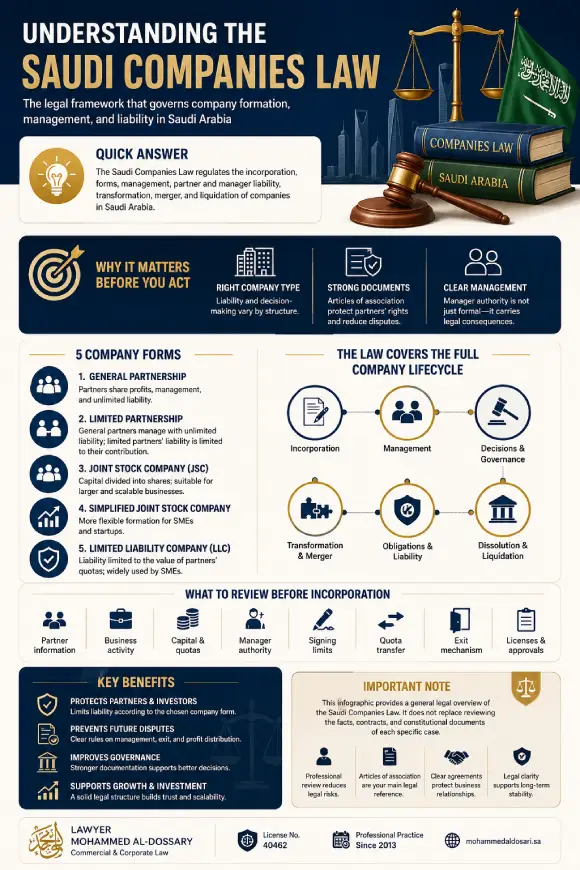
Types of Companies under Saudi Law
The Saudi Companies Law identifies the legal forms that a company may take in the Kingdom. Understanding types of Companies in Saudi Arabia is essential because the chosen structure affects liability, management, the transfer of shares or quotas, governance, and continuity of the legal entity.
| Company Type | General Concept | Practical Impact |
|---|---|---|
| General Partnership | Often based on personal trust between partners | Partner liability may be broader than in other forms |
| Limited Partnership | Combines general partners and limited partners | Partners may have different legal positions and liability levels |
| Limited Liability Company | Common for small and medium-sized businesses | Liability is generally linked to the partner’s capital contribution, subject to the law |
| Joint Stock Company | Suitable for larger businesses and more structured governance | Based on shares, assemblies, boards, and governance rules |
| Simplified Joint Stock Company | A more flexible form for management and organization | May suit modern business models when requirements are met |
| Holding and Subsidiary Companies | Used for structuring, ownership, and control over other companies | Helpful for expansion and organizing activities or investments |
How the Company Type Affects Partner Liability
The most important question before forming any company is: how far can partner liability extend? This question comes before the trade name, before the business activity, and sometimes even before capital.
In some company forms, liability is generally linked to what the partner contributes in quotas or shares, subject to the law and constitutional documents. In other forms, liability may be broader, particularly where the company is built on the personal relationship and trust of the partners. For this reason, the word “company” alone is not enough to understand the level of protection or risk.
Liability becomes important in practical situations such as debts, contracts, insolvency, partner disputes, admission of a new partner, exit of an existing partner, or a manager acting beyond the agreed authority. In these situations, parties do not rely on the trade name alone. They refer to the company type, articles of association, managerial powers, and documented decisions.
The company form must therefore be read together with the governing documents. For example, where partners have a strong personal relationship, a general partnership may appear suitable from a trust perspective, but it requires a deeper understanding of liability. If the objective is to reduce exposure to personal liability, limited liability structures or share-based structures may be more appropriate, provided the partners comply with the law, documentation requirements, and the separation between the company’s assets and the partners’ personal assets.
Articles of Association and Company Bylaws
The articles of association and bylaws are not merely documents attached to an incorporation application. They define the company’s internal structure and help determine powers, rights, and obligations during management, amendments, disputes, and exit situations.
The articles of association usually focus on basic company data and the relationship between partners: the company name, purpose, capital, quotas, management, company term when applicable, profit and loss distribution, transfer mechanisms, and exit rules. The clearer the document is, the easier it becomes to refer to it when partners disagree.
Bylaws are more prominent in company forms that require broader regulation of governance, shareholders, assemblies, and decision-making. They may be viewed as the internal operating document that regulates how the company functions according to the required legal form.
Important clauses to review before signing include capital, quotas or shares, manager authority, signing limits, profit and loss distribution, transfer of quotas or shares, admission of a new partner, partner exit, dispute resolution, liquidation, and documentation of decisions.
For example, if two partners establish a company without regulating how one of them may exit, the business may succeed commercially but become blocked when one partner wants to withdraw. Similarly, if a manager is granted broad authority without controls, the company may assume obligations that other partners did not approve. A strong corporate document should therefore do more than complete registration requirements. It should anticipate the questions that commonly arise during the company’s life.
Professional note: the strength of the articles of association is not measured by length. It is measured by their ability to regulate the issues most likely to cause disputes, such as authority, quotas, exit, and major decisions.
Company Management and Governance
Management under the Saudi Companies Law is not simply the name of a manager appearing in the commercial register or incorporation document. Management means the authority to represent the company, make decisions, enter into contracts, protect the company’s interests, and document decisions issued by partners, shareholders, assemblies, or boards, depending on the company type.
A manager or board member should understand that a managerial decision may have financial and legal consequences. Signing a contract, assuming debt, amending company data, or dealing with company assets must all be carried out within the authority granted by the law and company documents. If the authority is unclear, disputes may arise over the validity of the decision or the liability of the person who made it.
Governance is not only relevant to large companies. Even small businesses need a basic level of governance: who signs? who approves expenses? how are decisions documented? are there limits on the value of obligations that the manager may assume alone? how are financial or operational updates provided to partners? how are conflicts of interest handled?
Governance is especially important in family businesses or companies where some partners are not involved in day-to-day management. In these cases, one partner may manage operations while others remain distant from the details. Reports, minutes, authority limits, and oversight mechanisms then become protective tools, not merely formal requirements.
Liability of Managers and Partners under Saudi Companies Law
Partner liability varies according to the company type, the nature of the obligation, and the partner’s role in management. A partner may be only a quota holder or shareholder, may be a general partner, or may also be actively managing the company. Therefore, liability cannot be assessed merely by seeing a person’s name in the company documents. The company form, governing documents, and the act in question must all be reviewed.
Manager liability usually revolves around authority, decisions, and the obligation to act in the company’s interest. A manager is not free to use the company for personal interests, make decisions outside delegated authority, or neglect documentation. If the manager’s conduct harms the company or its partners, liability issues may arise depending on the law, documents, and facts.
Management disputes often arise from repeated patterns: lack of meeting minutes, exceeding authority, unclear use of company funds, assuming obligations without partner knowledge, conflicts of interest, or disagreements over profit and loss distribution.
In practice, many disputes do not begin with a clear violation. They begin with earlier ambiguity. If the contract does not define who has authority, how approval is documented, or when partners must be consulted, disagreement is expected once a financial obligation or major decision arises.
The best way to reduce management liability is not to restrict managers in a way that paralyzes the company. It is to define authority clearly. Management needs flexibility, but it also needs written boundaries, regular documentation, and separation between the company’s interests and personal interests.
Regulatory Obligations after Incorporation
Incorporation is not the end of legal compliance. Once a company is registered, a new phase begins. This phase includes updating data, documenting decisions, keeping records, dealing with the commercial register, and amending the articles of association or bylaws when required.
Regulatory obligations become important in situations such as changing the manager, amending the articles of association, admitting a new partner, exiting a partner, transferring quotas or shares, changing the business activity, or restructuring the company. These actions are not merely electronic forms. They may affect partner rights and the company’s legal position before third parties.
Neglecting regulatory obligations may lead to practical problems, such as difficulty proving authority, delays in procedures, disputes over the validity of decisions, or mismatch between the company’s registered data and its actual position. Internal documents, register data, and decisions should therefore remain as consistent as possible.
It is also important to understand that the electronic availability of a procedure does not mean that its legal effect is simple. Ease of submission does not remove the need to understand the substance of the decision before filing it. This is especially true for amendments to articles of association or bylaws because they may affect authority, ownership interests, and partner positions.
Common Mistakes before Incorporating a Company
Several mistakes commonly occur before company incorporation. Their impact often does not appear on the first day, but months or years later.
One mistake is choosing a company type that does not fit the nature of the business or the relationship between partners. The parties may choose a structure because it is quick or common, without understanding its effect on liability, management, and exit rights.
Another mistake is using a generic articles of association template without tailoring it to the actual relationship. A generic document may satisfy registration requirements, but it may not properly address withdrawal mechanisms, transfer of quotas, managerial authority, or dispute resolution.
A further issue is failing to define the manager’s authority. If signing and representation powers are unclear, a dispute may arise over whether the manager had authority to enter into a specific transaction. At the same time, excessive restrictions may block operations. The goal should be a balanced arrangement between flexibility and oversight.
Confusing a sole establishment with a company is also common. A sole establishment is generally more closely linked to its owner, whereas a company is a legal entity with a specific form, documents, and liability rules that vary depending on its type. This distinction matters when considering expansion, bringing in a partner, or separating financial liability.
Other common mistakes include failing to regulate partner exit, neglecting quota transfers, failing to document partner decisions, and assuming that the commercial register alone is enough to define rights. The commercial register is important, but it does not replace clear articles of association and documented decisions.
When Is Professional Review Needed?
Professional review becomes important when the issue is not only procedural, but also legal, financial, and managerial. Choosing a company type, for example, is not only about speed of incorporation. It affects liability, the nature of the partnership, management structure, and future expansion.
Review is especially important when admitting a new investor, amending the articles of association, changing the manager, dealing with partner disputes, transferring quotas, transforming the entity from one form to another, or considering merger or liquidation. In these cases, it is not enough that the procedure is available electronically. The legal effect on the parties’ rights must be understood.
Professional review may also be useful before signing a partners’ agreement. Many disputes begin with general language that does not clearly define exit rights, quota valuation, profit distribution, or the management of conflicts of interest.
Professional Conclusion
The Saudi Companies Law in 2026 helps founders, partners, and managers understand the legal effect of the company type before incorporation and during management. A company is not merely a commercial registration. It is a legal entity with a defined form, financial liability, authority, and obligations that may become critical during growth, disputes, or liquidation.
The importance of the new Saudi Companies Law lies in its regulation of the company lifecycle: selecting the legal form, preparing the articles of association or bylaws, managing the company, documenting decisions, and defining partner and manager liability. Reading the law and reviewing the relevant documents before signing is therefore a professional step that may reduce future risk.
This guide provides a general overview of Saudi Companies Law and does not replace a review of the facts and documents of each case.
Frequently Asked Questions about Saudi Companies Law
ما نظام الشركات الجديد في السعودية؟
نظام الشركات الجديد في السعودية هو الإطار النظامي الذي ينظم تأسيس الشركات، وأشكالها، وإدارتها، ومسؤولية الشركاء والمديرين، وتحولها أو اندماجها أو تصفيتها.
متى بدأ العمل بنظام الشركات الجديد؟
بدأ سريان نظام الشركات الجديد ولوائحه التنفيذية في 19 يناير 2023، وفق ما أعلنته الجهات الرسمية المختصة.
لماذا يجب فهم النظام قبل تأسيس الشركة؟
لأن اختيار نوع الشركة يؤثر في مسؤولية الشركاء، وطريقة الإدارة، وصلاحيات المدير، وعقد التأسيس، والالتزامات النظامية اللاحقة.
ما أبرز أنواع الشركات في النظام السعودي؟
تشمل الأشكال النظامية شركة التضامن، شركة التوصية البسيطة، شركة المساهمة، شركة المساهمة المبسطة، والشركة ذات المسؤولية المحدودة، مع تنظيمات مرتبطة بالشركات القابضة والتابعة.
كيف يختلف أثر المسؤولية بين شركة التضامن والشركة ذات المسؤولية المحدودة؟
في شركة التضامن قد تكون مسؤولية الشركاء أوسع، بينما ترتبط المسؤولية في الشركة ذات المسؤولية المحدودة غالباً بحصة الشريك وفق أحكام النظام.
لماذا يعد عقد تأسيس الشركة وثيقة مهمة؟
لأنه يحدد بيانات الشركة، وحصص الشركاء، ورأس المال، والإدارة، والصلاحيات، وآلية التعامل مع الحقوق والالتزامات بين الشركاء.
أين يظهر الفرق بين عقد التأسيس والنظام الأساس؟
يظهر الفرق في وظيفة كل وثيقة؛ فعقد التأسيس يرتبط بإنشاء الشركة وبياناتها الأساسية، بينما ينظم النظام الأساس هيكل الشركة وإدارتها في بعض الأشكال النظامية.
هل يكفي السجل التجاري لفهم حقوق الشركاء؟
لا يكفي السجل التجاري وحده لفهم حقوق الشركاء، لأن الحقوق والصلاحيات والالتزامات تُقرأ مع عقد التأسيس والنظام الأساس والقرارات الموثقة.
متى تتحول إدارة الشركة إلى نزاع؟
قد تتحول الإدارة إلى نزاع عند غياب التوثيق، أو تجاوز الصلاحيات، أو اختلاف الشركاء على القرارات الجوهرية، أو استخدام الشركة بطريقة تخالف الغرض النظامي.
متى تكون المراجعة المهنية مهمة قبل أو بعد التأسيس؟
تكون المراجعة المهنية مهمة عند دخول شريك أو مستثمر، أو تعديل عقد التأسيس، أو تحول الشركة، أو اندماجها، أو تصفيتها، أو ظهور خلاف بين الشركاء.
Official Sources.