A General Partnership in Saudi Arabia is one of the company forms that should be carefully reviewed before incorporation. A partner does not merely hold a financial interest in the company; they enter a legal position that may affect their personal assets if the company incurs debts or obligations.
For this reason, a general partnership should not be selected only because it is familiar, simple to register, or based on trust between partners. The more important questions are: does each partner understand the scope of their liability? Do the articles of association clearly regulate management, authority, profits, debts, partner admission, and partner exit?
This guide explains the meaning of a general partnership, the number of partners, partner liability, incorporation steps, advantages and disadvantages, management powers, and the difference between a general partnership and other company structures under Saudi law.
Quick Answer: General Partnership in Saudi Arabia
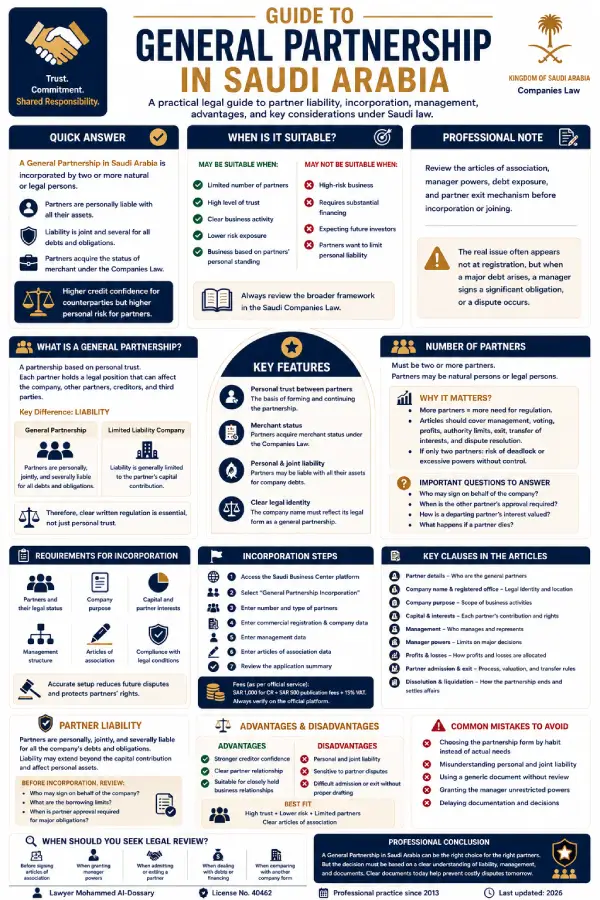
A General Partnership in Saudi Arabia is a company incorporated by two or more natural or legal persons. The partners are personally liable, with all their assets, and jointly and severally liable for the company’s debts and obligations. A partner in a general partnership also acquires the status of a merchant under the Saudi Companies Law.
Considering a General Partnership in Saudi Arabia but concerned that partner liability may reach your personal assets? A focused review of the articles of association, manager authority, debt exposure, and partner admission or exit rules can help clarify your legal position before incorporation, signing, or joining the company.
Or continue reading first to understand partner liability and incorporation risks.
In simple terms, a general partnership may give creditors and business counterparties stronger confidence because the partners do not stand only behind a limited capital contribution. However, this advantage creates a direct legal risk for the partners, because liability may extend to their personal assets.
Are you considering incorporating a general partnership or joining one as a partner and concerned about personal liability? A professional review of the articles of association, manager authority, debt limits, and partner exit mechanism before signing may help clarify your legal position and reduce the risk of future disputes.
Professional Note Before Taking Action
Before forming a general partnership or joining one as a partner, the articles of association, manager powers, debt exposure, and partner exit mechanism should be reviewed. The real issue often does not appear when the commercial registration is issued. It appears when a major debt arises, a manager signs a significant obligation, or a dispute occurs between partners.
When Is a General Partnership Suitable?
A General Partnership in Saudi Arabia may be suitable when the number of partners is limited, there is a high level of trust between them, and the business activity is clear in terms of obligations and risk exposure.
It may also suit certain business relationships where the personal standing of the partners gives additional confidence to suppliers, creditors, or business counterparties.
However, it is not always the best choice. If the activity is high risk, requires substantial financing, expects future investors, or if the partners want to reduce the possibility of personal asset exposure, another legal structure may need to be considered before incorporation.
For the broader legal framework, you may review the guide to Saudi Companies Law.
What Is a General Partnership in Saudi Arabia?
A general partnership is a form of partnership based heavily on personal trust between the partners. The identity, credibility, and legal position of each partner are important to the formation and continuity of the company.
This means that a partner is not viewed only as a holder of a financial interest. A partner also holds a legal position that may affect the company, the other partners, creditors, and third parties dealing with the business.
The main difference between a General Partnership in Saudi Arabia and several other company structures is liability. In a limited liability company, a partner’s liability is generally connected to their share in the capital, subject to the law and the facts of the case. In a general partnership, the general rule is that partners are personally, jointly, and severally liable for the company’s debts and obligations.
This makes the general partnership a sensitive legal choice. It may strengthen the company’s position with creditors and suppliers, but it also places a broader legal burden on the partners. For that reason, the relationship should be regulated by clear written documents, not only by personal trust.
Number of Partners in a General Partnership
A general partnership must be formed by two or more partners. Under the Saudi Companies Law, the partners may be natural persons or legal persons.
The number of partners is not just a detail in an incorporation form. As the number of partners increases, the need for careful regulation becomes stronger. The articles of association should address management, voting, profit distribution, authority limits, exit, transfer of interests, and dispute resolution.
If the company is formed by only two partners, the practical risk may arise when decisions become blocked, or when one partner is granted broad powers without sufficient controls. The articles of association should answer practical questions from the beginning: who may sign? When is the other partner’s approval required? How will a departing partner’s interest be valued? What happens if one partner dies?
Key Features of a General Partnership in Saudi Arabia
Personal Trust Between Partners
The general partnership is based on personal consideration. In practical terms, the partner is not just a financial investor. The partner’s identity, reliability, and relationship with the other partners matter.
This is why partner admission, withdrawal, transfer of interest, and death should not be left to general assumptions. They should be addressed clearly in the constitutional documents.
Merchant Status of the Partner
A partner in a general partnership acquires the status of a merchant under the Saudi Companies Law. This is not merely a descriptive label. It may have legal and practical consequences that should be reviewed before incorporation.
The Ministry of Commerce service page for incorporating a general partnership also lists several conditions, including that the partner must be at least 18 years old, the partners must not be government employees, and a guardianship deed is required if the partner is a minor under the age of puberty.
Personal and Joint Liability
The most important feature of a general partnership is personal and joint liability. A partner may be liable for the company’s debts not only up to the value of their contribution, but in all their assets, according to the law and relevant facts.
This is the feature that makes a general partnership different from many other company forms. It is also the reason why the company documents must be reviewed carefully before incorporation.
Company Name and Legal Clarity
The company name should reflect the legal nature of the entity. This helps third parties understand that they are dealing with a general partnership, not a limited liability company.
Clear identification of the company’s legal form reduces confusion and helps counterparties understand the nature of the entity and the risk structure attached to it.
Requirements for Incorporating a General Partnership in Saudi Arabia
Incorporating a General Partnership in Saudi Arabia requires determining the partners, company data, purpose, capital, partner interests, management structure, and articles of association. These should not be treated as procedural fields only. Each item may later affect liability, management, or disputes between partners.
The legal status of each partner should be reviewed before incorporation. If the partner is a natural person, their eligibility and capacity should be verified. If the partner is a legal person, its legal status and authorization to participate should be reviewed.
The company purpose must also be defined carefully. The purpose determines the scope of the company’s activity and may be connected to licenses or preliminary approvals depending on the nature of the activity. A very broad purpose may create uncertainty, while a very narrow purpose may restrict the business unnecessarily.
Capital and partner interests are also important. Each partner should understand their contribution, how it will be fulfilled, whether it is cash or in-kind, and how it affects profits, losses, voting, and internal rights.
Steps to Incorporate a General Partnership in Saudi Arabia
The Ministry of Commerce provides an electronic service for incorporating a general partnership through the Saudi Business Center platform. The service includes selecting the general partnership incorporation service, identifying the number of partners, entering commercial registration data, company data, management data, articles of association data, and reviewing the application summary.
Preparing the Data Before Using the Platform.
The first step is not merely accessing the platform. The partners should first prepare the core business and legal data, especially ownership interests, management powers, and signing authority.
Selecting the General Partnership Incorporation Service.
After entering the platform, the applicant selects the service for incorporating a general partnership. This step determines the legal form of the company, and should not be taken only because the procedure appears simple.
Entering Partner and Company Details.
The partners’ details, company name, registered office, activity, and commercial registration information are entered. Accuracy is important, because mistakes may later affect the articles of association, the commercial registration, or management authority.
Entering Management and Articles of Association Data.
This is one of the most important stages. The manager may represent the company and sign on its behalf. For this reason, the scope of authority should be clear before submitting the application.
Reviewing the Application Summary.
The final summary should be reviewed carefully before submission. This is not a formality. It is the last opportunity to detect errors in partner data, interests, authority, company purpose, or management structure.
The Saudi Business Center lists the service fees as SAR 1,000 for the commercial registration, SAR 500 for publication fees, and 15% VAT. These details should always be checked on the official service page at the time of filing, because official fees or service conditions may change.
Articles of Association for a General Partnership
The articles of association are the most important document in a general partnership. They do not merely record company details. They regulate the relationship between partners, manager authority, profit and loss distribution, partner admission, partner exit, dissolution, and liquidation.
| Clause | Why It Matters |
|---|---|
| Partner details | Identifies who holds the position of general partner |
| Company name and office | Defines the company’s legal identity and registered location |
| Company purpose | Determines the scope of business activity and related obligations |
| Capital and interests | Shows each partner’s contribution and economic position |
| Management | Identifies who represents and signs for the company |
| Manager powers | Helps restrict major decisions where needed |
| Profits and losses | Reduces disputes over financial allocation |
| Partner admission and exit | Regulates changes in the partnership structure |
| Dissolution and liquidation | Provides a framework for ending the company |
Relying on a generic template may be sufficient to complete registration, but it may not be enough to protect partners when a dispute arises. A weak document usually does not cause problems on the day of incorporation. It becomes a problem when debt, exit, management disagreement, or partner transfer occurs.
Partner Liability in a General Partnership
Partner liability is the core issue in a general partnership. The Saudi Companies Law provides that partners in a general partnership are personally liable, with all their assets, and jointly and severally liable for the company’s debts and obligations.
Personal liability means that the risk may not stop at the partner’s capital contribution. Joint and several liability means that partners are not fully separate from one another in relation to creditors.
For this reason, a partner should not enter a general partnership under the assumption that their exposure is limited to their contribution.
For example, if a general partnership enters into a significant supply contract and then becomes unable to pay, the company’s assets may not be the only relevant issue. Partner liability may arise depending on the law, the documents, and the facts.
Before incorporation, three points should be reviewed carefully: who may sign on behalf of the company? What are the borrowing limits? When is partner approval required for major obligations?
Advantages and Disadvantages of a General Partnership
A general partnership is not inherently good or bad. Its suitability depends on the nature of the activity, the number of partners, the level of trust, and the expected size of obligations.
| Aspect | Practical Assessment |
|---|---|
| Advantages | Stronger creditor confidence, clear partner relationship, suitable for closely held business relationships |
| Disadvantages | Personal and joint liability, high sensitivity to partner disputes, difficulty of admission or exit without proper drafting |
| When it may be suitable | High trust, lower-risk activity, limited number of partners, clear articles of association |
| When caution is needed | Large debts, expansion plans, multiple partners, broad manager powers |
The main advantage of a general partnership is that it may give counterparties greater confidence because the partners themselves stand behind the company. The corresponding disadvantage is that the same feature may expose partners to broader liability.
Management of a General Partnership and Manager Authority
Management in a general partnership should be clearly documented. It is not enough for the partners to agree verbally that one person will manage the business. The manager’s authority should be stated in the articles of association or later partner resolutions.
The powers that should be reviewed include signing contracts, opening bank accounts, borrowing, selling assets, hiring employees, representing the company before authorities, and entering into long-term agreements.
If the manager’s powers are too broad, the company may enter into obligations that the other partners did not expect. If the powers are too narrow, the business may become difficult to operate. A practical balance is usually needed: sufficient authority for daily business, and partner approval for major decisions.
It is also important to regulate multiple managers. Can each manager sign independently? Is joint signature required? Do authority limits depend on the value of the transaction? These details may protect the company before a dispute occurs.
Admission or Exit of a Partner
The admission of a new partner into a general partnership is not merely the entry of a new investor. It is the entry of a person into a relationship based on liability and trust. Their status, interest, powers, and effect on existing debts should be reviewed before admission.
Partner exit is one of the most common sources of disputes. The dispute is often not only about the right to exit. It may relate to valuation, payment timing, previous profits, existing debts, and continuing liability.
The articles of association should regulate exit clearly. Who values the departing partner’s interest? Is there a payment period? Do the remaining partners have a priority right? How is the document amended? When is the exit effective against third parties?
The clearer the drafting, the lower the likelihood of a long dispute. If the articles are silent, the business relationship may turn into a disagreement over interpretation and proof.
Death of a Partner in a General Partnership
The death of a partner is a sensitive matter in a partnership based on personal trust. The articles of association should state what happens if a partner dies.
The company may continue between the remaining partners, the heirs may have financial rights, the deceased partner’s interest may be valued, or another legal path may be required depending on the law, documents, and facts.
The practical problem usually arises when the surviving partners and heirs disagree over valuation, continuity, management, or the timing of payment. For this reason, the articles of association should contain a clear clause on death, valuation of the partner’s interest, heirs’ rights, and business continuity.
Dissolution and Liquidation of a General Partnership
A general partnership may end for legal or contractual reasons, such as expiry of its term, partner agreement, occurrence of a dissolution event, or circumstances that make continuation impractical.
However, dissolution does not mean that everything ends immediately. A liquidation phase may be required. During liquidation, the company’s assets are identified, debts are paid, obligations are settled, and any remaining surplus is distributed to the partners according to the law and documents.
During liquidation, creditor rights must be considered carefully. Liquidation is not merely an internal arrangement between partners. External obligations must be addressed before distributing any remaining funds.
Difference Between a General Partnership and a Limited Liability Company
The main difference between a general partnership and a limited liability company is the scope of liability.
In a general partnership, partners are personally and jointly liable for the company’s debts and obligations. In a limited liability company, a partner’s liability is generally limited to their capital contribution, subject to the law, documents, and facts.
For this reason, a limited liability company may be more suitable for projects that need clearer separation between company obligations and partners’ personal assets. A General Partnership in Saudi Arabia may be suitable for a close business relationship where partners accept a broader level of liability.
| Comparison Point | General Partnership | Limited Liability Company |
|---|---|---|
| Liability | Personal, joint, and several | Generally linked to capital contribution |
| Number of partners | Two or more | May be one or more, subject to the law |
| Suitability | High trust and broader liability | Projects requiring clearer liability separation |
| Main risk | Liability may extend to personal assets | Weak drafting of management or partner arrangements |
Difference Between a General Partnership and a Limited Partnership
A limited partnership includes at least one general partner and at least one limited partner. The general partner has a broader liability position, while the limited partner’s liability is generally narrower, subject to the law and documents.
This difference matters where one party wants to manage the business and assume a wider legal position, while another party wants to contribute capital without direct management or broader liability.
A general partnership should therefore not be confused with a limited partnership. The legal position of each partner must be clearly identified in the company documents.
Common Mistakes Before Incorporating a General Partnership
A common mistake is choosing a general partnership only because it is familiar. The legal form should not be selected by habit. It should be selected based on the activity, partner relationship, liability risk, and business plan.
Another mistake is misunderstanding personal and joint liability. Some partners assume that their interest in the capital is the maximum risk. That assumption is not accurate in a general partnership.
A third mistake is relying on a generic document without review. A generic document may not regulate manager powers, exit, transfer, death, or debt exposure clearly.
A fourth mistake is giving the manager unrestricted powers. Management needs flexibility, but major decisions should still be subject to controls.
A fifth mistake is delaying documentation. Verbal decisions may become a direct source of dispute when the relationship between partners changes.
When Is Legal Review Needed Before Incorporating a General Partnership?
Legal review is important before incorporating a General Partnership in Saudi Arabia if there is more than one partner, broad manager authority, in-kind contributions, financing, significant contracts, or a possibility of admitting investors later.
Review is also important when a partner enters or exits, when there are existing debts, when there is a management dispute, or when the partners are considering converting the company into another legal form.
Legal review does not mean complicating the process. It means reducing risk before submission. The objective is to ensure that the articles of association reflect the real relationship between the partners, rather than merely using a registrable template.
Professional Conclusion
A General Partnership in Saudi Arabia may be suitable for certain business relationships built on strong trust, but it is not a simple or low-risk option. A partner’s liability may extend to personal assets, which is why the articles of association, manager powers, debts, and partner exit mechanism should be reviewed before incorporation.
The better starting point is not asking how quickly the commercial registration can be issued. The more important question is how this legal form affects partners if a debt, dispute, exit, or transfer occurs.
If the document is clear, the powers are controlled, and the partners understand liability, the company is more likely to operate with stability and fewer disputes.
Frequently Asked Questions about General Partnership in Saudi Arabia
What is a General Partnership in Saudi Arabia?
A General Partnership in Saudi Arabia is a company incorporated by two or more persons, where the partners are personally and jointly liable for the company’s debts and obligations, and each partner acquires merchant status under the Saudi Companies Law.
How many partners are required for a general partnership?
A general partnership requires at least two partners. The partners may be natural or legal persons, subject to the Saudi Companies Law and official incorporation requirements.
What is partner liability in a general partnership?
Partner liability in a general partnership is personal, joint, and several. This means that the risk may extend beyond the partner’s capital contribution and may affect personal assets.
What is the main risk of a general partnership?
The main risk is that a partner’s liability may not be limited to their share in the company. It may extend to personal assets if the company incurs debts or obligations.
What are the advantages of a general partnership?
The advantages may include stronger creditor confidence, a clear partner relationship, and suitability for closely held business relationships based on trust.
What are the disadvantages of a general partnership?
The disadvantages include personal and joint liability, sensitivity to partner disputes, and difficulty in partner admission or exit if the articles of association are not clear.
When is a general partnership suitable?
It may be suitable where the partners are few, trust is high, the activity is relatively clear in risk, and the articles of association regulate management, debts, and exit.
When is a general partnership not suitable?
It may not be suitable for high-risk activities, heavily financed projects, or situations where partners want clearer separation between company obligations and personal assets.
What should the articles of association include?
They should include partner data, company name, purpose, capital, interests, management, manager powers, profit and loss distribution, partner admission and exit, dissolution, and liquidation.
Can manager powers be restricted?
Yes. Manager powers may be regulated in the articles of association or partner decisions, including limits on signing, borrowing, asset sales, or major contracts.
Official Sources: