The Types of Companies in Saudi Arabia differ in terms of liability, management, constitutional documents, and ownership structure. For this reason, the chosen company type should be understood before incorporation. The decision is not limited to a trade name or business activity; it determines the legal position of each partner or shareholder, the scope of liability, how the company is managed, how quotas or shares may be transferred, and whether the entity is suitable for future expansion or the admission of new partners.
Many commercial disputes do not begin because the business itself is weak. They often begin because the legal structure does not fit the real relationship between the parties. A business may be commercially successful, but the articles of association may be unclear, the manager’s authority may be too broad, or the selected company type may not support the expansion plan. In such cases, a quick incorporation decision may later become a long-running source of dispute.
Quick Answer: Types of Companies in Saudi Arabia
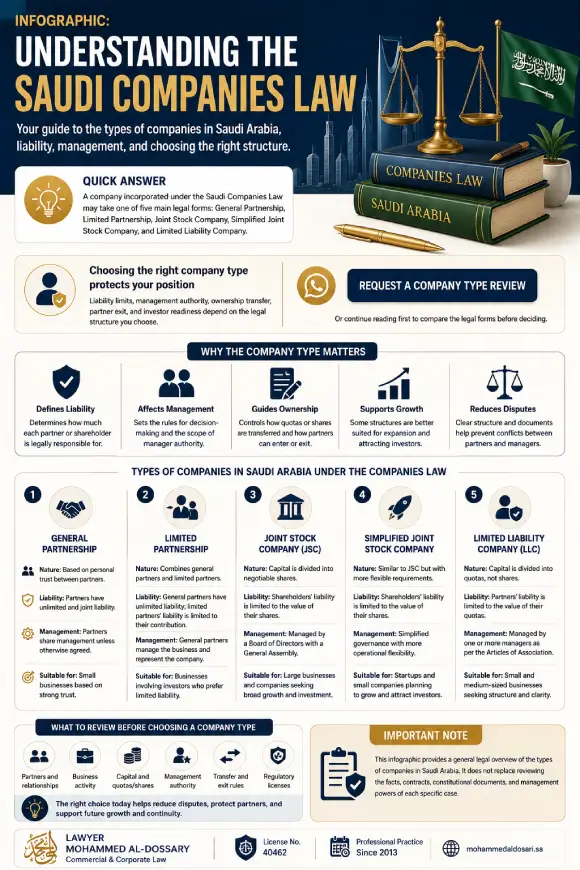
A company incorporated under the Saudi Companies Law may take one of five main legal forms: General Partnership, Limited Partnership, Joint Stock Company, Simplified Joint Stock Company, and Limited Liability Company.
Choosing between Types of Companies in Saudi Arabia but unsure which structure protects your position before incorporation, partner admission, or future expansion? A focused review of liability, management authority, ownership transfer, partner exit, and investor readiness can help you choose a clearer legal structure before filing or restructuring.
Choosing a company type before understanding liability limits and management authority can create avoidable risk. Registration may be easy, but the legal structure should match the business model. Understanding the difference between a limited liability company, a simplified joint stock company, and the other legal forms helps founders choose a clearer framework before incorporation or before admitting partners.
Professional guidance on selecting the right company type
You may continue reading the article first if you prefer to understand the differences between Types of Companies in Saudi Arabia calmly before seeking professional review.
A General Partnership is largely based on personal trust between partners, and the impact of liability may be broader. A Limited Partnership combines general partners and limited partners, which means the legal position of each partner may differ within the same entity.
A Joint Stock Company and a Simplified Joint Stock Company are both based on shares, but they differ in terms of governance and flexibility. A Limited Liability Company is one of the most common forms for small and medium-sized businesses because it provides a structured framework for quotas and management, while still requiring carefully drafted articles of association and clearly written management powers.
The right question before incorporation is not: what is the fastest company type to register? The better question is: which legal structure fits the liability, management, continuity, and future needs of the business?
For this reason, understanding Types of Companies in Saudi Arabia is not only useful for incorporation; it also helps founders assess liability, management authority, ownership transfer, and long-term business continuity.
Why Is Business Activity Alone Not Enough before Choosing the Company Type?
The business activity answers one question: what will the business do? The company type answers a different question: how will the business be managed, who will bear its obligations, and how will ownership move within it?
Two or more businesses may carry out the same activity but adopt different legal structures. One may operate as a sole establishment, another as a Limited Liability Company, and a third as a Simplified Joint Stock Company. The activity may be the same, but the legal consequences are different. Liability, decision-making, admission and exit of partners, transfer of quotas or shares, and governance are all linked to the legal form, not merely the business activity.
In practice, the importance of this choice appears when the company enters into a major financial obligation, when a partner wants to exit, when an investor joins, or when conflicts of interest arise between the manager and the other partners. In these situations, the commercial registration alone is not enough. The company type, its constitutional documents, and the scope of management authority must be reviewed.
Choosing the company type before incorporation is a preventive step. It helps define liability, organize the relationship between partners, and anticipate the business’s needs during expansion. The clearer the legal understanding behind the choice, the lower the risk of future disputes.
The company type should therefore be treated as a foundational legal decision, not as an administrative field inside an online form.
Types of Companies in Saudi Arabia under the Companies Law
The Saudi Companies Law sets out the legal forms that a company may take when incorporated under its provisions. Each form has a different nature in relation to liability, management, and constitutional documentation.
General Partnership
A General Partnership is a company built largely on the personal relationship and trust between the partners. Its main legal impact is that a partner is often not viewed merely as an investor, but as a party more closely connected to the company’s obligations than in some other legal forms.
This type may suit limited business relationships based on strong trust between partners, but it requires particular caution before selection. Entering into a General Partnership should not be based solely on ease of incorporation or the strength of personal relations. It should follow a clear understanding of liability, management, the scope of obligations, partner exit, and the continuity of the company if the relationship between the parties changes.
The articles of association are especially important in this type of company. They should define the company’s purpose, capital, management, profit and loss distribution, and partner authority. Ambiguity in any of these areas may later appear during dealings with third parties or when disputes arise between partners.
Limited Partnership
A Limited Partnership combines two categories of partners: one or more general partners and one or more limited partners. This makes it different from a pure General Partnership because the legal position of a general partner is not the same as the position of a limited partner.
The practical idea behind this structure is that one party may assume management or a broader legal position, while another contributes to capital without having the same role as the general partner. For this reason, the documents must be precise in defining each partner’s capacity, the limits of involvement, profit and loss distribution, and what each partner may or may not do within the company.
The sensitivity of this structure lies in the risk of role confusion. If it is not clear who manages, who finances, and who has decision-making authority, the relationship may turn into a dispute over liability and powers. Trust between the parties is not enough. That understanding must be translated into a clear written document.
Joint Stock Company
A Joint Stock Company is based on capital divided into shares. It generally suits entities that require broader governance, management, and ownership structures. In this type, the concept of a shareholder becomes clearer than the concept of a personal partner, because the relationship is not based only on direct personal trust between individuals, but on shares and the rights attached to them.
This form usually requires more detailed regulation of assemblies, management, shareholder rights, and major decisions. It may not always be suitable for small businesses that need simple administration, but it may be important for larger projects, expansion plans, or businesses that need a structure capable of accommodating a wider number of shareholders.
The bylaws are particularly important in a Joint Stock Company because they regulate governance, rights, and decision-making. They should not be treated as a formality, but as a governing framework for the company’s lifecycle and its relationship with shareholders.
Simplified Joint Stock Company
A Simplified Joint Stock Company is a legal form that offers greater flexibility for certain modern business models. Like a Joint Stock Company, it is based on shares, but it is designed to be more suitable for projects that need a scalable structure without excessive administrative complexity.
This form may be appropriate where the business is likely to admit investors, requires structured share rights, or expects future changes in ownership. However, it should not be selected merely because it is modern or flexible. Its bylaws should be reviewed carefully, particularly in relation to management, voting, and share transfer.
The practical value of this form appears when founders need a balance between flexibility and organization. If the documents are weak or unclear, the company may lose part of the flexibility for which it was selected.
Limited Liability Company
A Limited Liability Company is one of the most common forms for small and medium-sized businesses in Saudi Arabia. It is based on partners’ quotas and provides a structured framework for management, capital, quota transfers, and profit and loss distribution.
Choosing this form, however, does not make the relationship automatically secure. In many companies, the problem is not the legal form itself, but weak articles of association, unclear manager authority, or failure to regulate partner exit. The document should clarify who has signing authority, when the manager needs partner approval, how quotas may be transferred, and how disputes should be handled.
A Limited Liability Company is often suitable when partners want a clear structure for quotas and management without adopting a broader shareholding structure. Yet it requires carefully drafted documents in order to function properly in practice.
Comparison of Company Types by Liability and Management
The following table summarizes the practical differences between company types under Saudi law from the perspective of liability, management, and common use. It does not replace reviewing the law and the documents of each case, but it helps build an initial understanding before selecting the structure.
The following comparison helps readers evaluate Types of Companies in Saudi Arabia from the perspective of liability, management, and common business use.
| Company Type | Nature of Liability | Management Method | Commonly Suitable For |
|---|---|---|---|
| General Partnership | More closely connected to the partners | Partners or persons appointed by them | Limited relationships based on strong personal trust |
| Limited Partnership | Differs according to the partner’s legal capacity | Usually general partners | A working partner and a capital-contributing partner |
| Limited Liability Company | Generally linked to partners’ quotas, subject to the law and documents | One or more managers under the articles of association | Small and medium-sized businesses |
| Joint Stock Company | Linked to shares and broader governance | Board of directors and assemblies, subject to the law and documents | Larger entities or scalable businesses |
| Simplified Joint Stock Company | Linked to shares with greater structural flexibility | According to the bylaws | Modern business models or businesses expecting investors |
This comparison shows that there is no universally “best company type.” The suitable form depends on the size of the project, number of partners, business activity, financing plan, and sensitivity of personal liability.
Difference between a Company and a Sole Establishment in Saudi Arabia
When comparing Types of Companies in Saudi Arabia with a sole establishment, the difference is not merely one of naming. A sole establishment is generally more closely connected to its owner. A company, by contrast, is a legal entity that takes one of the forms recognized by the Companies Law and is governed by documents such as articles of association or bylaws.
In a sole establishment, the business is usually closer to an extension of the owner in terms of management and ownership. This may be suitable for some simple activities, but it does not provide the same structure that a company offers when admitting partners, distributing quotas or shares, regulating partner exit, or building a scalable management framework.
A company provides a clearer framework for regulating the relationship between owners, partners, or shareholders. It allows capital, quotas or shares, management, authority, transfer of ownership, and decision-making mechanisms to be defined. The difference between a company and a sole establishment becomes especially important during expansion, financing, admission of a new partner, or disputes.
A common mistake is for a business owner to start with a sole establishment because it appears faster, then later discover that the business needs partners, investors, or a clearer separation between management and ownership. In such cases, conversion or restructuring may become more complicated than selecting the correct structure from the beginning.
The better question is not simply: should I register a sole establishment or a company? The more useful question is: does the nature of the business require a simple individual structure, or a regulated relationship between more than one party?
Articles of Association, Bylaws, and Their Connection to the Company Type
When comparing company types in Saudi Arabia, knowing the company type is not enough without reviewing the document that governs the relationship between partners or shareholders. The articles of association and bylaws are the documents that regulate the internal structure of the company and define authority, rights, and management mechanisms.
Articles of association commonly appear in companies based on a direct relationship between partners, such as partnerships and the usual form of a Limited Liability Company. They define the company’s data, partners, capital, quotas, management, authority, profit and loss distribution, and transfer or exit mechanisms.
Bylaws are more prominent in share-based companies, such as Joint Stock Companies and Simplified Joint Stock Companies. They regulate management, shareholder rights, assemblies or decision-making mechanisms, share transfers, and governance-related matters.
The importance of these documents lies in their role as the practical reference during disputes. If partners disagree over the manager’s authority, profit distribution, or the right to transfer a quota, the trade name alone will not be enough. The company type, constitutional document, and subsequent decisions will be examined.
Weak documentation may turn an otherwise suitable company type into a source of dispute. Conversely, clear articles of association or well-drafted bylaws can reduce the likelihood of conflict by defining each party’s expectations before problems arise.
How to Choose the Right Company Type before Incorporation
Choosing the right company type before incorporation starts with practical questions, not with selecting the most popular form. Popularity does not mean suitability, and procedural ease does not necessarily mean legal soundness.
The first question is: how many partners or shareholders are involved? If the business is owned by one person, the options differ from a business involving multiple partners or shareholders. If one party is financing the project while another manages it, the relationship may require a different structure from a company managed equally by all partners.
The second question is: what level of liability is acceptable? Some forms make the partner more closely connected to the company’s obligations, while others provide a clearer separation between the partner’s contribution and the entity’s obligations, subject to the law and documents.
The third question is: will the business need investors in the future? If admitting investors is likely, early attention should be given to transferability of ownership, organization of shares or quotas, and protection of management decisions.
The fourth question is: how will the company be managed? Individual management may suit some businesses, while others require a board, assembly, or voting mechanism. Ambiguous management is one of the most common causes of disputes between partners.
The fifth question is: is there an expansion plan? A business that will remain limited is not the same as a business that may admit new partners, establish subsidiaries, or transform its legal form later.
These questions do not produce one universal answer, but they help prevent random selection and connect the company type to the business model rather than to registration speed alone.
Common Mistakes When Choosing a Company Type
When comparing company types under Saudi law, several recurring mistakes appear. These mistakes do not relate only to incorporation; they may also affect liability, management, partner exit, and the transfer of quotas or shares.
One common mistake is choosing a company type because it is familiar or widely used. Some founders select a Limited Liability Company simply because it is common, or choose a General Partnership because it appears simple, without analyzing the impact on liability, management, and exit.
Another mistake is confusing a company with a sole establishment. A sole establishment may be suitable for a simple individual activity, but it is not always a substitute for a company where more than one party is involved or where there is a need to admit partners or organize ownership interests.
A third mistake is relying only on the commercial registration. The commercial register is important, but it does not explain everything. It may not show the full details of authority, partner exit, transfer restrictions, or dispute resolution.
A further mistake is relying on a generic articles of association template without adapting it to the actual relationship. Generic documents may complete the procedure, but they do not always answer the questions that arise after incorporation: who has signing authority? how is a quota valued? when does the manager need partner approval?
Another issue is failing to distinguish between a quota and a share. A quota is commonly associated with forms such as the Limited Liability Company, while a share appears in companies whose capital is divided into shares. This distinction affects ownership transfer and governance.
A final mistake is ignoring the future. A company type may be suitable on the date of incorporation but unsuitable for admitting investors, expansion, or restructuring later. The decision should consider the third and fifth year of the business, not only the day of registration.
When Is Professional Review Needed?
When choosing between Types of Companies in Saudi Arabia, professional review becomes important if the decision affects partner liability, investor admission, non-managing partners, conversion from a sole establishment into a company, or selection of a structure suitable for future growth.
Review is also important where one partner provides funding while another manages the business, where partners disagree over authority, where partner exit must be regulated, or where an investor is to be admitted while maintaining balance in decision-making.
In these cases, the question is not only which company type to choose. The broader question is the full legal effect of the choice: who manages? who bears liability? how are quotas or shares transferred? what are the signing limits? how are decisions documented? and which document will be relied upon if a dispute arises?
This does not mean that every incorporation must be made complex. It means that important matters should not be treated as ordinary fields in a form. The higher the value of the project, the greater the number of partners, or the stronger the likelihood of expansion, the more important it becomes to review the documents before taking action.
Where there is a clear professional purpose, the professional contact page may be used to request appropriate communication without submitting sensitive documents or confidential information through a general form.
Professional Conclusion
Understanding Types of Companies in Saudi Arabia is not a merely formal step before incorporation. The selected company type determines liability, management authority, constitutional documents, ownership transfer, and may affect the stability of the business for years after registration.
A proper review begins with understanding the five legal forms recognized under the Saudi Companies Law: General Partnership, Limited Partnership, Joint Stock Company, Simplified Joint Stock Company, and Limited Liability Company. The next step is to compare these forms in practical terms: number of partners, legal position of each party, management method, and scalability.
It is not enough for a company type to be common or quick to register. What matters is whether it fits the nature of the business, the acceptable level of liability, the relationship between the partners, and the future financing or expansion plan.
To understand the broader framework within which these company types operate, you may refer to the article on Saudi Companies Law, which explains the impact of the law before incorporation and management.
Frequently Asked Questions about Types of Companies in Saudi Arabia
Warning: Undefined array key "name" in /home/u798195860/domains/mohammedaldosari.sa/public_html/wp-content/plugins/seo-by-rank-math-pro/includes/modules/schema/shortcode/faqpage.php on line 31
Warning: Undefined array key "text" in /home/u798195860/domains/mohammedaldosari.sa/public_html/wp-content/plugins/seo-by-rank-math-pro/includes/modules/schema/shortcode/faqpage.php on line 32
What are the main types of companies in Saudi Arabia?
The main company types under Saudi Companies Law include General Partnership, Limited Partnership, Joint Stock Company, Simplified Joint Stock Company, and Limited Liability Company. Each form differs in liability, management, ownership transfer, and governance requirements.
How do I choose the right company type in Saudi Arabia?
The right company type depends on the number of partners, liability expectations, management structure, future investors, business size, and expansion plans. The decision should not be based only on registration speed or popularity.
What is the most common company type for small and medium businesses in Saudi Arabia?
A Limited Liability Company is commonly used for small and medium-sized businesses in Saudi Arabia because it provides a structured framework for quotas, management, profit distribution, and partner relationships.
What is the difference between a Limited Liability Company and a Joint Stock Company?
A Limited Liability Company is usually based on partners’ quotas and is often suitable for smaller or medium-sized businesses. A Joint Stock Company is based on shares and generally involves broader governance, assemblies, and a more structured management framework.
What is a Simplified Joint Stock Company in Saudi Arabia?
A Simplified Joint Stock Company is a share-based company form designed to offer more flexibility in management and organization. It may suit startups, scalable businesses, or companies expecting future investors, subject to proper bylaws and legal requirements.
What is the difference between a General Partnership and a Limited Partnership?
A General Partnership is usually based on personal trust between partners and may involve broader partner liability. A Limited Partnership includes general partners and limited partners, meaning that each partner may have a different role and liability position.
Is a sole establishment the same as a company in Saudi Arabia?
No. A sole establishment is usually more closely connected to its owner, while a company is a separate legal structure governed by the Saudi Companies Law and regulated through articles of association or bylaws depending on its type.
Why is the company type important before incorporation?
The company type affects partner liability, management authority, ownership transfer, governance, documentation, and future expansion. A wrong structure may create disputes later, even if the business activity itself is successful.
What documents should be reviewed before choosing a company type?
The key documents include the articles of association, bylaws, partner arrangements, management authority clauses, quota or share transfer rules, exit mechanisms, and any documents affecting governance or liability.
Can the company type affect partner liability?
Yes. Different company types create different liability structures. Some forms are more closely connected to the partners personally, while others provide clearer separation between the company’s obligations and the partners’ ownership interests, subject to the law and documents.
Official Sources: