The difference between a company and a sole proprietorship in Saudi Arabia is not limited to registration procedures or initial setup costs. It affects ownership, liability, management, financing, investor entry, continuity, and the legal structure of the business.
In this article, the term sole proprietorship refers to an individual commercial establishment owned by one natural person. It does not refer to public institutions, non-profit entities, charitable institutions, or government-related bodies. A company, on the other hand, is a legal entity established under one of the company forms recognized by the Saudi Companies Law, with liability, ownership, and management rules that differ depending on the chosen form.
Before choosing between a company and a sole proprietorship, the owner should examine four practical questions: who bears the debts, who manages the business, how a partner or investor may enter, and what happens to the business when the owner changes. For a broader legal background, the Saudi Companies Law should be reviewed as the main framework governing company forms and their legal effects.
Quick Answer: What Is the Difference Between a Company and a Sole Proprietorship?
A sole proprietorship is a business activity owned by one individual, and its rights and obligations are closely connected to that owner. The difference between a company and a sole proprietorship in Saudi Arabia becomes clear because a company is established under a recognized legal form and, after registration, may acquire legal personality, with its own rights, obligations, and financial estate.
Choosing between a company and a sole proprietorship in Saudi Arabia and unsure which structure better protects your liability, ownership, and future investor plans? A focused legal review can help clarify the safer structure before you register, sign financing documents, or bring in a partner.
Prefer to understand the differences first? Continue reading the guide below.
The word “company” does not always mean limited liability. In a limited liability company, the partner’s liability is generally limited to their share in the capital. In a general partnership, however, partners may be personally and jointly liable for the company’s debts. For this reason, the exact company form must be identified before comparing risk levels.
A sole proprietorship gives the owner direct control and a simpler structure. A company helps organize ownership, management authority, partner entry, investor participation, and continuity after ownership changes. The size of the business alone does not decide the matter. A small business may need a company structure, while a relatively larger activity may continue as a sole proprietorship if its ownership and risk profile allow that.
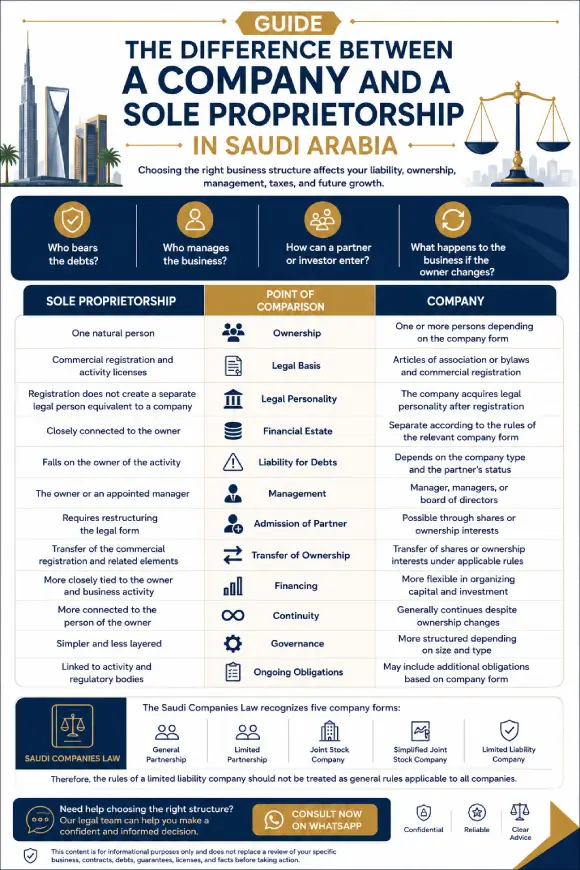
Comparison Table: Sole Proprietorship vs Company
The following table provides a general overview of the difference between a company and a sole proprietorship in Saudi Arabia. It should not be treated as a final legal opinion, because the effect of each point may differ according to the company form and its constitutional documents.
| Point of Comparison | Sole Proprietorship | Company |
|---|---|---|
| Ownership | One natural person | One or more persons depending on the company form |
| Legal Basis | Commercial registration and activity licenses | Articles of association or bylaws and commercial registration |
| Legal Personality | Registration does not create a separate legal person equivalent to a company | The company acquires legal personality after registration |
| Financial Estate | Closely connected to the owner | Separate according to the rules of the relevant company form |
| Liability for Debts | Falls on the owner of the activity | Depends on the company type and the partner’s status |
| Management | The owner or an appointed manager | Manager, managers, or board of directors |
| Admission of Partner | Requires restructuring the legal form | Possible through shares or ownership interests |
| Transfer of Ownership | Transfer of the commercial registration and related elements | Transfer of shares or ownership interests under applicable rules |
| Financing | More closely tied to the owner and business activity | More flexible in organizing capital and investment |
| Continuity | More connected to the person of the owner | Generally continues despite ownership changes |
| Governance | Simpler and less layered | More structured depending on size and type |
| Ongoing Obligations | Linked to activity and regulatory bodies | May include additional obligations based on company form |
The Saudi Companies Law recognizes five company forms: general partnership, limited partnership, joint stock company, simplified joint stock company, and limited liability company. Therefore, the rules of a limited liability company should not be treated as general rules applicable to all companies.
Legal Personality and Separate Financial Estate
Legal personality means that the law recognizes the company as a separate entity capable of owning assets, entering into contracts, assuming obligations, and litigating in its own name. It also means that the company may have its own financial estate, subject to the liability rules of its specific legal form.
Position of a Sole Proprietorship
A sole proprietorship is directly connected to its owner. The owner owns the activity, benefits from its profits, and bears its obligations. Obtaining a commercial registration for a sole proprietorship does not create a separate legal person equivalent to a company.
This does not mean that a sole proprietorship is unlawful or that its transactions are invalid. It simply means that the separation between the business assets and the owner’s personal assets does not operate on the same legal basis as a company with a separate financial estate.
The effect becomes clear when the business signs a lease, supply contract, financing arrangement, or similar obligation. In a sole proprietorship, the owner remains responsible for obligations arising from the business activity, even if the trade name of the establishment is used in dealings.
Opening a separate bank account for the business is useful for accounting discipline and evidentiary purposes. However, it does not by itself convert the sole proprietorship into a company, nor does it create full separation between the business estate and the owner’s estate.
Position of a Company
A company acquires legal personality after completing its incorporation and registration in accordance with the applicable law. Contracts, assets, and obligations may then be entered into in the company’s name, and its representative signs within the authority granted to them.
However, legal personality alone is not enough to determine the liability of owners. The company form must be examined. Liability may be limited, personal and joint, or different between categories of partners.
Why Are Not All Companies Limited Liability Companies?
A limited liability company is a clear example of a company with a separate financial estate. It may be established by one or more persons, and the company is generally responsible for its debts, while the owner or partner is generally liable only to the extent of their share in the capital.
In a general partnership, partners may be personally and jointly liable for the company’s debts. In a limited partnership, the position of the general partner differs from that of the limited partner.
For this reason, the correct question is not simply: “Should I choose a sole proprietorship or a company?” The more accurate question is: “Which company form suits the business activity, and what liability does that form create?”
For one of the most commonly used structures, the article on the limited liability company in Saudi Arabia may be reviewed separately.
Professional note before action: A business owner may choose a limited liability company, but later sign financing documents, promissory notes, or guarantees in their personal name. In that case, personal liability may arise from the independent guarantee, not merely from their status as an owner of shares or interests.
Ownership, Management, and Admission of Partners
The difference between a company and a sole proprietorship in Saudi Arabia becomes particularly clear when examining ownership structure, management authority, and the possibility of admitting new partners.
A sole proprietorship is based on one owner. That owner may manage the business directly or appoint a manager to handle day-to-day operations, while remaining the person with ultimate control over essential matters.
This structure allows faster decision-making and reduces the need for voting procedures or documented arrangements between multiple owners. It may be suitable for an activity that depends mainly on the owner’s personal expertise and does not expect to admit an investor or partner in the near future.
However, single ownership becomes a limitation when another person is intended to enter the business. A verbal agreement, a transfer of funds, or a profit-sharing arrangement is not enough to create formal ownership in a sole proprietorship. Disputes may arise over whether the money was a loan, an investment, or a participation in profits.
A company, by contrast, allows ownership to be organized through shares or ownership interests, depending on its form. Its constitutional documents may define each owner’s percentage, voting rights, management authority, transfer rules, investor entry, and partner exit.
Corporate management does not necessarily slow down daily operations. Well-drafted documents distinguish between operational powers given to the manager and reserved matters requiring owner approval, such as changing the activity, taking significant debt, selling a major asset, or admitting a new investor.
This becomes even more important when one owner manages the business while another contributes capital only. Without clear authority allocation, a simple commercial disagreement may turn into a dispute over control of the business.
Incorporation, Documents, and Costs
The difference between a company and a sole proprietorship in Saudi Arabia also appears in incorporation procedures, required documents, and costs associated with each structure.
Establishing a sole proprietorship generally requires commercial registration, selecting a trade name and activity, specifying the business address and owner or manager data, and obtaining any required licenses if the activity is subject to approval from a competent authority.
Establishing a company begins with choosing the legal form, identifying the owner or partners, determining capital, management, and authority, preparing the articles of association or bylaws, and completing registration and licensing procedures.
The articles of association are not the same as the commercial registration. The commercial registration proves the entity’s registration and basic data. The articles of association regulate the relationship between partners, ownership, management, decisions, and other issues required by the company’s nature.
With the application of the updated commercial registration framework, commercial registration services now include annual confirmation and data updates, rather than relying only on the earlier concept of renewal in the same way. Fees also depend on the type of service requested.
It is not advisable to choose a sole proprietorship merely because it is assumed to be cheaper, nor to choose a company based on a fixed figure published in an outdated article. Costs may be affected by company type, licenses, activity, capital, asset valuation, documentation, and accounting services.
Debts, Guarantees, and Risk Allocation
The difference between a company and a sole proprietorship in Saudi Arabia becomes more serious when a debt arises or a contract is breached. In a sole proprietorship, the owner is responsible for obligations resulting from the business activity. The owner should therefore carefully review contracts, cheques, promissory notes, and financing documents before signing them.
In a company, the first step is to identify the company form. If it is a limited liability company, the general rule is that the company bears its own debts, and the partner’s liability is limited to their share. If it is a general partnership, the partners may be personally and jointly liable.
However, identifying the company form is not the end of the analysis. It is also necessary to know who signed the contract and in what capacity. The manager may sign in the company’s name within their authority, provide a separate personal guarantee, sign a promissory note personally, or act beyond their authority.
For this reason, it is inaccurate to describe a company as absolute protection for the owners’ assets. It is equally inaccurate to ignore the value of the legal separation offered by certain company forms. The final result depends on three elements:
- The company form.
- The contract or instrument creating the obligation.
- The capacity and guarantees under which the owner or manager signed.
Risk also appears when assets and contracts remain in the owner’s name after a company has been formed. The existence of a company on paper does not automatically transfer all previous or future dealings to the company.
Financing, Expansion, and Investor Entry
The difference between a company and a sole proprietorship in Saudi Arabia is also relevant to financing, expansion, and investor participation.
A sole proprietorship may obtain financing and conduct a broad range of activities. However, financing is more closely connected to the owner’s history, the business performance, and the guarantees provided. Ownership of a sole proprietorship cannot be divided among investors without changing the legal structure.
A company allows investor entry to be organized through ownership interests or shares. It may increase capital, sell part of the ownership, or allocate financial and administrative rights within the limits of the law and the company’s documents.
This does not mean that forming a company automatically leads to financing. Lenders and investors examine financial statements, contracts, profitability, management, licenses, and existing obligations.
Still, a company provides a clearer framework when the business needs to separate:
- Ownership from management.
- Founder ownership from investor ownership.
- Daily decisions from strategic decisions.
- Profit rights from voting rights.
- Investor entry from later exit.
Zakat, Tax, and Financial Statements
The difference between a company and a sole proprietorship in Saudi Arabia may also affect zakat, tax, and financial reporting. There is no fixed rule stating that a sole proprietorship is always less taxable, or that a company is always more costly from a zakat perspective. The treatment may depend on the nationality and residency of the owner or partners, the nature of the activity, ownership structure, and sources of income.
Value Added Tax is also connected to the practice of economic activity and registration requirements. It does not arise automatically merely because a person chooses either a sole proprietorship or a company.
From an accounting perspective, company requirements are usually more structured, because company forms may be subject to the preparation and filing of financial statements in accordance with applicable rules. The filing framework covers the five company forms recognized under the Saudi Companies Law.
Certain exemptions from appointing an auditor may apply to some companies when conditions are satisfied. However, this does not mean that all accounting or legal obligations disappear.
Specialized review becomes important where the business involves a non-Saudi investor, mixed ownership, international operations, or the transfer of assets from an existing sole proprietorship into a new company.
Transfer of Ownership, Death, and Conversion into a Company
The difference between a company and a sole proprietorship in Saudi Arabia also appears in ownership transfer, death of the owner, and conversion into a company. Ownership of a sole proprietorship’s commercial registration may be transferred through the official service when the requirements are met. If the owner dies, continuity becomes tied to heirs’ procedures, transfer docu
ments, contracts, and licenses.
A company generally continues despite a change of ownership or the death of a partner, subject to its legal form and the rules governing shares or ownership interests.
Conversion from a sole proprietorship into a company should be considered when a partner enters, an investor is expected, contract values increase, management needs to be separated from ownership, or the business is being prepared for succession, sale, or expansion.
The conversion should begin by reviewing existing debts, guarantees, contracts, and licenses. Creating a company does not automatically release the owner from obligations that arose before conversion.
What Happens to the Previous Debts of a Sole Proprietorship?
Creating a company or transferring assets to it does not automatically release the owner from debts that arose before conversion. Creditors, contracts, and guarantees must be reviewed to determine what may transfer, what requires approval, and what remains attached to the owner’s personal estate.
For this reason, conversion should begin with a review of existing obligations, not merely the issuance of a new commercial registration.
Which Structure Is More Suitable for Your Business?
The following table provides an initial direction only. It is not a final legal opinion. Contracts, licenses, or guarantees may change the proper assessment from one case to another.
| Business Situation | Initial Direction |
|---|---|
| Limited activity owned and managed by one person | Sole proprietorship may be suitable |
| Business expecting a partner soon | Company is usually more organized |
| Activity requiring investors | Company is better for organizing ownership |
| High-value contractual business | Review company type and guarantees |
| Extended family business | Company with ownership and management rules |
| Low-obligation business experiment | Sole proprietorship may be simpler |
| Need to separate management from ownership | Company is more flexible |
| Business planned for sale or expansion | Company helps organize transfer |
| Existing sole proprietorship with debts | Obligations should be reviewed before conversion |
| Non-Saudi investor involved | Licensing, structure, and tax review required |
Decision Test Before Registration
Before establishing a sole proprietorship or company, ask:
- Will another person enter the ownership?
- Does the business need an investor or structured financing?
- Will someone other than the owner manage the business?
- Are there high-value contracts or obligations?
- Should the business continue after ownership changes?
- Will the owner sign personal guarantees?
- Does the activity need a special license?
- Is there a plan to sell part of the business later?
Common Mistakes When Choosing a Business Entity
Some aspects of the difference between a company and a sole proprietorship in Saudi Arabia appear through common mistakes made by business owners when choosing a legal structure.
The first mistake is choosing a sole proprietorship simply because its procedures appear easier. Later conversion may become more complex after contracts are signed or new parties enter the business, compared with choosing the proper structure from the beginning.
The second mistake is assuming that all companies limit the partners’ liability. This applies to specific company forms, but not to a general partner in a general partnership.
Other recurring mistakes include:
- Admitting a partner into a sole proprietorship through an undocumented arrangement.
- Choosing a company form without studying management authority.
- Granting the manager broad powers without controls.
- Signing personal guarantees without assessment.
- Keeping contracts and assets in the owner’s name after forming a company.
- Assuming conversion erases previous debts.
- Relying on outdated fees when calculating costs.
- Starting the activity before completing required licenses.
- Confusing transfer of commercial registration with automatic transfer of contracts.
- Ignoring the effect of death or exit of an owner.
When Is Professional Review Needed?
Professional review becomes more important if the project involves a partner or investor, long-term contracts, financing with guarantees, a licensed activity, high-value assets, family ownership, a non-Saudi party, or a plan to convert an existing sole proprietorship.
The review usually covers the nature of the activity, the business entity type, ownership distribution, management authority, prior debts, guarantees, investor entry, and transfer of interests or assets.
The difference between a company and a sole proprietorship in Saudi Arabia is not simply that a sole proprietorship is easier or that a company is larger. A sole proprietorship is connected to one owner and gives that owner direct control, but it also connects business obligations more closely to the owner.
A company provides a framework for organizing ownership, management, and continuity, while liability varies according to its legal form. A sole proprietorship may suit a limited individual activity, while a company may be more appropriate when a partner, investor, or high-value contract is involved.
The proper decision begins with the business activity, risk profile, ownership structure, and guarantees. The legal form should reflect these elements, rather than choosing a name first and forcing the business to fit it later.
Frequently Asked Questions About the Difference Between a Company and a Sole Proprietorship
ما الفرق الأساسي بين المؤسسة الفردية والشركة؟
المؤسسة الفردية يملكها شخص واحد وترتبط التزامات نشاطها بصاحبها. أما الشركة فتؤسس وفق أحد الأشكال النظامية وتكتسب شخصية اعتبارية بعد قيدها. وتختلف مسؤولية ملاك الشركة بحسب نوعها، فلا تكون جميع الشركات محدودة المسؤولية.
متى تناسب المؤسسة مشروعًا صغيرًا؟
قد تناسب المؤسسة نشاطًا فرديًا محدودًا لا يحتاج إلى شركاء أو مستثمرين، وتكون إدارته مرتبطة بصاحبه. لكن صغر المشروع لا يكفي وحده؛ إذ يجب أيضًا تقييم العقود، والمخاطر، والتمويل وخطة النمو.
أيمكن لشخص واحد تأسيس شركة؟
نعم، يمكن تأسيس شركة ذات مسؤولية محدودة من شخص واحد أو أكثر. لذلك لا تكون المؤسسة الفردية الخيار الوحيد عندما يكون للمشروع مالك واحد. ويعتمد الاختيار على المسؤولية والإدارة والتمويل المتوقع.
من يتحمل التزامات المؤسسة الفردية؟
يتحمل صاحب المؤسسة الالتزامات الناشئة عن نشاطها. ولا يؤدي فتح حساب مصرفي منفصل أو استخدام اسم تجاري إلى إنشاء شخصية اعتبارية مستقلة مماثلة للشركة.
ما حدود مسؤولية الشريك في الشركة؟
تختلف بحسب نوع الشركة. ففي الشركة ذات المسؤولية المحدودة تكون مسؤولية الشريك في الأصل بقدر حصته، بينما يتحمل الشريك في شركة التضامن مسؤولية شخصية وتضامنية عن الديون.
كيف يدخل شريك إلى مؤسسة قائمة؟
لا يكفي اتفاق خاص لإضافة شريك إلى بنية المؤسسة الفردية. يتطلب الأمر إجراءً نظاميًا مناسبًا، مثل التحول إلى شركة، مع تحديد الحصص والإدارة والحقوق والالتزامات وتوثيقها.
ما الفرق بين المؤسسة وشركة الشخص الواحد؟
كلتاهما قد تكون مملوكة لشخص واحد، لكن شركة الشخص الواحد تكون شركة لها شخصية اعتبارية وذمة مستقلة بعد القيد. أما المؤسسة فترتبط بصاحبها مباشرة.
أي الكيانين أقل تكلفة؟
تكون المؤسسة أبسط غالبًا من حيث الوثائق الأولية. أما تكلفة الشركة فتتغير بحسب شكلها والنشاط والتراخيص والخدمات اللازمة. لذلك يجب الرجوع إلى الرسوم الرسمية وقت تقديم الطلب.
كيف تتأثر الزكاة والضريبة بالشكل القانوني؟
لا يحدد اسم الكيان الالتزام بمفرده. تتأثر المعالجة بالجنسية والإقامة والملكية والنشاط والإيرادات. كما ترتبط ضريبة القيمة المضافة بممارسة النشاط الاقتصادي ومتطلبات التسجيل.
ماذا يحدث عند وفاة صاحب المؤسسة؟
يمكن معالجة نقل ملكية السجل إلى الورثة أو إلى مالك جديد بعد استكمال المستندات الرسمية. لكن الإجراء يكون أكثر اتصالًا بشخص المالك مقارنة باستمرار الشركة كشخصية اعتبارية مستقلة.
متى يصبح التحول إلى شركة مناسبًا؟
يستحق التحول الدراسة عند دخول شريك، أو زيادة العقود والالتزامات، أو جذب مستثمر، أو فصل الإدارة عن الملكية، أو التخطيط لاستمرار المشروع بين الأجيال.
Official Sources: