Partner liability in companies in Saudi Arabia does not arise merely because partners disagree. It depends on the company type, the partner’s legal capacity, the scope of management authority, and the existence of damage that can be proved through documents.
Under the Saudi Companies Law, a partner’s legal position changes according to the form of the company. In some companies, liability may generally be limited to the partner’s share. In other cases, or under specific facts, liability may extend beyond that share. A managing partner is also assessed differently from a partner who does not take part in management.
This article explains when a partner may be held liable, when the claim remains against the company itself, and when a dispute may require accounting, compensation, removal of a manager, or a structured settlement.
Quick Answer: When Does Partner Liability Arise?
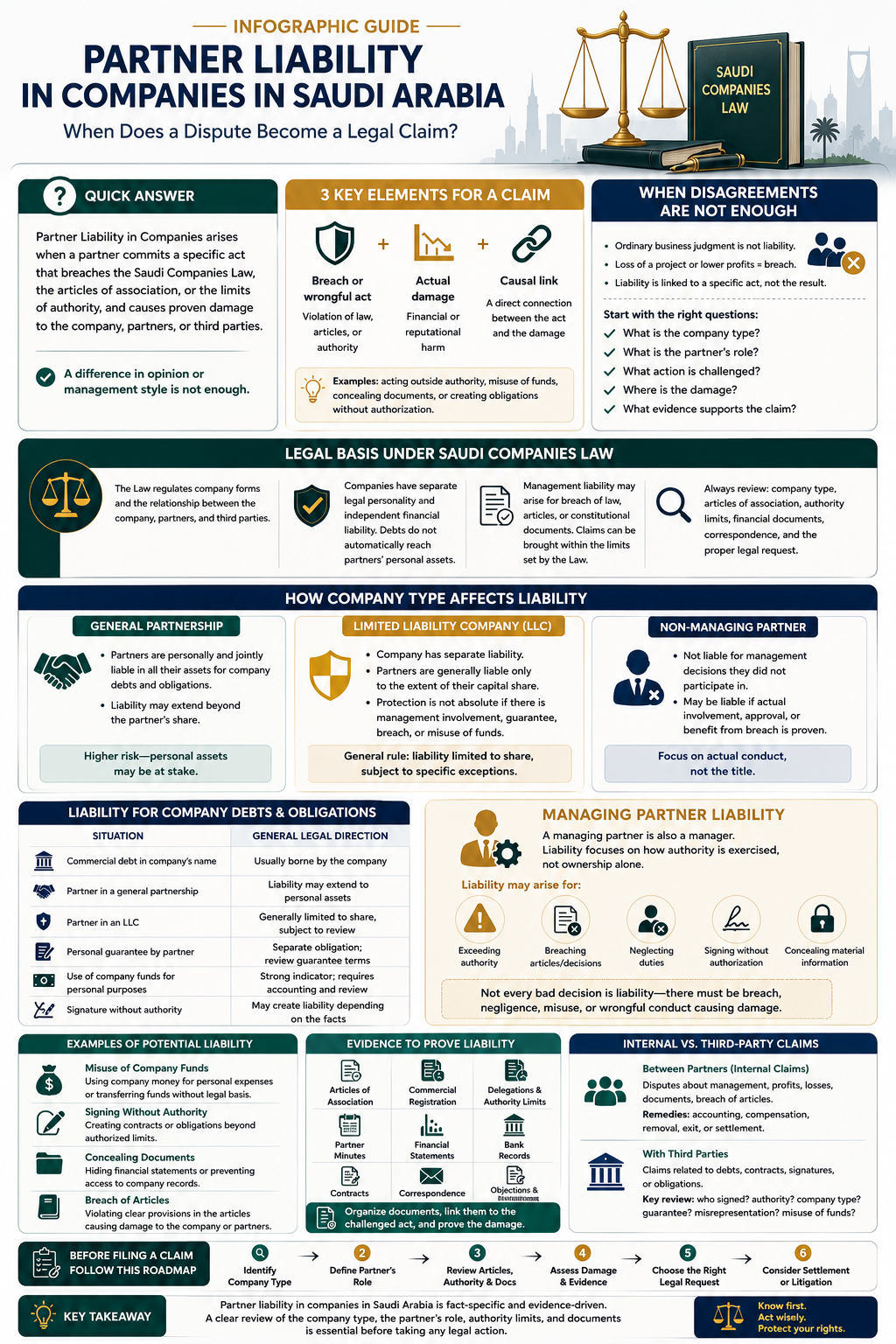
Partner Liability in Companies arises when there is a specific act that breaches the Saudi Companies Law, the articles of association, or the limits of authority, and that act causes damage that can be proved against the company, the partners, or third parties. A difference in opinion or management style is not enough by itself.
Are you concerned that a partner dispute may expose the company, your share, or even your personal assets? Before taking any step, a structured legal review can clarify the company type, the partner’s role, the authority limits, and the evidence needed to decide whether the right path is accounting, compensation, settlement, or another legal route.
Prefer to understand the legal framework first? You can continue reading the article calmly.
For a dispute to become a legal claim, three elements should usually appear: a breach or wrongful act, actual damage, and a causal link between the act and the damage. For example, a claim may become serious if a partner acts outside authority, uses company funds for personal purposes, hides material documents, or creates obligations without proper authorization.
When Are Disagreements Not Enough?
Disagreements are not enough when they reflect ordinary business judgment. A company may lose a project or experience lower profits without that result proving that a partner acted unlawfully.
Liability is not built on the result alone. It must be linked to a specific act or omission. The correct starting point is not simply asking who is at fault. The better questions are: What type of company is involved? What was the partner’s role? What action is being challenged? Where is the damage? What evidence supports the claim?
Legal Basis Under Saudi Companies Law
Saudi Companies Law regulates company forms and their legal effects, including the relationship between the company, its partners, and third parties. It distinguishes between company types, such as general partnerships and limited liability companies, because each form affects partner liability in companies in Saudi Arabia differently.
In many companies, the company has a separate legal personality and an independent financial liability. This means that the company’s debts do not automatically become personal debts of every partner. However, this principle is affected by the company type, the role exercised by the partner, and whether the partner committed a breach, gave a personal guarantee, or mixed personal funds with company funds.
The official Companies Law also regulates management liability where the law, the articles of association, or the company’s constitutional documents are breached. It gives the company, and in certain cases a partner or shareholder, a route to bring a liability claim within the limits set by law.
The company form must first be identified. Then the articles of association should be reviewed, followed by the authority limits, financial documents, correspondence, and the proper legal request.
How Company Type Affects Liability
Partner liability in companies in Saudi Arabia starts with identifying the company type. A partner in a general partnership is not in the same position as a partner in a limited liability company. A managing partner is also not treated the same way as a non-managing partner.
Liability in a General Partnership
A general partnership is one of the clearest forms where personal and joint liability may appear. A partner in this type of company is not merely a passive investor. The partner’s personal standing and trust are closely connected to the company’s obligations.
Under the Saudi Companies Law, a general partnership is formed by two or more persons, and the partners are personally and jointly liable in all their assets for the company’s debts and obligations.
For this reason, a dispute in a general partnership requires careful assessment. The effect of a partner’s conduct may not stop at the partner’s share in the company. It may extend to personal assets depending on the nature of the obligation. For a more detailed explanation, see the article on General Partnership in Saudi Law.
Liability in a Limited Liability Company
In a limited liability company, the general principle is that the company’s financial liability is separate from the partner’s personal financial liability. The company is responsible for the debts and obligations arising from its business, while the partner is generally liable only to the extent of the partner’s share in the capital.
This principle does not mean that protection is absolute in every case. If the partner takes part in management, gives a personal guarantee, acts outside authority, or mixes personal funds with company funds, the facts may require closer legal review.
Liability of a Non-Managing Partner
A non-managing partner is not usually liable for every management decision in which the partner did not participate. If the partner’s role is limited to ownership of a share and the partner does not manage, sign, instruct employees, or interfere with daily operations, that position differs from the position of a managing partner.
However, liability may still be considered if actual involvement is proved. This may include approving a wrongful act, benefiting from a breach, issuing instructions in practice, or participating in conduct that harms the company or other partners. The legal assessment depends on documents and actual conduct, not labels alone.
Liability for Company Debts
One of the most common questions is whether a partner is personally liable for company debts. The answer is not the same in all companies. It depends on the company type, the partner’s role, the existence of a personal guarantee, and whether there has been a breach, misuse, or mixing of funds.
In a general partnership, personal and joint liability is more direct. In a limited liability company, the general rule is that debts remain within the company’s own financial liability, subject to special cases that require review.
A distinction must also be made between a debt owed by the company and a debt owed by the partner. A debt is usually a company debt when it arises in the company’s name, within its business, and through proper authority. A debt may reach the partner if the partner signed as guarantor, acted personally, acted outside authority, or created facts that justify personal responsibility.
| Situation | General Legal Direction |
|---|---|
| Commercial debt in the company’s name | Usually borne by the company |
| Partner in a general partnership | Liability may extend to personal assets |
| Partner in an LLC | Generally limited to the share, subject to review |
| Personal guarantee by the partner | Separate obligation requiring review |
| Use of company funds for personal purposes | Strong indicator requiring accounting review |
| Signature without authority | May create liability depending on the facts |
Managing Partner Liability
A managing partner should be assessed from two angles: as a partner who owns a share, and as a manager who exercises authority. This combination makes the assessment more precise, because the issue may not be ownership itself, but the way management powers were exercised.
Managing partner liability often turns on the duty of care, acting in the company’s interest, respecting authority limits, and complying with the articles of association and partner resolutions. If the managing partner acts without proper authority, neglects material obligations, or signs contracts beyond the approved limits, liability may arise according to the damage caused.
Saudi Companies Law regulates liability claims against managers or board members where there is a breach of the law, the articles of association, or the company’s constitutional documents, or where management errors cause harm. The law also provides routes for the company, and in certain cases the partner or shareholder, to pursue the claim.
When Is a Managing Partner Liable?
A managing partner may be liable when authority is exceeded, the articles of association are breached, a material duty is neglected, obligations are signed without authorization, or important information is withheld from partners.
However, not every unsuccessful commercial decision creates liability. A manager may make a legitimate business decision that does not produce the expected result. Liability appears when the decision is unlawful, negligent, unauthorized, or inconsistent with the required standard of management.
Partner vs. Managing Partner
A partner owns a share in the company. A managing partner owns a share and exercises management. For that reason, it is not enough in a claim involving partner liability in companies in Saudi Arabia to say that the person is a partner. The claim should explain whether the person managed, signed, authorized, instructed, prevented access to documents, or caused damage.
This distinction is important. A claim against a non-managing partner without evidence may be weak. A claim against a managing partner supported by documents may be more specific and easier to assess.
When Does a Dispute Become a Claim?
A dispute between partners becomes a legal claim when it can be proved and measured. This usually requires a specific breach, visible damage, supporting documents, and a clear request that can be presented to the competent authority.
The breach may involve exceeding authority, breaching the articles of association, using company funds, hiding accounts, or signing obligations without authorization. The damage may be financial loss, an unjustified obligation, deprivation of profit, or disruption to the company’s management.
Documents are often the dividing line. A claim based on a general loss of trust is different from a claim supported by articles of association, commercial registration records, bank statements, correspondence, meeting minutes, and financial reports.
The request must also be defined. Is the requested remedy accounting, compensation, removal of a manager, access to documents, or a structured settlement? A vague request may make the process longer and less effective.
Practical point: do not start with a broad claim against a partner. Start by describing the act, identifying the company type, defining the partner’s role, proving the damage, and choosing the right legal route.
Practical Examples of Partner Liability in Companies
These examples do not mean that the result will be the same in every case. They help explain when a normal dispute may become a potential liability issue.
Use of Company Funds
If a partner or managing partner uses company funds for personal expenses, transfers amounts without a legal basis, or mixes company expenses with personal expenses, the matter may become suitable for accounting review and potential claim.
The issue is not the existence of disagreement. The issue is the possible violation of the company’s separate financial liability.
Signature Without Authority
In cases involving partner liability in companies in Saudi Arabia, a partner may sign a contract or obligation in the company’s name without being authorized to do so. In that case, the articles of association, partner resolutions, commercial registration records, and delegation documents must be reviewed.
If the signature was outside authority and caused damage, liability may arise against the person who carried out the act.
Concealing Accounts or Documents
Hiding financial statements or preventing partners from reviewing documents may indicate an administrative or financial problem. The first step may not always be a compensation claim. It may be an accounting request, access to documents, or an independent financial review, depending on the facts.
Breach of the Articles
The articles of association define shares, management, authority, decision-making, and the distribution of profits and losses. If a partner or managing partner breaches a clear provision and damage follows, the articles become a central document in proving the breach.
Evidence Needed to Prove Liability
Proving partner liability in companies in Saudi Arabia requires documents, not general statements. The more organized the file is, the easier it becomes to assess the legal route.
Key evidence may include:
| Evidence | Why It Matters |
|---|---|
| Articles of association | Defines shares, authority, and obligations |
| Commercial registration | Proves company data and managers |
| Delegations | Shows signing and management limits |
| Partner minutes | Proves approval or objection |
| Financial statements | Shows losses or financial conduct |
| Bank statements | Tracks transfers and payments |
| Correspondence | Proves notice, knowledge, or objection |
| Contracts | Shows obligations created for the company |
| Previous objections | Supports the position of the affected partner |
Internal Claims vs. Third-Party Claims
Understanding the difference between internal claims and third-party claims prevents confusion in drafting requests. The relationship between partners has one legal character, while the relationship between the company and creditors or counterparties has another.
Claims Between Partners
An internal claim usually concerns management, profits, losses, access to documents, breach of the articles, and allocation of responsibilities. The claim may involve accounting, compensation, removal of a manager, exit arrangements, or financial settlement.
This type of claim must explain the connection between each partner and the disputed act. Not every partner is liable for every mistake within the company.
Claims by Third Parties
A third-party claim is usually connected to a debt, contract, signature, or obligation created between the company and an external party. The review should ask: who signed? In whose name was the obligation issued? Was the signatory authorized? What is the company type? Is there a personal guarantee, misrepresentation, or mixing of funds?
This distinction matters because a third-party claim may remain against the company in some cases, while in other cases it may reach a partner, depending on the company type, the facts, and the documents.
Professional Note Before Filing a Claim
Before filing a claim related to partner liability in companies in Saudi Arabia, the file should be reviewed in an organized manner. The starting point is not drafting a statement of claim. It is document review.
First, identify the company type: general partnership, limited liability company, or another form. Then identify the partner’s role: manager, non-manager, authorized signatory, guarantor, or actual participant in management.
Next, review the articles of association, commercial registration, delegations, and financial documents. The damage should then be defined clearly. Is there a specific amount? Is the loss provable? Is the proper request compensation, accounting, removal, access to documents, or settlement?
In some cases, a professional accounting review or settlement may be better than filing a direct liability claim. In other cases, litigation may be necessary to protect the company, the partner, or third parties.
Partner liability in companies in Saudi Arabia does not arise from disagreement alone. It requires a specific legal basis: the company type, the partner’s role, the scope of authority, the act being challenged, the damage, and the evidence.
Before turning a dispute into a claim, the articles of association, commercial registration, financial documents, and correspondence should be reviewed. Where a live dispute needs legal assessment, a professional review of the facts and documents can help determine the most suitable route before any step is taken.
Frequently Asked Questions on Partner Liability in Companies
When does partner liability arise in Saudi companies?
It arises when a specific breach or wrongful act causes provable damage to the company, the partners, or third parties.
Is every partner personally liable for company debts?
No. The answer depends on the company type, the partner’s role, and whether there is a personal guarantee, breach, or special circumstance.
What is the key risk in a general partnership?
In a general partnership, the partner may be personally and jointly liable for company debts and obligations.
Is an LLC partner personally liable?
The general rule is that an LLC partner’s liability is limited to the partner’s share, subject to specific facts that may require review.
When does a partner dispute become a legal claim?
It becomes a claim when there is a specific breach, provable damage, supporting evidence, and a clear legal request.
What is the difference between a partner and a managing partner?
A partner owns a share. A managing partner owns a share and exercises management powers, so management conduct must also be reviewed.
Can a partner claim compensation from another partner?
Yes, if breach, damage, and causation can be proved through documents and the applicable legal basis.
What documents help prove partner liability?
Important documents include the articles of association, commercial registration, delegations, financial statements, bank records, contracts, and correspondence.
Does a breach of the articles justify a claim?
It may justify a claim if the breach is clear and causes provable damage.
Is WhatsApp correspondence enough as evidence?
It may support the file, but it should usually be connected with contracts, financial records, decisions, or other documents.
Official Sources: