In Saudi Arabia, partner removal from a general partnership is not a simple update to names in the articles of association or the commercial register. A general partnership is based on personal trust, and each partner may be personally and jointly liable for the company’s debts and obligations.
The issue becomes more sensitive when the exit is disputed, when the remaining partners want to remove
a partner, or when a new partner joins without reviewing existing debts, contracts, bank obligations, and active claims.
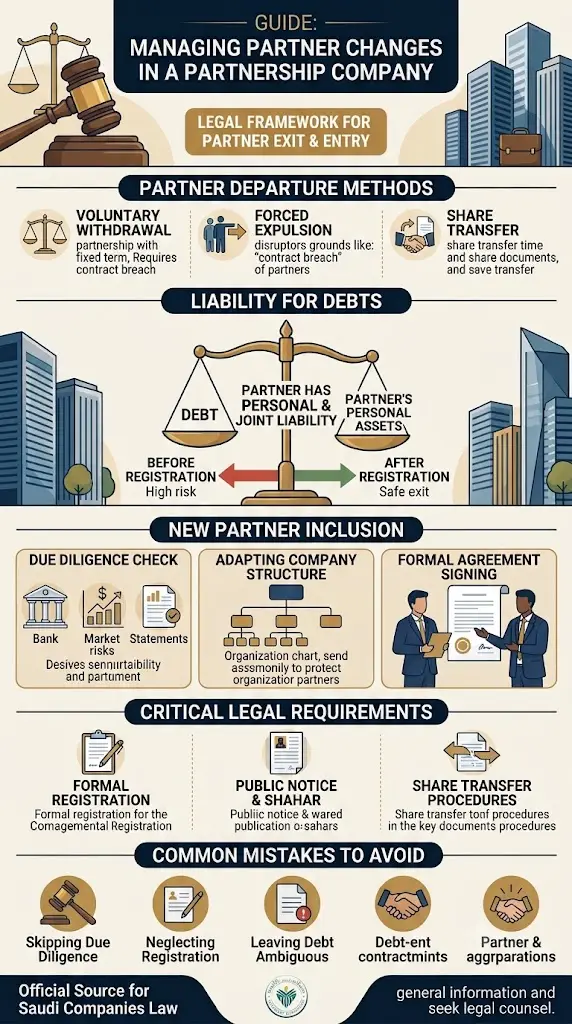
This guide explains when a partner may enter or leave a general partnership, how the change affects debt liability, why registration and publication matter, and what should be reviewed before signing. For the wider legal framework, see the guide on Saudi Companies Law.
Practical Answer
A partner may enter a general partnership by contributing a new share or by receiving an existing share under the required legal controls. A partner may leave through withdrawal, removal, or assignment of a share.
Concerned that admitting or removing a partner may leave you exposed to old debts, disputed shares, or registration issues? A focused legal review can help you understand the safer route before signing, by checking the partnership agreement, debt position, partner authority, publication requirements, and continuity of the company.
Prefer to understand the rules first? Continue reading the guide calmly.
For this reason, partner removal from a general partnership affects more than the internal relationship between partners. It may affect debt liability, registration and publication, third-party reliance, and the company’s ability to continue after the change.
The main question is not whether a partner’s name can be added or removed. The main question is whether the change has been documented, registered, published, and reviewed against the company’s existing obligations.
Admitting a New Partner
When a new partner joins a general partnership, the partner enters a legal position that may carry wide financial consequences. If the partner joins with a new share, liability may extend to debts that existed before admission and to debts created after admission.
In practice, admitting a new partner should start with a debt review, not with commercial expectations. Expected profit, asset value, and verbal trust cannot replace a review of contracts, bank obligations, supplier claims, and pending liabilities.
The partners may agree to exempt the new partner from previous debts. That agreement should be written and aligned with registration and publication requirements so its effect can be assessed against creditors and third parties.
Liability for Previous Debts
Previous debts are often the main risk for a new partner. They may appear in supply contracts, loan documents, unpaid invoices, continuing guarantees, or claims that are not clear from a short financial summary.
Before a new partner joins, the partner should request documents that show the company’s real financial position before signing. A debt that started before admission may still create exposure after the partner joins.
If the parties agree on an exemption from previous debts, the wording should be clear. The timing of registration and publication should also be checked because creditors may rely on the company’s official records.
Documents to Review Before Admission
The document review should include the articles of association, amendments to the commercial register, partner resolutions, financial statements, debt schedules, active contracts, banking obligations, and material correspondence with creditors or suppliers.
Documents are not a secondary step in a partner-change file. They are the basis for identifying who bears past debts, what obligations continue, and whether the incoming partner will also have management or signing authority.
The review should also examine whether the new partner will hold only an ownership share or will take part in management. Management powers may increase practical exposure if the partner signs contracts or represents the company before third parties.
Removing a Partner from a General Partnership
Partner removal is not justified by personal disagreement alone. It usually requires a clear reason, supporting evidence, and a legal basis in the articles of association or the relevant facts.
In the context of partner removal from a general partnership, removal should be treated as a serious legal step. It may affect the partner’s share, debt exposure, voting position, and relationship with creditors or suppliers.
Possible reasons may include breach of essential obligations, obstruction of necessary decisions, misuse of authority, conflict of interest, or conduct that harms the company. These reasons must be supported by documents, not by general dissatisfaction.
Removing a Partner Without Consent
Removing a partner without consent is the most sensitive route. If the partner refuses to leave, the remaining partners should review the articles of association, meeting minutes, correspondence, financial records, and evidence of the reason for removal.
The outcome may require a formal or judicial route depending on the facts. After removal, the company should still deal with valuation, previous debts, later debts, amendment of the articles, registration, and publication.
Removal is also different from a liability claim. Removal focuses on ending the partner’s relationship with the company. A liability claim focuses on fault, damage, and compensation. The same facts may support both routes, but the legal purpose is not the same.
Admission, Withdrawal, Removal, and Assignment
These routes should not be treated as one procedure. Admission brings a partner into the company. Withdrawal is a voluntary exit. Removal usually responds to a reason that justifies ending the partner’s relationship. Assignment transfers a share to another person.
| Route | Main Use | Main Legal Effect |
|---|---|---|
| Admission | Bringing in a new partner or restructuring ownership | May create liability for previous and later debts |
| Withdrawal | Voluntary exit by a partner | Requires review of previous debts and publication |
| Removal | Ending a partner’s relationship for a legal reason | May require evidence and a formal route |
| Assignment | Transferring a share | Requires review of assignor, assignee, and creditors |
A wrong classification may leave responsibility in place even when the partner believes the exit is complete. The route should be chosen after reviewing documents, debts, and creditor position.
Registration and Publication
Registration and publication in the commercial register are not minor formalities. They are the way the change becomes visible to third parties who deal with the company.
For partner removal from a general partnership, internal agreement alone may not be enough. Creditors and suppliers often rely on the company’s official records, including the identity and status of partners.
If registration and publication are delayed, a dispute may arise over when liability started or ended. This is especially important when a new partner is exempted from previous debts, or when an outgoing partner wants to avoid liability for debts created after exit.
If Registration and Publication Are Not Completed
If the change is not registered and published, it may remain effective only between the partners and may be difficult to rely on against third parties. A partner may have signed an exit agreement but still appear in official records.
The correct process should include amending the articles of association, updating the commercial register, publishing the change, reviewing debts, and keeping proof of any necessary notices.
Partner Liability for General Partnership Debts
Debt liability is the central issue in a general partnership. The risk is not limited to the capital contribution. It may extend to the partner’s personal assets according to the nature of this company form.
For partner removal from a general partnership, the analysis should separate previous debts from later debts. It should also review the date of admission or exit, registration and publication, creditor position, and any written release.
A new partner should review existing debts, long-term contracts, pending claims, and banking obligations. An outgoing partner should review the exit date, publication date, previous debts, and whether creditors have given any required release.
For a broader discussion, see partner liability in companies in Saudi Arabia.
Liability of the New Partner
A new partner who joins with a new share may be exposed to both previous and later debts. Any agreed exemption from old debts should be documented and checked against registration and publication requirements.
The review should not focus only on profits. A single unpaid contract, bank facility, or supplier claim may be more important than the value of the share being acquired.
Liability of the Outgoing Partner
An outgoing or removed partner does not leave all debt risk automatically. Debts created before exit may still require review. Debts created after proper registration and publication of exit are treated differently.
In this context, the date of the debt and the date of publication are often decisive. Assignment of a share also requires separate review because liability may depend on the assignor, assignee, and creditors.
Can the General Partnership Continue After Exit?
A general partnership may continue after one partner leaves if more than one partner remains, unless the articles of association provide otherwise. The issue becomes serious when only one partner remains.
If only one partner remains, the company’s position must be corrected within the legal period. This may require admitting another partner or converting the company into another available legal form.
The exit plan should therefore be prepared before signing. It should address the partner’s share, debt position, amendment of the articles, registration, publication, and continuity of the company.
Valuing the Outgoing Partner’s Share
When a partner withdraws or is removed, the value of the outgoing partner’s share should be determined clearly. The review should identify the valuation date, the method of valuation, and the rights or obligations included in the calculation.
Valuation should consider assets, liabilities, debts, active contracts, financial statements, and current accounts between partners. This prevents mixing financial periods and reduces later disputes.
The outgoing partner should not bear or benefit from results unrelated to the period of participation unless those results are connected to transactions that existed before exit.
Common Mistakes Before Partner Changes
In files involving partner removal from a general partnership, most mistakes come from treating the change as a quick administrative amendment. The legal and financial effect may be much wider.
- Admitting a new partner without reviewing previous debts.
- Removing a partner without a clear reason or supporting evidence.
- Relying on a private agreement without registration and publication.
- Confusing withdrawal with assignment.
- Failing to value the outgoing partner’s share.
- Ignoring creditor position.
- Allowing only one partner to remain without a correction plan.
When Legal Review Is Needed
Legal review is needed when there are existing debts, important contracts, partner disputes, refusal to leave, disagreement over share value, creditor concerns, or a risk that only one partner will remain.
Before partner removal from a general partnership, the review should start with the articles of association, debts, commercial register, company obligations, management powers, and the reason for admission or exit.
The review is especially important when the new partner will hold a major share or take a management role. It is also important when the company has long-term contracts, supplier exposure, bank obligations, or unresolved partner disputes.
FAQ About partner removal from a general partnership
What does partner removal from a general partnership mean?
It means ending a partner’s relationship with the company through a legal route based on the articles of association, the facts, or a competent decision. It should be supported by evidence.
Can a new partner be liable for previous debts?
Yes. A new partner may be exposed to previous debts depending on the legal rules, documents, and registration and publication status. Any exemption should be reviewed carefully.
Is a private agreement enough to release a partner from liability?
A private agreement may regulate the partners’ internal relationship, but it may not be enough against creditors or third parties without the required legal steps.
What is the difference between withdrawal and assignment?
Withdrawal is a partner’s exit from the company. Assignment is the transfer of a share to another person. Each route has different effects on debts and company records.
What happens if only one partner remains?
The company’s position must be corrected within the applicable legal period. This may require admitting another partner or converting the company into another legal form.
What documents should be reviewed?
The main documents include the articles of association, commercial register, partner resolutions, financial statements, debts, contracts, banking obligations, and creditor correspondence.
Legal Content Review: This article provides general information on partner changes in a general partnership in Saudi Arabia. It is not legal advice for a specific case. The result may differ depending on the articles of association, debt date, method of exit, registration and publication, creditor position, and available documents.
Conclusion
A partner change in a general partnership is not a simple name change. It affects liability, debts, company continuity, and the position of third parties who deal with the company.
The correct approach starts with the articles of association, then debts, then the route of admission or exit, and then registration and publication.
For partner removal from a general partnership, the strongest position is built before signing: clear documents, debt review, valuation, creditor analysis, and a completed registration process.
Official Sources: