A liability claim under Companies Law is not used for every dispute between partners. It is also not a tool to challenge management simply because the company lost money in a transaction or project. This claim becomes relevant when a specific act or omission can be linked to the manager or board members, and that conduct causes provable damage.
To understand the wider legal framework behind this topic, you can first review Saudi Companies Law in Saudi Arabia.
Practical Answer: When Does a Liability Claim Become Relevant?
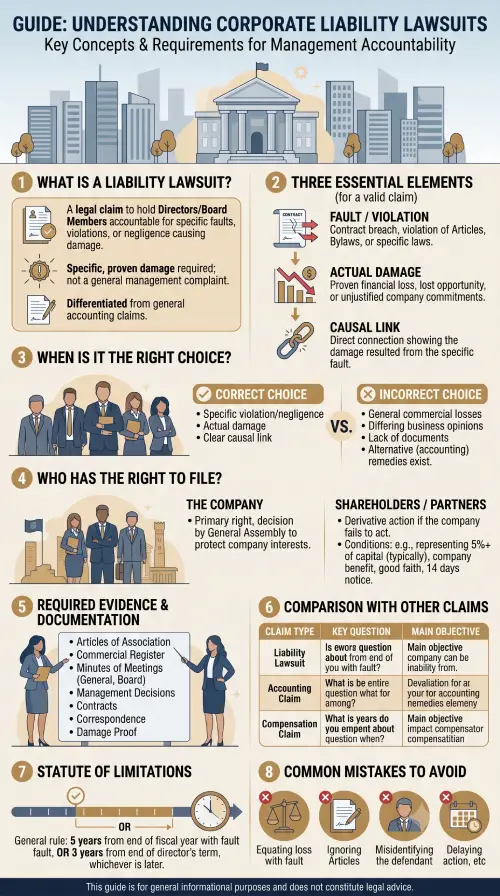
A liability claim under Companies Law becomes relevant when three connected elements exist: wrongful conduct or negligence by management, actual damage, and a clear link between the conduct and the damage.
Saudi Companies Law allows the company to bring a liability claim against managers or board members when they breach the law, the articles of association, or the company’s bylaws, or when their fault, negligence, or failure to perform their duties causes damage to the company.
The practical rule is simple: loss alone is not enough. A manager may make a commercial decision based on available information, but market conditions may later change. In that situation, liability does not arise merely because the result was poor.
Liability may need to be examined when the decision was outside the manager’s authority, ignored the company’s interest, breached the articles of association, or involved the concealment of material information.
The first review should focus on documents, not on general dissatisfaction with management.
What Is a Liability Claim under Companies Law?
A liability claim under Companies Law is a legal claim used to hold a manager or board member accountable for fault, breach, negligence, or failure to perform a duty that caused damage.
The claim may arise where management breaches Saudi Companies Law, the articles of association, the company’s bylaws, or the duties attached to their position. The fault may be an active act, such as signing a contract without proper authority. It may also be an omission, such as failing to take a necessary step to protect the company’s rights.
The claim does not take one form only. The company may bring it when the damage affects the company’s assets, rights, or financial position. A partner or shareholder may also have standing in certain cases, either when the company fails to act or when the partner or shareholder suffers a separate personal damage.
When Is a Liability Claim Not the Right Route?
A liability claim under Companies Law is not the right route when the dispute is only a disagreement between partners about a business decision. It is also not the right route where the loss resulted from ordinary market risk, or where there are no documents linking management conduct to the alleged damage.
The claim should not replace an accounting claim when the real issue is access to financial records. If a partner does not know where the money went, or needs to review financial entries, expenses, or transactions, an accounting or document-access route may be more suitable at the first stage.
A liability claim also should not be used as a shortcut for every internal corporate dispute. If the issue concerns partner liability, partner conduct, or company debts, the legal analysis may be different from a claim against a manager or board member.
Who May Be Subject to a Liability Claim?
A liability claim may be directed against the manager, board members, a managing partner, or a liquidator, depending on the company structure and the facts of the dispute.
A company manager may be questioned when they have authority to manage, sign, represent the company, or implement decisions, and their conduct causes damage to the company, a partner, or a shareholder. The title of “manager” alone is not enough. The claim must identify what the manager did, or failed to do.
Board members may be questioned when the damage is connected to a board decision, failure of oversight, breach of duties, or improper management. In these cases, minutes of meetings, voting records, and recorded objections are important because they show who participated in the decision and who objected.
A managing partner requires careful analysis. The person is not questioned merely because they are a partner. Liability arises from the management role, use of authority, or conduct that affected the company. This is why partner status must be separated from management responsibility.
A liquidator may also be subject to liability where errors during liquidation cause damage. Saudi Companies Law includes specific rules related to claims against a liquidator after the company is removed from the commercial register, except in cases such as forgery or fraud.
How Does Manager or Board Liability Arise?
Manager or board liability arises when three elements come together: fault or breach, damage, and causation.
Fault may involve a breach of Saudi Companies Law, the articles of association, the company’s bylaws, the manager’s authority, or the duties of management. Negligence may also arise where the manager fails to take a necessary step, such as neglecting a clear financial claim until it becomes difficult or impossible to recover.
Damage is the effect suffered by the company, partner, or shareholder, depending on the type of claim. It may be financial loss, loss of a right, an unnecessary obligation imposed on the company, or harm to the company’s position because of improper conduct.
Causation connects the fault to the damage. It is not enough to show a separate fault and a separate loss. The damage must be the result of the conduct attributed to the manager or board members. If the damage was caused by an external event unrelated to management conduct, the claim may become weaker.
Administrative Fault and Commercial Risk
Commercial risk may be acceptable when the manager acts within their authority, uses available information, and seeks the company’s interest. The decision may still fail, but failure by itself does not create liability.
Administrative fault appears when the manager acts outside their authority, ignores clear documents, enters into a transaction involving an unmanaged conflict of interest, or fails to take a necessary step to protect the company.
For example, a company may enter a new market and lose money because market conditions changed. That alone is not enough. But signing a major contract without authorization, hiding a material financial obligation from the partners, or failing to collect a confirmed debt until it is lost may require a liability review.
Who Has the Right to File a Liability Claim?
The company is generally the party entitled to file a liability claim under Companies Law when the damage affects the company itself. The decision to file the claim and appoint a representative depends on the company’s legal form and governance structure.
Saudi Companies Law also gives partners or shareholders a route when the company fails to protect its rights. A partner or shareholder, or more than one, representing at least 5% of the company’s capital may file the company’s liability claim if the company does not do so, unless the articles of association or bylaws set a lower percentage. The claim must be in the company’s interest, based on valid grounds, and filed in good faith. The manager or board members must also be notified of the intention to file the claim at least 14 days before filing.
There is also a different type of claim: a personal claim. This is not filed on behalf of the company. It is filed where the partner or shareholder suffers a special damage that is separate from the general damage suffered by the company.
This distinction affects the legal result. In a company claim, the compensation belongs to the company. In a personal claim, the claim relates to the person who suffered the separate damage.
Conditions for a Liability Claim under Saudi Companies Law
A liability claim under Companies Law should meet four practical conditions before it is suitable for legal review:
- Fault or breach: This may include exceeding authority, breaching the articles of association, or neglecting a necessary duty.
- Damage: The damage must be provable, not merely an assumption or dissatisfaction with management.
- Causation: The damage must result from the conduct attributed to the manager or board members.
- Serious interest and good faith: The claim should not be used to pressure management or disrupt the company.
The stronger the documents supporting these elements, the more accurate the legal framing becomes. Weak claims often begin with broad accusations. Strong claims begin with a specific act, a date, a document, and a measurable effect.
What Evidence Is Needed Before Filing the Claim?
A liability claim is document-driven. It should be prepared through records that show authority, decisions, conduct, and damage.
Important evidence may include:
- The articles of association or company bylaws.
- The commercial registration and manager details.
- Partners’ resolutions or general assembly minutes.
- Board or managers’ council minutes.
- Manager decisions and authorizations.
- Financial statements and auditor reports.
- Contracts related to the dispute.
- Correspondence, emails, and business messages.
- Documents proving the damage, its value, and its timing.
The existence of these documents does not mean that the claim will necessarily succeed. It means the file can be reviewed properly. General statements such as “management was poor” or “the manager caused losses” are usually not enough.
A financial or accounting report may be needed where the damage is financial, connected to accounting conduct, asset valuation, or undisclosed liabilities. The purpose of the report is not to decorate the claim. It is to connect the numbers to the facts.
Difference between a Liability Claim, an Accounting Claim, and a Compensation Claim
A liability claim, an accounting claim, and a compensation claim may overlap in corporate disputes, but they are not the same. Each route answers a different legal question: Do we need to uncover the accounts? Do we need to prove management fault? Or do we need to claim financial compensation?
| Point of Comparison | Liability Claim | Accounting Claim | Compensation Claim |
|---|---|---|---|
| Main question | Who was at fault, and did that fault cause damage? | Where did the money go, and what financial actions took place? | What is the value of the damage to be compensated? |
| Purpose | To hold a manager or board member accountable for fault, negligence, or failure to perform duties | To uncover accounts, entries, expenses, income, and disputed transactions | To seek financial compensation for proven damage |
| Main focus | Fault, damage, and causation | Books, records, expenses, income, transfers, and financial entries | Damage value and the legal basis for compensation |
| When used | When management conduct caused damage | When accounts are unclear or financial records are withheld | When damage is proven and needs to be compensated |
| Key documents | Articles of association, resolutions, authorizations, financial statements, correspondence | Books, financial statements, bank statements, invoices, accounting entries | Evidence of damage, value, and connection to the act |
| Possible outcome | Finding liability or awarding compensation if liability is proven | Disclosure of accounts or delivery of financial records | Awarding financial compensation |
| Common mistake | Filing it without proving damage or causation | Using it instead of a liability claim when fault is already clear | Claiming compensation without explaining the legal basis |
Some files may start with an accounting claim when the numbers are unclear. A liability claim may appear later if the accounting process reveals fault or negligence. A compensation claim may then follow as the result of proven damage.
The correct route should be chosen after reviewing the documents. The key question is whether the problem is unclear accounts, management fault, or damage valuation. This distinction makes the claim more precise.
Limitation Period for a Liability Claim
The limitation period is a key practical point in a liability claim under Companies Law. A file may be strong on the facts but still become weaker if action is delayed.
Under Saudi Companies Law, except in cases of forgery or fraud, a liability claim is not heard after five years from the end of the financial year in which the harmful act occurred, or three years from the end of the manager’s work or the board member’s membership, whichever is later.
This rule requires careful application. The review must identify the date of the harmful act, the relevant financial year, and the date on which the manager’s work or board membership ended. It must also consider whether the facts involve forgery or fraud, because these situations are treated differently under the rule.
Knowing the period in theory is not enough. The dates must be connected to the actual company documents. A timeline of events should be prepared before filing the claim or responding to it.
Personal Liability and Joint Liability for Company Debts
As a general rule, the company has its own financial liability according to its legal form. Company debts do not automatically move to the manager or partner merely because the company is indebted or financially distressed.
A liability claim focuses on fault, negligence, or failure to perform a duty that caused damage. Joint liability for company debts, or personal liability for company obligations, requires a separate legal basis or a specific statutory situation.
For this reason, the phrase “the manager is liable for company debts” should not be used without explanation.
There may be statutory situations that create special responsibility, such as false or misleading statements in financial reports, lists, or documents related to the company’s financial position in specific contexts. But these issues require careful legal framing. Liability for management fault is not always the same as liability for company debts, and joint liability is not an automatic result of every management error.
Common Mistakes before Filing a Liability Claim
Some recurring mistakes weaken liability claims before they start. The most common mistake is treating every business loss as management fault. This weakens the file because the loss may have resulted from market conditions or legitimate commercial risk.
Other common mistakes include:
- Ignoring the articles of association or bylaws when reviewing authority.
- Filing the claim against a person who does not have the correct legal capacity.
- Confusing a liability claim with an accounting or compensation claim.
- Ignoring limitation periods.
- Relying on general messages without financial records, resolutions, authorizations, or reports.
These mistakes do not always mean that the right is lost. They do mean that the legal framing becomes weaker and that document review becomes more important before taking action.
When Do You Need Legal Review before Filing?
Before filing a Liability Claim under Companies Law, legal review is important when there is clear financial damage, a disputed management decision, refusal to deliver documents, suspected concealment of information, disagreement over who represents the company, or an approaching limitation period.
Before turning a corporate dispute into a liability claim, the review should start with the articles of association, meeting minutes, financial statements, and authorizations. Only then can the file be assessed as a liability claim or another legal route.
The purpose of legal review is not to push every dispute to court. It is to choose the correct path. The issue may be better suited to an accounting claim, a compensation claim, an objection to a decision, a documented settlement, or an internal corporate action that protects the company.
Frequently Asked Questions about a Liability Claim under Companies Law
What is a liability claim under Saudi Companies Law?
It is a claim used to hold a manager or board member accountable when a breach, fault, negligence, or failure to perform duties causes damage.
When can a liability claim be filed against a company manager?
It may be filed when an act or omission by the manager causes clear damage and there is a causal link between the conduct and the result.
Is company loss enough to prove liability?
No. A commercial loss alone is not enough. The loss must be connected to fault, negligence, failure to perform a duty, or a provable breach.
Who may file a liability claim?
The company may file the claim when it suffers the damage. A partner or shareholder may also file it in specific cases, especially where the company fails to act or where there is special personal damage.
When can a partner file the claim on behalf of the company?
A partner or shareholder may file the company’s liability claim if the statutory percentage and conditions are met, including good faith, company interest, and prior notice.
What are the main conditions for the claim?
The main conditions are fault or breach, provable damage, causation, correct legal capacity of the defendant, and a serious interest in filing the claim.
What evidence strengthens the claimant’s position?
Important evidence includes the articles of association, bylaws, meeting minutes, management decisions, financial statements, authorizations, contracts, and correspondence.
How is administrative fault different from commercial risk?
Commercial risk may result from a professional decision affected by market conditions. Administrative fault involves breach, negligence, acting outside authority, or ignoring the company’s interest.
Is the manager personally liable for company debts?
Not always. Company debts generally relate to the company’s own financial liability, but specific statutory situations may create personal or joint liability.
What is the difference between a liability claim and an accounting claim?
An accounting claim focuses on uncovering accounts and financial transactions. A liability claim focuses on holding a manager or board member accountable for fault that caused damage.
Conclusion
A liability claim under Companies Law is not a pressure tool in every corporate dispute. It is also not an automatic result of every business loss. It is a precise legal route based on fault, breach, negligence, or failure to perform a duty, together with provable damage and causation.
The strength of the claim starts with documents: the articles of association, bylaws, meeting minutes, authorizations, financial statements, contracts, and correspondence. General dissatisfaction with management is not enough.
Before filing or responding to the claim, it is necessary to identify the company type, the responsible person’s legal capacity, the type of damage, the limitation period, and the most suitable legal route. The correct route may be a liability claim, an accounting claim, a compensation claim, an internal corporate action, or a documented settlement.
Official Sources: