Wife Commercial Registration in Saudi Arabia is not a problem by itself. It is also not a legal shield by itself. The correct legal view depends on the real facts behind the registration.
If the wife is the real owner of the activity, funds it, manages it, understands its obligations, and controls its decisions, the position is different from a case where the wife says: “My husband wants to open a commercial registration in my name,” while the husband is the real manager, financier, authorised signatory, or actual beneficiary.
Before opening any registration, it is important to understand Commercial Registration in Saudi Arabia as the official record that connects the business activity, the registered owner, and the legal effects of carrying on business.
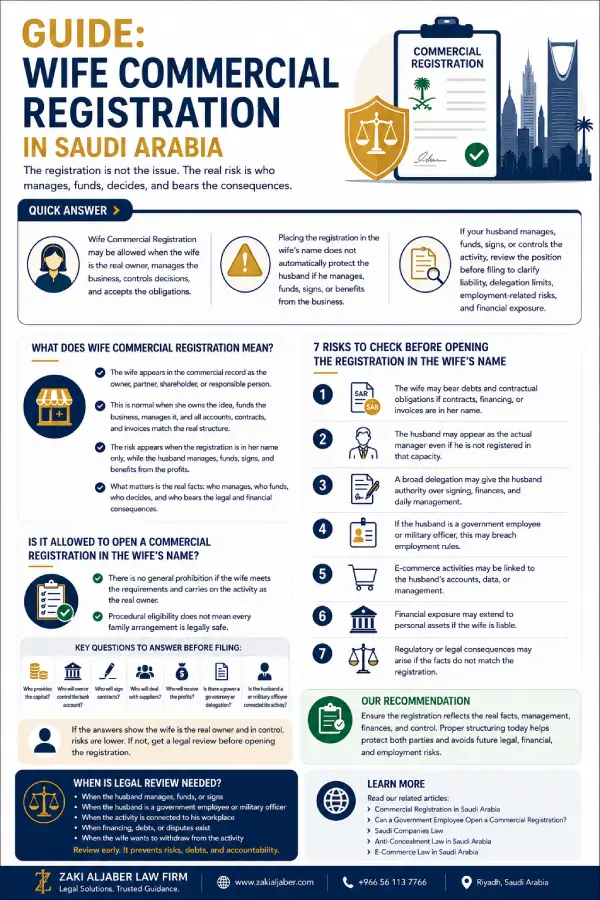
Quick Answer
Wife Commercial Registration may be allowed where the wife is genuinely the owner of the business, understands the activity, controls management or delegation, and accepts the financial obligations clearly.
However, placing the registration in the wife’s name does not automatically protect the husband if he is the real manager, financier, authorised signatory, or actual beneficiary of the business.
If the registration will be opened in your name while your husband manages, funds, signs, or controls the activity, the position should be reviewed before filing. A review can clarify each party’s responsibility, the limits of delegation, employment-related risks, financial exposure, and whether the legal structure reflects the real business.
Will a commercial registration be opened in your name while your husband manages, funds, signs, or controls the business? A focused legal review can clarify liability, delegation limits, employment-related risks, debts, and whether the structure reflects the real business before the registration is issued.
The issue is not always the opening of the registration. The issue often appears when the registration is used as a visible name for a business actually managed by another person. For that reason, it is necessary to distinguish between a wife who owns and runs her project, and a registration issued in the wife’s name while decisions, accounts, contracts, and business dealings are controlled by the husband.
The risk increases if the husband is a government employee or military officer, if the activity is connected to his workplace, if the delegation is broad, or if money moves through accounts that do not match the registered owner. In these cases, the right question is not only: can the registration be issued? The better question is: who is the real business owner?
What Does Wife Commercial Registration Mean?
Wife Commercial Registration means that the wife appears in the commercial record as the owner, partner, shareholder, or responsible person for an establishment or company.
This can be completely normal when the wife carries on commercial activity independently and in an organised manner. It is a natural arrangement where the wife owns the business idea, capital, management rights, or the ability to supervise operations, and where accounts, licences, contracts, and invoices match the real structure of the project.
The risk appears when the registration is in the wife’s name only, while the husband manages the business daily, negotiates, signs, funds the activity, deals with suppliers and customers, and benefits from the profits.
In that situation, the legal issue is no longer the registration alone. The issue becomes the real nature of the activity and the person who actually conducts it.
The professional wording is simple: a registration in the wife’s name is not prohibited by itself, and it is not protection by itself. What matters is the factual reality: who manages, who funds, who decides, and who bears the legal and financial consequences if a dispute or claim arises?
Is It Allowed to Open a Commercial Registration in the Wife’s Name in Saudi Arabia?
As a general starting point, there is no general prohibition merely because the commercial registration is in the wife’s name, provided that she meets the regulatory requirements and carries on the activity as the registered owner.
But procedural eligibility does not mean that every family arrangement around the registration is legally safe.
The name in the registration matters because it identifies the visible registered owner. Still, it does not answer every risk question. The wife may be the registered owner on paper, while the facts show that the husband funds, contracts, and manages the business.
In that case, financial, employment, or regulatory risks may arise depending on the husband’s status and the nature of the activity.
Before opening the registration, practical questions must be answered:
- Who provides the capital?
- Who will own or control the commercial bank account?
- Who will sign contracts?
- Who will deal with suppliers?
- Who will receive profits?
- Is there a power of attorney or delegation?
- Is the husband a government employee or military officer?
- Does he work for an entity connected to the activity?
If the answers are clear and consistent with the wife being the real owner of the business, the risks are lower. If the answers show that the wife does not know the details, does not control the money, or does not manage the business, legal review becomes necessary before filing.
7 Risks to Check Before Opening the Registration in the Wife’s Name
The main risks in Wife Commercial Registration cases are:
- The wife may bear debts and contractual obligations if contracts, financing, or invoices are in her name.
- The husband may appear as the actual manager even if he is not registered in that capacity.
- A broad delegation may give the husband authority over signatures, accounts, financing, and operations.
- A functional or employment conflict may arise if the husband is a government employee.
- The position may become more sensitive if the husband is a military officer and manages the business continuously.
- The registration, bank account, licences, invoices, and actual operations may not be consistent.
- A formal front, concealed beneficiary, or anti-concealment issue may arise depending on the parties, management method, and actual beneficiary.
These risks do not mean that a violation exists automatically. They mean that ownership, management, financing, and delegation should be defined before the business starts.
Wife Commercial Registration for a Government Employee Husband
Where the husband is a government employee, it is not enough to say that the registration is in the wife’s name.
The important question is whether the government employee is actually practising the business through that registration. Does he manage, fund, sign, benefit from, or operate a project that may conflict with his position or workplace?
A government employee is subject to employment restrictions that differ from those applying to a person outside public service. For that reason, the statement “my husband wants to open a commercial registration in my name” requires closer review if the husband is actively employed by a government entity.
The risk is higher where the husband handles daily management, negotiation, signing, dealings with authorities, or supplier relationships.
Not every case has the same level of risk. If the wife owns, funds, and manages the activity, the situation differs from a case where she is only the registered name while the employee is the actual manager. Broad delegation, use of professional relationships, or an activity connected to the husband’s workplace are all indicators that require review before opening or continuing the business.
For the general rule concerning public employees, see Can a Government Employee Open a Commercial Registration?, then return to this page for the specific case where the registration is in the wife’s name.
Wife Commercial Registration for a Military Husband
A military-related case needs more care than general wording. Military service, internal instructions, rank, time commitments, official status, information access, and professional relationships may make the management of a business in the wife’s name more sensitive from an employment and regulatory perspective.
The fact that the registration is in the wife’s name is not enough if the military husband actually manages, funds, signs for, or represents the business.
The relevant point is not only whose name appears in the registration. It is also who conducts the business in practice, who appears in the bank account, who holds delegations, who signs contracts, and who communicates with customers and suppliers.
Some people assume that a family shop or small online store does not need review. This is not accurate. Even a family business may raise questions if the military husband receives payments, manages advertisements, negotiates with suppliers, or has wide authority over the commercial bank account or digital platforms.
The key distinction is between limited family assistance that does not create an organised commercial role, and continuous actual management that makes the military husband the practical decision-maker in the business.
The Difference Between Wife Ownership and Husband Management
Ownership means that the wife owns the registration, share, or business activity. Actual management means that another person makes the decisions and controls money, contracts, customers, suppliers, and employees.
Confusing these two concepts is the source of most Wife Commercial Registration risks.
In a normal ownership structure, the business data, bank account, licences, invoices, and contracts are consistent with the wife’s role. She may appoint a manager or delegate certain tasks, but the delegation should be clear and limited. It should not turn a person who is restricted from practising trade into a hidden actual manager.
Actual management appears from daily facts:
- Who negotiates?
- Who sets prices?
- Who contracts with suppliers?
- Who hires employees?
- Who responds to customers?
- Who controls access to bank accounts and platforms?
- Who benefits from profit?
Delegation and signing authority are not prohibited in every case. But they are important indicators. A limited delegation for a clear administrative task differs from a broad delegation that allows the husband to open accounts, sign contracts, request financing, manage the store, and dispose of business funds.
The broader the authority, the greater the need for legal and accounting review before granting it.
Is Opening the Registration in the Wife’s Name Commercial Concealment?
It is not correct to use the term “commercial concealment” for every case where the registration is in the wife’s name.
Commercial concealment has a specific legal scope. It should not be confused with every family arrangement or every delegation between husband and wife.
The wife may be the real owner of the business and may ask her husband to assist with limited tasks without creating a concealment issue. There may also be a formal front, employment violation, or financial dispute without necessarily amounting to commercial concealment in the statutory sense.
For that reason, the facts must be described accurately.
A formal front risk appears when the wife does not know the details of the activity, does not manage it, does not monitor accounts, and does not understand the obligations, while the husband funds, manages, contracts, and benefits.
The risk may increase if the wife’s name is used to bypass an employment restriction, hide the real beneficiary, or allow a person without the required status to conduct the activity.
If a non-Saudi person practises the activity for their own account using the wife’s name, registration, or licence, the case must be reviewed under the Anti-Concealment Law. The correct approach is to distinguish between three issues: commercial concealment, employment violation, and a formal-front arrangement that may affect debts, disputes, or evidence.
Opening a Company in the Wife’s Name or Adding the Husband as a Partner
A company may provide better organisation than a sole proprietorship in some cases. It can define partners, managers, capital, signing powers, and representation before third parties.
However, a company is not an automatic solution if the actual reality remains unclear.
When opening a company in the wife’s name, or when the husband enters as a partner, the articles of association or bylaws must be reviewed before signing. The practical questions are direct:
- Who is the manager?
- Who is authorised?
- Who has signing authority?
- Who represents the company before third parties?
- Is the husband only a partner or also a manager?
- Is there any employment restriction that prevents this role?
Owning a share is one thing. Managing the company is another.
The husband may be a partner with no management role, or he may be a manager or authorised signatory with broad powers. Each structure has a different legal effect. It is therefore not enough to review the ownership percentage only. The manager’s authority, signing mechanism, delegation, bank account, and financing must also be reviewed.
If the husband is a government employee or military officer, if the activity is connected to his workplace, or if the company deals with entities related to his official duties, the risk increases. The relationship should be structured before starting the activity, not after a problem appears.
For broader company structuring issues, see Saudi Companies Law.
Opening an Online Store in the Wife’s Name
An online store in the wife’s name is still a commercial activity if there are sales, payments, shipping, advertisements, and dealings with customers and suppliers.
The fact that the activity is online does not remove the need for legal and financial review.
The same questions apply:
- Who buys the products?
- Who manages advertisements?
- Who receives payments?
- Who communicates with customers?
- Who sets prices?
- Who manages platforms and shipping companies?
If the practical answer is that the husband does all of this, then the registration in the wife’s name does not fully reflect the actual business reality.
A freelance document or online account should not be treated as a shortcut to bypass restrictions. It may be suitable for certain activities under its own rules, but it does not remove the need to identify who manages the activity, who benefits from it, and who bears its obligations.
When opening an online store in the wife’s name, the store data, bank account, communication channels, invoices, and management responsibility should match the real owner and manager of the activity. Inconsistency may create problems in disputes, financing, or regulatory review.
Debts and Financial Obligations in Wife Commercial Registration
The most overlooked point is that the name in the registration may create practical obligations for the registered wife.
Opening a commercial registration is not only an online form. It may lead to contracts, leases, salaries, invoices, financing, zakat or tax files, and commercial claims.
If the registration is in the wife’s name, and she signs contracts, accepts financing, or opens a commercial account for the activity, obligations may appear against her depending on the documents and facts.
It may not be enough later to say that the husband was the actual manager if the papers, delegations, accounts, and financing documents indicate responsibility on the registered owner.
Financing and loans should be reviewed before approval. Who signed the financing agreement? Who used the funds? Who pays the instalments? Are there guarantees? Is the bank account in the establishment’s name or in another person’s name? Is there documented financing between the spouses?
The problem often appears when the business struggles, not when it is profitable. For that reason, Wife Commercial Registration should be treated as a full legal and financial decision, not as a family favour or a way to help the husband only.
Zakat, Tax, Licences, and the Commercial Bank Account
What happens after opening the registration is as important as the issuance itself.
The activity may require a municipal licence, a sector-specific licence, a commercial bank account, invoices, zakat or tax files depending on the type and size of the activity, and other operational obligations.
Inconsistent data increases risk. For example, the registration may be in the wife’s name, but the bank account may be controlled by the husband alone. Contracts may be in the husband’s name. Payments may go to a personal account. The licence and operations may not reflect who actually manages the activity.
The same care is needed when cancelling the registration or stopping the activity. Cancelling a commercial registration does not always close every file connected to the business. Licences, bank accounts, employees, zakat or tax obligations, and existing contracts should be reviewed so that unresolved claims do not remain.
The practical rule is clear: do not open a registration before understanding what comes after it. Issuance is only the beginning. Obligations arise through operation, financing, invoicing, employment, and closure.
Checklist Before Opening a Commercial Registration in the Wife’s Name
Before agreeing to open a commercial registration in the wife’s name, use this checklist. The purpose is not to prevent investment. The purpose is to prevent later surprises involving debts, disputes, or employment accountability.
- Is the wife the real owner of the activity?
- What is the source of capital?
- Who manages the activity daily?
- Who signs contracts and applications?
- Who controls the commercial bank account?
- Is the husband a government employee or military officer?
- Is the activity connected to the husband’s workplace?
- Are there internal rules restricting the activity?
- Is there a delegation to the husband?
- What are the limits of that delegation?
- Are there debts, financing, or guarantees?
- Does the activity need a special licence?
- Is the online store actually managed by the wife?
- Is there a formal-front or hidden-beneficiary risk?
- Is the financial and management relationship between the spouses documented?
- Was the position reviewed before opening the registration?
If the answers are unclear, do not rely only on the electronic filing process. Management, delegation, accounts, and obligations should be organised before issuance.
When Is Legal Review Needed?
Legal review is useful before opening the registration if the husband is a government employee or military officer, if he will manage, finance, or sign, if the activity is connected to his workplace, or if the registration will be used for an online store, financing, or continuous dealings with suppliers and customers.
Review becomes more important if the registration has already been issued and debts or claims have appeared, if the wife wants to withdraw from the activity, if there is a dispute between the spouses or partners, or if the wife discovers that her information was used in an activity she did not understand.
Legal review does not automatically mean that a violation exists. Its purpose is to identify the least risky route:
- Should the wife remain the owner and manager?
- Does the husband need a defined and lawful role?
- Should the delegation be amended?
- Should accounts be separated?
- Is a company with clear powers a better structure?
- Are there employment risks that should be resolved before starting?
Review a Wife Commercial Registration Before Signing
If the registration is in the wife’s name and the husband will manage, fund, sign, or use delegations, legal review can help identify risks before debts or accountability arise.
Review the position before opening the registration.
General legal awareness that does not replace reviewing the actual business facts
This guide was prepared for general legal awareness regarding Wife Commercial Registration in Saudi Arabia. It does not replace a review of the real business owner, source of financing, actual management, delegations, financial obligations, commercial registration documents, bank accounts, licences, and the husband’s employment or military status before opening a registration, entering a company, or launching an online store.
Professional review: Lawyer Mohammed Al-Dossary
License No.: 40462
Last updated: August 2026
Frequently Asked Questions About Wife Commercial Registration
متى يكون فتح سجل تجاري باسم الزوجة جائزاً؟
يكون جائزاً من حيث الأصل إذا كانت الزوجة صاحبة النشاط فعلاً، وتدير أو تفوض بوضوح، وتفهم الالتزامات المالية والنظامية المرتبطة بالسجل.
زوجي بيفتح سجل تجاري باسمي، ما أول خطوة؟
أول خطوة هي معرفة من سيمول ويدير ويوقع ويتحمل الديون. لا توافقي قبل فهم التفويضات، الحساب البنكي، نوع النشاط، والالتزامات المحتملة.
ما أثر سجل الزوجة على الزوج الموظف الحكومي؟
قد تظهر مخاطر إذا كان الموظف الحكومي هو المدير أو الممول أو المفوض أو المستفيد الفعلي، خصوصاً إذا كان النشاط قريباً من جهة عمله أو يخلق تضارب مصالح.
حالة العسكري مع سجل زوجته كيف تُفحص؟
تُفحص من خلال طبيعة الخدمة، التعليمات الداخلية، دور العسكري في النشاط، التفويضات، التمويل، ووجود أي صلة بين النشاط وجهة العمل أو الصفة العسكرية.
إدارة الزوج لسجل زوجته متى تكون مشكلة؟
تكون أكثر حساسية إذا تحولت إلى إدارة فعلية مستمرة تشمل التوقيع، التفاوض، الحسابات، التمويل، التعامل مع الموردين، أو تمثيل النشاط أمام الغير.
التفويض على سجل الزوجة هل يكفي لإثبات الإدارة؟
التفويض لا يثبت مخالفة تلقائياً، لكنه قرينة مهمة إذا كان واسعاً أو مرتبطاً بالتوقيع والتمويل والحسابات والإدارة اليومية.
من يتحمل ديون السجل التجاري باسم الزوجة؟
تتحدد المسؤولية بحسب العقود والتمويلات والتفويضات والوقائع. لكن وجود السجل باسم الزوجة قد يجعل الالتزامات ظاهرة عليها إذا كانت هي صاحبة القيد والعقود.
فتح متجر إلكتروني باسم الزوجة هل يختلف؟
لا يختلف كثيراً إذا كان المتجر يمارس نشاطاً فعلياً. يجب فحص من يدير الإعلانات، يستقبل المدفوعات، يتعامل مع العملاء، ويتحمل الالتزامات.
متى يصبح السجل باسم الزوجة واجهة شكلية؟
يقترب من الواجهة الشكلية إذا كانت الزوجة لا تدير ولا تعلم التفاصيل، بينما الزوج هو من يمول ويدير ويوقع ويستفيد فعلياً من النشاط.
ما أفضل إجراء قبل فتح سجل باسم الزوجة؟
الأفضل إجراء مراجعة قانونية ومحاسبية مختصرة تحدد صاحب النشاط الحقيقي، مصدر التمويل، حدود التفويض، الالتزامات، وأي تعارض وظيفي محتمل.
Legal Conclusion
Wife Commercial Registration in Saudi Arabia should not be assessed by the name alone. It may be a normal arrangement if the wife is the true owner of the business. It may become risky if the husband is the real manager, financier, authorised signatory, or actual beneficiary, especially where he is a government employee, military officer, or connected to the activity through his workplace.
The practical test is the reality, not the family arrangement: who owns the money, who manages, who signs, who benefits, and who bears the debts?