Government Employee Commercial Registration in Saudi Arabia should not be treated as a simple online filing question. The first point is the person’s status. Is the applicant a government employee, military officer, private-sector employee, or retiree? Is the person only investing, or will they manage, sign, delegate, finance, or operate the activity? Is the registration in their own name, or in the name of a spouse or relative?
For this reason, the question is not only whether the platform can accept the application. The real issue is the nature of the activity, the employee’s role, the risk of conflict of interest, the connection with the employing authority, and whether the situation becomes actual commercial practice.
Before any filing, it is important to understand commercial registration in Saudi Arabia as the record that links the activity, owner, company, and legal effects of doing business.
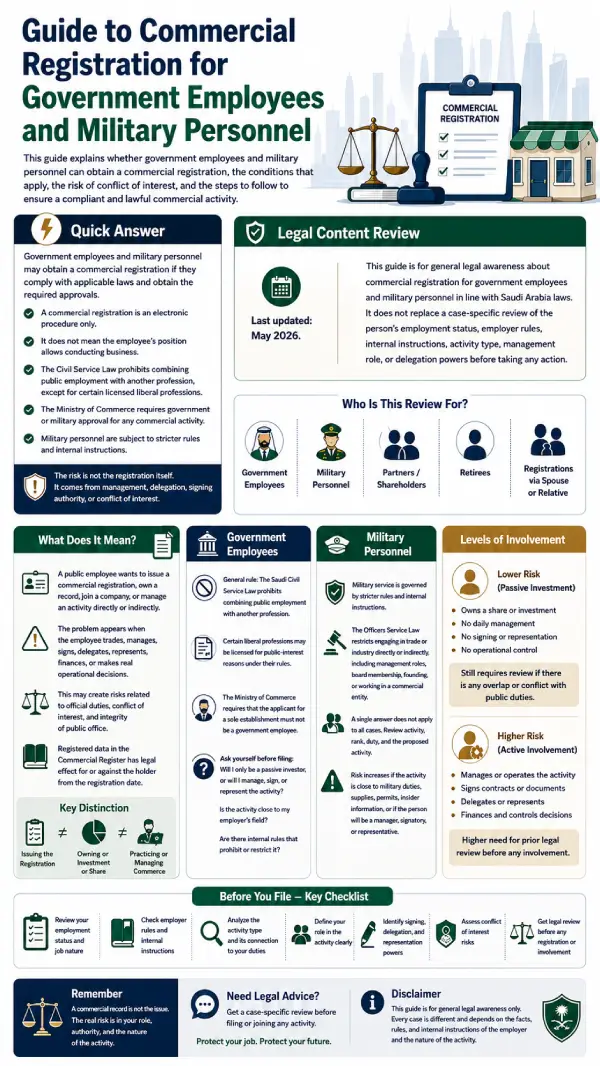
Last updated: August 2026.
This guide is prepared for general legal awareness about commercial registration for government employees and military personnel in Saudi Arabia. It does not replace a case-specific review of the person’s employment status, employer rules, internal instructions, activity type, management role, or delegation powers before taking action.
Quick Answer
Government Employee Commercial Registration should not be handled as an electronic procedure only. A filing platform may be able to receive the request, but this does not necessarily mean that the employee’s position allows commercial practice, management, or operational involvement.
The Saudi Civil Service Law sets a general rule against combining public employment with another profession, except where certain liberal professions may be licensed for public-interest reasons under their rules. In addition, the Ministry of Commerce service for registering a sole establishment requires that the applicant must not be a government employee.
Military personnel need a more cautious review because military service is governed by stricter professional and internal rules. A single answer should not be applied to all military cases without reviewing the authority, rank, duty type, and proposed commercial activity.
Before opening a commercial registration while employed by a government body or military authority, review your status and your actual role in the activity. The risk is not always the registration itself. It may arise from management, delegation, signing authority, or conflict of interest.
Reviewing the Position Before Filing
This review is relevant for government employees, military personnel, partners, retirees, and anyone considering a registration through a spouse or relative.
What Does Government Employee Commercial Registration Mean?
The term Government Employee Commercial Registration refers to a situation where a person who is still in public employment wants to issue a commercial registration, own a business record, join a company, or manage a commercial activity directly or indirectly.
The problem is not always the appearance of the employee’s name in a record. The problem usually appears when the employee trades, manages, signs, delegates, represents the business before authorities, finances the business, or makes real operational decisions.
At that point, the matter may move from a commercial filing to an employment-risk issue. It may relate to official duties, conflict of interest, the integrity of public office, or the limits of professional conduct.
The Saudi Commercial Registration Law does not treat the register as a purely formal entry. Registered data can have legal effect for or against the trader from the date of registration. This makes the registered information important in dealings with third parties.
The practical distinction is between three matters: issuing the registration, owning an investment or share, and actually practicing or managing commerce. Some passive investment structures may be less risky than direct management, but they are not automatically safe if they overlap with the employee’s public role.
Can a Saudi Government Employee Open a Commercial Registration?
The practical answer is that the person should not rely on platform acceptance alone. The employment framework, public authority, and nature of the activity must be reviewed before filing.
In practice, Government Employee Commercial Registration must be assessed before the application is submitted. The fact that an online request can be processed does not mean that the employee is cleared to trade, manage, or represent the activity.
The Ministry of Commerce and Saudi Business Center platforms regulate the registration process and the activity requirements. They do not give a final employment-law clearance that the person’s public position allows commercial practice.
The service for registering a sole establishment is designed to start commercial practice, and its conditions state that the applicant must not be a government employee. This makes the legal question earlier than the technical filing question.
The starting point should not be: can I fill out the form? The better question is: will I only make a passive investment, or will I become a direct trader, manager, signatory, or delegated representative? Is the activity close to my employer’s field? Are there internal rules that prohibit or restrict the activity?
Can Military Personnel Open a Commercial Registration?
The position of military personnel requires a specific review. Military service makes commercial registration more sensitive because of the authority, rank, assignment, internal instructions, and the nature of the proposed activity.
The Officers Service Law includes restrictions on engaging in trade or industry directly or indirectly. This may include managing financial business, acting as a chairman or board member, founder, manager, consultant, or employee in a company or commercial establishment, while the purchase of shares in joint-stock companies is treated differently under the relevant rule.
It is therefore inaccurate to say that every military person may open a commercial registration. It is also inaccurate to say that every military case has the same answer. The more precise position is that the military person must review the rules and internal instructions that apply before filing any registration, joining a company, or managing a store.
The risk increases when the activity is close to the military authority’s field, involves supplies, permits, government dealings, internal information, or professional relationships gained through the person’s position. It also increases if the person appears as a manager, delegate, or representative of the activity.
The Difference Between Owning a Registration and Practicing Commerce
Not every commercial connection carries the same level of risk. The key issue in Government Employee Commercial Registration is the difference between ownership or investment on one side, and management, delegation, signing, and direct commercial practice on the other.
Ownership or Passive Investment
Ownership or passive investment means that the person holds a financial interest without daily management of the activity. This position may be less risky than direct commercial practice, but it is not enough by itself to say that the arrangement is safe.
Under the Saudi Companies Law, a company is formed through articles of association or bylaws, usually through contributions by partners or shareholders to a profit-seeking project. Certain companies may also be formed by a single person where the law allows.
The company documents should therefore be reviewed before entry. Is the employee only a shareholder or partner? Is the employee a manager? Does the employee have signing authority? Can the employee represent the company? Does the activity create any conflict with the employee’s public role?
For example, a government employee who owns a small share in a company without management or signing authority is not in the same position as an employee who is the company’s manager and authorized representative before authorities. The first case requires review. The second carries a higher level of risk.
Management and Delegation
Management, delegation, and signing authority are the higher-risk areas. An employee who manages a company, represents an establishment, signs contracts, or deals with authorities on behalf of a business may be closer to actual commercial practice.
The Companies Law provides that the manager of a limited liability company represents the company before courts, arbitration bodies, and third parties. The manager may also delegate some powers for specific acts. This shows that the manager’s position is not a formal detail. It has direct legal effect.
It is therefore not enough to say “I am only a partner” if the documents, delegation, or practical reality give the employee a manager’s role or representative powers. The assessment is based on authority and reality, not only on labels.
Sole Establishment or Company?
The legal form affects the level of risk. In Government Employee Commercial Registration, a sole establishment usually creates a clearer link between the person and the activity, while a company may involve partners, shares, managers, and defined authorities.
A sole establishment connects the person directly with the business. If the government employee owns the establishment, the question becomes more direct: will the person trade, sell, buy, manage, contract, or represent the activity?
A company may allow separation between ownership and management. But this does not solve the issue if the employee is the manager, authorized signatory, or actual controlling person. A company is a legal structure, and its articles, managers, and powers are registered according to the Companies Law.
Where the likely option is a sole establishment, the person should also understand sole establishment registration and its effects before treating it as a suitable step while still employed.
Can a Government Employee Be a Partner in a Company?
A government employee may appear as a shareholder, managing partner, authorized signatory, or actual financier without clear visibility in the documents. Each position carries a different risk level.
For Government Employee Commercial Registration, the shareholding position must be separated from management authority. Owning a share does not necessarily mean managing the company. But if the articles of association give the employee authority to manage, sign, or represent the company, the risk increases.
Conflict-of-interest risk may also arise if the activity is close to the employee’s public authority or professional duties, even where the employee’s formal role appears limited.
The Companies Law gives importance to the articles of association, company bylaws, managers’ details, and the scope of their powers. It also makes registered information relevant against the company and third parties. For that reason, the documents should be read before entry, not only the ownership percentage.
Registering the Business Under a Spouse or Relative
Putting the registration under a spouse or relative does not automatically solve the problem. In Government Employee Commercial Registration, the issue is not only the visible name in the record. The issue is who funds, manages, controls, and benefits from the activity in practice.
An employee may think that placing the registration under a spouse, sibling, or parent removes the risk. But if the employee is the person who funds, manages, negotiates, deals with suppliers and customers, and makes decisions, the risk may remain from the perspective of actual commercial practice or conflict of interest.
Additional issues may arise where the visible name is used to hide the true beneficiary or to bypass employment restrictions. A relative should not be turned into a purely formal front without legal, accounting, and regulatory review.
The professional position is that a registration in a relative’s name is not prohibited by itself, and it is not a solution by itself. What matters is the practical reality: who manages, who funds, who decides, and whether there is any conflict with the job.
Online Stores and Freelance Documents
E-commerce is not outside employment restrictions simply because it takes place online. An online store may be a regulated commercial activity with accounts, payments, shipping, advertising, and consumer dealings.
The Saudi E-Commerce Law defines an online store as an electronic platform through which a service provider displays, sells, provides, or advertises a product or service. It also defines a trader as a person registered in the commercial register who practices e-commerce.
This means that online activity may be connected to commercial registration in many cases. It should not be treated as separate from regulatory obligations merely because it is conducted digitally.
It is therefore inaccurate to say that online selling is always a simple side activity. If the employee manages a store, advertises, contracts with suppliers, receives payments, or hires others, these are signs of commercial activity that require review.
A freelance document should also not be treated as a way to bypass employment restrictions. It may be suitable for certain activities under its own rules, but it does not remove the need to review the employer’s rules, conflict-of-interest risks, and special instructions, particularly for government employees and military personnel.
Can Commercial Registration Affect Employment?
A Government Employee Commercial Registration may affect employment if it is linked to commercial practice, management, conflict of interest, misuse of public position, or interference with working time and duties.
The Saudi Job Discipline Law defines a disciplinary violation as an act or omission by an employee that involves a breach of duties, committing employment prohibitions, or harming the honor and dignity of the public office.
This means that the issue is not limited to the existence of a record. The risk may arise from the accompanying conduct: managing the activity during working hours, using information obtained through the job, contracting with the employing authority, or practicing an activity supervised by the same authority.
The sensitivity is higher in regulatory authorities, licensing bodies, procurement environments, tenders, permits, and inspection functions. The activity should be assessed before filing, not after a disciplinary issue appears.
Penalty for Opening a Commercial Registration as a Government Employee or Military Person
No single penalty applies to every Government Employee Commercial Registration. Liability differs according to the applicable law, authority, employee status, nature of the activity, level of actual management, and existence of conflict of interest.
The Job Discipline Law provides for disciplinary penalties where a violation is established. The penalty must be proportionate to the level of the violation and the surrounding circumstances. It is therefore inaccurate to say that every registration leads to dismissal. It is also inaccurate to say that every registration is safe.
The more accurate position is that the risks vary. The matter may result in a note, inquiry, disciplinary penalty, or a more serious action depending on the facts. Risk increases where there is actual management, delegation, misuse of position, or an activity close to the employee’s public authority.
Government Employee vs Private-Sector Employee
A private-sector employee is not governed by the Civil Service Law in the same way. The relevant documents are usually the employment contract, Saudi Labor Law, confidentiality obligations, and any valid non-compete clause.
It is therefore wrong to apply the government-employee rule to a private-sector employee without distinction. A private-sector employee may be able to open a commercial registration in some cases. But if the activity competes with the employer, breaches the contract, or uses client data or business secrets, contractual or labor liability may arise.
One common point should be corrected: Article 53 of the Saudi Labor Law concerns the probation period. It is not the main rule that prohibits opening a commercial registration. Non-compete issues are usually assessed under the rule that allows the employer to protect legitimate interests where the work gives the employee access to clients or business secrets, provided the restriction is written and limited in time, place, and type of work.
For comparison, the first question should be: is the person a government employee, military person, private-sector employee, or retiree? The second question is: which law, contract, or internal rule applies?
Retired Employees and Commercial Registration
A retiree is different from an active employee. Ending service removes many restrictions related to combining public employment with another activity. But this does not mean that all legal effects can be ignored.
The type of retirement, pension source, former authority, and any special instructions should be reviewed. The need for review increases where the retiree is a former military person or was employed by a sensitive authority, especially if the proposed activity is close to the former field of work.
The pension should also be separated from the business activity. Not every commercial activity automatically affects pension rights, but a general answer should not be given without reviewing the pension framework and former authority.
What Should You Do Before Filing?
Before issuing the registration, follow a practical review. This review does not stop the decision. It reduces the risk of taking the wrong step.
- Identify your status: government employee, military person, private-sector employee, or retiree.
- Identify your role: owner, partner, manager, financier, delegate, or beneficial controller.
- Review your employer’s rules: are there internal instructions that prohibit or restrict the activity?
- Check conflict of interest: is the activity close to your job or public authority?
- Review activity and licensing: does the activity require a sectoral or municipal license?
- Read the company documents: if it is a company, review management, signing, and authority clauses.
- Do not use a relative as a front: the visible name does not remove practical responsibility.
- Request clearance or approval where needed, especially if the authority requires it.
- Obtain advice before signing, especially in cases of management, delegation, or partnership.
- Document your review so you can show that the position was assessed before filing.
When Do You Need Legal Review Before Opening a Registration?
In Government Employee Commercial Registration, legal review is especially important before filing if you are active military personnel, a government employee in a regulatory authority, planning an activity close to your public role, managing the business yourself, or considering registration under the name of a spouse or relative.
The need for review also increases if you will enter a company as a partner, become a manager, sign contracts, obtain financing, deal with debts, carry out a licensed activity, or correct a registration that has already been issued.
Legal review is not meant to prevent investment. It is meant to identify the lower-risk route. Is passive investment enough? Should the articles of association be changed? Should another person be authorized? Is clearance needed? Does the activity itself create a conflict of interest?
Frequently Asked Questions About Commercial Registration for Government Employees
No schema found.Legal Conclusion
The correct question in Government Employee Commercial Registration is not only: does the platform allow the filing? The more important question is whether the person’s employment status allows ownership, management, financing, representation, or actual commercial practice.
Commercial registration for a government employee or military person requires review before action, especially where there is management, delegation, signing authority, use of a relative’s name, or an activity close to the employing authority. A private-sector employee is different, because the employment contract, Labor Law, and any valid non-compete clause may control the matter.