Trademark Registration in Saudi Arabia should begin before launching a name, logo, or brand identity in the market. A strong design is not enough if the mark is similar to an existing mark, too descriptive, or unsuitable for registration. Filing the mark can turn a business name or logo from a marketing idea into a legal asset that can be protected and enforced.
The process is not limited to submitting an electronic application to the Saudi Authority for Intellectual Property. The correct path starts with checking whether the mark is registrable, searching for similar marks, choosing the right class, and then following the application, objections, renewals, and licensing when needed. This is what makes the mark a business protection tool, not only a visual design.
Quick Answer: What Is a Trademark in Saudi Arabia?
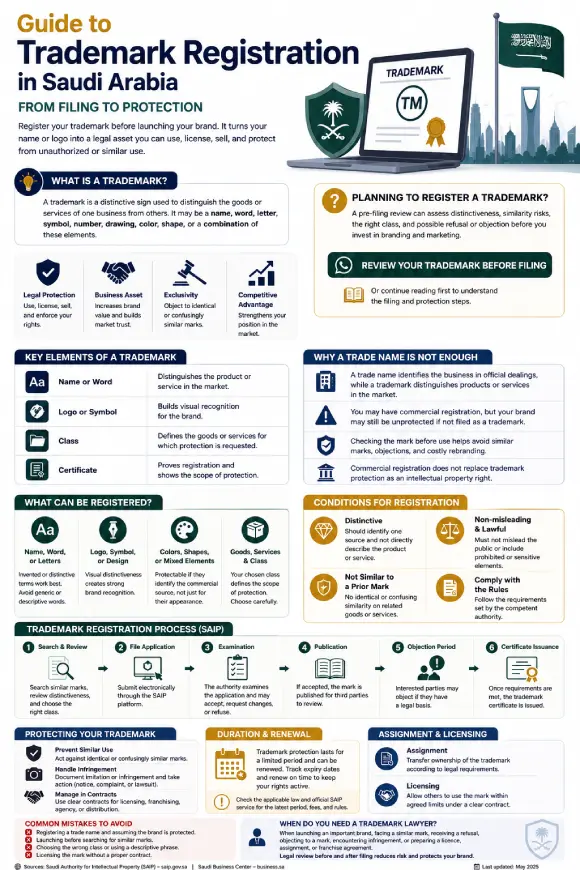
A trademark in Saudi Arabia is a distinctive sign used, or intended to be used, to distinguish the products or services of one business from others. It may be a name, word, letter, symbol, number, drawing, color, shape, or a combination of these elements if it can identify the commercial source of the goods or services.
The value of Trademark Registration is that it gives the owner a legal basis to use the mark, license it, sell it, and object to unauthorized use of an identical or confusingly similar mark on related goods or services. A trademark should not be treated as a logo only. It is part of the business identity, reputation, and market value.
Are you preparing to register a trademark and concerned that the name or logo may be similar to an existing mark or not registrable? A pre-filing review can help assess distinctiveness, similarity risks, the right class, and possible refusal or objection before you spend on branding and marketing.
Or continue reading first to understand the filing and protection steps.
| Element | Practical Meaning |
|---|---|
| Name or word | Distinguishes the product or service in the market. |
| Logo or symbol | Builds visual recognition for the brand. |
| Class | Defines the goods or services for which protection is requested. |
| Certificate | Proves registration and shows the scope of protection. |
Why Is a Trade Name Not Enough to Protect the Brand?
A trade name alone is not enough to protect the brand. A trade name identifies the business in its official dealings, while a trademark distinguishes products or services in the market. You may have a valid commercial registration, but your mark may still be unprotected if it has not been filed with the competent authority.
This problem appears when a business owner launches a name or logo, spends on design, packaging, and advertising, and then discovers a similar mark or an objection from a prior owner. For this reason, checking the mark before commercial use is an important step in protecting the investment made in the brand identity.
For the wider framework of business records and company data, see Commercial Registration in Saudi Arabia. Commercial registration does not replace trademark protection as an intellectual property right.
What Can Be Registered as a Trademark?
A trademark may be a name, word, letters, numbers, logo, drawing, color, shape, or a combination of these elements, provided that it can distinguish the goods or services of one business from those of others. Not every visual or verbal idea is registrable. The mark must have enough distinctiveness.
1. Name, Word, or Letters.
A mark may be an invented word, a distinctive name, or letters used by the public to identify a specific source. When choosing a name, avoid terms that directly describe the product or service. Generic or descriptive words are difficult to monopolize for one business.
2. Logo, Symbol, or Design.
A logo or symbol may be the core of protection when it has visual distinctiveness. This matters in sectors where customers rely on visual memory, such as restaurants, clothing, applications, online stores, and consumer products.
3. Colors, Shapes, or Mixed Elements.
A mark may also consist of a color, shape, or combined elements. However, the strength of protection usually depends on whether those elements can identify the commercial source, not merely whether they look attractive.
4. Goods, Services, and Trademark Class.
Trademark Registration is not separate from the goods or services it covers. The class you choose defines the protection field. The same name may be treated differently if used for a different activity. Choosing the right class is therefore part of the filing strategy.
Conditions for Registering a Trademark in Saudi Arabia
A successful Trademark Registration depends on whether the mark is distinctive, non-misleading, and not in conflict with a prior mark or legal restriction. These conditions should be reviewed before filing. Refusal is not always linked to design quality. It may result from weak distinctiveness, similarity, or non-compliance with registration rules.
1. The Mark Must Be Distinctive.
A distinctive mark helps the public identify one product or service from others. A mark that directly describes the product, or uses wording that competitors need to describe their goods, may be more exposed to refusal because it does not perform the distinguishing function clearly.
2. The Mark Must Not Be Misleading or Unlawful.
The mark should not mislead the public about the source, quality, or characteristics of the product or service. It should also avoid prohibited or sensitive elements. This is especially important when the mark includes foreign words, geographic references, or symbols with regulatory sensitivity.
3. The Mark Must Not Be Similar to a Prior Mark.
Similarity is not limited to exact copying. It may appear in pronunciation, design, overall impression, or the closeness of goods and services. For this reason, Trademark Registration should not begin before a preliminary search of similar registered or published marks.
Trademark Registration Process Through the Saudi Authority for Intellectual Property
The filing process is handled electronically through the Saudi Authority for Intellectual Property. SAIP indicates that trademark procedures filed after 19/12/2023 are handled through the unified intellectual property platform. The official service page should always be reviewed for updated requirements, fees, and processing details before filing.
Search and Review Before Filing
The practical first step is to search for close marks, review the proposed name or logo, and select the proper class. This step reduces the risk of refusal or objection, especially where the proposed mark is close to a known name or used in a crowded sector.
Filing the Application Through the Platform
After review, the application is submitted through the approved electronic path. If the application is filed through an agent, SAIP’s service information should be checked to confirm the requirements for trademark agents and related authorizations.
Examination, Publication, and Objection
After filing, the application is examined by the competent authority. It may be accepted, amended, or refused depending on the result. If the application moves to publication, third parties may monitor the published mark and object where they have a legal basis.
Certificate Issuance and Protection
When the requirements are completed and the official service conditions are satisfied, the trademark certificate is issued. The certificate is important evidence of registration, but it is not the end of protection. Use, renewal, enforcement, licensing, and ownership changes may still need follow-up.
Trademark Search Before Filing
A trademark search does not mean only typing the name into a search tool. A proper review considers phonetic similarity, visual similarity, conceptual similarity, the closeness of goods or services, and whether the average consumer may be confused.
Two marks may differ in some letters or design details but still create a similar impression. The risk is higher when the class is the same or the products are close. Lack of exact matching does not always mean the mark is safe.
This is why the search stage strongly affects the success of Trademark Registration. It helps the business owner adjust the name or logo early, before spending heavily on packaging, signage, websites, advertising campaigns, or distribution contracts.
Reasons a Trademark Application May Be Refused
A trademark application may be refused for reasons related to the mark itself, its similarity to a prior mark, or a legal restriction. Knowing the reason helps determine whether to respond, adjust the strategy, or choose a different mark.
1. Direct Description of the Product or Service.
If the mark directly describes the product or service, it may not be distinctive enough. The purpose of trademark protection is not to monopolize words that all traders need to describe their products, but to protect signs that identify the commercial source.
2. Similarity to an Existing Mark.
Similarity to a prior mark is one of the most common refusal risks. It may be found in the name, pronunciation, logo, or overall impression. Therefore, the mark should be reviewed before filing, not only after a refusal is issued.
3. Misleading Meaning or Regulatory Concerns.
A mark may raise concerns if it suggests an inaccurate source, quality, or feature, or if it contains elements that conflict with registration rules. In such cases, legal review helps understand the scope of the issue and whether it can be addressed.
Objection to a Similar Trademark
An objection may arise when a published mark appears similar to an earlier mark and may cause confusion among the public. A valid objection requires more than a general feeling of similarity. It should analyze the elements of both marks, the classes, the target public, and the closeness of goods or services.
Timing matters because objections are linked to publication and procedural stages. Owners should monitor close marks and not wait until the similar mark becomes widely used in the market. Early action is often more effective than a later dispute.
A strong objection explains the points of similarity, the source of confusion, the potential harm, and the prior right in the mark. This is where a clear legal submission supported by documents becomes important.
Trademark Protection After Registration
Protection does not end when the certificate is issued. Registration provides an important legal foundation, but maintaining the value of the mark requires market monitoring, reviewing similar marks, and regulating use in contracts and licences.
1. Preventing the Use of Similar Marks.
After registration, the owner may challenge uses that cause confusion or infringe the mark. The position is stronger when the mark is clearly used, correctly registered, and connected to specific goods or services.
2. Handling Imitation or Infringement.
When imitation or unauthorized use appears, the first practical step is documentation. This may include product images, website links, invoices, advertisements, or other evidence of use. After that, the owner can consider a notice, complaint, or court action depending on the situation.
3. Protecting the Mark in Contracts and Licences.
If the mark will be used in distribution, franchising, agency, or licensing, the arrangement should be documented in a clear contract. The contract should state who may use the mark, where, for how long, on which goods or services, and under what quality standards. Contractual control reduces disputes between the owner and the user.
Trademark Duration and Renewal
Duration and renewal should be checked against the applicable law and official service before action is taken, because procedural details and fees may change. The practical point is that the owner should not treat registration as a one-time step. It is a right that needs monitoring and renewal on time.
Failure to renew may lead to loss of protection or create commercial and legal risk. Businesses should therefore keep an internal schedule for trademark dates, especially if they own several marks or use a mark in distribution or franchise arrangements.
In each case, review the certificate details and the official service requirements before the protection period ends.
Assignment and Licensing of a Trademark
A trademark may be a commercial asset that can be transferred or licensed. Its value is not limited to protecting a name or logo. It may be involved in sale, licensing, franchise, or distribution agreements. These relationships should be documented to prevent disputes.
Assignment of Ownership
Assignment means transferring the trademark right from one owner to another according to the applicable requirements. The mark details, scope of the right, and classes covered by the assignment should be clear before the transfer is completed.
Licensing the Trademark
Licensing allows another party to use the mark within agreed limits. The contract should define the scope, term, territory, class, quality standards, payment, and control rights. Leaving these points unclear may weaken the mark or create disputes over the limits of use.
Common Mistakes in Filing a Trademark
One common mistake is registering a trade name and assuming the brand is protected. This confusion may leave the logo or market-facing name without enough intellectual property protection.
Another mistake is launching the brand before searching for similar marks. The mark may be close to an existing one, and the risk may appear only after printing materials or starting campaigns. At that point, changing the brand becomes more costly.
A Trademark Registration application may also be weakened by choosing the wrong class, using a descriptive phrase, or failing to monitor published marks for possible objection.
When Do You Need a Trademark Lawyer?
You may need a trademark lawyer when launching an important brand, dealing with a similar mark, receiving a refusal, facing an objection, discovering imitation in the market, or preparing a licence, assignment, or franchise agreement.
The lawyer’s role is not limited to filling in the application. The more important role is reading risk before filing, checking similarity, identifying the right class, drafting responses or objections, and protecting the mark after registration from unauthorized use.
Legal review becomes more important if the mark will be used for more than one activity, in more than one country, under distribution or franchise agreements, or where the mark is a major part of the project value.
Frequently Asked Questions About Trademark Registration
What is a trademark in Saudi Arabia?
A trademark is a distinctive sign used to distinguish the products or services of one business from others, such as a name, logo, word, symbol, color, shape, or a combination of these elements.
Why does a brand need trademark filing?
Filing helps prove ownership and gives the owner a legal basis to object to identical or confusingly similar marks used on related goods or services.
What is the difference between a trade name and a trademark?
A trade name identifies the business in official dealings, while a trademark distinguishes products or services in the market before customers.
When does commercial registration not protect the mark?
Commercial registration alone does not replace trademark protection as an intellectual property right. A market-facing name or logo usually needs separate trademark filing.
How does the filing process usually start?
It usually starts with reviewing the mark and class, then filing through the competent platform, followed by examination, publication, possible objection, and certificate issuance if requirements are met.
What conditions affect acceptance?
The mark should be distinctive, non-misleading, lawful, and not confusingly similar to a prior mark on related goods or services.
How should I search before filing?
The search should consider similarity in wording, pronunciation, visual appearance, concept, and the closeness of goods or services, not exact matching only.
What should I do if the mark is refused?
Start by identifying the refusal reason. Then assess whether a response, amendment strategy, or a different mark is more suitable.
How can I object to a similar mark?
An objection should review the published mark, explain the similarity and likely confusion, and rely on documents showing the prior right or interest.
How long does trademark protection last?
The protection period and renewal requirements should be checked against the applicable law and official service before action, because procedural details may change.
Legal Conclusion:
Do not treat Trademark Registration as a formality after launching the brand. Early review helps reduce similarity and refusal risks, while registration provides a legal basis to protect the name, logo, or symbol that distinguishes your products or services.
Protection does not end with the certificate. Similar uses should be monitored, renewals should be followed on time, and any licence or assignment should be documented in a clear contract. A trademark is not only a logo. It is a commercial asset that needs ongoing legal management.
Official Sources.