A Trademark Assignment should begin with one practical question: what rights will actually transfer, and what will remain outside the deal? A trademark may be a name, logo, commercial identity, or valuable intangible asset linked to the reputation of a business and its customers.
A general agreement to “sell” or “assign” a trademark is not enough. The parties should clearly define the trademark details, covered classes, price, effective date, warranties, restrictions, prior licences, and each party’s responsibility after the transfer. Any vague clause may later create a dispute over ownership, use, or the scope of protection.
For the broader framework of registration, protection, and renewal, you may review Trademark in Saudi Arabia. This article focuses on reviewing the assignment agreement before signing.
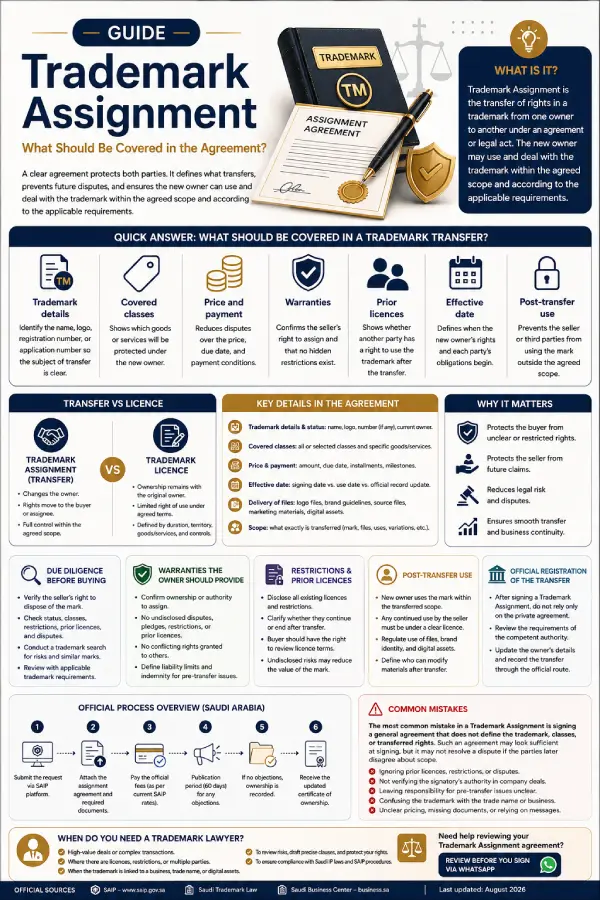
Quick Answer: What Should Be Covered in a Trademark Transfer?
The most important point in a Trademark Assignment is to define the transferred trademark with precision. The agreement should identify the mark, the covered classes, the relevant goods or services, the price, payment method, effective date, ownership warranties, and any prior restrictions, licences, or disputes.
Buying a trademark or assigning your brand rights in Saudi Arabia and unsure what will actually transfer? A focused legal review can help you clarify the trademark details, covered classes, price, warranties, prior licences, restrictions, and scope of rights before you sign.
Prefer to understand the key clauses first? Continue reading below.
The purpose of the agreement is not only to prove that both parties intended to transfer the mark. It is also to protect the buyer from acquiring an unclear or restricted right, and to protect the seller from later claims caused by unclear use after the transfer.
| Clause to Review | Why It Matters |
|---|---|
| Trademark details | Identifies the name, logo, registration number, or application number so the subject of transfer is clear. |
| Covered classes | Shows which goods or services will be protected under the new owner. |
| Price and payment | Reduces disputes over the commercial value, due date, and payment conditions. |
| Warranties | Confirms that the seller has the right to assign the trademark and that no hidden restrictions exist. |
| Prior licences | Shows whether another party has a right to use the trademark after the transfer. |
| Effective date | Defines when the new owner’s rights and each party’s obligations begin. |
| Post-transfer use | Prevents the seller or third parties from using the mark outside the agreed scope. |
What Does Trademark Assignment Mean?
A Trademark Assignment means the transfer of rights in a trademark from one owner to another under an agreement or legal act. After the transfer, the new owner may use and deal with the trademark within the agreed scope and according to the applicable official requirements.
A trademark transfer does not automatically mean that the company, business activity, customers, trade name, or operational assets are also transferred. The deal may cover only the trademark, or it may be part of a wider business sale that includes a store, commercial activity, digital assets, or other related rights.
This distinction matters. A trademark is an intellectual property right, while the trade name, commercial registration, business activity, customer base, and operating assets may involve different procedures and risks. A well-drafted agreement should answer this question clearly: is the transferred asset only the trademark, or does the deal include related business assets?
When Is a Trademark Transfer a Sale, and When Is It a Licence?
A Trademark Assignment is different from a trademark licence. A transfer changes the owner, while a licence allows another party to use the mark within defined limits while ownership remains with the original owner.
In a sale or assignment, the right moves to the buyer or assignee according to the agreement and the required procedure. In a licence, the trademark owner keeps ownership and grants another party a limited right to use the mark. That licence may be limited by duration, territory, goods, services, channel of use, or quality controls.
This difference is practical. If the other party only needs temporary use of the trademark for a branch, project, franchise, or distribution arrangement, a licence may be the proper tool. If the purpose is full ownership and future control, the transaction should be treated as a transfer, sale, or assignment of the trademark.
The Saudi Authority for Intellectual Property distinguishes between services related to transferring trademark ownership and services related to licensing trademark use. This makes it important to choose the correct legal structure before preparing the agreement or filing the request.
What Details Should Be Included in the Assignment Agreement?
A trademark agreement should not rely on a broad phrase such as “the first party assigns the mark.” Safer drafting starts by identifying the asset, then defining the scope of rights, then setting the obligations that apply before and after signing.
Trademark Details, Number, and Status
The agreement should identify the assigned trademark clearly enough to remove uncertainty. This may include the trademark name, image, description, registration or application number if available, and the details of the current owner.
The status of the mark should also be checked before signing. The buyer should not acquire a right without understanding whether the trademark is registered, pending, restricted, disputed, or connected to any unresolved issue.
Covered Classes, Goods, and Services
Classes define the scope of protection. A mark may be registered or applied for in specific classes only, or for particular goods or services within a broader class. The agreement should state whether the transfer covers all classes or only selected classes.
It should also explain whether the transfer includes the logo, word mark, design form, commercial variations, and all versions used in the market. This prevents a later dispute over whether the buyer acquired the full brand identity or only part of it.
Price and Payment Method
The price is one of the most sensitive clauses. The agreement should state the amount or method of calculation, the due date, and whether payment will be made in one instalment or across stages.
The parties may also link certain payments to agreed milestones, such as signing, delivery of documents, acceptance of the request, or update of ownership data, as long as this does not conflict with the official requirements that apply to the transaction.
Effective Date and Delivery of Files
The agreement should distinguish between the signing date, the date the buyer may start using the mark, and the date when official ownership records are updated.
It should also address delivery of trademark-related materials if they are part of the deal. These may include logo files, brand guidelines, source design files, marketing materials, digital assets, or social media accounts, depending on the agreed scope.
Due Diligence Before Buying or Accepting an Assignment
Before buying or accepting a trademark transfer, the buyer should check whether the seller has the right to dispose of the mark, whether the status and scope of the mark are clear, and whether any restrictions, licences, or disputes affect its value.
A prior Trademark Search may also help before purchase. It can support a review of the mark’s status, similar results, and potential risks connected to the proposed transaction.
It is not enough for the seller to send a screenshot, certificate, or brand name. The buyer should review the registered owner, covered classes, disclosed restrictions, prior licences if any, and the relationship between the trademark and any existing business, trade name, contracts, or commercial activity.
Before buying or accepting an assignment, the agreement should also be read alongside the applicable Trademark Requirements so the buyer can understand whether the mark’s data, scope, and classes are clear enough for the intended deal.
Warranties the Trademark Owner Should Provide
Warranties protect the buyer if a problem appears after signing. For this reason, a Trademark Assignment agreement should include clear statements from the current owner about ownership, authority, and the absence of undisclosed restrictions.
The seller should confirm that they are the owner or legally authorised to assign the mark. They should also state that the trademark is not subject to an undisclosed dispute, pledge, restriction, or prior licence, and that no conflicting right has been granted to another party.
General warranties may not be enough where the transaction is valuable or connected to an operating business. In that case, the agreement should define what the seller guarantees, the limits of liability, the process if a later claim appears, and who bears losses or liabilities connected to the period before transfer.
Restrictions and Prior Licences Affecting the Mark
A trademark may already be subject to a licence, contractual restriction, dispute, pledge, or obligation that limits the owner’s ability to transfer it freely. These issues may directly affect the commercial value of the deal because they may prevent the buyer from using the mark exclusively or developing it as intended.
The agreement should therefore contain a direct clause on prior licences. Do they exist? Will they continue after the transfer? Must they be terminated before completion? Does the buyer have the right to review their terms? These are not formal questions. They determine whether the buyer receives a clean right or a right restricted by third-party interests.
What Happens to Trademark Use After the Transfer?
After a trademark transfer, the agreement should make it clear who may use the mark. In principle, the new owner should have the right to use the trademark within the transferred scope. Any continued use by the seller should be based on a clear contractual right.
If the seller needs a transition period, or wants limited use in a specific class, region, sales channel, or business context, this should be written as a separate licence or transition clause. Leaving this issue open may confuse customers and create a dispute between the parties.
The agreement should also regulate the use of files, brand identity, and related digital assets. If the deal includes the logo, marketing materials, or brand files, the method and timing of delivery should be specified. The agreement should also state who may modify those materials after the transfer.
Official Registration of the Transfer
After signing a Trademark Assignment, the parties should not rely only on the private agreement between them. They should review the requirements of the competent authority to update the owner’s details and record the transfer through the official route.
The Saudi Authority for Intellectual Property provides services related to the transfer of trademark ownership from one owner to another. Its trademark services pages also refer to official digital channels for intellectual property applications within the scope stated by the authority. For that reason, the official page should be checked before filing to confirm current requirements, fees, and attachments.
The process may require documents proving the transaction, the parties’ details, trademark data, and any other attachments required by the official service. Fixed fees or timelines should not be assumed without checking the current official service, because requirements may change or differ depending on the trademark’s status and the nature of the transaction.
Common Mistakes in Trademark Transfer Agreements
The most common mistake in a Trademark Assignment is signing a general agreement that does not define the trademark, classes, or transferred rights. Such an agreement may look sufficient at signing, but it may not resolve a dispute if the parties later disagree about scope.
Other mistakes include ignoring prior licences, failing to verify who is authorised to sign for a company, leaving responsibility for previous use unclear, and failing to define the effective date. Some parties also confuse the trademark with the commercial registration, trade name, or operating business.
The parties should also avoid unclear pricing, incomplete supporting documents, and reliance on informal messages instead of a written agreement that defines obligations and warranties.
When Do You Need a Trademark Lawyer?
You need a trademark lawyer when the transaction has significant value, involves licences or restrictions, includes several parties, or forms part of the sale of a business, store, franchise, or commercial project.
Legal review becomes more important when the seller is a company and the authority of the signatory must be checked. It is also important where the trademark is connected to a trade name, digital accounts, distribution agreements, previous use, or potential claims.
The lawyer’s role is not only to draft a long document. It is to read the risks: is the transferred asset clear? Is the price linked to the right steps? Are there restrictions? Can the buyer use the mark after the transfer without objection? Do the warranties actually protect both parties?
Frequently Asked Questions About Trademark Assignment
What does Trademark Assignment mean?
It means transferring rights in a trademark from one owner to another under an agreement or legal act, with a clear definition of the transferred scope and rights.
What is the most important clause in a trademark assignment agreement?
The most important clause is the precise identification of the trademark, including its details, number if available, status, covered classes, and scope of transferred rights.
Does assigning a trademark also transfer the business?
Not always. The agreement should state whether the deal covers only the trademark or also includes the business, customers, trade name, digital assets, or other commercial assets.
What is the difference between assigning and licensing a trademark?
Assignment transfers ownership to another party. Licensing grants a limited right to use the mark while ownership remains with the trademark owner.
Can a trademark be sold in Saudi Arabia?
Yes, a trademark may be treated as a transferable commercial and intellectual property asset. However, the agreement and official requirements should be reviewed before completing the deal.
What should be checked before buying a trademark?
Ownership, trademark status, covered classes, disputes, prior licences, restrictions, and the actual use of the mark in the market should be reviewed.
Should the transfer be recorded with the competent authority?
The parties should review the official requirements because recording the transfer may be necessary to protect the new owner and update ownership data.
Who may use the trademark after assignment?
The new owner should use the trademark within the transferred scope. The seller should not continue using it unless the agreement provides a clear licence or exception.
What are the risks of a vague agreement?
A vague agreement may create disputes over the price, classes, scope of use, warranties, prior licences, and each party’s responsibility after the transfer.
Can a trademark be assigned with the business activity?
Yes, but the agreement should clearly state whether the deal includes only the trademark or also the business activity, trade name, customers, contracts, or other assets.
Legal Conclusion.
Do not treat Trademark Assignment as a simple owner-name change. The transaction may transfer an important intellectual property right, and it may be connected to restrictions, licences, or obligations that should be reviewed before signing.
A solid agreement identifies the trademark, classes, price, warranties, restrictions, effective date, and use of the mark after transfer. The higher the commercial value of the mark, the more important pre-signing legal review becomes for both buyer and seller.
Official Sources.