Filing a commercial lawsuit in Saudi Arabia does not start with the Najiz platform only. The right starting point comes earlier: reviewing jurisdiction, organizing documents, drafting the claims, checking whether prior notice is required, and confirming whether an arbitration clause changes the dispute route.
You may have a contract, invoices, correspondence, or a clear financial claim. But these items are not enough if they are not organized or linked to a specific legal request. A strong commercial case shows the business relationship, performance, breach, claim value, and final requests in a clear sequence.
This guide explains what should be reviewed before filing a commercial lawsuit, what documents are usually needed, how a commercial statement of claim should be prepared, and what mistakes may delay registration or weaken the claimant’s position. It is part of the practical route for understanding commercial disputes in Saudi Arabia from a pre-filing perspective.
Practical Summary: How Do You Prepare a Commercial Case Before Filing?
Preparing a commercial case starts with checking the competent court, then organizing the documents that prove the relationship and the claim. After that, prior notice should be sent if required, then the statement of claim should be drafted clearly with facts, legal grounds, and requests. The case is then submitted through the statement of claim service on Najiz with the supporting attachments.
The Saudi Ministry of Justice explains that the statement of claim service allows filing cases before several courts, including the commercial court. The general process includes accessing Najiz, selecting the statement of claim service, entering the case classification, case details, parties’ information, attaching documents, and submitting the request. The service also refers to basic access requirements, such as ID details, national address, claimant and defendant identification, and a valid power of attorney that includes litigation authority if the applicant is acting as an attorney-in-fact.
So, do not make Najiz your first step. Start by reviewing the file itself: What is the commercial relationship? Which document proves it? What is the final request? Is there prior notice or an arbitration clause? Are the defendant’s details correct?
| Pre-Filing Question | Practical Answer |
|---|---|
| What is the basis of the claim? | Contract, supply, invoices, partnership, or commercial breach |
| What is the key document? | The contract or any document proving dealing and performance |
| Is an invoice enough? | Usually not without a legal basis, performance, or correspondence |
| Is there a prior step? | Notice or another route may be required depending on the case |
| Where is the filing made? | Through the statement of claim service on Najiz after file preparation |
What Does Filing a Commercial Lawsuit Mean?
Filing a commercial lawsuit means submitting a judicial claim before the competent court because of a dispute arising from a commercial relationship, contract, or transaction. It is different from an amicable demand or a demand letter because a lawsuit is a formal court procedure with a statement of claim, parties, requests, and attachments.
A commercial claim may begin with a letter, notice, or negotiation. A lawsuit, however, transfers the dispute into a judicial process where the claimant asks the court for a specific judgment, such as payment, compensation, contract termination, or performance of an obligation.
A claim is not ready for court filing just because an amount is due. The facts must be clear, the documents must be organized, the requests must be specific, the defendant’s details must be known, and the legal route must be correct. If invoices are not linked to a contract or delivery, or if the defendant is not properly identified, or if the request is vague, the case may start from a weak position.
For example, if a company claims the price of supplied goods, it is not enough to say that the other party failed to pay. The better sequence is: agreement or purchase order, supply, delivery, invoice, demand, then non-payment. This makes the file easier to understand and assess.
Checking Jurisdiction Before Filing
Before filing a commercial lawsuit, you must check whether the dispute falls within the jurisdiction of the commercial court. This article does not expand on jurisdiction because that topic has a separate guide. The point here is simple: jurisdiction is a pre-filing step.
A dispute may be commercial if it arises from a commercial contract, dealings between traders or companies, a claim connected to business activity, or a dispute involving a company, partner, or commercial regulation. But the existence of a company in the dispute, or a high claim value, is not always enough.
If there is doubt about the nature of the dispute, review the dedicated guide on commercial court jurisdiction before drafting the statement of claim. This keeps each page focused: the jurisdiction article answers “which court?”, while this article answers “how do I prepare the case before filing?”
A jurisdiction error may cause delay or a procedural objection. For that reason, the nature of the relationship, the parties’ status, the basis of the claim, the arbitration clause, and the type of request should be reviewed before selecting the case classification on Najiz.
Documents Required Before Filing a Commercial Lawsuit
Documents are not just attachments added at the end of the request. They are the foundation of the case. Each document should support a specific fact: the contract, performance, delivery, claim value, or the other party’s failure to perform.
| Document | Purpose | When It Matters |
|---|---|---|
| Commercial contract | Shows obligations, term, jurisdiction, and arbitration | When there is a written contract |
| Invoices | Prove the claim value or part of it | If linked to supply or services |
| Purchase orders | Prove request and acceptance | In sale and supply disputes |
| Delivery records | Prove performance and receipt | When goods or services were delivered |
| Bank transfers | Show what was paid and what remains due | In payment claims |
| Account statement | Shows the transaction history | In ongoing business dealings |
| Electronic correspondence | Proves negotiation, acknowledgment, or objection | When WhatsApp, email, or messages exist |
| Commercial registration | Proves entity details and party status | When dealing with a company or establishment |
| Arbitration clause | Determines whether court filing is suitable | If the contract includes arbitration |
| Prior notice | Proves a pre-filing step, if required | In cases where the law or regulations require it |
An invoice alone may not be enough if it is not linked to a contract, purchase order, delivery, or correspondence. The connection between the invoice and the commercial transaction must be clear.
Correspondence should also be saved clearly, including the date, sender, recipient, and context. A message showing acceptance, objection, or a promise to pay may be important, provided it is linked to the facts and other documents.
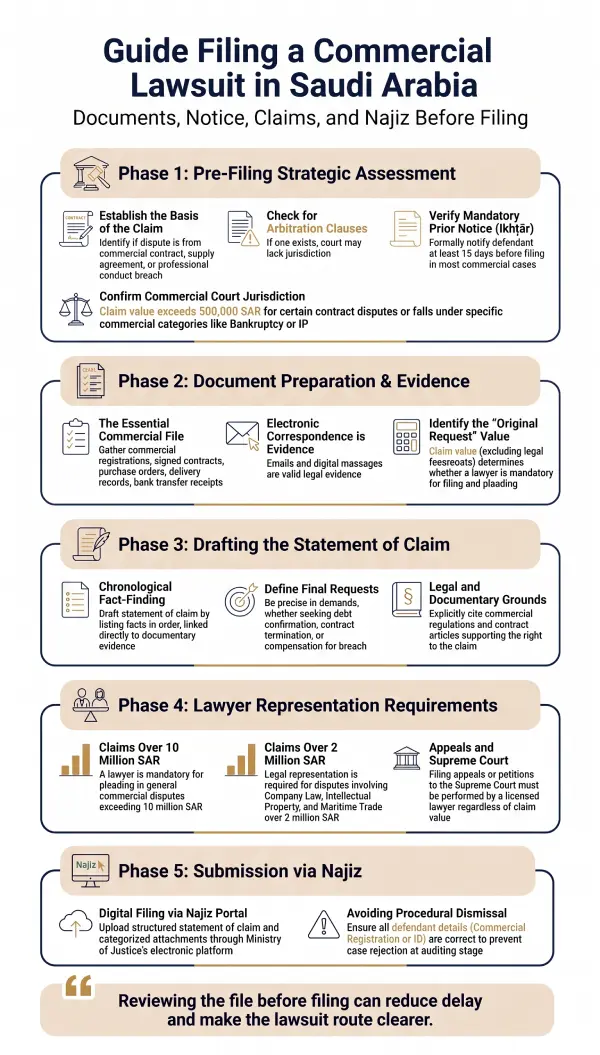
Prior Notice Before Registering a Commercial Claim
Prior notice is a pre-filing step where the claimant asks the other party to perform its obligation before court filing. Its purpose is not only procedural. It also gives the other party a chance to pay, perform, or settle, while helping define the claim before registration.
The Saudi Ministry of Justice provides a “Financial Claim Notice” service. It allows one party in a contractual relationship to notify the other party to fulfill contractual obligations. The service refers to the requirements of the Commercial Courts Law and is accessed through Najiz under judicial notification services.
A proper notice should be clear. It should include the parties’ details, the basis of the claim, the amount or subject of the obligation, the deadline, and key documents where needed. A general message that does not explain the claim may be weak in some cases.
It is also inaccurate to assume that every claim requires the same type of prior step. The safer legal approach is to say that notice is required in the cases stated by law and regulations, and that failure to complete it when required may cause delay or inadmissibility depending on the case.
What Should a Commercial Statement of Claim Include?
The commercial statement of claim is the document that presents the dispute to the court. It must be clear, concise, and connected. Long facts without a clear request are not enough. Many attachments without explaining their relevance may also weaken the filing.
The statement usually starts with the parties’ details. This includes the claimant’s name, defendant’s name, legal status, commercial registration details if an establishment is involved, contact details, and address. The facts then come in a short chronological order.
After the facts, the legal and documentary grounds should be stated. These may include a contract, invoice, purchase order, delivery record, bank transfer, correspondence, or prior notice. The final requests should then be written directly.
A clear request may say: “Order the defendant to pay a specific amount for goods supplied under the invoice and delivery record.” A weak request may say: “Order the defendant to do what the court deems appropriate.” The second wording is too broad and does not define the scope of the claim.
Commercial Lawsuit Requests
The requests are the result the claimant wants from the court. The clearer the requests, the clearer the file.
The most common requests in a commercial lawsuit include ordering the defendant to pay a sum, compensation for breach, performance of a contract, termination of a contract, confirmation of debt, delivery of goods or documents, or payment of costs and legal fees where there is a proper basis.
Requests should not become a long, disconnected list. If all requests arise from the same contract or fact, explain the link between them. If they arise from different contracts or unrelated events, they may need to be separated or reorganized.
In a claim for the price of goods, the main request is usually payment. In a supply contract breach, the request may be performance, compensation, or termination depending on the claimant’s interest and documents. In a partner dispute, the request may not be only financial; it may relate to accounts, resolutions, or management liability.
Filing a Commercial Lawsuit Through Najiz
After preparing the file, the electronic submission stage begins. The Ministry of Justice explains that the statement of claim service is accessed through Najiz and includes entering the case classification, case details, parties’ information, attaching the required documents, and submitting the request.
Before accessing the service, prepare an organized file with clear document names. Examples include: “Commercial Contract,” “Invoice No. 1,” “Delivery Record,” “Bank Transfer Statement,” and “Claim Notice.” This makes data entry and review easier.
When writing the facts on Najiz, do not copy every detail. State the essentials: the date of the relationship, type of contract, what was performed, the breach, claim value, and supporting documents. Then review the requests before submission.
Pay close attention to the defendant’s information. An error in the company name, commercial registration number, or address may delay notification and processing. If the filing is made by an attorney-in-fact, a missing or insufficient power of attorney may also cause a procedural issue.
Mistakes That May Delay or Weaken a Commercial Lawsuit
- Filing before checking jurisdiction. The claim may be valid, but the selected court may not be the correct route. Separate the validity of the right from the validity of the path.
- Missing attachments. Do not rely only on an invoice if the relationship requires a contract, purchase order, or delivery record. Each attachment should prove part of the facts.
- Unclear requests. A general request weakens the statement of claim. State exactly what you want: payment, performance, termination, compensation, or confirmation of a right.
- Ignoring the arbitration clause. An arbitration clause may change the dispute route. Review the dispute resolution clause before filing a commercial lawsuit.
- Sending an incomplete notice or failing to send notice when required. If notice is required, it must be clear and supported.
- Entering incorrect defendant details. A minor error in company details or representative information may delay notification.
- Uploading many documents without structure. A large number of documents does not make the case stronger unless the attachments are organized and connected to the facts and requests.
Practical Examples Before Filing
| Case | What to Review Before Filing | Documents That Strengthen the File | Practical Note |
|---|---|---|---|
| Claim for price of goods | Confirm the purchase order or contract, prove delivery, and identify invoice value and remaining balance. | Contract or purchase order, invoice, delivery record, account statement, bank transfers. | Do not start with the amount only; link the claim to proven supply and clear documents. |
| Claim based on invoices | Link each invoice to performed services, delivered goods, or correspondence proving acceptance. | Invoices, purchase orders, correspondence, proof of performance or delivery. | An invoice alone may be weak if the reason for issuing it or the other party’s acceptance is unclear. |
| Supply contract breach | Review obligations, delivery dates, performance, breach, and resulting damage. | Supply contract, purchase orders, delivery records, correspondence, proof of damage. | Choose the request according to the file: performance, termination, refund, or compensation. |
| Partner dispute | Review articles of association, bylaws, resolutions, accounts, and disputed conduct. | Articles of association, bylaws, partner resolutions, financial statements, correspondence. | Do not reduce a partner dispute to a financial claim only; it may involve management, authority, or profits. |
| Claim against a company | Verify the company’s correct name, commercial registration, office, representative, and link to the claim. | Commercial registration, contract, invoices, correspondence, representative details. | Incorrect company details may delay notification or weaken filing. |
| Claim with arbitration clause | Review the arbitration clause before filing and decide whether the agreed route is arbitration or court. | Contract, arbitration clause, dispute correspondence, later agreements between the parties. | Ignoring arbitration may open the door to a procedural objection that could have been anticipated. |
When Do You Need Legal Review Before Filing a Commercial Lawsuit?
You may need legal review before filing a commercial lawsuit when the claim value is high, the contract is unclear, the documents are extensive, an arbitration clause exists, the dispute involves partners, or a jurisdiction objection is expected.
The need becomes stronger when the case may fall between more than one route: commercial, civil, or employment. In that situation, the title of the contract or the invoice value is not enough. The relationship, request, parties, and documents must be reviewed.
If the file includes a commercial contract, invoices, correspondence, an arbitration clause, or a financial claim that may need court filing, it is better to review the documents and requests before filing.
Do you have a commercial claim and want to confirm whether your documents are ready before filing? Reviewing the contract, invoices, notice, and requests can help you start the case on a clearer route.
Legal Summary
A successful commercial lawsuit starts before filing. The correct beginning is to check jurisdiction, organize documents, send notice if required, and draft a clear statement of claim that links facts, attachments, and requests.
An invoice or financial claim alone is not always enough. The real strength of the case appears when you can show a clear commercial relationship, proven performance, specific breach, and a request that the court can understand and decide.
This article has been prepared for legal awareness regarding filing a commercial lawsuit in Saudi Arabia, focusing on documents, notice, statement of claim, requests, Najiz, and checking jurisdiction before registration. It does not replace reviewing the contracts and documents of each specific case.
Licence No.: 40462
Last updated: September 2026
FAQs About Filing a Commercial Lawsuit
What is the first step before filing a commercial lawsuit in Saudi Arabia?
The first step is to review jurisdiction, organize the supporting documents, check whether prior notice is required, and confirm whether the contract includes an arbitration clause.
What documents are needed before filing a commercial lawsuit?
Key documents include the commercial contract, invoices, purchase orders, delivery records, bank transfers, account statements, correspondence, commercial registration, prior notice, and any arbitration clause.
Is an invoice enough to file a commercial lawsuit?
An invoice alone may not be enough. It should be linked to a contract, purchase order, delivery record, service performance, or correspondence proving that the other party accepted the transaction.
How is a commercial lawsuit filed through Najiz?
A commercial lawsuit is filed through the statement of claim service on Najiz by entering the case classification, case details, parties’ information, attaching documents, and submitting the request electronically.
What should a commercial statement of claim include?
It should include the parties’ details, facts of the dispute, legal and documentary grounds, claim value, final requests, and supporting attachments.
When is prior notice important before filing?
Prior notice is important when the law or regulations require it before registration. It should clearly state the parties, claim basis, amount or obligation, deadline, and key supporting documents.
What mistakes may delay a commercial lawsuit?
Common mistakes include filing before checking jurisdiction, missing attachments, unclear requests, ignoring an arbitration clause, incomplete notice, incorrect defendant details, and unorganized documents.
Can a commercial lawsuit be filed without a written contract?
It may be possible if other evidence proves the relationship, such as invoices, purchase orders, delivery records, bank transfers, and correspondence.
How does an arbitration clause affect a commercial lawsuit?
An arbitration clause may change the dispute route. It should be reviewed before filing because the agreed path may be arbitration rather than court proceedings.
When should I seek legal review before filing?
Legal review is useful when the claim value is high, the contract is unclear, documents are extensive, an arbitration clause exists, the dispute involves partners, or a jurisdiction objection is expected.
Official Sources: