A commercial lawsuit petition is not a generic form where you simply replace party names. A proper petition is a structured legal document that presents a commercial dispute clearly: who is the claimant, who is the defendant, what is the commercial relationship, what caused the dispute, which document proves it, and what final relief is requested?
The petition matters before submitting the statement of claim. If the facts, requests, attachments, or defendant details are unclear, the case may be weakened or delayed. A ready-made template may help as a starting framework, but it should not be treated as a final document unless it matches the contract, documents, and nature of the claim.
This guide explains what a commercial lawsuit petition in Saudi Arabia should include, with a simplified model, a table of supporting attachments, and common drafting mistakes to avoid before filing.
Quick Answer: What Should a Commercial Lawsuit Petition Include?
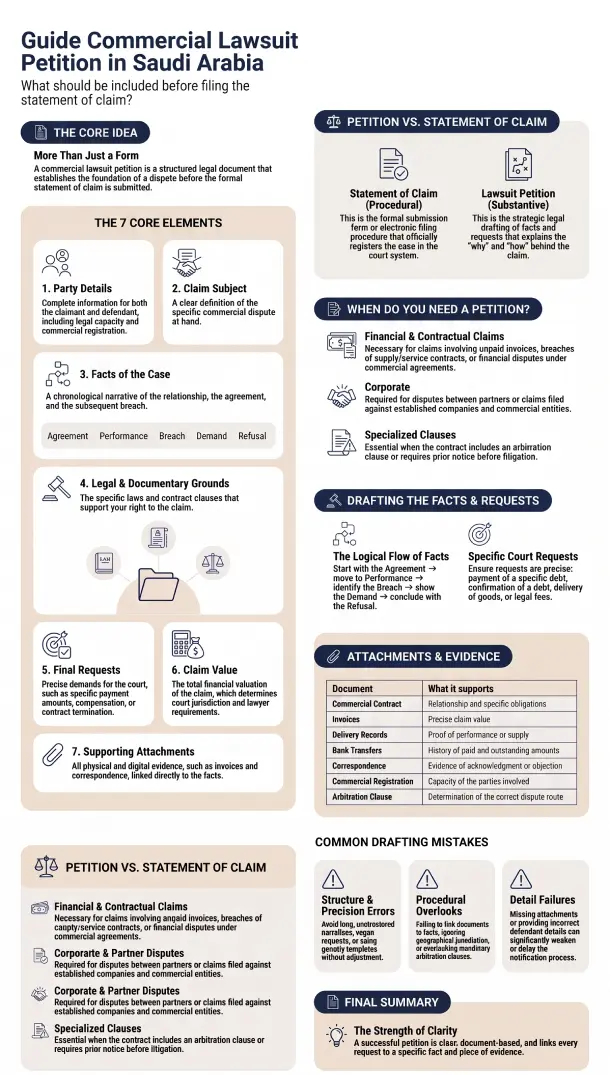
A commercial lawsuit petition usually includes seven core elements: party details, claim subject, facts, legal and documentary grounds, final requests, claim value, and supporting attachments. A general template is not enough unless it is tailored to the contract, facts, and documents.
Do you have a commercial lawsuit petition and worry that the facts, requests, or attachments may not be clear enough before filing? Reviewing the petition helps organize the dispute, connect each request to its supporting document, and check defendant details, jurisdiction, arbitration clauses, and prior notice before starting the procedure.
| Petition Element | Purpose |
|---|---|
| Party details | Identifies the claimant, defendant, and legal capacity of each party |
| Claim subject | Defines the type of dispute and the claim |
| Facts | Presents the practical sequence of the dispute |
| Grounds | Links the facts to contracts and documents |
| Requests | States what the claimant asks the court to award |
| Claim value | Shows the amount or subject of the right when a financial claim exists |
| Attachments | Supports the petition with evidence and documents |
What Is a Commercial Lawsuit Petition?
A commercial lawsuit petition is the legal text that presents a commercial dispute before the court. It is different from a demand letter or notice because it is used in a judicial context and connects the facts, documents, and requests.
A petition usually begins with party details, then the subject of the claim, then a clear chronological statement of facts, followed by legal and documentary grounds, and finally the requests. Its purpose is to give the court an organized view of the dispute without unnecessary detail or ambiguity.
In commercial disputes, the right may exist in principle, but a poor presentation may weaken the file. For example, a claimant may demand payment for invoices without explaining the contract, purchase order, delivery record, or correspondence showing acceptance. In that case, the claim may appear as a number only, not as a proven commercial right.
For this reason, a commercial lawsuit petition should not be treated as a formal template only. It is a method for organizing the dispute: what was agreed, what was performed, where the breach occurred, what evidence supports the claim, and what result is being requested.
Difference Between a Petition and a Statement of Claim
A statement of claim is the form or procedural submission made through the approved electronic channels. A petition is the legal drafting that explains the facts, requests, and documents inside the statement of claim or as an attachment to it.
| Comparison Point | Statement of Claim | Lawsuit Petition |
|---|---|---|
| Nature | Filing procedure or submission form | Legal drafting of facts and requests |
| Purpose | Registering the case and organizing its details | Explaining the dispute and proving the claim |
| Content | Data, classification, and attachments | Facts, grounds, and detailed requests |
| Common weakness | Missing data or attachments | Vague facts or overly broad requests |
This distinction matters. Completing the form does not always mean the case is strong. The statement of claim may be procedurally complete, while the petition remains weak if each request is not linked to its supporting document.
If the file is still at the stage of preparing documents and prior notice before registration, review the guide on filing a commercial lawsuit to understand the pre-filing preparation stage. This page focuses only on drafting the petition and its core elements..
When Do You Need a Commercial Lawsuit Petition?
You need a commercial lawsuit petition when you want to organize a commercial claim before submitting it to the court, especially if the dispute involves a contract, invoices, purchase orders, supply, partnership, or a financial claim connected to business activity.
Common situations that require a structured petition include:
- A financial claim arising from a commercial contract.
- A claim for invoice amounts.
- Breach of a supply, distribution, or service contract.
- A dispute between partners or with a company.
- A claim against a company or establishment.
- A claim involving an arbitration clause or prior notice.
- A case that requires clear claim value and precise requests.
A template helps arrange the petition elements, but it does not replace legal review. Each dispute has its own documents, facts, and requests. In one case, the request may be payment. In another, it may be compensation. In a third case, it may be termination, performance, or confirmation of debt.
Party Details in a Commercial Lawsuit Petition
Party details are the first element to check in a commercial petition. An error in the company name, commercial registration number, or legal capacity may delay notification or weaken the clarity of the dispute.
The petition should include enough details about the claimant and defendant, such as name, capacity, commercial registration number if applicable, address, and details of the legal representative when dealing with a company or establishment. If the claimant is represented by an attorney-in-fact or lawyer, that capacity should be clear and connected to the claim.
In a claim against a company, it is not enough to use the trading name if it differs from the registered legal name. The entity details should be checked before filing the statement of claim because the lawsuit must be directed against the correct person or legal entity, not only the commonly used name.
The petition should also state each party’s role in the dispute. Is the party a seller, supplier, partner, agent, buyer, or contractor? This role helps explain the nature of the obligation and links the party details to the subject of the claim.
Facts of the Claim: How Should They Be Written Clearly?
The facts are the legal story of the dispute. They should be written in a clear chronological order. Do not start with the conclusion, such as “the defendant owes an amount.” Start with the relationship that created the debt.
A strong order is usually: agreement, performance, breach, demand, then refusal or dispute. This helps the court or the reader understand how the right arose and why it became a claim.
Brief example:
On a specific date, the parties agreed on the supply of certain goods. The claimant performed its obligation and delivered the goods under a delivery record and invoice. The defendant failed to pay despite being asked to do so. The claimant therefore requests an order for payment.
The facts do not need to include every message or minor detail. Only legally relevant facts should be stated: what proves the relationship, what obligation existed, what was performed, where the breach occurred, and what effect followed.
Unclear facts weaken the petition. Well-ordered facts make the requests easier to understand and reduce the risk of confusing a commercial claim with a civil, employment, or other type of dispute.
Legal Grounds and Supporting Documents
The legal and documentary grounds support the facts stated in the petition. They may include a contract, invoice, purchase order, delivery record, bank transfer, email, electronic correspondence, prior notice, or any document proving the relationship or breach.
The practical rule is simple: do not mention an important fact without linking it to a document if one exists. If you say the goods were delivered, refer to the delivery record. If you say the defendant acknowledged the amount, refer to the message, transfer, or document proving that acknowledgment. If you mention prior notice, state its date and purpose briefly.
Invoices may be important, but they are not always enough on their own. Their link to the contract, purchase order, performance, or delivery should be clear. An invoice that is not connected to a transaction, delivery, or correspondence may be disputed as to its basis or value.
Electronic correspondence should also be preserved clearly, with the date, parties, and context. Attaching scattered screenshots without explanation is not enough. The petition should explain how the message supports the fact relied upon.
Commercial Lawsuit Requests: How Should They Be Drafted?
Requests are the outcome you ask the court to award. They should be clear, specific, and consistent. A broad request weakens the petition, while a precise request defines the scope of the claim.
Common requests in a commercial petition include:
- Ordering the defendant to pay a specific amount.
- Compensation for breach of contract.
- Contract termination where legally and factually supported.
- Performance of a commercial obligation.
- Confirmation of debt.
- Delivery of goods or documents.
- Costs or legal fees where there is a proper basis.
The original request should be separated from supporting or related requests. The original request is the main purpose of the claim, such as payment or performance. Related requests may concern costs, compensation, or consequences of the breach.
Do not combine inconsistent requests without explanation. If you ask for contract termination while also asking for full performance of all obligations, the petition may need more precise drafting or a clear alternative request. A strong petition does not rely on many requests; it arranges them according to priority and supporting documents.
Attachments to a Commercial Lawsuit Petition Before Filing
Attachments are not a formal list. Each attachment should prove a specific point in the petition. It is useful to prepare an internal table before submitting the statement of claim that links each document to the relevant fact and request.
| Document | What It Proves | Practical Note |
|---|---|---|
| Commercial contract | The relationship and obligations | Review payment, arbitration, and jurisdiction clauses |
| Invoices | Claim value or part of it | Link them to performance or delivery |
| Purchase orders | Request for goods or services | Important in supply relationships |
| Delivery records | Performance of obligation | Strengthens payment claims |
| Bank transfers | Paid and outstanding amounts | Link the transfer to its purpose |
| Account statement | Transaction history between the parties | Useful in ongoing dealings |
| Correspondence | Acknowledgment, objection, or negotiation | Preserve date and context |
| Commercial registration | Entity details and party capacity | Check the name and registration number |
| Prior notice | Pre-filing demand where required | State its date and content |
| Arbitration clause | Agreed dispute route | Review before drafting requests |
Organizing attachments prevents document clutter. The reader should understand why each document is attached and which fact it supports.
Simplified Commercial Lawsuit Petition Template
The following template is for guidance only. It is not a final form for all cases. It should be adjusted based on the contract, facts, documents, jurisdiction, and claimant’s requests.
Claimant and Defendant Details
Before the Commercial Court in: (……)
Claimant: (company, establishment, or individual name)
Commercial registration or ID number: (……)
Address: (……)
Represented by: (……)
Defendant: (company, establishment, or individual name)
Commercial registration or ID number: (……)
Address: (……)
Represented by: (……)
Subject of the Claim
Commercial claim arising from:
(supply contract / invoices / breach of contract / partnership / commercial financial claim / other)
Facts
On (……), a commercial relationship arose between the parties under (contract / purchase order / agreement / correspondence).
The claimant performed its obligation by (……), as supported by (invoice / delivery record / correspondence / bank transfers).
The defendant failed to (pay / perform / deliver / fulfill the obligation) despite being requested to do so.
As a result, the defendant owes an amount or obligation of (……).
Grounds and Documents
The claimant relies on the following documents:
- Contract or agreement.
- Invoices or purchase orders.
- Delivery records or proof of performance.
- Bank transfers or account statement.
- Relevant correspondence.
- Prior notice, if any.
- Any other document supporting the request.
Final Requests
The claimant requests the court to:
- Order the defendant to pay an amount of (……) Saudi riyals.
- Order the defendant to (perform the obligation / terminate the contract / pay compensation / deliver documents), depending on the case.
- Order costs or legal fees where there is a proper basis.
Attachments
The claimant attaches the documents supporting the facts and requests, organized according to their sequence in the petition.
Common Mistakes in Drafting a Commercial Lawsuit Petition
- Writing long facts without structure. Length does not equal strength. The facts should be clear and lead to the final request.
- Drafting broad requests, such as “order what is legally appropriate.” This does not define the scope of the claim. The court should understand exactly what is being requested.
- Missing attachments or failing to connect them to the facts. A document with no explanation may have limited value.
- Ignoring jurisdiction. If you are not sure which court is competent before drafting, review the guide on commercial court jurisdiction first.
- Ignoring an arbitration clause. A dispute resolution clause may change how the dispute should be handled, so it should be reviewed before submitting the statement of claim.
- Incorrect defendant details, especially in claims against a company or establishment. This may delay notification or cause procedural issues.
- Relying on a ready-made commercial lawsuit petition without adjustment. A template is only a framework; the actual dispute needs tailored drafting.
When Do You Need Legal Review Before Submitting the Petition?
You may need legal review before submitting the petition if the claim is high-value, the contract is complex, the documents are extensive, there is an arbitration clause, the dispute involves partners, or a jurisdiction objection is expected.
Review is also important when the requests are unclear. Are you asking only for payment, compensation, termination, or performance? Choosing the wrong request may weaken the petition even when the documents are strong.
Do you have a draft commercial lawsuit petition and want to confirm whether it is ready? Reviewing the facts, requests, and attachments can help make the statement of claim clearer and more connected to the documents.
Legal Summary
A commercial lawsuit petition is not just a ready-made form. It is a method for organizing the dispute and presenting it to the court through correct party details, ordered facts, clear grounds, specific requests, and attachments linked to each fact.
The shorter and clearer the petition is, the better it can present the right being claimed. A generic petition or a petition overloaded with irrelevant details may confuse the file instead of strengthening it.
This article has been prepared for legal awareness regarding a commercial lawsuit petition in Saudi Arabia, focusing on party details, facts, grounds, requests, and attachments before submitting the statement of claim. It does not replace reviewing the documents of each specific case.
FAQs About a Commercial Lawsuit Petition
What is a commercial lawsuit petition?
A commercial lawsuit petition is the legal text that presents the dispute, facts, requests, and supporting documents before the commercial court in an organized way.
What should a commercial lawsuit petition include?
It should include party details, claim subject, facts, legal and documentary grounds, final requests, claim value, and supporting attachments.
What is the difference between a petition and a statement of claim?
The statement of claim is the filing procedure or form submitted to the court, while the petition is the legal drafting that explains the facts and requests.
How should the facts be written in a commercial petition?
Facts should be written in chronological order: agreement, performance, breach, demand, and then refusal or dispute.
What attachments support a commercial lawsuit petition?
Important attachments include the contract, invoices, purchase orders, delivery records, bank transfers, correspondence, commercial registration, and prior notice if required.
How should requests be drafted in a commercial petition?
Requests should be direct and specific, such as payment, compensation, contract termination, performance of an obligation, or confirmation of debt.
Is a ready-made petition template enough?
A ready-made template may be used as a framework, but it should be tailored to the contract, facts, documents, jurisdiction, and requested relief.
When is an invoice not enough for a commercial claim?
An invoice may not be enough if it is not linked to a contract, purchase order, delivery, or correspondence proving acceptance or performance.
Should an arbitration clause be mentioned in the petition?
An arbitration clause should be reviewed before filing because it may affect the dispute route or court jurisdiction.
When should a lawyer review the petition?
Legal review is useful when the claim is high-value, the contract is complex, documents are extensive, an arbitration clause exists, or a jurisdiction objection is expected.
Official Sources: