Commercial contract termination in Saudi Arabia should not begin with drafting a termination notice. The first question is whether the breach actually gives a valid basis for ending the contract. A supplier may deliver late, a customer may stop paying, or one party may fail to meet an agreed specification. None of these situations automatically makes termination legally justified.
The review should begin with the contract itself. Identify the obligation that was breached, assess how serious the breach is, check whether formal notice is required, and determine whether the defaulting party must first be given an opportunity to cure the breach.
The Saudi Civil Transactions Law regulates remedies for non-performance in reciprocal contracts. Depending on the facts and the contractual wording, the affected party may seek performance or termination, together with compensation where the legal requirements for compensation are met.
The practical question is therefore not simply, “Can this contract be terminated?” It is: Which obligation was breached, how serious is the breach, and is termination the appropriate legal and commercial response?
Are you considering ending a commercial contract but unsure whether the breach, notice process, or cure period actually supports termination? A focused legal review before the final notice can help clarify the available route, preserve the right evidence, and reduce the risk of turning the original breach into a second dispute.
Prefer to understand the legal framework first? Continue reading the article below.
Commercial contract termination means ending a valid contract because of a breach that legally justifies termination, subject to the contract terms, any required notice, and any applicable cure period. Before ending the agreement, the affected party should compare termination with performance or cure and review the evidence, financial consequences, and dispute resolution provisions.
When Does a Breach Justify Commercial Contract Termination?
For reciprocal contracts, Article 107 of the Saudi Civil Transactions Law provides that if one party fails to perform an obligation, the other party may, after giving the required notice, seek performance or termination. Compensation may also be available where there is a legal basis for it.
The court may refuse termination where the part that remains unperformed is of minor importance compared with the overall contractual obligation. This means that proving some form of non-performance is not always enough.
The analysis should identify the obligation, the breach, its practical importance, the notice given, and the evidence supporting each step.
Official legal source:
Saudi Civil Transactions Law – Bureau of Experts at the Council of Ministers
.
| What Should Be Reviewed? | Practical Question |
|---|---|
| Obligation | What was the other party required to do? |
| Breach | What was not performed or was performed incorrectly? |
| Seriousness | How did the breach affect the purpose of the contract? |
| Notice | Was formal notice required and was it given correctly? |
| Cure | Does the agreement allow time to remedy the breach? |
| Evidence | Which documents prove the disputed event? |
| Remedy | Is performance, cure, settlement, or termination more appropriate? |
| Effect | What happens to payments and continuing obligations? |
Termination, Automatic Termination, and Invalidity
Termination for breach concerns a problem that arises during performance of a valid contract. It should not be used as a general label for every way in which a contractual relationship can end.
If the issue concerns validity or formation from the outset, the question may instead involve invalidity or voidability. If performance becomes impossible for a reason beyond the debtor’s control, the Civil Transactions Law deals separately with the resulting automatic termination. The parties may also agree to end their relationship by mutual consent.
| Situation | Practical Meaning |
|---|---|
| Termination for breach | A valid contract ends because of a breach in performance. |
| Automatic termination | Performance becomes impossible for a reason outside the debtor’s control. |
| Invalidity or voidability | The problem concerns the validity or formation of the contract. |
| Mutual termination | Both parties agree to end the contractual relationship. |
| Expiry | The contract ends when its agreed term expires. |
The first step is therefore not to select the word “termination.” It is to identify the correct legal basis for ending the contractual relationship.
What Are the Conditions for Commercial Contract Termination?
Commercial contract termination does not arise simply because the relationship has deteriorated or one party is dissatisfied. The assessment usually turns on the obligation, the seriousness of the breach, and formal notice where notice is required.
Identify the Contractual Obligation
Start with the contract itself. Identify the clause that required payment, delivery, supply, performance to an agreed specification, or abstention from prohibited conduct.
A statement such as “the company failed to comply” is too general. The relevant clause, deadline, quantity, specification, or performance standard should be identified and compared with what actually happened.
For example, if the dispute concerns late supply, review the contractual delivery date, any agreed grace period, and whether later correspondence changed the timetable.
Assess the Seriousness of the Breach
Not every breach is serious enough to justify termination. Article 107 allows the court to refuse termination where the part that remains unperformed is of minor importance compared with the overall obligation.
A short delay that can be corrected may therefore differ substantially from a complete failure to supply goods required for the operation of a production facility.
There is no universal percentage that automatically makes a breach material. The nature of the obligation, the extent of non-performance, its consequences, whether it can be cured, and the purpose of the contract should all be considered.
Check Whether Formal Notice Is Required
As a general rule, termination for non-performance may require formal notice before termination is sought.
Article 177 regulates methods by which notice may be given, while Article 176 identifies circumstances in which formal notice may not be required. These include certain cases where performance becomes impossible or useless because of the debtor’s conduct, where the debtor states in writing that performance will not occur, or where the parties agree that default occurs when the due date passes.
The contract may impose additional requirements, including written notice, service at a defined address, identification of the breach, a cure period, or a further notice after that period expires.
Legal reference: Civil Transactions Law, Articles 176 and 177, Bureau of Experts at the Council of Ministers.
Can a Contract Be Terminated Without a Court Judgment?
Yes. Article 108 of the Civil Transactions Law allows the parties to agree that the creditor may terminate the contract for breach without first obtaining a court judgment.
However, termination without a court judgment and termination without formal notice are two different issues. An agreement allowing termination without a judgment does not by itself remove the notice requirement. A separate express agreement is required if the parties intend to dispense with notice.
A termination clause may also limit the right to particular breaches or require a specified cure period, notice method, or effective date.
Practical question: Does the breach fall within the termination clause, and have all contractual steps for exercising that right been followed?
When Is Performance Better Than Termination?
A proven breach does not always make ending the agreement the best option. The affected party may still have a stronger interest in receiving the promised performance, particularly where replacement would create substantial cost, delay, or operational disruption.
Before pursuing commercial contract termination, compare four possible responses:
- Performance: where the agreed performance remains possible and useful.
- Cure: where the breach can still be corrected within a reasonable or agreed period.
- Negotiation or settlement: where preserving the relationship still has commercial value.
- Termination: where continued performance no longer serves the contractual purpose and the legal requirements for termination are satisfied.
The Civil Transactions Law also recognises the defence of non-performance in reciprocal contracts. However, the existence of a dispute does not automatically entitle one party to suspend its own performance. The relationship between the reciprocal obligations and whether they are due should be reviewed before that step is taken.
How Do You Prove a Contractual Breach?
The clearest approach is to connect the written obligation to what happened during performance and then identify the evidence that proves the difference.
| Issue | Evidence That May Be Relevant |
|---|---|
| Non-payment | Invoices, account statement, and payment demand |
| Delay | Contract, project schedule, and correspondence |
| Non-delivery | Purchase order and delivery records |
| Failure to meet specifications | Specifications, photographs, inspection report, or technical report |
| Partial performance | Quantities, acceptance records, and delivery documents |
| Refusal to perform | Correspondence or written acknowledgement |
The Saudi Evidence Law recognises digital evidence derived from electronically created, transmitted, received, stored, or communicated data that can be retrieved in an understandable form. Digital correspondence, email, and other electronic communications may therefore be relevant depending on attribution, context, and their connection to the disputed facts.
Article 55 provides that digital evidence is treated as written evidence in accordance with the rules of the Evidence Law.
Official legal source:
Saudi Evidence Law – Bureau of Experts at the Council of Ministers.
A file does not become stronger simply because it contains more documents. A better approach is to arrange the evidence chronologically and connect each document to the fact it is intended to prove.
Review Matrix Before a Termination Decision
The following sequence helps organise the analysis before proceeding with commercial contract termination. Notice and cure requirements can vary significantly from one agreement to another.
- Identify the obligation: locate the clause, deadline, specification, or condition requiring performance.
- Document the breach: connect the event to the contract and organise invoices, correspondence, delivery records, and technical reports.
- Review notice: determine whether notice is required and how it must be served.
- Check the cure period: review the period stated in the agreement, if any.
- Test seriousness: ask whether the breach undermines the main purpose of the agreement or can still be remedied.
- Compare remedies: consider performance, cure, settlement, and termination before sending the final notice.
What If the Contract Is Terminated Incorrectly?
Sending a termination notice does not make termination legally valid by itself.
If the breach does not justify termination, if the required notice procedure is not followed, or if a contractual cure period is ignored, the dispute may shift from the original breach to the legality of the termination itself.
The risk increases where termination results in suspension of a project, cessation of supplies, withholding of payments, replacement at a higher cost, interruption of an ongoing service, enforcement of liquidated damages, or commencement of proceedings despite an arbitration clause.
The central question may then change from:
to
“Did the party that terminated the agreement become responsible for stopping performance?”
For that reason, commercial contract termination should be assessed before the final notice is issued rather than after a separate dispute has arisen over whether termination was valid.
What Happens After the Contract Is Terminated?
Article 111 of the Civil Transactions Law provides that following termination or automatic termination, the parties are generally restored to the position they occupied before entering into the contract. Where restoration is impossible, compensation may be awarded.
Depending on the agreement and facts, this may involve repayment of amounts already paid, return of goods or consideration, adjustment for completed performance, treatment of assets or benefits already transferred, or compensation where restoration is impossible.
Time-based and continuing contracts require separate consideration because termination does not necessarily operate retrospectively in the same manner.
The parties should also identify provisions intended to survive the end of the relationship, including confidentiality, dispute resolution, and arbitration provisions where applicable.
Legal reference: Civil Transactions Law, Article 111, Bureau of Experts at the Council of Ministers.
Can Termination and Compensation Be Claimed Together?
Yes. The Civil Transactions Law allows termination together with compensation where the legal requirements for compensation are satisfied.
The two remedies perform different functions. Termination ends the contractual relationship. Compensation addresses legally recoverable loss caused by breach.
Termination does not therefore make every amount claimed automatically recoverable. The loss, its connection to the breach, and the legal basis of the claim must still be established.
Where the contract provides agreed compensation or liquidated damages, Articles 178 and 179 regulate their effect. Agreed compensation may be affected where no loss occurred, where the amount is excessive, or where part of the original obligation has been performed, subject to the conditions set by law.
Article 178 also contains a specific rule concerning obligations whose subject is the payment of money. Agreed compensation provisions should therefore not be applied mechanically to every contractual obligation.
Legal reference: Civil Transactions Law, Articles 178 and 179, Bureau of Experts at the Council of Ministers.
Where the dispute becomes mainly a claim for repayment or a separate monetary amount, the dedicated guide on
financial claim lawsuits in Saudi Arabia provides the more appropriate procedural discussion.
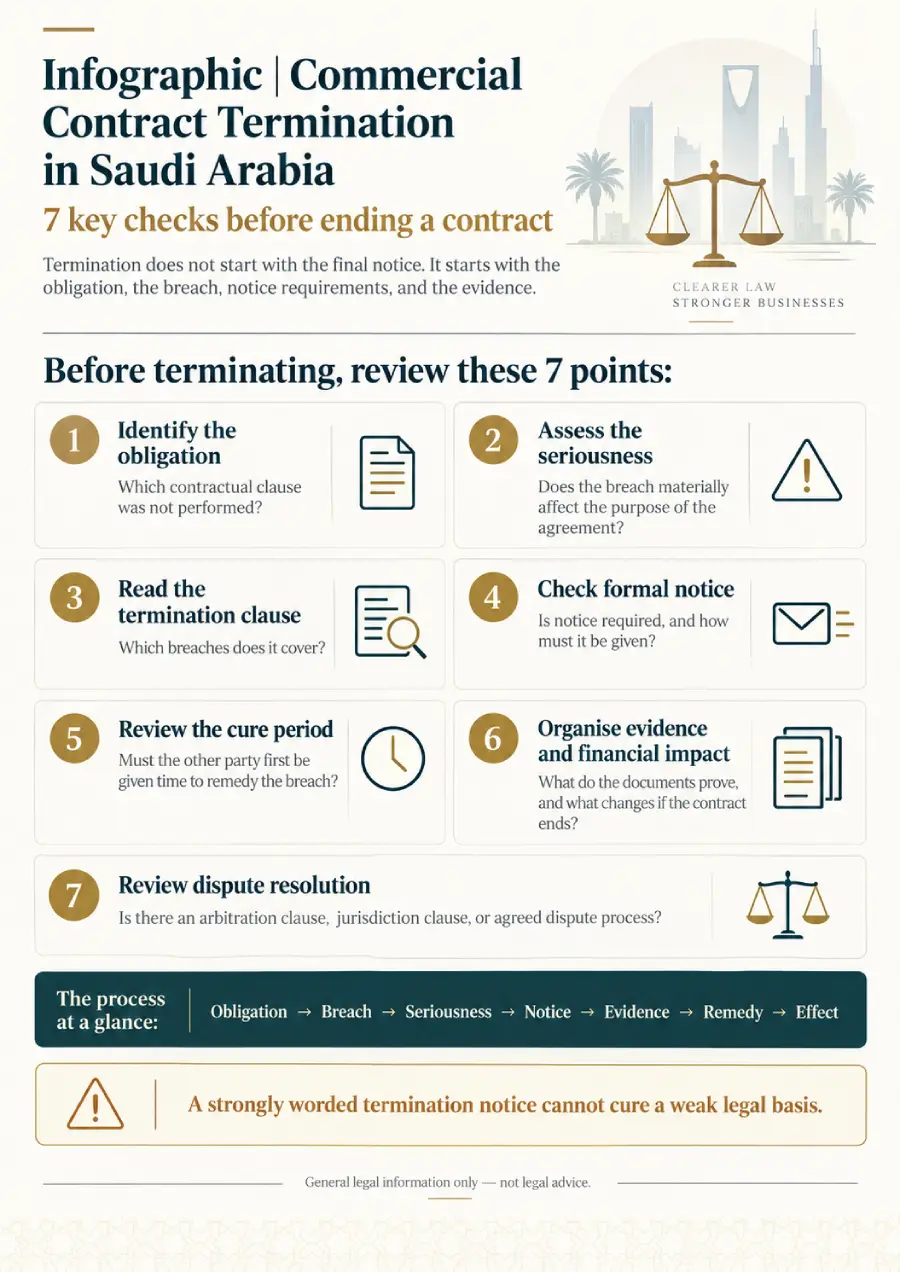
7 Checks Before Seeking Contract Termination
Before pursuing commercial contract termination, review these seven points:
- Identify the obligation: Which contractual clause was not performed?
- Assess the impact: Does the breach materially affect the purpose of the agreement?
- Read the termination clause: Which breaches does it cover?
- Check formal notice: Is notice required, and how must it be given?
- Review the cure period: Must the other party first be given time to remedy the breach?
- Organise the evidence and financial impact: What do the documents prove and what changes if the contract ends?
- Review dispute resolution: Is there an arbitration clause, jurisdiction clause, or agreed dispute process?
Calling an agreement “commercial” does not automatically mean that the Saudi Commercial Court has jurisdiction. Jurisdiction depends on the parties, the legal relationship, the basis of the claim, and the applicable jurisdiction rules.
Where the issue becomes which court should hear the dispute, see Commercial Court jurisdiction in Saudi Arabia rather than repeating the full jurisdiction analysis here.
Mistakes That Can Weaken a Termination Decision
Before escalating commercial contract termination, avoid mistakes that can turn the original breach into a second dispute over whether termination itself was valid:
- Treating every breach as material: a minor breach may not justify termination.
- Sending a final notice too quickly: review the termination clause and notice procedure first.
- Ignoring the cure period: where the agreement requires one, it should not be bypassed.
- Ignoring later amendments: correspondence may have changed the deadline or method of performance.
- Suspending your own performance without review: the legal basis for withholding performance should first be assessed.
- Claiming a fixed amount without analysing loss: compensation should be linked to an identifiable legal basis and loss.
- Ignoring arbitration or dispute resolution provisions: they should be reviewed before choosing a forum.
- Confusing termination with invalidity or automatic termination: each has a different legal basis.
- Acting inconsistently with the termination notice: later conduct may create uncertainty about the party’s position.
- Deleting earlier correspondence: earlier communications may establish the sequence of breach and notice.
A strongly worded termination notice cannot cure a weak legal basis. The strength of the decision starts with the contract, the facts, the notice process, and the evidence.
When Is Professional Legal Review Important?
Not every contractual breach requires litigation. Professional review becomes more important where the contract has a high value, the breach is disputed, advance payments are involved, or the agreement contains a termination clause, liquidated damages provision, or arbitration clause.
It also becomes more important where the business must choose between insisting on performance and ending the relationship, or where termination will immediately stop a project, supply arrangement, ongoing service, or reciprocal payment obligations.
A useful review does not begin with “How should the termination notice be drafted?” It begins with the following questions:
- Which obligation was breached?
- What proves the breach?
- Is formal notice required?
- Is there a cure period?
- Is performance or termination commercially preferable?
- What are the financial consequences?
- Is there an arbitration or dispute resolution clause?
If the agreement contains a cure period, termination clause, arbitration provision, or significant continuing obligations, the legal basis and consequences should be reviewed before a final notice changes the parties’ positions.
Do not send contracts, party names, detailed dispute information, or sensitive data through a public contact form.
This article provides general legal information about commercial contract termination in Saudi Arabia. It is not legal advice for a specific matter, and reading it does not create a lawyer-client relationship. The legal assessment may differ depending on the contract wording, facts, documents, parties, and any special law applicable to the transaction.
Frequently Asked Questions About Commercial Contract Termination
When Can a Commercial Contract Be Terminated for Breach?
A reciprocal contract may be terminated where one party breaches an obligation and the breach is sufficiently important to justify termination. Formal notice must also be given where required. A minor breach will not necessarily justify termination, and the court may refuse termination where the unperformed part is of limited importance compared with the overall obligation.
Is Delay Alone Enough to Terminate a Contract?
Not necessarily. Review the agreed deadline, the length and effect of the delay, any grace or cure period, and later correspondence. The parties may have changed the original timetable or accepted a different performance arrangement after the contract was signed.
When Is Formal Notice Not Required?
The Civil Transactions Law identifies situations in which notice may not be required, including certain cases where performance becomes impossible or useless because of the debtor’s conduct, where the debtor states in writing that performance will not occur, or where the parties expressly agree on automatic default after the due date.
Can a Contract Be Terminated Without a Court Judgment?
Yes. The parties may agree that the creditor can terminate for breach without first obtaining a court judgment. This does not automatically waive formal notice. Any separate agreement regarding notice, service, cure periods, and other contractual conditions must still be reviewed.
What Evidence Is Most Useful to Prove a Contractual Breach?
The evidence depends on the disputed obligation. Relevant records may include invoices, purchase orders, delivery documents, account statements, technical reports, notices, emails, and other digital correspondence. The strongest file connects each document to the contractual obligation and the event it is intended to prove.
What Happens If the Termination Was Not Justified?
The dispute may shift to whether the terminating party was itself responsible for stopping performance or causing additional loss. The contractual basis for termination, notice requirements, cure periods, arbitration provisions, and financial consequences should therefore be reviewed before the final notice is issued.
Conclusion
Commercial contract termination should not begin with a termination letter. It begins with identifying the contractual obligation, determining the seriousness of the breach, checking the notice and termination provisions, and organising the evidence.
The next decision is whether performance, cure, settlement, or termination is the better legal and commercial response. If termination is appropriate, the review should also cover prior payments, compensation, continuing obligations, confidentiality, arbitration, and any provisions intended to survive the end of the relationship.
Before sending the final notice, test these elements against the actual wording of the agreement rather than relying on a generic termination template.