A complaint against a shop should not start with choosing an authority. It should start with identifying the problem and the legal outcome you want. The issue may be a regulatory violation that should be reported, a disputed financial right that may require court action, or an enforceable instrument that makes enforcement more appropriate than filing a new claim.
The position may also change if the transaction took place through an online store, the product is defective or fraudulent, or the facts suggest conduct that goes beyond a contractual breach and may require separate criminal assessment.
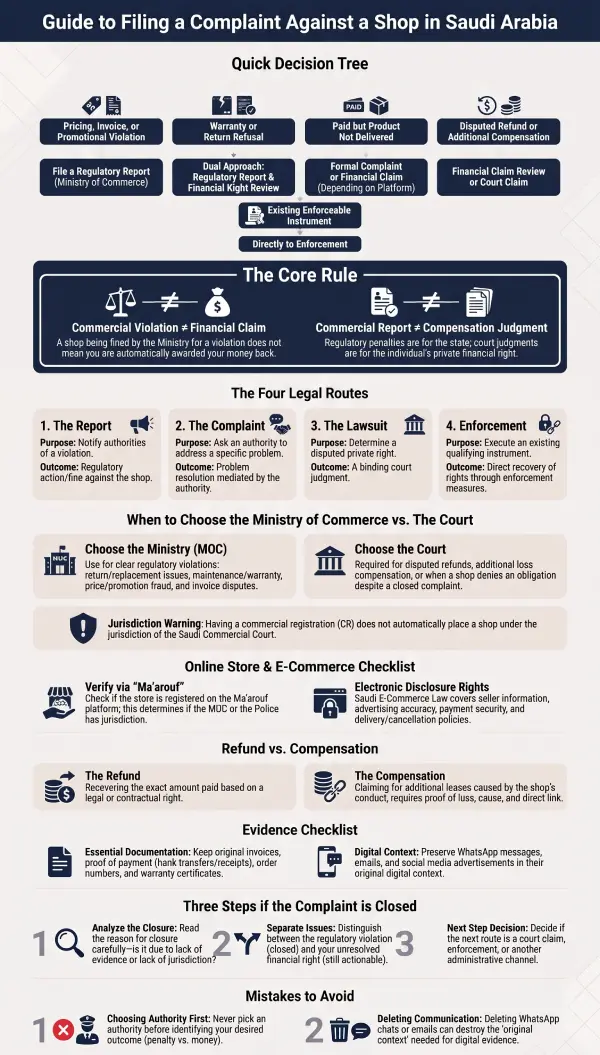
The practical approach is based on three points: a commercial violation is not the same as a financial claim, filing a report is not the same as obtaining compensation, and the correct route depends on the right, the facts, and the evidence.
The real question is therefore not only, “Where should I complain?” It is: What outcome am I seeking, and which legal route is most appropriate?
Quick Answer: Should You File a Complaint or a Lawsuit?
The correct route for a complaint against a shop depends on the nature of the problem and the result you want. A single dispute may include both a regulatory issue and a financial claim, so the authority should not be selected simply because the other party is a shop or registered business.
Did a shop refuse a refund, fail to deliver your order, ignore a warranty issue, or leave you unsure whether to file a complaint or pursue a financial claim? Identifying the correct legal route first can help you avoid unnecessary escalation and clarify whether your matter is better addressed through a regulatory complaint, a claim for repayment or compensation, enforcement, or another appropriate process.
Prefer to understand the available routes first? Continue with the guide below.
| Your Situation | Route to Consider First |
|---|---|
| Pricing, invoice, or promotional violation | Regulatory report, subject to the authority’s jurisdiction |
| Refusal to honour a warranty or return | Review both the regulatory issue and the financial right |
| You paid but did not receive the product | Complaint or financial claim, depending on the facts |
| You want a disputed amount refunded | Review the financial claim route |
| You are seeking additional compensation | Review the court route and jurisdiction |
| You hold a qualifying enforceable instrument | Consider enforcement before filing a new claim |
| There are independent indicators of fraud | Consider a separate criminal-law assessment |
The Saudi Ministry of Commerce accepts several categories of commercial reports, including matters relating to warranties, maintenance and spare parts, replacement and return, sales and invoices, discounts, and other violations within its regulatory jurisdiction.
However, the existence of a reporting service does not mean that every financial dispute can be resolved through the regulatory process.
What Is the Rule for Distinguishing a Complaint from a Lawsuit?
When making a complaint against a shop, a regulatory complaint or report will usually focus on a violation that falls within the powers of an administrative authority. A lawsuit, by contrast, asks the competent court to determine a disputed private right and issue a binding judgment.
If the right is already established by an enforceable instrument that meets the legal requirements, the appropriate question may be whether enforcement is available rather than whether a new lawsuit should be filed.
Unsure whether your matter is a regulatory complaint or a financial claim? The answer depends on what you want to achieve, what your documents prove, and whether you need regulatory intervention, a court judgment, or enforcement of an existing right.
Or continue reading to understand how the different routes work.
What Is the Difference Between a Report, a Complaint, and a Lawsuit?
These terms are sometimes used loosely in everyday conversation, but each serves a different purpose when dealing with a complaint against a shop.
A commercial report alerts the regulatory authority to conduct that may amount to a violation within its jurisdiction. The Ministry of Commerce provides official channels for submitting and following up commercial reports.
A complaint is broader in practical use. It may involve asking an authority to address a specific problem, objecting to a business practice, or following up on an earlier report.
A lawsuit is different. It is a judicial dispute in which the claimant asks the competent court to determine a right, such as payment of money, entitlement to a refund, or compensation that remains disputed.
Enforcement is another route. A person seeking enforcement is not asking the court to establish the right from the beginning. Instead, the applicant relies on an enforceable instrument that satisfies the applicable legal conditions.
| Route | Main Purpose | Possible Outcome |
|---|---|---|
| Report | Notify the authority of a violation | Regulatory action within jurisdiction |
| Complaint | Ask for a problem to be addressed | Depends on the authority and issue |
| Lawsuit | Determine a disputed private right | Court judgment |
| Enforcement | Enforce an existing instrument | Enforcement measures |
This distinction forms part of the initial legal characterisation of a dispute. For a broader explanation, see commercial disputes in Saudi Arabia. This article, however, focuses specifically on deciding whether the dispute should begin as a complaint or move into a court-based route.
Does Filing a Commercial Report Automatically Get Your Money Back?
No. Filing a complaint against a shop as a commercial report should not be treated as an automatic guarantee of a refund or compensation.
Regulatory intervention may sometimes correct the violation or encourage a resolution. A specific law may also provide a particular financial remedy in defined circumstances.
For example, under the Saudi Anti-Commercial Fraud Law, a fraudulent product may be withdrawn and its value returned to the purchaser where the relevant legal conditions are satisfied. The injured party may also retain a separate right to claim compensation.
That is a specific rule for commercial fraud. It should not be treated as a general rule for every consumer dispute.
When Is a Complaint Against a Shop Enough?
A complaint against a shop is more likely to be the right starting point where the main objective is to address a clear regulatory violation rather than resolve a complex financial dispute.
Sales and invoice issues: The Ministry of Commerce receives reports relating to sales and invoices. Where the problem concerns a clear regulatory practice, a commercial report may therefore be an appropriate first step.
Returns and replacements: These issues fall within categories of commercial reports handled by the Ministry. However, wanting to return a product does not automatically mean that a legal right to return exists in every case. The type of product, the transaction, the reason for return, and the applicable terms or legal rules remain relevant.
Warranty and maintenance: Commercial reporting categories also include warranty, maintenance, and spare-parts issues. The regulatory route can therefore be practical where the problem falls within those areas.
Prices, offers, and discounts: Where the issue concerns a price, promotion, discount, or commercial practice that falls within regulatory oversight, reporting the violation may be more appropriate than immediately starting court proceedings.
Fraudulent products: Not every defect amounts to commercial fraud. The Saudi Anti-Commercial Fraud Law identifies specific forms of fraudulent products, including certain cases where a product does not comply with approved standards.
Practical rule: a complaint against a shop is usually the closer route where your first objective is to address a clear commercial violation. If the financial right itself remains disputed, another legal route may need to be considered.
When Is a Complaint No Longer Enough and a Court Claim May Be Needed?
Court proceedings become more relevant when the dispute moves beyond a regulatory violation and becomes a contested private right that requires a binding determination.
Where the refund itself is disputed: A shop may accept that the sale took place but dispute your entitlement to a refund or the amount that should be repaid. At that point, the issue is no longer limited to reporting a violation.
Where you are seeking compensation: Recovering the purchase price is different from claiming an additional amount for loss allegedly caused by the seller’s conduct. A compensation claim requires a proper basis and evidence connecting the claimed loss to the relevant conduct.
Where the other party denies the obligation: If the business denies the transaction, disputes the agreement, or challenges the obligation you rely on, the matter becomes a dispute about the existence or scope of the right.
Where the regulatory complaint is closed but the financial issue remains unresolved: Closure of a report does not automatically extinguish a private financial right. Equally, it does not prove that the amount is legally due. The reason for closure, the evidence, and the remaining claim should be reviewed.
Where a binding judgment is required: Some disputes cannot be resolved through regulatory action because the parties disagree about facts, contractual terms, or the amount claimed.
Where the dispute has become primarily financial, the separate guide on filing a financial claim in Saudi Arabia explains the financial-claim route in more detail. This article is limited to identifying when a matter may have moved beyond the complaint stage.
Ministry of Commerce or Court: How Do You Identify the Correct Route?
There is no accurate rule that says every consumer problem belongs with the Ministry of Commerce and every unresolved complaint automatically becomes a Commercial Court case.
The better approach is to classify the right first.
Clear regulatory violation?
Review the Ministry of Commerce’s jurisdiction and the relevant reporting category.
Seeking a judgment for a disputed refund or compensation?
Review the legal relationship and identify the competent court.
Already holding an enforceable instrument for an amount that is due?
Consider enforcement before starting a new dispute.
Facts suggesting a separate criminal offence?
Assess the potential criminal route separately from the contractual breach.
Does Every Claim Against a Shop Fall Within the Commercial Court’s Jurisdiction?
No. The fact that the defendant operates a shop, business, or commercial registration does not automatically give the Saudi Commercial Court jurisdiction.
Jurisdiction depends on matters such as the status of the parties, the nature of the transaction, the source of the claim, the activity that gave rise to the dispute, and the applicable jurisdictional rules.
For that reason, this article does not duplicate the full jurisdiction analysis. Once the question becomes “Which court should hear the case?”, see the separate guide on jurisdiction of the Saudi Commercial Courts.
What Changes If the Complaint Concerns an Online Store?
E-commerce transactions are subject to additional rules, so they should not always be approached in the same way as an in-store purchase.
The Saudi E-Commerce Law regulates information that a service provider must display in an online store. It also addresses contractual information relating to price, payment, delivery, and warranties, and prohibits certain forms of misleading electronic advertising.
Subject to statutory exceptions, a consumer may terminate an e-commerce contract within seven days after receiving the product or entering into a service contract, provided the consumer has not used the product, benefited from the service, or otherwise obtained the relevant benefit.
The law also addresses delayed delivery or performance. In applicable cases, where the service provider delays delivery or performance for more than fifteen days beyond the relevant agreed or legally applicable date, the consumer may have a right to terminate the contract and recover amounts paid, unless the delay resulted from force majeure.
This means several situations must be kept separate:
- the store never dispatched the order;
- delivery occurred late;
- the product arrived but did not match what was agreed;
- the consumer received and used the product.
The fact that a seller operates through Instagram, Snapchat, or another social platform does not automatically place the transaction outside e-commerce rules. What matters is the nature of the business activity, the transaction, the parties, and the surrounding facts.
If the seller is outside Saudi Arabia, additional questions arise around the provider’s identity, place of business, payment route, jurisdiction, and practical enforcement. A cross-border transaction should therefore not be assumed to follow exactly the same path as a domestic dispute.
Refund or Compensation: What Are You Actually Claiming?
A common source of confusion is the difference between recovering the purchase price and claiming compensation for additional loss.
A refund means recovering money paid under the transaction where there is a legal or contractual basis for returning it.
Compensation is different. It concerns an additional loss allegedly caused by the other party’s conduct.
That raises separate questions:
- What loss occurred?
- Can it be proved?
- What caused it?
- How is it connected to the shop’s conduct?
The existence of a regulatory violation may be relevant, but it does not automatically establish every element of a separate compensation claim.
When Does the Dispute Become a Financial Claim?
Example 1: You paid SAR 20,000 for products that were never delivered, and the seller refuses to return the money. The central issue has now become entitlement to a specific sum rather than simply reporting a commercial violation.
Example 2: You received a product that you say differs from the advertisement, while the seller maintains that it complies with the agreed description. The advertisement, order details, stated specifications, and actual product become central evidence.
Example 3: The shop refunded the purchase price, but you are seeking additional compensation for a separate loss that you say resulted from the breach. The legal basis and evidence of that additional loss now become the focus.
What Documents Can Strengthen Your Complaint or Claim?
The strength of a complaint against a shop, or any later claim, does not depend on the number of attachments. It depends on whether each document proves a relevant fact.
| Issue | Useful Evidence |
|---|---|
| You paid but received nothing | Payment evidence + order number + correspondence |
| Defective or different product | Invoice + photographs + warranty + specifications |
| Advertisement differs from reality | Copy of advertisement + order details + product received |
| Return refused | Proof of purchase + published return policy + correspondence |
| Delivery dispute | Contract or order + agreed date + later communications |
Invoice and proof of purchase: These can help establish the transaction and its value, but they may not prove every disputed element.
Payment evidence: This shows that money was transferred. If the reason for the payment is disputed, additional documents may be needed.
Order number: This can connect the product, transaction date, amount, and seller.
WhatsApp messages and other digital communications: Do not discard them. The Saudi Evidence Law recognises digital evidence, including digital correspondence and means of communication, and regulates its evidential effect.
Where possible, retain communications in their original context rather than relying only on isolated screenshots that do not show the full sequence.
Photographs and technical reports: These become more important where the dispute concerns a physical defect, technical issue, or lack of conformity.
What Should You Do If the Complaint Is Closed Without a Solution?
Closure of a complaint against a shop does not automatically end every possible right, and it does not mean that court proceedings are always the next step.
- Read the reason for closure. Determine whether the authority found no violation, lacked sufficient information, considered the matter outside its jurisdiction, or closed the report for another procedural reason.
- Separate the regulatory issue from the financial right. The regulatory aspect may end while a dispute over money or compensation remains.
- Review the evidence. Identify what proves the purchase, payment, obligation, and alleged breach.
- Check the available follow-up route. Review the official channels available for following up the report or complaint.
- Identify the next legal route. Consider whether the matter now requires a court claim, enforcement of an existing instrument, or another procedure.
The purpose is not to escalate simply because the complaint was closed. It is to reclassify the unresolved issue and select the route that addresses it.
When Can the Dispute Raise Commercial Fraud or Criminal Concerns?
It is a mistake to describe every delay or failure to perform as “fraud”.
A contractual dispute may simply concern a delivery date, contractual term, or scope of an obligation.
A commercial violation may involve conduct regulated by a particular authority or statutory regime.
Commercial fraud has specific forms under the Saudi Anti-Commercial Fraud Law, including matters relating to a product’s characteristics, source, description, or compliance with applicable standards.
A suspected criminal fraud case requires facts and conduct that go beyond ordinary non-performance.
Failure to deliver a product, by itself, does not automatically prove a criminal offence. The activity, advertising, communications, identity of the seller, handling of the payment, and surrounding circumstances all need to be assessed before applying a criminal characterisation.
This distinction matters because an inaccurate criminal description may distract from the legal route that actually protects the claimant’s right.
Seven Mistakes That Can Weaken Your Position Before Escalation
Before escalating a complaint against a shop, avoid procedural and evidentiary mistakes that can weaken your position or lead you toward the wrong legal route.
- Choosing the authority before identifying the outcome you want. First decide whether you are seeking regulatory action, a refund, compensation, or enforcement.
- Failing to keep proof of purchase. Retain the invoice, order details, and payment evidence.
- Deleting communications. Messages may help establish the agreement, deadlines, acknowledgements, or reason for refusal.
- Calling every breach fraud. A contractual breach does not automatically amount to a criminal offence.
- Treating a regulatory report as a financial judgment. Regulatory action and determination of a disputed private financial right are different processes.
- Assuming Commercial Court jurisdiction. The existence of a trader or commercial registration does not decide jurisdiction by itself.
- Filing a lawsuit before reviewing the instrument you already hold. If a qualifying enforceable instrument exists, enforcement may be more appropriate than a new claim.
When Should You Seek Professional Review Before Escalating?
Not every complaint against a shop requires legal review. Many clear regulatory issues can begin through the designated reporting channel.
Professional review becomes more important where the amount is substantial, contractual terms are complex, jurisdiction is unclear, additional compensation is being claimed, the regulatory report has been closed while the financial issue remains unresolved, an existing document may qualify for enforcement, the invoice conflicts with advertising or correspondence, or the facts potentially go beyond an ordinary contractual dispute.
A useful legal review does not begin with:
“How do I file the case?”
It begins earlier:
What exactly am I claiming?
Which document proves it?
Is this a regulatory violation or a disputed private right?
Do I need a new judgment?
Do I already have an instrument that may be enforced?
Legal Summary
When dealing with a complaint against a shop, start with the outcome you want rather than the name of the authority.
- Clear commercial violation: review the regulatory reporting route.
- Disputed refund or compensation: review the court claim and jurisdiction.
- Qualifying enforceable instrument: consider enforcement before filing a new lawsuit.
- Facts indicating a separate criminal offence: assess the criminal route independently.
The most appropriate route is not always the most aggressive one. It is the route that matches the legal nature of the right and is supported by the available evidence.
Frequently Asked Questions About a Complaint Against a Shop
How do I file a complaint against a shop in Saudi Arabia?
Start by identifying the type of violation and the authority responsible for it. If the issue falls within the Ministry of Commerce’s jurisdiction, you may submit a commercial report through its official channels and attach the relevant evidence.
When should I report a shop to the Ministry of Commerce?
A report may be appropriate where the issue involves a regulatory violation, such as certain sales, invoice, warranty, return, pricing, or promotional matters within the Ministry’s jurisdiction.
What is the difference between a commercial report and a lawsuit?
A commercial report alerts a regulatory authority to a possible violation. A lawsuit asks the competent court to determine a disputed private right and issue a binding judgment.
Can a commercial report help me recover my money?
Not automatically. A report may address the regulatory violation, but a disputed refund or financial claim may require a separate legal route depending on the facts and applicable law.
When does a complaint against a shop become a financial claim?
It may become a financial claim when the dispute centres on a specific amount, such as a disputed refund, unpaid amount, or compensation that requires a binding determination.
Which court handles a claim against a shop in Saudi Arabia?
Jurisdiction depends on the parties, the nature of the transaction, the source of the claim, and the applicable jurisdictional rules. The existence of a commercial registration alone does not automatically give the Commercial Court jurisdiction.
What evidence should I keep when disputing a purchase?
Useful evidence may include the invoice, proof of payment, order number, warranty documents, advertisements, photographs, delivery records, and WhatsApp or other digital correspondence.
What should I do if my Ministry of Commerce complaint is closed?
Review the reason for closure first. Then identify whether a financial right remains unresolved and whether the next step should involve follow-up, a court claim, enforcement, or another legal route.
How is a complaint against an online store different?
Online transactions may be subject to additional rules under the Saudi E-Commerce Law, including requirements relating to disclosure, advertising, delivery, cancellation, and consumer rights.
When can a dispute with a shop raise fraud concerns?
Fraud should not be assumed from delay or non-performance alone. A criminal assessment requires facts indicating conduct that goes beyond an ordinary contractual breach or regulatory violation.