Legal content prepared by
Lawyer Mohammed Aboud Al-Dossary
Saudi-Licensed Lawyer — Licence No. 40462
Published: 19 September 2026
Last updated: 19 September 2026
The Duty of Care and Loyalty defines how a company manager should use managerial authority and what should be considered before making a decision. Article 26 of the Saudi Companies Law sets out seven connected duties relating to authority, the company’s interests, independent judgment, reasonable care, conflicts of interest, disclosure, and benefits from third parties. A business loss alone does not prove a breach. The assessment begins with the decision, the information available at the time, the manager’s authority, any personal interest, and the supporting records.
Quick Answer
The Duty of Care and Loyalty requires a company manager to act within the granted authority, in the company’s interests, and with independent judgment. It also requires reasonable care, diligence, and skill, together with proper treatment of conflicts of interest. Compliance is assessed from the decision-making process and the information available when the decision was made, not from profit or loss alone.
Official source:
Saudi Companies Law — Bureau of Experts at the Council of Ministers.
Articles 26, 27, 28 and 31 checked in September 2026.
What Does the Duty of Care and Loyalty Mean?
The two duties are connected, but they answer different questions. The duty of care focuses on how the manager reached a decision: what information was available, what risks were understood, and whether the decision received an appropriate level of attention. The duty of loyalty focuses on whose interests the decision serves and whether the manager acted independently for the company.
A manager may fail to exercise adequate care even without receiving any personal benefit. For example, a material decision may be made without enough information. A different decision may be financially well prepared but still raise a loyalty issue because a personal interest was not properly addressed. Both duties can therefore arise in the same facts.
Duty of Care
Article 26 requires the manager or board member to exercise the care, attention, diligence, and skill reasonably expected in the circumstances. The preparation required should reflect the importance and effect of the decision. A routine operational decision will not normally require the same level of analysis as acquiring a major asset or entering into a long-term financial commitment.
The duty of care does not guarantee commercial success. Market conditions may change after a decision was properly considered, and a loss may still occur. The more relevant question is what the manager knew, what information was reasonably available, and how the decision was made at that time.
Duty of Loyalty
The duty of loyalty directs managerial authority toward the company’s interests and requires independent judgment. It is also connected to avoiding conflicts of interest and disclosing direct or indirect interests that relate to company transactions or contracts.
A disagreement between a manager and the partners does not by itself establish a loyalty problem. The question is whether the manager exercised independent judgment for the company or allowed another interest to influence the decision. Detailed rules on conflicts, competition, and corporate opportunities should be considered separately where those issues arise.
| Point of Comparison | Duty of Care | Duty of Loyalty |
|---|---|---|
| Main focus | Quality of the decision-making process | Company interests and independent judgment |
| Main question | Were the information and level of care appropriate? | Did the decision serve the company without an unmanaged conflicting interest? |
| Key records | Reports, studies, risk analysis, and minutes | Disclosures, approvals, and records of independent decision-making |
| Personal benefit required? | No | A personal interest may become a central part of the assessment |
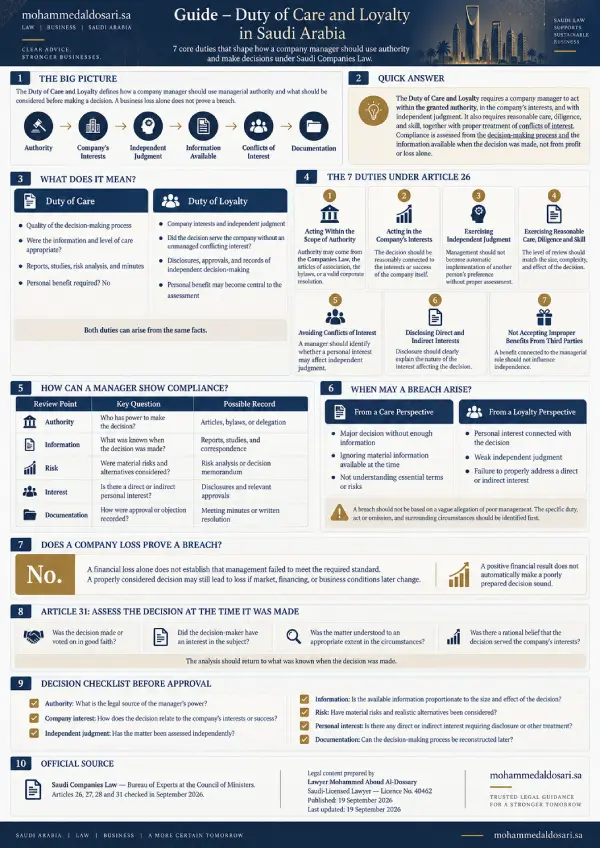
What Seven Duties Does Article 26 Establish?
The Duty of Care and Loyalty under Article 26 operates through seven connected obligations. They do not mean that every breach automatically creates liability. Instead, they provide the starting points for assessing the conduct of a company manager or board member.
1. Acting Within the Scope of Authority
Every decision begins with authority. A manager’s power may come from the Companies Law, the articles of association, the bylaws, or a valid resolution issued by the competent corporate body. Holding the title of “manager” does not by itself mean that the person may approve every transaction or sign every commitment.
Management structures also differ according to the company form. The Saudi Companies Law provides the wider framework for company forms, management structures, and the documents that should be considered when reviewing managerial authority.
2. Acting in the Company’s Interests
The Companies Law makes the company’s interests central to management decisions. This does not mean that every decision must benefit every partner or shareholder in exactly the same way. It means that management should be able to identify a reasonable connection between the decision and the interests or success of the company itself.
3. Exercising Independent Judgment
Independent judgment does not require a manager to ignore partners, shareholders, or other corporate bodies. It means that where the manager has responsibility for a decision, that responsibility should not become an automatic implementation of another person’s preference without assessing whether the decision serves the company.
4. Exercising Reasonable Care, Diligence and Skill
This is the practical core of the duty of care. Before approving a material decision, the manager should understand its nature, the main obligations it creates, the important risks, and the information needed to assess it. The level of review will depend on the size, complexity, and circumstances of the decision.
5. Avoiding Conflicts of Interest
Conflicts of interest are closely connected to the duty of loyalty, although Article 27 deals with them in greater detail. For the purpose of this article, the key point is that a manager should identify whether a personal interest may affect independent judgment and then address that interest under the applicable legal rules.
6. Disclosing Direct and Indirect Interests
Disclosure is of limited value if it is too vague to explain the nature of the interest. The relevant corporate body should be able to understand the interest that may affect the decision so that it can deal with the matter under the Companies Law and the company’s constitutional documents.
7. Not Accepting Improper Benefits From Third Parties
This duty protects management independence where a benefit is connected to the manager’s role in the company. The assessment depends on the nature of the benefit, its connection with the position, and the surrounding facts. It should not be expanded into legal characterisations that fall outside the scope of the corporate duty being discussed here.
The Implementing Regulations of the Companies Law contain further provisions relating to duties of care and loyalty, indirect interests, disclosure, and competition.
Official source:
Implementing Regulations of the Companies Law.
Source checked in September 2026.
How Can a Manager Show Compliance with the Duty of Care and Loyalty?
There is no single document that proves compliance in every case. The decision-making record usually needs to be read as a whole, starting with authority and then considering the information available, the risks discussed, the decision process, and any disclosure or approval connected with the matter.
A material decision requires information proportionate to its significance. Where a subject falls outside management’s ordinary knowledge, technical, financial, or legal reports may form part of the information used to understand it. The existence of a report is not enough by itself; its scope, assumptions, and the information on which it was based may also matter.
Documentation comes at the end of this process. Minutes or a written resolution do not make a weak decision sound by themselves. They do, however, help show what information was before the decision-maker, who approved the decision, and whether a material interest, objection, or risk was considered.
| Review Point | Question | Possible Record |
|---|---|---|
| Authority | Who has power to make the decision? | Articles, bylaws, or delegation |
| Information | What was known when the decision was made? | Reports, studies, and correspondence |
| Risk | Were material risks and alternatives considered? | Risk analysis or decision memorandum |
| Interest | Is there a direct or indirect personal interest? | Disclosures and relevant approvals |
| Documentation | How were approval or objection recorded? | Meeting minutes or written resolution |
When Is the Duty of Care and Loyalty Breached?
A breach should not be based on a general allegation of “poor management.” The specific duty, act or omission, and surrounding circumstances should first be identified. From a care perspective, risk may increase where a manager makes a major decision without understanding its essential terms or ignores material information that was available at the time.
From a loyalty perspective, the assessment focuses on independent judgment, the company’s interests, and any personal interest connected with the decision-maker. Where the facts involve a direct or indirect interest, competition, company assets, or corporate opportunities, Article 27 may become relevant. Those issues still require their own factual and documentary assessment.
A breach of a duty should also be distinguished from the legal consequences that may follow. Article 28 connects management liability with damage resulting from a breach of the Companies Law or the company’s constitutional documents, or from fault, negligence, or failure to perform duties. Identifying the duty is therefore only one part of the analysis.
Does a Company Loss Prove a Breach?
No. A financial loss alone does not establish that management failed to meet the required standard. A decision may be made after appropriate information and risk review, yet market, financing, or business conditions may later change. The reverse is also possible: a poorly prepared decision may produce a positive financial outcome, but that result does not automatically make the process sound.
Article 31 and the Assessment of a Decision
Article 31 helps distinguish the quality of a decision from its later outcome. It considers a decision made or voted on in good faith and looks at whether the decision-maker had an interest in the subject, whether the matter was understood to an appropriate extent in the circumstances, and whether there was a rational belief that the decision served the company’s interests. The Article also places the burden of proving the contrary on the claimant.
When assessing the Duty of Care and Loyalty, the analysis should therefore return to the time when the decision was made. What information was available? Was there a personal interest? Was the belief that the decision served the company based on a reasonable foundation? These questions are more useful than judging management only after the commercial result becomes known.
What Documents Help Assess the Decision?
No single document is always decisive. The value of each record depends on the issue being examined. Articles of association or bylaws may establish the original authority structure, while meeting minutes may show what was presented, who approved the decision, and whether an objection was recorded.
Reports and studies help identify the information available at the time. Disclosures and approvals become especially important where a direct or indirect interest exists. Contracts, correspondence, and implementation records may also show whether what was eventually carried out matched the decision that had actually been approved.
If the issue moves from assessing managerial duties to seeking compensation or determining liability, the search intent changes. The separate article on Liability Claim under Companies Law covers that framework without duplicating it here.
Decision Checklist Before Approval
The following checklist is a general organisational tool for material company decisions. It is not a separate statutory requirement for every decision and does not replace the Companies Law or the company’s constitutional documents.
- Authority: What is the legal source of the manager’s power to make or sign the decision?
- Company interest: How does the decision relate to the company’s interests or success?
- Independent judgment: Has the decision been assessed independently within the manager’s authority?
- Information: Is the available information proportionate to the size and effect of the decision?
- Risk: Have the material risks and realistic alternatives been considered?
- Personal interest: Is there any direct or indirect interest that requires disclosure or other treatment?
- Documentation: Do the records allow the decision-making process to be reconstructed later?
Frequently Asked Questions About Duty of Care and Loyalty
What Does the Duty of Care and Loyalty Require?
The Duty of Care and Loyalty requires a company manager to act within the granted authority, in the company’s interests, and with independent judgment. It also requires reasonable care, diligence, and skill, together with proper treatment and disclosure of relevant interests under the Saudi Companies Law.
What Is the Difference Between Care and Loyalty?
The duty of care focuses on the quality of the decision-making process, including information, risk, attention, and skill. The duty of loyalty focuses on the company’s interests, independent judgment, and personal interests that may influence a decision. Depending on the facts, both duties may arise from the same decision.
What Does Article 26 of the Saudi Companies Law Require?
Article 26 addresses seven connected duties: acting within authority, working for the company’s interests and success, exercising independent judgment, applying reasonable care and skill, avoiding conflicts of interest, disclosing direct or indirect interests, and not accepting a third-party benefit connected with the management role.
Does a Company Loss Prove Managerial Negligence?
No. A loss may occur even where management used appropriate information and understood the material risks. The assessment should consider the circumstances when the decision was made, the available information, independent judgment, and any personal interest. A later negative commercial result does not by itself prove negligence.
How Can a Manager Show That Reasonable Care Was Exercised?
There is no single decisive document. Relevant evidence may include clear authority, reports and studies available before the decision, records of material risks, meeting minutes, written resolutions, and conflict disclosures where applicable. The value of each record depends on the nature of the decision and the issue being assessed.
Which Documents Are Important When Reviewing a Manager’s Decision?
Important records may include the articles of association or bylaws, delegations of authority, meeting minutes, reports and studies prepared before the decision, disclosures of personal interests, relevant approvals, contracts, and correspondence. No document is automatically decisive; its importance depends on the fact or duty it is intended to establish.
Legal Conclusion
The Duty of Care and Loyalty does not make a company manager liable for every commercial loss, nor does it give management unlimited discretion. The assessment begins with authority, the company’s interests, and independent judgment, then considers the information available, the standard of reasonable care, any conflicting interest, and the records showing how the decision was made.
The difference between a legitimate commercial decision and conduct that may raise liability cannot be determined from the outcome alone. The analysis should return to what was known when the decision was taken and to the documents showing authority, information, interests, and approval. This keeps the Duty of Care and Loyalty within the wider corporate governance framework without turning this article into a guide to litigation or legal services.
Disclaimer
This content is provided for general legal awareness only. It does not constitute legal advice for a specific matter and does not create a lawyer-client relationship. The assessment may differ according to the company form, constitutional documents, management authority, decision, information, records, and facts of each case.
About the Author
Lawyer Mohammed Aboud Al-Dossary
Saudi-Licensed Lawyer — Licence No. 40462 — practising since 2013.
Professional verification:
Licensing and Membership