Legal content prepared by
Saudi-Licensed Lawyer — Licence No. 40462
Published: 18 September 2026
|
Last updated: 18 September 2026
Corporate Governance defines who may make decisions within a Saudi company, the limits of that authority, and how material decisions should be documented. A manager or board member is not liable merely because the company suffers a loss. Liability depends on matters such as breach of law, error, negligence, failure to perform a duty, and resulting damage. The analysis may also vary according to the company form, its constitutional documents, and whether it is listed on the Saudi capital market.
Quick Answer
Corporate Governance is the framework that defines decision-making authority, oversight, and accountability within a company. Management liability may arise where a manager or board member breaches the Companies Law or the company’s constitutional documents, or commits an error, negligence, or omission that causes damage. An adverse financial result alone does not establish liability.
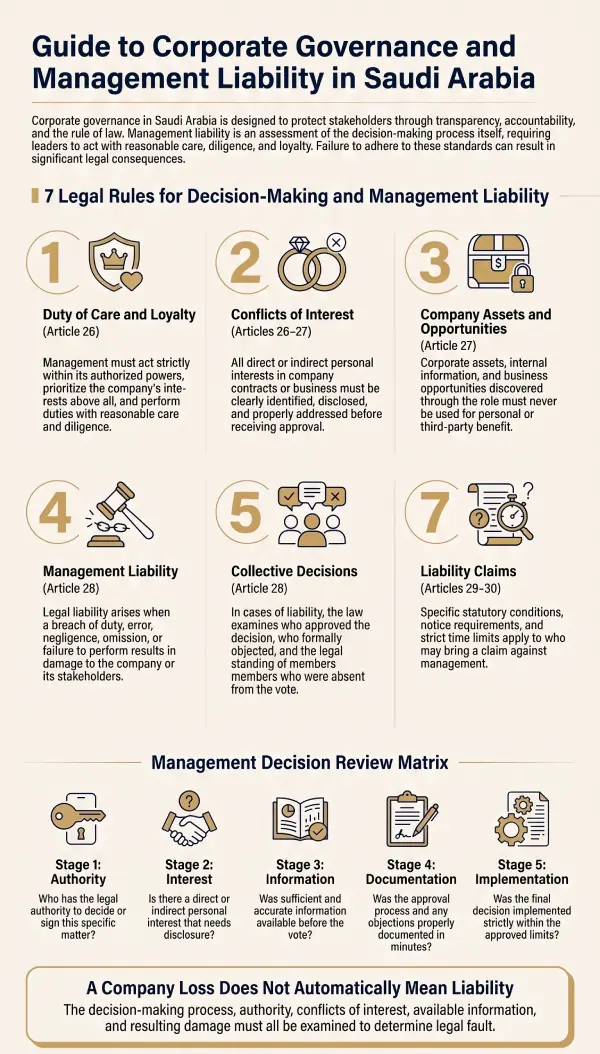
| Rule | Practical Question | Main Provision |
|---|---|---|
| Duty of care and loyalty | Was authority exercised with proper care and in the company’s interest? | Article 26 |
| Conflicts of interest | Was there a direct or indirect interest, and how was it addressed? | Articles 26–27 |
| Company assets and opportunities | Were company assets, information, or opportunities used for personal benefit? | Article 27 |
| Management liability | Was there a breach, error, negligence, or omission that caused damage? | Article 28 |
| Collective decisions | Who approved, objected, or was absent? | Article 28 |
| Decision assessment | Was the decision independent, informed, and made in the company’s interest? | Article 31 |
| Liability claims | Who may bring the claim and what conditions and time limits apply? | Articles 29–30 |
Official source:
Saudi Companies Law — Bureau of Experts at the Council of Ministers.
Articles 26–31 checked in September 2026.
What Does Corporate Governance Mean in Practice?
Corporate governance is not simply the existence of a manager, board of directors, or internal policy. It begins by identifying who has authority to make a particular decision, what limits apply to that authority, and how the decision is supervised. Company records should also make it possible to reconstruct the decision-making process if a dispute later arises. This makes governance part of the company’s legal structure rather than a purely administrative exercise.
The analysis also depends on the company form, its articles of association or bylaws, and the powers granted to management. A limited liability company does not necessarily operate under the same management structure as a joint-stock company or simplified joint-stock company. Company documents may impose additional restrictions or approval requirements alongside the Companies Law. Sound governance therefore begins by identifying the legal source of each power before it is exercised.
7 Rules Governing Corporate Governance and Management Liability
Articles 26–31 of the Companies Law create a connected framework for authority, conflicts of interest, decision-making, documentation, and management liability. These rules should not be assessed in isolation because a single decision may involve several of them at the same time. Damage alone does not remove the need to identify the act or omission said to have caused it. The following seven rules provide the general framework.
1. Management Is Subject to Duties of Care and Loyalty
Article 26 requires a company manager or board member to act within the powers granted to them, work in the company’s interest, promote its success, and exercise independent judgment. The duties also include applying the care, attention, diligence, and skill reasonably expected in the circumstances. Conflicts of interest must also be avoided or addressed as required. A failure may therefore arise from the way a decision was made even where the decision-maker acted without an intention to cause harm.
The duty of care should not be confused with the commercial result. A transaction may produce a loss even though management reviewed the available information, assessed the risks, and remained within its authority. The more relevant question is whether the decision-making process was properly informed and independent. A profitable outcome does not automatically correct a deficient decision-making process either.
The duty of loyalty becomes particularly important where the company’s interests and a manager’s personal interests may diverge. In that situation, the analysis should consider the interest itself, the disclosure made, and the relevant approval process. The commercial attractiveness of a transaction is not the only question. The decision must also be examined from the perspective of loyalty to the company.
The Implementing Regulations of the Companies Law provide additional detail concerning duties of care and loyalty, indirect interests, disclosure, and competition.
Official source:
Ministry of Commerce — Implementing Regulations of the Companies Law.
Source checked in September 2026.
2. Conflicts of Interest Should Be Addressed Before Approval
Article 27 regulates direct and indirect interests in transactions and contracts entered into for the company’s account. A direct interest may exist where a manager or board member is personally involved in a transaction, while an indirect interest may arise through another entity, relationship, or arrangement. The issue does not begin only after the company suffers a loss. The existence of the interest may itself require disclosure, independence, and statutory approval to be examined.
Disclosure should be specific enough to allow the competent corporate body to understand the nature of the interest before making its decision. The correct approving body cannot be described through one formula for every Saudi company. Depending on the company form and circumstances, the relevant body may be the partners, general assembly, shareholders, or a person validly authorised by them. The company form and its constitutional documents therefore remain part of the analysis.
3. Company Assets and Opportunities Are Not Personal Benefits
Article 27 also addresses competition and the use of company assets, information, and investment opportunities. A manager may learn of an opportunity or receive information because of their position within the company, but that access does not automatically make the opportunity or information a personal right. The analysis should consider how the opportunity arose, whether it relates to the company’s business or interests, and whether a personal benefit exists. Statutory approval may also need to be examined where competition with the company is involved.
This does not mean that every transaction between management and the company is prohibited. The legal position depends on the facts, the nature of the interest, the disclosure made, the approval process, and the company’s interests. Risk increases where company resources, information, or opportunities are redirected to a manager or connected entity without a clear process. Proper documentation is therefore important to explain how the decision was reached.
4. Liability Depends on Breach and Resulting Damage
Article 28 provides the central statutory basis for management liability. Managers and board members may be liable for damage resulting from a breach of the Companies Law, the articles of association or bylaws, or from errors, negligence, or failure to perform their duties. A financial loss alone is therefore not enough. The analysis should identify the duty said to have been breached, the relevant act or omission, the damage, and the connection between them.
Management liability should also be distinguished from the liability of a partner or shareholder merely because that person holds an ownership interest. Ownership, management authority, and personal conduct are separate questions. Where the issue specifically concerns proceedings against management, the framework is addressed in more detail in
liability claims under Companies Law.
This distinction helps identify the correct legal basis for a claim.
5. Collective Decisions Do Not Place Every Member in the Same Position
Article 28 distinguishes between different positions within collective decision-making. Where a decision is adopted unanimously, joint liability may arise under the conditions stated in the Law. Where a decision is adopted by majority, a dissenting member is treated differently if the objection is expressly recorded in the minutes. An oral objection that does not appear in the record may therefore create an evidential problem later.
Absence from a meeting does not automatically release a member from liability. The Law considers whether the absent member was unaware of the decision or was unable to object after becoming aware of it. Timing, knowledge, and the ability to object therefore matter. Meeting minutes may become important evidence of attendance, voting, objections, and the information available when the decision was made.
6. Decision Assessment Is Different From Outcome Assessment
Article 31 provides a statutory framework for assessing a decision made or voted on in good faith. The relevant elements include the absence of a personal interest, an appropriate level of knowledge about the subject in the circumstances, and a rational belief that the decision serves the company’s interests. The burden of proving the contrary falls on the claimant under the Article. The decision-making process is therefore central to the analysis.
Commercial activity necessarily involves risk. A carefully assessed investment may fail because market conditions change, while a poorly considered decision may sometimes produce a profit. The legal assessment should focus on the circumstances and information available when the decision was made rather than relying only on the later outcome. This distinction is central to Corporate Governance because it separates legitimate commercial risk from possible negligence or breach of duty.
7. Liability Claims Have Conditions and Time Limits
Article 29 allows the company to bring a liability claim against a manager or board member where the statutory conditions are satisfied and damage has been caused to the company. It also permits one or more partners or shareholders representing 5% of the company’s capital, unless the constitutional documents specify a lower percentage, to bring the company’s claim where the company itself has not done so and the remaining conditions are met. Management must be notified of the intention to bring the claim at least 14 days before filing. These figures were checked against the official statutory text in September 2026.
Article 30 provides that a discharge from liability approved by the partners, general assembly, or shareholders does not prevent a liability claim from being brought under the Companies Law. Except in cases of fraud or forgery, the claim is not heard after five years from the end of the financial year in which the harmful act occurred or three years from the end of the manager’s service or board membership, whichever is later. These rules should be read together with Article 29. Procedural detail remains separate from the broader governance analysis on this page.
When Is Management Liability Personal or Joint?
Within Corporate Governance, holding a management position does not place every manager or board member in the same legal position. An act may be attributable to one person, another decision may be collective, and a member may have expressly objected to a majority decision. The position of an absent member may depend on knowledge of the decision and the ability to object after learning of it. Liability therefore begins with conduct connected to the decision rather than the title alone.
| Position | What Should Be Examined? |
|---|---|
| Individual decision-maker | The act, scope of authority, and resulting damage |
| Members who approved unanimously | The decision and the conditions for joint liability |
| Member who opposed a majority decision | Whether the objection was expressly recorded |
| Absent member | Knowledge of the decision and ability to object after learning of it |
What Evidence Matters When Assessing Management Liability?
The assessment should begin by identifying the legal or corporate duty said to have been breached, followed by the relevant act or omission and the damage said to result from it. The source of the duty may be the Companies Law, articles of association, bylaws, or a valid decision issued by the competent corporate body. Documents created before and during the decision are often more useful than conclusions formed only after the outcome became known. A clear documentary chain makes the assessment more precise.
Relevant records may include the company’s constitutional documents, the manager’s appointment and delegated authority, meeting minutes, voting records, objections, correspondence, reports reviewed before the decision, conflict disclosures, and evidence of damage. Where the decision concerns financing, a contract, or disposal of an asset, it may also need to be read within the wider framework of commercial contracts in Saudi Arabia.
Internal authority should not be assessed separately from the obligation created by the transaction.
Management Decision Review Matrix Before Approval
An initial review of a management decision can be organised around five connected areas: authority, personal interest, information, documentation, and implementation. The purpose is not to guarantee a profitable commercial outcome. It is to confirm that the person making the decision has authority, material information has been considered, conflicts have been identified, approval is documented, and implementation remains within the approved limits. The matrix is a general organisational tool and does not replace analysis of the facts of a particular company.
| Review Stage | Question to Resolve | Main Document |
|---|---|---|
| Authority | Who may make the decision or sign? | Articles, bylaws, and delegations |
| Interest | Is there a direct or indirect personal interest? | Conflict disclosure and related approvals |
| Information | Was sufficient information available before the decision? | Reports, proposals, studies, and correspondence |
| Documentation | Who approved, objected, or voted? | Minutes and formal decision |
| Implementation | Was the decision implemented within the approved limits? | Contract, execution order, and implementation records |
Does Corporate Governance Differ for Listed Companies?
Yes. Corporate Governance for Saudi listed joint-stock companies includes an additional regulatory layer alongside the Companies Law. Listed companies are also subject to relevant Capital Market Authority regulations, including governance requirements and implementing rules applicable to listed joint-stock companies. Requirements concerning board committees, independence, and particular disclosure duties should therefore not automatically be transferred to every limited liability company or simplified joint-stock company. The company’s legal form and regulatory status must be identified first.
The reverse is also important. A company does not cease to have governance duties simply because it is not listed. The general duties and management liability framework under Articles 26–31 of the Companies Law remain relevant within their statutory scope. Listing therefore adds regulatory requirements rather than creating governance from nothing.
Official source:
Capital Market Authority — Implementing Regulations of the Companies Law for Listed Joint Stock Companies.
Source checked in September 2026.
Mistakes That Leave Corporate Governance on Paper Only
Corporate Governance becomes weak when a company writes clear authority limits but repeatedly ignores them in practice without proper documentation. Another weakness appears where conflict disclosure is treated as a general annual form even though a new conflict may arise in a particular transaction or investment opportunity. Meeting minutes may also become ineffective where they record only the final result but not voting, objections, or material information considered before approval. In those situations, the documents exist but do little to explain how authority was exercised.
Another mistake is confusing ownership with management. A large ownership percentage does not remove limits created by the Companies Law, articles, bylaws, partners, shareholders, or the general assembly. Management status likewise does not provide unlimited authority over company assets or opportunities. Reviewing the constitutional documents and delegation structure before a major decision is fundamentally different from trying to reconstruct the process after damage has occurred.
Frequently Asked Questions About Corporate Governance
What Does Corporate Governance Mean in Saudi Arabia?
Corporate Governance is the framework that organises authority, oversight, and accountability within a Saudi company. It identifies how managers and board members exercise their powers and how important decisions are reviewed and documented. Management liability may arise where a legal or corporate duty is breached and damage results, but a financial loss alone does not automatically establish liability.
What Are the Main Duties of a Company Manager?
A manager or board member should act within the powers granted, work in the company’s interest, exercise independent judgment, and apply reasonable care, diligence, and skill. The duties also include addressing conflicts of interest, disclosing direct or indirect interests where required, and avoiding improper personal benefits connected with the management role.
Does a Company Loss Prove Management Liability?
No. A company may suffer a loss even where management acted in good faith, reviewed appropriate information, and had no personal interest in the decision. Article 31 provides a statutory framework for evaluating decisions. The available information, independence, circumstances, and decision-making process therefore matter more than the financial result viewed in isolation.
How Should a Board Member Record an Objection?
Where a decision is adopted by majority, Article 28 makes the express recording of an objection in the meeting minutes important when assessing the dissenting member’s position. An informal oral objection may not provide the same evidence. An absent member’s position depends on knowledge of the decision and the ability to object after becoming aware of it.
Does Discharge From Liability Prevent a Later Claim?
No. Article 30 provides that approval by the partners, general assembly, or shareholders of a discharge from liability does not prevent a liability claim under Article 29. The claim must still satisfy the statutory requirements and remains subject to the applicable time limits for hearing the claim under the Companies Law.
When Can a Partner or Shareholder Bring a Liability Claim?
One or more partners or shareholders representing at least 5% of the company’s capital may, subject to Article 29 and unless the constitutional documents specify a lower percentage, bring the company’s claim where the company has not done so. Management must also be notified of the intended claim at least 14 days before filing.
Legal Conclusion
Corporate Governance and management liability are closely connected. Governance determines who may make a decision, how authority should be exercised, and how the process should be documented. Liability examines whether management departed from the Companies Law, the company’s constitutional documents, or the required standard of care and whether damage resulted. The legal analysis therefore begins with authority and conduct rather than the financial outcome alone.
The purpose of governance is not to eliminate commercial risk because risk is part of business activity. The objective is to ensure that important decisions are made by authorised persons, on the basis of adequate information, with conflicts properly addressed, and with records that explain how the decision was reached. Where a dispute arises, the analysis should return to the Companies Law, the company’s constitutional documents, meeting minutes, disclosures, and the information available when the decision was taken. A specific company decision should then be assessed on its own documents and facts rather than by applying one conclusion to every business.
Disclaimer
This content is provided for general legal awareness only. It does not constitute legal advice for a specific matter and does not create a lawyer-client relationship. The legal assessment may vary according to the company form, constitutional documents, parties, management decision, evidence, and facts of each case.
About the Author
Mohammed Aboud Al-Dossary
Saudi-Licensed Lawyer — Licence No. 40462 — practising since 2013.
Professional verification:
Licensing and Membership
Editorial methodology:
Sources and Methodology.