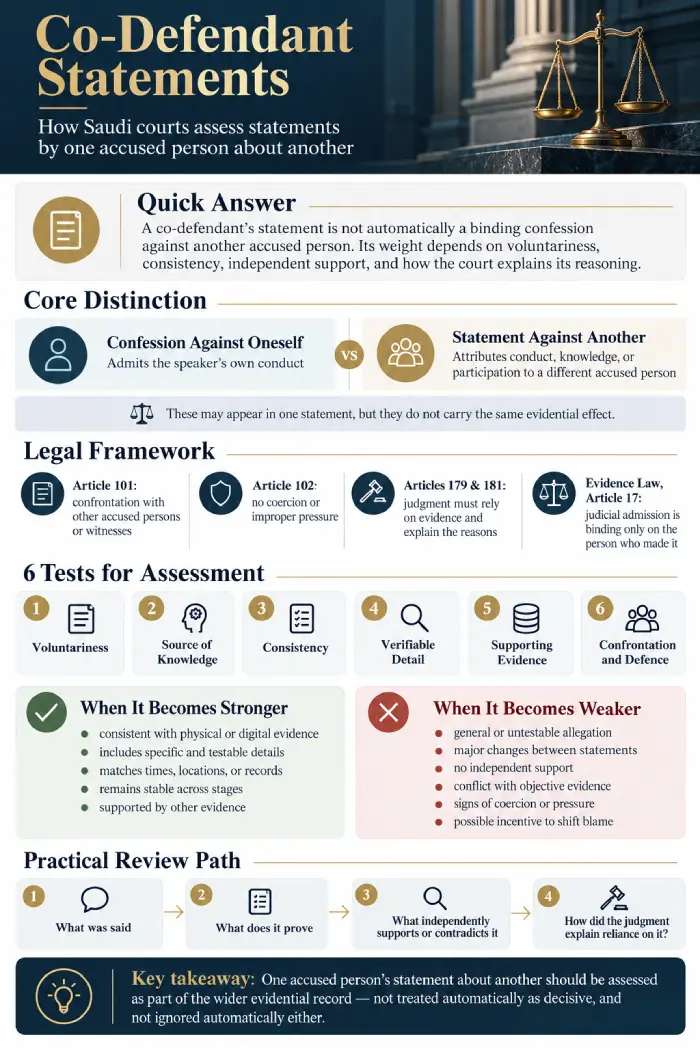
Co-Defendant Statements in Saudi criminal cases cannot be assessed simply because one accused person names another during questioning or in a confession. A statement about one’s own conduct is different from a statement that attributes conduct, knowledge, or participation to another accused person.
When a court reviews such a statement, the key questions are where it came from, whether it was made voluntarily, whether it remained consistent, what independent evidence supports or contradicts it, and whether the other accused person had a fair opportunity to answer it.
A common mistake is to take one of two extreme positions: either that statements made by an accused person have no value against anyone else, or that they automatically amount to a binding confession against a co-defendant. Published Saudi judicial practice reflects a more careful approach.
Quick Answer
Co-Defendant Statements do not automatically become a binding confession against another accused person. Their evidential weight depends on how they were obtained, whether they are consistent, and whether independent evidence supports them. In a published Saudi judicial decision, one accused person’s admission concerning another was treated as limited in its direct effect but capable of reinforcing other existing evidence.
What Are Co-Defendant Statements?
Co-Defendant Statements are parts of an accused person’s statement that attribute an act, role, agreement, knowledge, or participation to another accused person in the same case.
The same statement may therefore contain two legally different elements:
- what the speaker admits about their own conduct; and
- what the speaker alleges about another accused person.
This distinction matters because the evidential effect of a statement against oneself is not necessarily the same as the effect of an accusation against another person.
For example, if one accused person says, “I did this with X,” the first part concerns the speaker’s own conduct. The second part attributes involvement to X and should be assessed separately before being used to support a conclusion against X.
Definition
A co-defendant statement is the part of an accused person’s account that attributes conduct, participation, knowledge, or another material fact to a different accused person. It should not automatically be treated as that other person’s confession.
What Is the Legal Framework for Reviewing Co-Defendant Statements?
The Saudi Law of Criminal Procedure regulates the questioning of accused persons and allows investigators to confront an accused person with other accused persons or witnesses.
Articles 101 and 102 of the Saudi Law of Criminal Procedure allow the investigator to confront an accused person with other defendants or witnesses, while requiring interrogation to take place without improperly affecting the accused person’s will or using coercive methods.
At trial, the court assesses the evidence presented before it. Articles 179 and 181 of the Saudi Law of Criminal Procedure require the judgment to be based on evidence presented during the proceedings and the written judgment to state the supporting evidence, arguments, reasoning, and legal basis.
These rules do not create a simple formula stating that a co-defendant’s statement is always sufficient or always worthless.
The better question is: how did the court evaluate the statement, what supported it, and how was that evaluation explained in the judgment?
Is One Accused Person’s Confession Binding on Another?
No automatic rule should be assumed.
A confession concerning one’s own conduct must be distinguished from statements that implicate another person.
Saudi evidence principles treat a judicial admission, in principle, as binding on the person who made it rather than automatically on someone else. Article 17 of the Saudi Evidence Law states that a judicial admission is conclusive against the person making it and limited to that person. This helps explain why a statement made by one accused person should not automatically be treated as another accused person’s own confession.
However, this does not mean that everything said about another accused person must be ignored.
The analysis shifts from the direct effect of the confession to the evidential value of the statement as part of a wider body of evidence.
In a published Saudi judicial decision from the Ministry of Justice judicial collections, the court treated one accused person’s admission implicating another as limited in its direct binding effect, while still considering it capable of strengthening other existing indicators in the case.
Practical Rule
A statement about another accused person is not automatically binding as a confession. But it may still have evidential value when independent facts, records, or other evidence support it.
6 Tests for Assessing Co-Defendant Statements
Co-Defendant Statements can be reviewed through six practical tests:
| Test | Practical Question |
|---|---|
| Voluntariness | Was the statement made in circumstances that support free and voluntary choice? |
| Source of Knowledge | Is the accused speaking about something personally seen or participated in, or repeating information heard from someone else? |
| Consistency | Did the account remain stable between initial questioning, investigation, and trial? |
| Verifiable Detail | Does the statement include times, places, actions, or other facts that can be independently checked? |
| Supporting Evidence | Do messages, seizure records, expert reports, witnesses, or other evidence support the statement? |
| Confrontation and Defence | Was the other accused person given an opportunity to respond to the allegation and related evidence? |
Meeting one test does not automatically make the statement sufficient. Likewise, weakness in one factor does not always make it irrelevant.
The evidential value comes from the overall picture.
Confession Against Oneself vs Statement Against Another Accused Person
A confession against oneself attributes conduct to the person making the statement.
A statement against another accused person attributes conduct, participation, or knowledge to someone else.
Both may appear in the same sentence, but they do not necessarily have the same evidential effect.
If one person admits participation in an offence and says another accused person acted with them, the court may first assess the admission against the speaker. It then separately reviews what was said about the other person.
Relevant questions include:
- Is there independent evidence supporting the allegation?
- Do the details match the objective evidence?
- Did the other accused person deny the allegation?
- Does the speaker have an incentive to reduce personal responsibility?
The correct question is therefore not simply, “Did the accused confess?”
The more useful question is: What did the accused admit about their own conduct, what did they allege about the other person, and what evidence supports that second part?
Can Co-Defendant Statements Alone Support a Conviction?
Saudi criminal procedure does not contain a general rule stating that one accused person’s statement is always sufficient by itself to convict another.
Nor is there a general rule stating that such statements have no evidential value at all.
The more accurate approach is to look at how Saudi courts have assessed them in published decisions.
In the judicial example referred to above, the court did not treat the statement of one accused person against another as a completely independent and decisive item of evidence. Instead, it treated the statement as supporting a wider set of existing indicators.
This is important, but it remains a judicial application in a particular case. It should not be converted into a universal rule for every future case.
Important
Avoid absolute statements such as “a co-defendant’s statement can never be evidence” or “it is always sufficient for conviction.” Both are broader than the legal basis supports. The correct analysis starts with the statement and then asks what independent evidence supports or contradicts it.
When Do Co-Defendant Statements Become Stronger?
Co-Defendant Statements become more persuasive when their details can be independently tested.
If an accused person identifies a specific place, time, communication method, transaction, or act, and independent records confirm those details, the statement becomes easier to verify than a general accusation.
Factors that may strengthen the evidential value include:
- consistency with independent physical or digital evidence;
- details that were not obvious from the seizure record alone;
- agreement with established times and locations;
- stability across different stages of the proceedings;
- statements or actions by the other accused person that confirm part of the account.
The issue therefore remains closely connected to attribution, evidential scope, and consistency across the case file.
When Do Co-Defendant Statements Become Weaker?
Co-Defendant Statements become weaker where they remain general allegations that cannot be tested, change materially between stages of the case, or conflict with stronger objective evidence.
Closer scrutiny is also needed where the speaker has an obvious interest in reducing personal responsibility or shifting a larger share of blame onto someone else.
That interest does not automatically make the statement false. It is simply another reason to avoid assessing it in isolation.
Warning signs may include:
- repeated withdrawal or reversal of the statement;
- material differences between records;
- no independent support for the facts attributed to the other accused person;
- conflict with CCTV, expert findings, communications data, or physical evidence;
- a serious allegation that the statement was obtained through coercion or improper pressure.
What Is the Effect of Confronting One Accused Person With Another?
The Saudi Law of Criminal Procedure allows investigators to confront one accused person with another.
Confrontation can help test competing accounts and identify where the parties agree or disagree.
It may also produce direct answers to specific allegations made by one accused person against another.
However, confrontation does not automatically make either statement true.
Its value lies in what it reveals:
- Did the other person deny the allegation?
- Was an alternative explanation given?
- Did the original speaker change the account?
- Did new details emerge that can be independently checked?
Where the final judgment relies heavily on Co-Defendant Statements, the reasons should make clear how the court evaluated those statements and what supporting material it relied on.
How to Analyse Co-Defendant Statements in 6 Steps
A structured review can be carried out in six stages. This approach reflects the broader professional focus on criminal cases, evidence analysis, and criminal procedures.
- Separate self-incrimination from allegations against others.
Identify precisely what the speaker admitted about their own conduct and what they attributed to the other accused person. - Identify the source of knowledge.
Did the speaker participate, observe the event directly, or repeat information received from someone else? - Compare every stage.
Place initial statements, investigation statements, and trial statements side by side. - Extract verifiable details.
Look for times, locations, communications, payments, seized items, and named persons. - Look for independent evidence.
Do not count the same account as multiple pieces of evidence simply because it appears in several records. - Review the judgment reasoning.
Did the court explain why it accepted the statement and what evidence supported it?
Useful Review Tool
Create a four-column table: “Statement”, “Fact It Is Used to Prove”, “Independent Supporting or Contradicting Evidence”, and “How the Judgment Addressed It”. This helps prevent the same narrative from being counted several times simply because it appears in more than one record.
Saudi Judicial Applications
Published judicial collections from the Saudi Ministry of Justice provide useful examples of how statements by one accused person may appear within a wider evidential structure.
In one published judgment, the court considered several indicators, including an admission by a second accused person that implicated the first. The court described the admission as limited in its direct binding effect, but treated it as strengthening other evidence already present in the case.
In another published judgment, statements made by one accused person against another appeared alongside a wider body of material, including seizure records, other statements, physical evidence, and surrounding circumstances.
The important lesson is that Saudi judicial analysis does not necessarily reduce the case to one isolated statement.
These examples help explain the method, but they do not mean every later case must reach the same result. Evidential weight always depends on the specific record.
When Should Co-Defendant Statements Receive Closer Legal Review?
Closer review may be needed where Co-Defendant Statements form a major part of the prosecution case or judgment, but the independent support for them is unclear.
Review is also important where:
- the account changed materially between investigation and trial;
- there is a serious dispute about how the statement was obtained;
- the other accused person consistently denied the allegation;
- the judgment relied on the statement without clearly explaining the supporting evidence;
- objective evidence appears to contradict the account.
If You Have an Existing Case
Start by collecting all statements made by the accused persons, any confrontation records, the full judgment, and the independent evidence referred to in the case file. The legal review should then compare the statements with the evidence and the court’s reasoning, following a structured methodology for reviewing facts, documents, evidence, and the applicable legal framework.
The mere existence of a statement by one accused person against another does not, by itself, make the case strong or weak. The assessment depends on the entire evidential record.
Frequently Asked Questions About Co-Defendant Statements
Are Co-Defendant Statements treated as a confession against the other accused person?
Conclusion
Co-Defendant Statements in Saudi Arabia should not be reduced to a simple rule that they are either always accepted or always rejected.
A statement against oneself is different from a statement that implicates another accused person. The latter should be reviewed according to its source, voluntariness, consistency, verifiable detail, supporting evidence, and the opportunity given to the other person to answer it.
Published Saudi judicial practice also offers an important practical lesson: a statement may be limited in its direct binding effect while still gaining evidential significance when supported by independent and consistent indicators.
The correct analysis therefore moves through four stages: what was said, what it proves, what independently supports it, and how the court explained its reliance on it.
Disclaimer: This article provides general legal information only. It does not assess a specific criminal case, does not constitute legal advice, and does not create a lawyer-client relationship. The evidential value of co-defendant statements depends on the facts, statements, independent evidence, and reasoning in each case. For information on how legal sources are selected and reviewed, see the site’s Sources and Methodology.