Quick Answer
Proof of harm in marriage is not measured by the volume of screenshots or documents submitted to the court. Instead, it relies on proving a specific event, attributing it directly to the spouse, and establishing that it causes harm severe enough to make cohabitation unsustainable. If harm cannot be established but discord persists, the court directs the dispute toward court-appointed arbitrators (Hakamayn) under the framework of the Personal Status Law.
What Does Proof of Harm Mean in Marital Lawsuits?
In family court proceedings, legal proof refers to verified evidence submitted to establish an act that caused material or psychological injury. Broad statements such as “poor treatment” or “continuous distress” carry no legal weight unless anchored to measurable, verifiable facts.
The Saudi Personal Status Law explicitly obligates spouses to refrain from harming each other physically or emotionally, providing a clear remedy through court dissolution under Article (108).
Actionable evidence focuses on precise events, such as:
- A message sent on a specific date containing defamatory or abusive language.
- A physical altercation resulting in documented injuries.
- An explicit admission or confession regarding a defined incident.
- Repeated behavioral patterns documented across a clear chronological timeline.
Once an event is identified, the focus shifts to evaluating the evidence submitted to substantiate it.
What Does Article 108 of the Personal Status Law Require?
Regarding the statutory threshold for proof of harm in marriage, Article (108) provides that the court shall dissolve the marriage contract at the wife’s request if the husband causes harm that renders normal marital life untenable, provided such harm is legally proven.
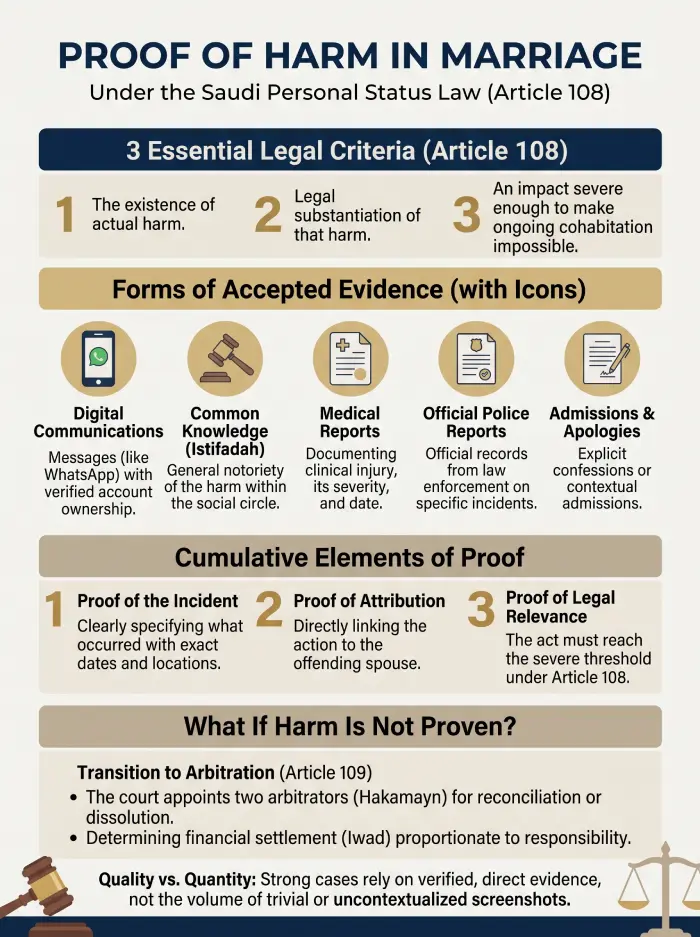
The statutory text outlines three essential criteria:
- The existence of actual harm.
- Legal substantiation of that harm.
- An impact severe enough to make ongoing cohabitation impossible.
What Is the Difference Between Harm and Discord (Shiqaq)?
Distinguishing between harm (Darar) and discord (Shiqaq) is essential when assessing proof of harm in marriage.
Article (108) governs cases where severe harm is legally established, leading directly to judicial dissolution. In contrast, Article (109) applies when harm cannot be substantiated, yet severe discord continues and reconciliation fails.
| Case Status | Statutory Classification | Primary Legal Outcome |
|---|---|---|
| Harm is proven and cohabitation is untenable | Article (108) | Judicial dissolution (Faskh) |
| Harm is unproven, but discord persists | Article (109) et seq. | Referral to arbitrators (Hakamayn) |
| Normal marital friction or minor disputes | Inadequate grounds | No immediate statutory remedy |
Failing to establish harm does not automatically conclude the legal proceedings; it shifts the litigation onto the statutory path of arbitration.
What Must Be Proven in Court?
To establish solid proof of harm in marriage, an evidentiary claim must satisfy three cumulative elements:
- Proof of the Incident: Clearly specify what occurred without generalizations. A precise date, place, and statement carry far more weight than alleging vague mistreatment.
- Proof of Attribution: The submitted evidence must directly link the action to the offending spouse. Submitting audio, video, or messages requires demonstrating account ownership and authenticity.
- Proof of Legal Relevance: The substantiated act must reach the severe threshold defined in Article (108), rather than ordinary domestic friction.
The Legal Evidentiary Sequence
Parties must substantiate each phase sequentially rather than jumping directly from an allegation to a legal conclusion.
What Forms of Evidence Are Accepted in Saudi Family Courts?
No single form of evidence applies to every marital dispute. Under the Saudi Law of Evidence, admissible evidence in marital disputes includes:
- Judicial admissions and explicit confessions.
- Direct eyewitness testimonies.
- Widespread communal knowledge (Istifadah) under statutory conditions.
- Digital communications, records, and electronic data.
- Official records, police reports, and administrative documentation.
- Certified medical reports from accredited health facilities.
- Corroborating judicial presumptions (Qara’in).
Presenting a single document does not automatically conclude the matter; it often substantiates only a specific part of the disputed facts.
How Does Hearsay and Common Knowledge (Istifadah) Work?
Article (27) of the Executive Regulations of the Personal Status Law provides that testimony based on common knowledge (Shahadah bil-Istifadah) circulating within the spouses’ social environment is admissible to prove harm for marriage dissolution, but it is not admissible to deny harm.
Because domestic abuse frequently takes place behind closed doors without direct witnesses, this statutory rule provides an essential legal instrument. However, it strictly requires genuine notoriety within the family’s shared social circle, rather than hearsay created after a conflict begins.
Are WhatsApp Messages Admissible to Establish Harm?
Digital messages, voice notes, and chat records can serve as credible proof of harm in marriage if they connect directly to the incident and can be authenticated. However, submitting isolated screenshots is rarely sufficient.
When examining digital evidence, courts assess:
- Account ownership and verified phone number association.
- Accurate timestamps and dates.
- Message continuity and whether excerpts omit context.
- The full sequence of prior and subsequent communications.
- Relevance to the specific incident claimed.
Why Is Conversation Context Critical?
A single sentence taken out of context can distort the facts. An excerpt that appears to be an admission may prove to be a quote, a sarcastic reply, or a reaction to a completely different issue when viewed in the full chat log.
Preserving complete conversations with intact dates, technical logs, and contextual flows protects the integrity of digital submissions against procedural challenges.
Do Medical Reports Prove Assault?
A medical report provides objective technical documentation, but its scope must be evaluated strictly based on what it actually confirms.
A certified medical report verifies:
- The existence and clinical nature of physical injury.
- The degree and severity of bodily harm.
- The exact time and date of the clinical examination.
However, a medical report alone does not identify the perpetrator or establish the specific circumstances of the dispute. Connecting the injury to a specific individual requires supporting elements such as admissions, witness testimony, or official incident reports.
What Is the Value of Official Police Reports?
Official records establish that a complaint was formally filed or that law enforcement intervened on a specific date. However, courts distinguish between:
- A report that merely documents an individual’s personal statements.
- An official record detailing actions and investigations conducted by officers.
- An on-site inspection or direct observation recorded by an official authority.
Evidentiary value increases significantly when an official report reflects objective observations rather than uncorroborated allegations.
Do Admissions or Apologies Suffice?
While an admission carries substantial weight, its probative value depends on its wording. A generic text stating “I apologize for what happened” does not equal an explicit confession to a specific assault or abusive act. Courts interpret apologies within their overall context rather than assuming an admission of legal liability.
Handling Conflicting Evidence
In family disputes, evidence often presents apparent contradictions. For instance, a claimant may present a medical report while the opposing party submits contrary testimony or complete denials. Courts resolve these discrepancies by examining:
- Timeline consistency across all submitted documents.
- Stability of the factual narrative throughout all stages of litigation.
- Independent corroborating proof.
- Plausible alternative explanations for the evidence.
What Happens If Harm Is Not Proven?
Failing to establish conclusive proof of harm in marriage does not dismiss the case if discord persists and living together remains impossible.
Under Article (109), the court appoints two arbitrators (Hakamayn) for a duration not exceeding 60 days, extendable by mutual agreement. Under Article (110), the arbitrators hear both parties, investigate the causes of discord, and attempt reconciliation.
Thus, the claim seamlessly transitions into the statutory arbitration procedure.
The Role of Court-Appointed Arbitrators
During the arbitration phase, the two arbitrators examine the underlying causes of marital discord. A spouse’s refusal to attend or cooperate does not prevent them from performing their duties. Under Article (29) of the Executive Regulations, the arbitrators prepare a comprehensive report for the court detailing the parties’ statements and recommendations.
Determining Financial Settlement (Iwad) After Arbitration
If reconciliation proves impossible, Article (30) of the Executive Regulations defines clear parameters for financial settlements (Iwad):
| Primary Cause of Discord | Statutory Recommendation |
|---|---|
| Entirely caused by the husband | Dissolution without financial compensation (Iwad) |
| Entirely caused by the wife | Dissolution with return of the full paid dowry (Mahr) |
| Shared fault between both parties | Compensation proportionate to each party’s responsibility |
| The responsible party cannot be identified | Dissolution with return of half the dowry |
Arbitrators must take into account the duration of the marriage. Under Article (31), the court retains final discretion to adopt the arbitrators’ recommendations or order dissolution with an adjusted settlement.
Does a Lack of Eyewitnesses Prevent Proving Harm?
A lack of direct eyewitnesses does not prevent establishing proof of harm in marriage. Because domestic disputes rarely occur in public view, Saudi courts accept alternative evidentiary methods, such as communal knowledge (Istifadah), authenticated digital records, medical findings, and official incident reports.
What Weakens an Evidentiary Claim?
Common procedural and factual errors can compromise proof of harm in marriage, including:
- Vague Accusations: Presenting general claims of ill-treatment without specific dates or descriptions.
- Timeline Inconsistencies: Conflicts between alleged dates and document timestamps.
- Selective Excerpts: Submitting truncated messages that omit conversational context.
- Overstating Evidence: Assuming a medical report identifies the perpetrator on its own.
- Conflating Legal Causes: Mixing claims of harm, physical defects, non-support, and desertion without clear legal categorization.
The Five-Step Case Review Method
In accordance with the professional methodology applied by legal practitioners such as Lawyer Mohammed Al-Dossary, case files should be organized across five practical steps before submitting proof of harm in marriage:
Quality of Evidence vs. Quantity of Documents
A strong legal case does not depend on submitting voluminous records. Dozens of screenshots proving trivial friction can distract from core legal facts. High-quality proof of harm in marriage focuses on authenticated documents tied directly to material events.
Key indicators of quality evidence include:
- Direct relevance to the alleged injury.
- Clear chain of custody and source attribution.
- Unbroken chronological sequence.
- Complete absence of internal contradictions.
Common Misconceptions in Marital Harm Claims
| Common Misconception | Statutory Correction |
|---|---|
| Harm must be continuous and repeated | Article (108) sets no mandatory minimum number of incidents |
| A medical report identifies the perpetrator | It documents injury, not the identity of who caused it |
| Every chat screenshot serves as conclusive evidence | Attribution, context, and authenticity must be verified |
| No eyewitnesses means no legal case | Alternative evidence, including Istifadah, is legally admissible |
| Unproven harm ends the dissolution process | The court refers the dispute to arbitration (Shiqaq) |
| Arbitrators’ recommendations are final | The family court retains oversight to adopt or adjust outcomes |
Legal Summary
Presenting effective proof of harm in marriage does not rely on multiplying allegations or document volume. It requires establishing a logical chain from the specific incident to the supporting evidence, its legal meaning, and the statutory remedy. Article (108) provides dissolution where severe harm is substantiated, while Article (109) governs cases where harm is unproven but prolonged discord makes cohabitation unsustainable.
Frequently Asked Questions About Proof of Harm in Marriage
Can a wife obtain a divorce without proving harm in Saudi Arabia?
Yes. If harm cannot be substantiated under Article (108), the case can proceed under the rules of marital discord (Shiqaq) via court-appointed arbitrators under Article (109), or through mutual consensual separation (Khul'), subject to statutory provisions regarding financial compensation.
How does the court verify digital evidence such as WhatsApp chats?
Family courts verify digital records by confirming registered phone ownership, reviewing full unedited chat threads, and, if contested, referring files to official forensic technical experts under the Saudi Law of Evidence.
Does verbal abuse qualify as grounds for dissolution under Article 108?
Verbal abuse can qualify as severe harm if it is substantiated through admissions, credible witnesses, or digital records, and reaches a severity that makes continuing marital life untenable under prevailing social and legal standards.