Criminal Charge Reclassification is generally permitted during a Saudi criminal trial because the court is not bound by the legal description used in the indictment. The court must give the alleged act the legal classification it considers appropriate based on the facts and evidence before it.
However, reclassification does not mean that an accused person may be convicted under a new legal description without being informed of it. If the court changes the legal classification, Saudi criminal procedure requires the accused to be notified.
The issue becomes especially important where the underlying conduct remains the same, but the legal meaning changes because of intent, purpose, participation, possession, or another element of the offence.
Quick Answer
A Saudi criminal court may change the legal classification of the act charged under Article 158 of the Law of Criminal Procedure, even if the new classification differs from the indictment. If it does so, the accused must be informed. This is different from an amendment to the indictment by the Public Prosecution under Article 159.
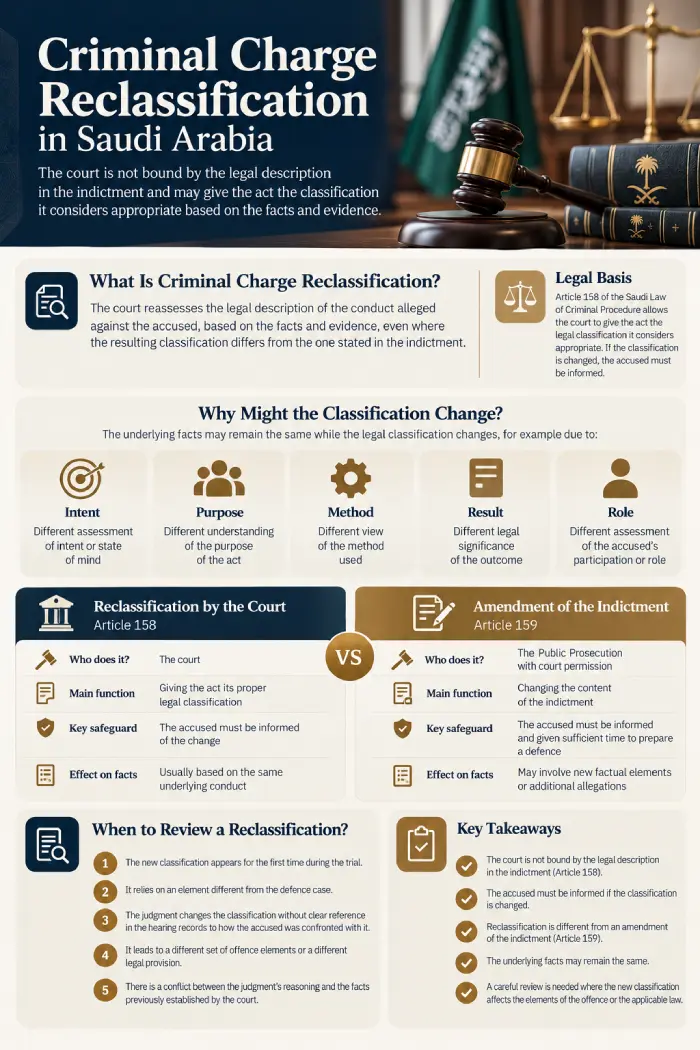
What Is Criminal Charge Reclassification?
Criminal Charge Reclassification means that the court reassesses the legal description of the conduct alleged against the accused.
The underlying facts may remain the same while the legal classification changes. This can happen where the final assessment depends on factors such as intent, purpose, method, result, or the accused person’s role in the conduct.
The court is therefore not required to adopt the exact legal label used by the prosecution. It reviews the facts and evidence and then decides which legal description properly applies.
This does not mean that the court may simply replace one case with another. The key question is whether the same underlying conduct is being reclassified, or whether new factual elements are being introduced.
Definition
Criminal charge reclassification is the court’s reassessment of the legal character of the act attributed to the accused, based on the facts and evidence before it, even where the resulting classification differs from the one stated in the indictment.
What Is the Legal Basis for Criminal Charge Reclassification?
Article 158 of the Saudi Law of Criminal Procedure provides that the court is not bound by the legal description stated in the indictment. It must give the act the description it considers legally appropriate.
If the court changes the classification, it must inform the accused.
The Implementing Regulations also require the court to identify the criminal classification in the judgment before determining the penalty. This confirms that legal classification comes before sentencing and is not a label added after the punishment has already been selected.
The Supreme Judicial Council has also emphasised that, before imposing a criminal penalty, the judgment should establish both the conviction and the legal classification of the punishable act. Mere suspicion or the existence of an allegation is not itself a criminal classification.
Core rule: Do not begin with the name of the offence. Begin with the conduct alleged in the indictment, identify the elements of the original classification, and then compare them with the classification ultimately adopted by the court.
Criminal Charge Reclassification vs Amendment of the Indictment
One of the most common sources of confusion is treating Criminal Charge Reclassification and amendment of the indictment as if they were the same thing.
They are addressed separately under Articles 158 and 159 of the Saudi Law of Criminal Procedure.
| Issue | Reclassification | Amendment of the Indictment |
|---|---|---|
| Who does it? | The court | The Public Prosecution with court permission |
| Relevant Article | Article 158 | Article 159 |
| Main Function | Giving the act its proper legal classification | Changing the content of the indictment |
| Express Safeguard | The accused must be informed of the change | The accused must be informed and given sufficient time to prepare a defence |
Article 159 allows the court to permit the Public Prosecution to amend the indictment before pleadings are closed. The accused must be notified and given sufficient opportunity to prepare a defence against the amendment.
This distinction matters because giving the same facts a different legal description is not necessarily the same as introducing new factual elements into the prosecution case.
If the change goes beyond legal classification and introduces facts or elements that were not part of the original allegation, the issue should be examined in light of the scope of the indictment and the accused person’s right to know and answer the case against them.
6 Checks for Reviewing Criminal Charge Reclassification
Criminal Charge Reclassification can be reviewed through six practical questions.
- What was the original conduct alleged?
Separate the factual allegation from the legal label attached to it. - What were the elements of the original classification?
Consider intent, purpose, result, participation, or any other relevant element. - What changed in the new classification?
Did only the legal analysis change, or did the factual basis also change? - Was the accused informed?
Article 158 requires notification where the court changes the classification. - Could the defence respond effectively?
This is especially important where the new classification changes the issues that must be answered. - Did the judgment explain the change?
The final classification should be consistent with the proven facts, evidence, and reasoning.
This issue is closely connected to criminal judgment reasoning because the validity of a new classification cannot be assessed from the operative ruling alone. The reasons should explain why the court considered the new legal description appropriate.
Does Reclassification Mean the Facts Have Changed?
Not necessarily.
The facts may remain unchanged while the legal interpretation changes.
For example, the dispute may concern the accused person’s intent or purpose rather than whether the underlying act occurred.
The distinction becomes more important where the new classification requires factual elements that were not clearly part of the original prosecution case.
In that situation, it is not enough to compare the names of the offences. The facts in the indictment should be compared with the facts used by the court to support the new classification.
Practical distinction
If the underlying facts remain the same and only their legal interpretation changes, the issue is closer to reclassification. If the new offence depends on additional facts that were not part of the case the accused was required to answer, the issue is broader and requires closer review of notice and defence rights.
How Does Reclassification Affect Defence Rights?
Notification is not a minor procedural formality.
The defence is built around the elements of the allegation the accused must answer. If the classification changes, the relevant defence may also change.
A fact or piece of evidence that was secondary under the original classification may become central under the new one.
A proper file review should therefore identify:
- when the new classification first appeared;
- how the accused was informed;
- what opportunity was given to answer it;
- whether the defence could address the new legal elements.
The written judgment alone may not answer these questions. The hearing record and defence submissions may also need to be reviewed.
At the same time, failure to notify should not automatically be reduced to a formula that “the judgment is always invalid.” The effect depends on the nature of the procedural defect, the stage of the case, and whether it affected the accused person’s ability to defend against the classification used for conviction.
Official Judicial Example: When a Court Changes the Classification
The practical importance of Article 158 can be seen in published Saudi judicial decisions.
In one criminal case published within the Ministry of Justice judicial collections, the accused was originally charged under a classification of quasi-intentional killing in a case involving reckless driving activity.
After reviewing the circumstances and the absence of the required intent, the court changed the classification to accidental killing.
The value of the example is not that every similar case must reach the same result. It illustrates the analytical sequence:
- identify the conduct and facts;
- examine the relevant mental element;
- determine the legal classification that fits the proven facts.
Practical Review Tool
Create a four-column table: “Proven Facts”, “Classification in the Indictment”, “Classification Adopted by the Court”, and “Element That Changed”. If the difference between the two classifications cannot be clearly identified, the real dispute may concern evidence, facts, or legal reasoning rather than reclassification alone.
How Does Criminal Evidence Affect Reclassification?
Criminal Charge Reclassification is not simply a change in terminology. It often results from how the court reads the evidence.
The evidence may prove that the conduct occurred while leaving another question open, such as intent, purpose, participation, or the legal significance of possession. Where the issue concerns changing accounts by the accused and their effect on attribution or an offence element, that question should be examined separately through the analysis of Contradictory Accused Statements.
The court may therefore agree with the prosecution about what happened while disagreeing about the offence that those facts legally establish.
A sound analysis should separate three questions:
- What does the evidence prove?
- To whom can the evidence be attributed?
- What legal conclusion can properly be drawn from it?
The answer to the third question may be what ultimately changes the criminal classification.
Reclassification and Sentencing: Why the Order Matters
The Implementing Regulations require the court to determine the criminal classification in the judgment before imposing the sentence.
This order is important.
The punishment follows the legal classification established by the court. The classification should not be selected by working backwards from a desired penalty.
The proper sequence is:
- What conduct was proven?
- What is its legal classification?
- What legal rule applies?
- What penalty follows in the circumstances of the case?
The Supreme Judicial Council has also stressed that the judgment should establish conviction and identify the criminal classification before punishment is imposed.
This confirms that legal classification is a distinct stage between proof of the facts and sentencing.
When Does Criminal Charge Reclassification Require Closer Review?
A closer legal review may be needed where the new classification appears for the first time during trial or where it introduces an element that was not central to the original defence.
Review is also important where:
- the classification changes only in the final judgment;
- the hearing record does not clearly show how the accused was notified;
- the new classification changes the essential elements of the alleged offence;
- a different legal provision becomes applicable;
- the judgment’s reasons conflict with the facts previously accepted by the court.
If You Have an Existing Case
A proper review usually starts by comparing the indictment, hearing records, defence submissions, and final judgment. The key questions are what conduct was originally alleged, what classification was first used, what classification was ultimately adopted, and when the accused was informed of the change. This follows the site’s professional methodology for reviewing facts, documents, and the applicable legal framework before evaluating the available procedural options.
The fact that a classification changed does not, by itself, prove that the judgment contains an error. The assessment depends on the case facts, the evidence, the hearing record, and the procedure actually followed.
Frequently Asked Questions About Criminal Charge Reclassification
Is a Saudi criminal court bound by the classification used by the Public Prosecution?
No. Article 158 of the Law of Criminal Procedure provides that the court is not bound by the legal classification stated in the indictment. It must give the act the classification it considers appropriate. If the court changes the classification, the accused must be informed.
Must the accused be informed if the court changes the classification?
Yes. Article 158 expressly requires notification where the court changes the legal classification. The purpose is to ensure that the accused knows the legal description being faced and can address the elements relevant to that classification.
What is the difference between charge reclassification and amendment of the indictment?
Criminal Charge Reclassification under Article 158 is carried out by the court when it gives the conduct the legal classification it considers correct. An amendment to the indictment under Article 159 is made by the Public Prosecution with permission from the court before pleadings are closed. The accused must be informed of the amendment and given sufficient opportunity to prepare a defence.
Does reclassification mean the court added new facts?
Not necessarily. The same underlying facts may remain in place while their legal classification changes. If the new offence depends on additional factual elements that were not clearly part of the original prosecution case, however, the issue should be reviewed more closely in light of notice and defence rights.
Can the court change the classification to a more serious offence?
The question cannot be answered solely by asking whether the new classification is more or less serious. The proper review should consider the alleged conduct, the applicable legal rules, jurisdiction, notice to the accused, the opportunity to answer the new classification, and the reasoning used in the final judgment.
Does failure to notify the accused automatically invalidate the judgment?
Notification is a legal requirement where the classification is changed. However, the effect of a failure to notify should be assessed in the context of the actual case. The review should determine whether a genuine reclassification occurred, whether the accused otherwise became aware of it during the proceedings, and how the issue affected the right to defend against the final classification.
Conclusion
Criminal Charge Reclassification in Saudi Arabia reflects the principle that the criminal court is not bound by the legal label selected by the prosecution.
The court may give the conduct the legal classification it considers appropriate, but the accused must be informed when that classification changes.
The most reliable analysis compares four layers:
- the facts alleged in the indictment;
- the evidence accepted by the court;
- the original legal classification;
- the final classification adopted in the judgment.
Only after those elements are compared should the review move to defence rights and the reasoning of the judgment.
This approach makes it easier to distinguish a lawful reclassification from a case that requires closer examination of the facts, procedure, evidence, or judgment reasoning.
Disclaimer: This article provides general legal information only. It does not assess a specific criminal case or judgment, does not constitute legal advice, and does not create a lawyer-client relationship. The effect of any reclassification depends on the facts, evidence, hearing records, nature of the change, and procedural stage.