Verify licensing and membership
Marital dissolution in Saudi Arabia does not take one legal form, and its consequences are not the same in divorce, khul’, and judicial annulment. Saudi law distinguishes between several ways a marriage may end. The legal effect depends on how the marriage ended, the statutory ground involved, and the facts that must be established.
The Saudi Personal Status Law regulates these forms separately. A proper analysis should therefore begin by identifying the type of dissolution, then the disputed fact and the evidence supporting it, and finally the legal consequence that follows if that fact is proven.
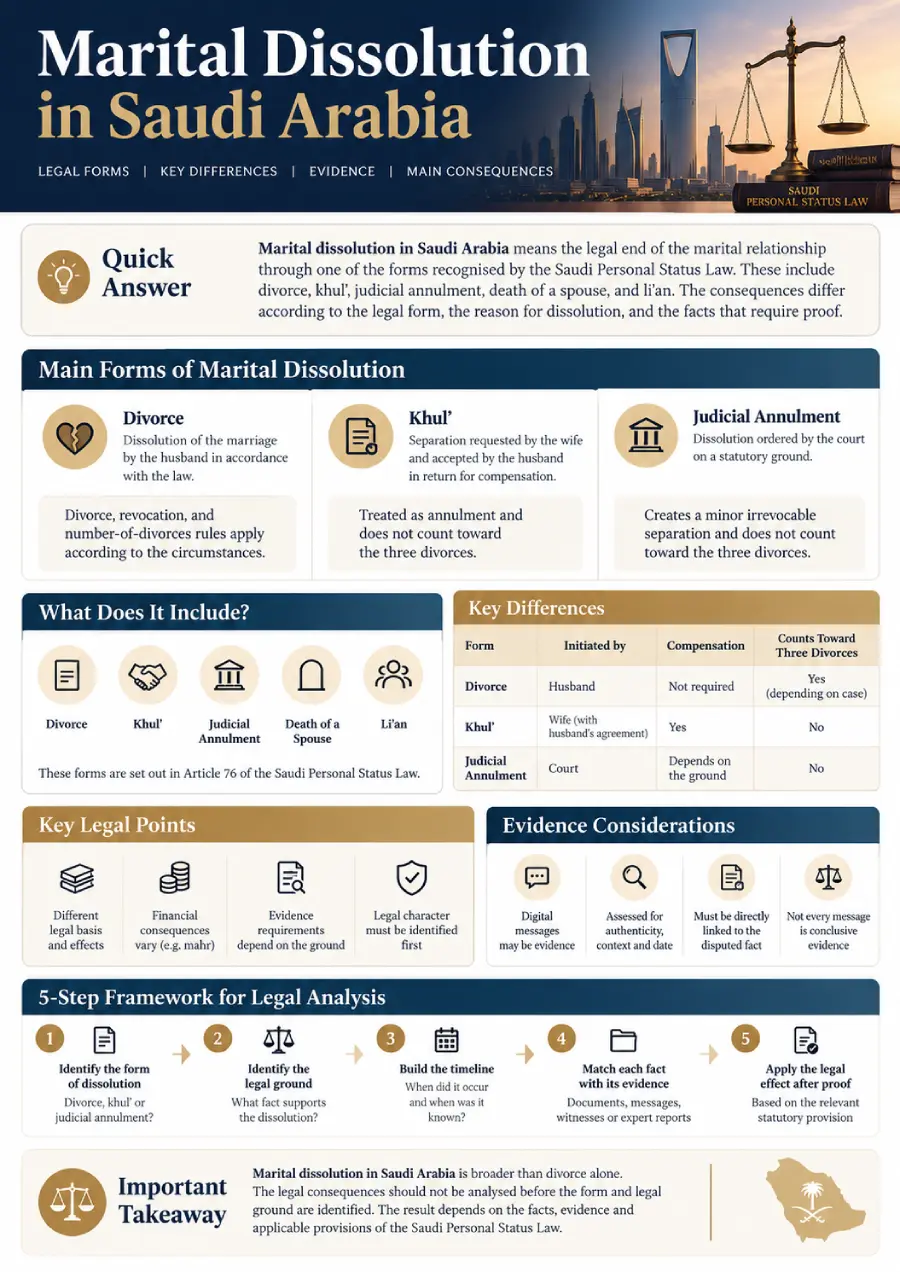
What Does Marital Dissolution in Saudi Arabia Mean?
Article 76 of the Saudi Personal Status Law identifies the situations in which separation between spouses occurs. These include divorce, khul’, annulment of the marriage contract, death of either spouse, and li’an.
This means that marital dissolution is broader than divorce alone. The distinction matters because different forms may produce different consequences concerning the number of divorces, the mahr, the right of return, compensation, and the evidence required.
The more accurate question is not simply “Has the marriage ended?” It is: “How did it end, and what legal basis applies?”
- The form of dissolution.
- The statutory ground.
- The date on which it occurred or was established.
- The disputed fact.
- The evidence supporting that fact.
What Are the Main Forms of Marital Dissolution?
The forms of marital dissolution in Saudi Arabia that most often require careful distinction are divorce, khul’, and judicial annulment. Their legal basis and principal effects are not identical.
| Form | Legal Basis | Main Feature |
|---|---|---|
| Divorce | Dissolution of the marriage by the husband in accordance with the law. | Divorce, revocation, and number-of-divorces rules apply according to the circumstances. |
| Khul’ | Separation requested by the wife and accepted by the husband in return for compensation. | It is treated as annulment and does not count toward the three divorces. |
| Judicial Annulment | Dissolution ordered by the court on a statutory ground. | It creates a minor irrevocable separation and does not count toward the three divorces. |
Article 77 defines divorce as dissolution of the marriage contract by the husband through words indicating divorce.
Article 95 defines khul’ as separation requested by the wife and accepted by the husband in return for compensation paid by the wife or another person. Article 97 provides that khul’ is treated as annulment of the marriage contract and does not count toward the three divorces.
Article 103 likewise provides that separation ordered by a court is treated as annulment and results in a minor irrevocable separation that does not count toward the three divorces.
These provisions can be checked directly in the official Saudi Personal Status Law.
Key Rule:
The legal effects of divorce should not automatically be applied to every annulment, and khul’ rules should not automatically be applied to every court-ordered dissolution. The legal character of the dissolution must be identified first.
What Is the Difference Between Divorce, Khul’ and Judicial Annulment?
The distinction is not merely about terminology. It begins with how the marriage comes to an end.
Divorce is initiated by the husband in accordance with the statutory rules. Khul’ is based on the wife’s request, the husband’s agreement, and compensation. Judicial annulment takes place through a court judgment where a statutory ground for annulment is established.
The comparison should not be reduced to whether the mahr must be returned. Financial consequences may change according to the legal ground, the timing of the relevant event, and whether consummation or valid seclusion occurred.
Annulment Based on a Defect
Articles 104 and 105 regulate a harmful or repugnant defect that prevents marital relations. The legal consequences may depend on when the defect arose, when the other spouse became aware of it, and whether consummation or valid seclusion had already occurred.
For the specialised analysis of this ground, see Defect-Based Marriage Annulment.
Why Does Evidence Depend on the Ground for Dissolution?
Evidence in marital dissolution in Saudi Arabia should not begin with the question, “What is the strongest evidence?” It should begin with a more basic question: What fact needs to be proven?
The dispute may concern whether a divorce occurred, the date of divorce, the existence of a relevant defect, an alleged incident of harm, the date on which one spouse learned of a fact, later words or conduct, or an agreement concerning compensation in khul’.
The value of evidence changes according to the fact it is intended to prove. A medical report may establish the nature of a medical condition, but it does not necessarily establish every legal element required for annulment.
Likewise, an electronic message may establish that a particular statement was made, but it does not automatically determine the legal meaning or consequence of that statement.
Is Alleging Harm Enough to Obtain Judicial Dissolution?
No. An allegation of harm should not be confused with proof of the facts on which that allegation depends.
Marital conflict may be established while the parties still disagree about what conduct occurred, who was responsible for it, or whether it falls within the legal ground relied upon.
Three matters should therefore remain separate: the alleged fact → the evidence supporting it → the legal consequence after proof.
Detailed evidence rules in marital harm claims belong in the specialised evidence article rather than being repeated in full on this pillar page.
What Role Do Messages and Digital Communications Play?
Article 53 of the Saudi Evidence Law defines digital evidence as evidence derived from data created, issued, received, stored, or communicated through digital means and capable of being retrieved in an understandable form.
Article 54 includes digital records, digital documents, electronic signatures, digital correspondence, means of communication, and digital media. Article 55 addresses the legal treatment of digital evidence alongside written evidence.
The official text can be reviewed in the Saudi Evidence Law.
This does not mean that every WhatsApp message, email, or digital conversation becomes conclusive evidence simply because it is submitted.
- The source of the evidence.
- Whether it can be attributed to the relevant person.
- The integrity of the content.
- Whether the complete context is available.
- The date of the communication.
- Its direct connection to the disputed fact.
A sentence taken from a longer conversation may carry a different meaning when the surrounding messages are considered. Context therefore matters.
Defect-Based Annulment Shows Why Legal Classification Matters
Article 104 illustrates why correct legal classification is essential. It allows either spouse to seek annulment where the other has a harmful or repugnant defect that prevents marital relations, whether that defect existed before marriage or arose later.
The position may differ where the spouse seeking annulment knew of the defect when the marriage was concluded or later became aware of it and then made a statement or performed an act indicating acceptance.
The court may also seek expert assistance in identifying and assessing the defect. This means that the analysis may require several separate questions.
What Is the Nature of the Defect?
The medical or factual condition must first be identified.
When Did It Arise?
Timing may affect the statutory analysis and the resulting financial consequences.
When Did the Other Spouse Learn About It?
Knowledge may be relevant to whether the statutory right remains available.
How Does It Affect Marital Relations?
The legal issue is not merely whether a medical condition exists. Its effect within the statutory test must also be considered.
Was There Later Conduct Indicating Acceptance?
Later words or conduct may have a specific legal effect under Article 104.
Can Later Conduct Affect the Ground for Dissolution?
In marital dissolution in Saudi Arabia, conduct after the alleged event may be relevant. However, there is no universal rule that continuing the relationship always means acceptance or that delay always amounts to waiver.
The answer depends on the legal ground and the provision that governs it. For defect-based annulment, Article 104 expressly addresses later words or conduct indicating acceptance after knowledge of the defect.
The position may be different where the alleged ground is marital harm. The effect of continued cohabitation after an incident should therefore be analysed separately rather than reduced to a general rule on this pillar page.
How Does the Form of Dissolution Affect the Mahr?
There is no single mahr rule that applies to every form of marital dissolution in Saudi Arabia. The result may depend on the legal ground, whether consummation or valid seclusion occurred, whether compensation was agreed, and whether a specific statutory provision governs the situation.
In khul’, Article 101 regulates the situation where the agreed compensation is the mahr. It provides that the compensation is limited to the amount of mahr already received and that the unpaid balance falls away, even if it had been deferred.
For defect-based annulment, Article 105 provides different consequences depending on when the defect arose, whether consummation or valid seclusion occurred, and which spouse had the defect.
Instead of asking, “Does annulment require repayment of the mahr?”, ask: “What is the ground for annulment, when did the relevant fact arise, did consummation or valid seclusion occur, and what specific provision applies?”
Divorce Documentation and Lack of Knowledge
Article 90 of the Saudi Personal Status Law regulates divorce documentation. It requires divorce to be documented within the statutory period from the time the separation takes effect, while preserving the wife’s right to bring a claim to establish the divorce.
Article 91 deals with a more specific situation. Where the husband fails to document the divorce as required and the wife did not know that she had been divorced, she may be entitled to compensation of no less than the minimum maintenance amount for the period from the date of divorce until the date she became aware of it.
Late documentation alone does not automatically create a right to compensation. The wife’s lack of knowledge is also part of the statutory rule.
Is Documentation the Same as Legal Proof?
Not always. Documentation records a legal status in the official system through the prescribed process. Proof deals with establishing whether an event occurred, when it occurred, or how it should be legally characterised where those matters are disputed.
Article 90 preserves the wife’s right to seek proof of divorce. Article 93 addresses evidence in disputes concerning divorce and revocation. Article 102 also allows a person with a legal interest to seek proof of khul’ through recognised means of evidence.
| Issue | Function |
|---|---|
| Proof | Establishes whether an event occurred, who is connected to it, or when it occurred. |
| Documentation | Records the legal status in the relevant official record or document. |
Which Consequences Do Not Follow Automatically?
A common mistake is to assume that the form of dissolution automatically determines child custody or child maintenance. It does not.
Ending the marital relationship does not end children’s rights. Likewise, the fact that the marriage ended through divorce, khul’, or annulment is not enough by itself to determine custody or the amount of maintenance.
These matters have separate statutory rules and criteria. For that reason, this pillar article does not expand into custody, visitation, child maintenance, housing, education, or medical expenses. Those topics have separate search intent and require dedicated analysis.
How to Analyse Marital Dissolution in Saudi Arabia
A sound review should begin with the facts and documents rather than with a desired legal outcome. The following five-step framework keeps the analysis organised.
Common Mistakes About Marital Dissolution
Several recurring errors can lead to an inaccurate understanding of marital dissolution in Saudi Arabia.
| Common Mistake | Correct Approach |
|---|---|
| Every end of a marriage is a divorce. | Saudi law distinguishes between divorce, khul’, annulment, and other forms. |
| Every annulment requires repayment of the mahr. | The financial consequence depends on the ground and circumstances. |
| Every digital message is conclusive evidence. | Its value depends on attribution, integrity, context, and the applicable evidence rules. |
| Every delay in documenting divorce creates compensation. | Article 91 has additional statutory conditions, including lack of knowledge. |
| Continuing the relationship always means the right is lost. | The effect depends on the ground, statutory provision, and later facts. |
| The form of dissolution automatically decides custody and maintenance. | Each issue has separate statutory rules and criteria. |
Frequently Asked Questions About Marital Dissolution
What Forms of Marital Dissolution in Saudi Arabia Are Recognised by Law?
Saudi law recognises several forms, including divorce, khul', judicial annulment, death of a spouse, and li'an. Each has its own legal basis and may produce different consequences. The correct classification should therefore be established before applying rules relating to mahr, revocation, compensation, or evidence.
Does Khul' Count as One of the Three Divorces?
Article 97 of the Saudi Personal Status Law provides that khul' is treated as annulment of the marriage contract and does not count toward the three divorces. Khul' arises from the wife's request and the husband's agreement in return for compensation, subject to the statutory rules governing it.
Does Every Judicial Annulment Require the Wife to Return the Mahr?
No. There is no single rule requiring repayment of the mahr in every annulment. The result depends on the statutory ground, when the relevant fact arose, whether consummation or valid seclusion occurred, and whether a specific provision regulates the financial consequences of that form of annulment.
Are WhatsApp Messages Automatically Conclusive Evidence in Family Cases?
No. Digital communications may qualify as digital evidence under the Saudi Evidence Law, but their legal value depends on factors such as attribution, integrity, context, date, and connection to the disputed fact. A message should be assessed for what it actually proves.
Does Late Documentation of Divorce Always Create a Right to Compensation?
No. Article 91 does not create compensation simply because documentation was delayed. The provision also addresses whether the wife was unaware of the divorce. The legal effect therefore depends on satisfying the statutory conditions rather than on the timing of documentation alone.
Legal Conclusion
Marital dissolution in Saudi Arabia is broader than divorce alone. It includes khul’, judicial annulment, and other forms recognised by the Saudi Personal Status Law.
The consequences should not be analysed before the form and legal ground are identified. The result may differ in relation to the number of divorces, mahr, compensation, documentation, and the evidence required.
Where the dispute concerns the ground, date, or underlying event, the clearer analytical sequence is: identify the fact → examine the evidence → apply the statutory consequence.
This approach prevents the rules governing one form of dissolution from being incorrectly applied to another and keeps the legal analysis tied to the statutory provision and the facts actually established.
This article is based on official Saudi legal sources, principally the Saudi Personal Status Law and the Saudi Evidence Law.
The analysis separates statutory rules from the factual assessment of an individual dispute. A specific case may produce a different result depending on its facts, documents, evidence, and applicable legal provisions.
Learn more about the site’s Sources and Methodology
.
Disclaimer:
This content is provided for general legal education and analysis only. It is not legal advice for a specific case, and reading it does not create an attorney-client relationship. Legal outcomes vary according to the facts, documents, evidence, legal ground, and provisions applicable to each case.