Legal content prepared by: Lawyer Mohammed Aldosari
Licensed lawyer in the Kingdom of Saudi Arabia — License No. 40462 — Professional practice since 2013.
Published: 28 September 2026
Last updated: 28 September 2026
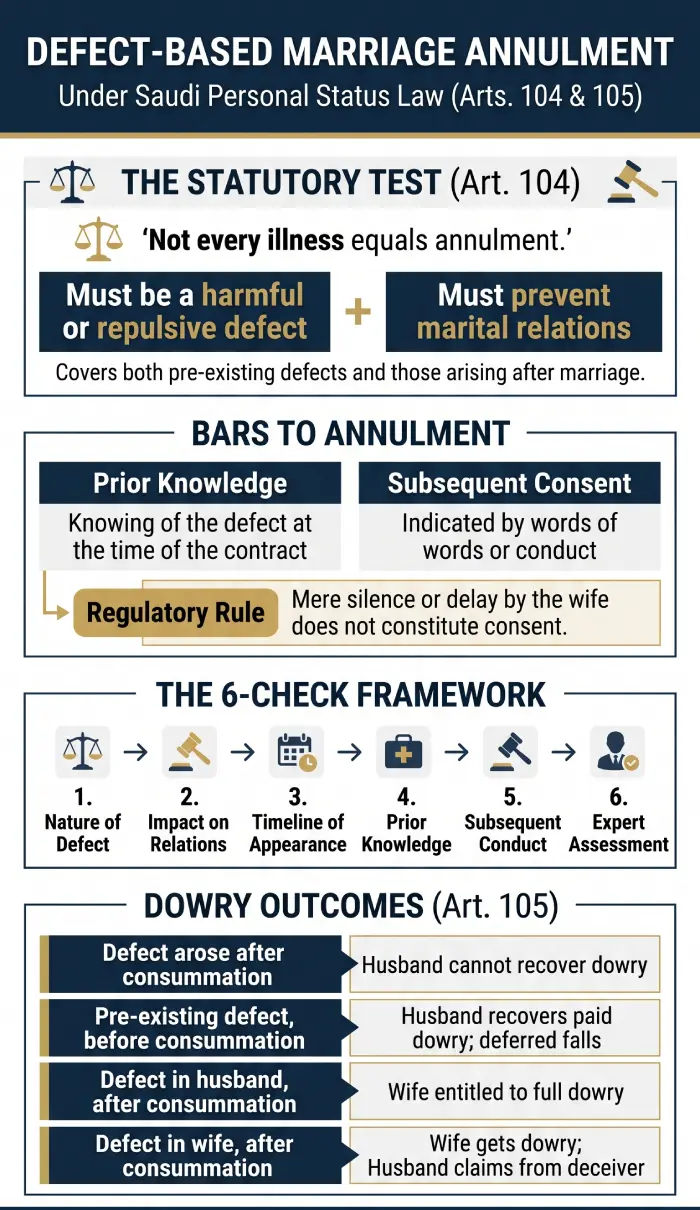
Defect-Based Marriage Annulment does not mean that every illness, condition, or personal defect gives either spouse an automatic right to end the marriage contract. Under Saudi Personal Status Law, the test is more specific. The issue is whether there is a harmful or repulsive defect that prevents marital relations. For that reason, the legal analysis must examine the real effect of the condition, when it appeared, whether the requesting spouse knew about it, and whether any words or conduct later indicated consent.
Quick Answer
Defect-Based Marriage Annulment may apply when one spouse has a harmful or repulsive defect that prevents marital relations, whether the defect existed before the marriage contract or appeared later. The right may be lost if the requesting spouse knew about the defect at the time of marriage, or later knew of it and gave consent by words or conduct.
Extractable Definition
Defect-Based Marriage Annulment is an annulment analysis based on a harmful or repulsive defect in one spouse that prevents marital relations. The issue is assessed by the defect’s real effect, timing, the other spouse’s knowledge, any later consent, and what documents or expert evidence can prove.
This article is limited to the defect or ailment addressed in Articles 104 and 105 of the Saudi Personal Status Law. It does not cover all grounds for marriage annulment, Najiz filing steps, or general family litigation procedure. This limitation keeps the page analytical and suitable for the personal professional website of Lawyer Mohammed Aldosari, rather than turning it into a service page or direct case-intake page.
What Does Defect-Based Marriage Annulment Mean?
People often use general expressions such as a defect in the husband, a defect in the wife, or an illness that ends marriage. The legal test is more precise. Saudi law refers to a harmful or repulsive defect that prevents marital relations. This means the analysis is not based on the medical name of the condition alone, but on its practical and legal effect within the marital relationship.
Article 104 of the Saudi Personal Status Law gives either spouse the right to request annulment on this basis if the defect existed before the marriage contract or appeared later. The right does not apply if the requesting spouse knew of the defect when the contract was concluded, or later knew of it and gave consent by words or conduct. The same article allows the court to rely on expert assistance to identify and assess the defect.
| Issue Presented | Main Legal Question |
|---|---|
| Illness or medical condition | Does it qualify as a harmful or repulsive defect? |
| Treatable condition | What is its current effect according to facts and expertise? |
| Condition not affecting marital relations | Does it have any legal effect under Article 104? |
| Stable and material condition | When did it appear, was it known, and was there later consent? |
The more accurate approach is therefore not “illness equals annulment.” A health condition is not automatically a ground for annulment, and even a serious condition does not always produce the same result. The analysis starts from the statutory text, then moves to facts, documents, and expert assessment. This is consistent with the website’s professional approach, which gives priority to understanding facts before choosing a legal path.
When Is a Defect Legally Relevant in Marriage?
A defect becomes legally relevant when it moves beyond a medical or personal description and becomes a condition that affects marital relations within the meaning of Article 104. It is not enough that the condition exists, or that it causes distress or disagreement, unless it has a legally relevant effect on the point being examined.
This is why three issues must be separated: the existence of the defect, whether it fits the statutory description, and whether its effect is proven through evidence or expert assessment. A medical condition may exist without preventing marital relations. Another condition may require expert review to determine its nature, seriousness, duration, or impact. In some cases, the dispute may focus on prior knowledge or later consent, not on the existence of the condition itself.
Pre-Existing Defects and Defects Appearing After Marriage
The law does not require the defect to exist only before marriage. Article 104 covers a defect that existed before the marriage contract and a defect that appeared after it. However, that does not mean the legal result is identical in every case. Prior knowledge of the defect, or later consent after discovering it, may affect the right to request annulment.
The timing of the defect becomes even more important when the dowry is considered. Article 105 distinguishes between a pre-existing defect and a defect occurring after consummation. It also distinguishes annulment before consummation or seclusion from annulment after either has occurred. A financial conclusion should therefore not be reached before the timeline is clear.
Material Defect vs Minor Defect
A material defect is one that falls within the scope of a harmful or repulsive condition preventing marital relations. A minor defect is different. It does not change the substance of the marital relationship and does not materially fall within Article 104. For this reason, fixed lists that say one illness always leads to annulment, or another diagnosis can never matter, should be avoided.
| Review Test | Material Defect | Minor Defect |
|---|---|---|
| Effect on marital relations | Falls within Article 104 | Does not change the core relationship |
| Need for expertise | May require technical assessment | Shows no clear legal effect |
| Connection to result | May affect the annulment request | Often remains outside the dispute |
This comparison keeps the page within one search intent: understanding Defect-Based Marriage Annulment. It is not a list of diseases, not procedural advice on filing a lawsuit, and not a page about damage-based annulment, discord, or khula.
Effect of Knowledge or Consent to the Defect
This is one of the most important limits in Article 104. The existence of a defect is not enough if the requesting spouse knew of it when the marriage contract was concluded. Proving that the condition existed before marriage is different from proving that the other spouse actually knew about it at that time.
Consent after knowledge is also not limited to an express phrase such as “I accept.” The law refers to words or conduct that indicate consent. The analysis should therefore separate three dates: when the defect appeared, when it became known, and when the conduct relied on as consent occurred. This distinction prevents confusing delay with legal consent.
The Implementing Regulations of the Saudi Personal Status Law, published by the National Center for Archives and Records, add an important rule. A wife’s right to request annulment due to a defect in the husband that prevents marital relations does not fall merely because she remained silent about making the request. This does not cancel the effect of any separate words or conduct showing consent, but it prevents treating silence alone as consent within the scope addressed by the regulation.
Analytical Note
The better question is not: “She did not request annulment immediately, so she accepted.” The correct question is: was there any word or conduct after knowledge that indicates consent, or was there only silence or delay?
How Are the Facts Reviewed Before Annulment?
Article 104 allows the court to rely on expert assistance to identify and assess the defect. Expert review may be important when the nature, effect, or duration of the condition is disputed. A medical report may prove diagnosis or date of discovery, but it does not always answer the final legal question.
The better method is to read reports and documents in a clear timeline. When did the condition appear? When was it diagnosed? When did the other spouse learn of it? What happened after knowledge? Can expert evidence explain its effect on marital relations? These questions make the Defect-Based Marriage Annulment analysis fact-based rather than impression-based.
| Issue to Clarify | What May Help Clarify It? |
|---|---|
| Existence of the condition | Relevant medical report or medical file |
| Time of appearance | Diagnosis date and earlier records |
| Nature and effect | Expert opinion where needed |
| Prior knowledge | Documents or facts showing disclosure and knowledge |
| Conduct after knowledge | Evidence of words or conduct alleged to show consent |
It is not accurate to state, as an absolute rule, that a private medical report has no value, or that a report is considered only if issued by court referral. The more precise approach is that the court weighs what is presented and may seek expert assistance where needed, while the legal characterization remains tied to the statutory test and the facts.
Effect of Defect on Dowry Under Article 105
Article 105 regulates the effect of annulment due to defect on the dowry. Therefore, broad statements such as “annulment means the dowry must be returned” or “the dowry always becomes fixed after marriage” are not accurate. The result differs according to the timing of the defect, whether consummation or seclusion occurred, and which spouse had the defect.
| Situation Under Article 105 | Effect on Dowry |
|---|---|
| The defect occurred in either spouse after consummation | The husband does not recover what he paid as dowry |
| The defect existed before the contract and annulment occurred before consummation or seclusion | The husband recovers what he paid and the remaining dowry falls, even if deferred |
| The defect was in the husband before the contract and annulment occurred after consummation or seclusion | The wife is entitled to the dowry |
| The defect was in the wife before the contract and annulment occurred after consummation or seclusion | The wife is entitled to the dowry, and the husband may claim it from the person who deceived him |
This table shows why annulment for defect should not be mixed with annulment for harm, khula, or marital discord. Each path has its own legal basis and effects. Importing rules from those paths into Article 105 weakens the legal accuracy of the analysis and confuses search intent.
Difference Between Defect-Based Annulment, Divorce, and Khula
Divorce, khula, and annulment due to defect are not interchangeable terms. Divorce has its own path and rules. Khula is generally based on the wife redeeming herself through compensation under its own conditions. Defect-based annulment focuses on a material defect in one spouse within the scope of Article 104.
| Path | Main Issue | Why It Should Not Be Mixed Here |
|---|---|---|
| Defect-based annulment | Harmful or repulsive defect preventing marital relations | It is the subject of this article |
| Divorce | Ending marriage through a different legal path | It is not based on Article 104 |
| Khula | Redemption through compensation | It has a different legal and search intent |
| Annulment for harm or discord | Harm or breakdown based on another legal basis | It does not explain the defect rule alone |
Practical Evidence Block: 6 Checks for Defect-Based Marriage Annulment
The practical value of this topic is not to draft a claim. It is to prevent confusion between a medical diagnosis and a legal characterization. Defect-Based Marriage Annulment can be reviewed through six organized checks:
- Identify the nature of the defect: What condition is actually proven, and what proves it?
- Identify its effect: Does it fall within a harmful or repulsive defect preventing marital relations?
- Arrange the timeline: Did it exist before the contract, or did it appear later?
- Review knowledge: Did the requesting spouse know of the defect at the time of marriage?
- Review later consent: Were there words or conduct after knowledge indicating consent?
- Connect the file to expertise: Is expert opinion needed to explain the defect and its effect?
Factors That May Extend Review
There is no single fixed timeline for reviewing these issues. Review may take longer where expert assessment is needed, where knowledge is disputed, where documents conflict, or where facts before and after the marriage contract must be arranged. Any timing should be treated as case-dependent, not as a promised result or fixed duration.
What Weakens a Defect-Based Annulment Analysis?
The analysis of Defect-Based Marriage Annulment becomes weak when it is based only on the name of the illness, ignores prior knowledge, treats silence as consent in every case, or imports rules from khula or harm-based annulment into the defect rule. It also becomes weak when it states a dowry result without returning to the different situations under Article 105.
| Common Error | Why It Weakens the Analysis |
|---|---|
| Relying only on the illness name | It does not prove Article 104 by itself |
| Ignoring prior knowledge | Knowledge at the time of marriage may prevent the request |
| Treating silence as consent in every case | The regulation prevents this oversimplification in the situation it addresses |
| Generalizing the dowry result | Article 105 sets different outcomes |
Trust and Legal Reference
This content is published on the personal website of Lawyer Mohammed Aldosari, a licensed lawyer in the Kingdom of Saudi Arabia, License No. 40462, and is based on official Saudi legal sources.
You may review the methodology for documenting legal information to understand how sources are selected and how published content is limited.
Frequently Asked Questions About Defect-Based Marriage Annulment
Does any illness justify annulment?
No, only a harmful or repulsive defect preventing marital relations qualifies under Article 104.
Can an annulment be sought for defects arising after marriage?
Yes, the law covers conditions existing before the contract as well as those appearing afterward.
What invalidates the right to request annulment?
Knowing of the condition at contract signing or later indicating consent through words or actions bars the claim.
Does a wife’s silence count as consent?
No, executive regulations clarify that delay or silence alone does not legally constitute consent.
How does annulment affect the dowry?
Entitlement depends on Article 105 rules regarding timing, consummation, and which party had the defect.
How does this differ from divorce or khula?
It relies strictly on proving a qualifying physical or mental impediment rather than unilateral termination or compensated separation.
Conclusion
Defect-Based Marriage Annulment is not based on a fixed list of illnesses, nor on medical diagnosis alone. The starting point is Article 104 of the Saudi Personal Status Law: a harmful or repulsive defect that prevents marital relations, together with the timing of the defect, the requesting spouse’s knowledge, any words or conduct showing consent, and the role of expert assessment.
When the discussion moves to dowry, Article 105 provides different outcomes depending on the timing of the defect, whether consummation or seclusion occurred, and which spouse had the defect. The more accurate reading is therefore based on a sequence of facts, documents, and expert evidence, not on broad phrases such as “every illness annuls marriage” or “every pre-existing defect requires return of dowry.”
Disclaimer
This content is for general legal awareness only. It is not an assessment of any specific case, and it does not replace review of facts, documents, and the competent authority. You may review the limits of published legal content before relying on any information in a specific matter.