marital cohabitation after harm does not, by itself, produce one automatic legal result in a Saudi marriage annulment claim. A couple may remain in the same home after an incident, reconcile and return to married life, or continue living together while the underlying dispute remains unresolved.
Continued cohabitation should therefore not automatically be treated as consent to the harm or as a waiver of the right to seek annulment.
This article addresses one focused question: what do events occurring after the alleged harm mean when an annulment request is assessed under Saudi law? It examines continued cohabitation, the reason for staying, reconciliation, return to married life, the timeline of events, and whether the harm ended, continued, or later recurred.
It does not explain how to file an annulment claim, Najiz procedures, legal fees, or case submission steps. Those topics involve a different search intent and are intentionally kept outside this analytical article.
Article 108 of the Saudi Personal Status Law provides for annulment, at the wife’s request, where harm by the husband is established and is serious enough to make continued marital life
on proper terms untenable. The starting point is therefore the proven harm and its legal character. Later events help explain the context; they do not replace the statutory test.
Quick Answer
How Should Marital Cohabitation After Harm Be Assessed?
The expression does not describe only one factual situation. It may mean that both spouses continued living in the same home, resumed married life after separation, remained together despite an unresolved dispute, or returned after family intervention or reconciliation.
Shared residence alone does not show that the relationship returned to normal. Likewise, returning after separation does not explain why the return occurred or what happened afterward.
A couple may remain together for a period and later stabilise, or a new incident may arise while the underlying dispute remains unresolved.
The better questions are direct: What exactly continued? Why did it continue? What happened next?
Reading Rule
Staying together is only the starting fact. The nature of the continued relationship, the reason for it, and what followed must be identified before drawing conclusions about harm, consent, or reconciliation.
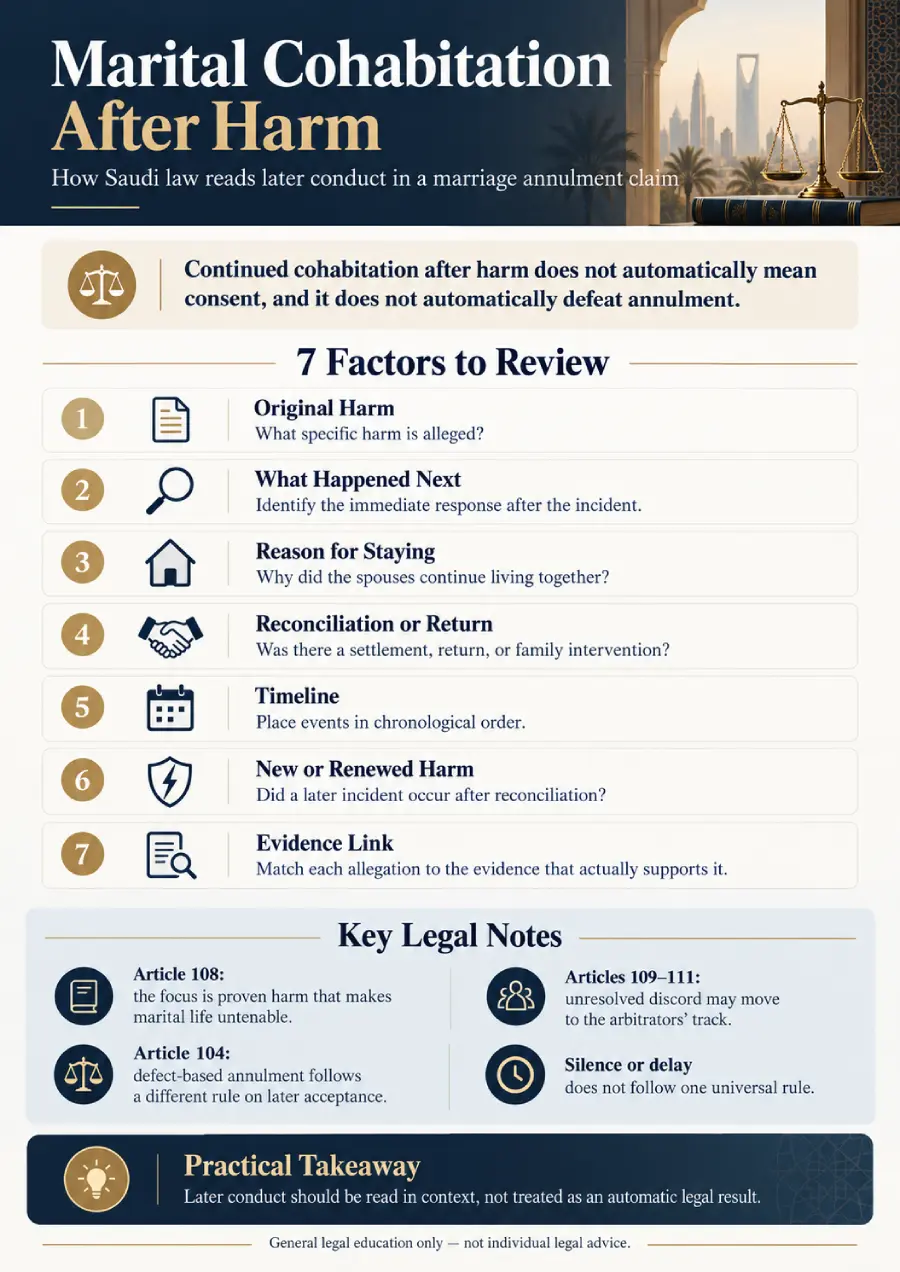
Continued Cohabitation and Consent Are Not the Same
Marital cohabitation after harm does not, by itself, establish consent. Continued cohabitation is a fact, while consent is a legal inference. It is therefore unsafe to move directly from “the spouses remained together” to “the harm was accepted” or “the right to seek annulment was waived.”
Article 108 does not state that continuing married life after an incident automatically defeats an annulment claim. Instead, the provision focuses on whether the husband’s harm has been established and whether that harm makes continued marital life on proper terms untenable.
The official Saudi Personal Status Law can be reviewed through the Saudi Bureau of Experts legal portal.
That does not mean later conduct is irrelevant. Saudi law gives later conduct a specific effect under some grounds of annulment. A clear example is annulment based on a defect or illness.
Why Is Defect-Based Annulment Different?
Article 104 addresses a harmful or repugnant defect that prevents marital relations. It also considers whether the spouse seeking annulment knew of the defect and later made a statement or performed an act indicating acceptance.
That rule is specific to annulment based on a defect. It should not automatically be extended to every harm-based claim governed by Article 108.
For a separate analysis of Article 104, see Defect-Based Marriage Annulment.
Key Distinction:
Attempting Reconciliation Does Not Automatically Mean Waiver
Family intervention, reconciliation, or a return to married life may follow an incident of harm. Participating in those efforts should not automatically be treated as a blanket waiver of the earlier incident.
The Personal Status Law itself regulates reconciliation where marital discord continues. If the level of harm required under Article 108 is not established, but discord continues and reconciliation is not possible, Article 109 provides for the appointment of two
arbitrators.
Articles 110 and 111 then regulate their role in hearing the spouses, identifying the causes of discord, attempting reconciliation, and reporting the outcome to the court.
This shows that reconciliation forms part of the statutory framework for family disputes. At the same time, reconciliation should not be treated as legally meaningless.
The relationship may stabilise afterward, a later incident may occur, or the previous conduct may return.
Later Conduct Helps Explain the Context of Harm
When marital cohabitation after harm is assessed, the analysis should not stop at the original incident. It should also consider what happened afterward. These later facts do not automatically prove or disprove the claim, but they may show whether the dispute ended, continued, paused, or later returned in another form.
An incident may be followed by continued living together without a clear settlement. There may then be a reconciliation attempt and a period of stability. In another case, reconciliation may be followed by a different dispute. These situations should not be treated as legally identical.
This sequence prevents an earlier incident from being used automatically to prove a later allegation. It also prevents the opposite error of ignoring earlier history where there is a genuine connection between the events.
Reconciliation and Return Do Not Have One Fixed Meaning
Reconciliation may genuinely resolve a dispute. It may also be an attempt to restore the marriage before later events occur.
The analysis should therefore ask what the reconciliation covered, whether the relationship stabilised afterward, and whether the current incident is the same as the earlier event or a separate one.
The same applies to returning after separation. A return does not automatically prove that the harm ended. It also does not automatically prove that it continued.
Its meaning depends on the reason for the return, the period that followed, and the conduct during that period.
What Does Renewed Harm After Reconciliation Mean?
Harm may be described as renewed where conduct stopped, or an effort was made to repair the relationship, and similar conduct later occurred again.
That description still requires the later incident to be identified, dated, and connected to the current dispute. A new dispute does not automatically restore every earlier incident to the same evidentiary weight.
Article 108 also does not impose a numerical rule requiring harm to occur several times.
The focus remains on whether qualifying harm is proven and whether it reaches the level required for annulment.
A Clear Timeline Prevents Old and New Harm From Being Mixed
One of the most useful ways to analyse marital cohabitation after harm is to place the events in chronological order.
Instead of combining several incidents under one broad description, each event should be located in time: when it happened, what followed, whether reconciliation occurred, and when any later dispute began.
This timeline helps show whether events are connected or separate. It also helps match each allegation to the evidence that actually relates to it, rather than using an earlier document to prove a later incident simply because the subject matter is similar.
When marital cohabitation after harm is being analysed, timing may therefore be as important as the fact of continued cohabitation itself.
Practical Evidence Framework: 7 Questions to Ask
The following framework helps organise the facts before any legal conclusion is drawn.
It is designed to clarify what happened after the alleged harm without turning later conduct into an automatic legal rule.
| Review Point | Question | Why It Matters |
|---|---|---|
| Incident | What specific harm is alleged? | Prevents reliance on broad descriptions. |
| Date | When did it occur? | Establishes the starting point of the timeline. |
| Continuation | What happened immediately afterward? | Clarifies the later marital relationship. |
| Reason | Why did the relationship or shared residence continue? | Prevents continuation from being read outside context. |
| Reconciliation | Was there a settlement or reconciliation attempt? | Separates one phase of the relationship from another. |
| Recurrence | Did a later incident occur? | Distinguishes earlier harm from renewed or later harm. |
| Consistency | Do the dates, statements, and documents align? | Tests whether the factual account is coherent. |
Limit of this framework:
This table is an analytical tool. It is not a statutory legal test and cannot predict the outcome of a particular case.
When Does the Dispute Move to the Arbitrators’ Track?
Saudi law distinguishes between proven harm under Article 108 and another situation where that level of harm is not established, but marital discord continues and reconciliation is not possible.
In the second situation, Article 109 provides for the appointment of two arbitrators.
The law gives them a period not exceeding 60 days from the date of their appointment.
Article 110 requires the arbitrators to hear both spouses, investigate the causes of the discord, and make a genuine effort to reconcile them. Article 111 addresses the position reported where reconciliation cannot be achieved.
Timing Note:
The 60-day period applies to the arbitrators’ mandate. It does not mean that the
entire annulment case must be completed within 60 days.
The relevant provisions can be reviewed in the official publication of the Saudi Personal Status Law.
Silence and Delay Do Not Follow One Universal Rule
It is inaccurate to treat the passage of time alone as consent or waiver. The legal effect of silence depends first on the ground of annulment because Saudi law and its implementing regulations create specific rules for particular grounds.
Article 26 of the Implementing Regulations of the Personal Status Law provides that a wife’s right to seek annulment for a defect in the husband that prevents marital relations is not lost merely because she remained silent and did not immediately make the claim.
The official regulations can be reviewed through the official publication of the Implementing Regulations.
That is a specific rule for that type of defect. It should not be turned into a universal rule that silence can never matter in any harm-based dispute. The opposite approach is also unsafe: delay alone should not automatically be treated
as a waiver of rights.
Continuous, Renewed, and New Harm Are Different
These labels help organise the facts, but they are not legal outcomes by themselves.
Continuous harm describes a condition or course of conduct said to remain ongoing.
Renewed harm describes conduct that returns after a pause or after an attempt at reconciliation.
New harm is a later incident that may be different from the first one.
Separating these categories prevents two opposite errors: treating every dispute in the relationship as one continuing event, or ignoring earlier history even where there is a real connection between the events.
If reconciliation took place and a different incident later occurred, the later incident should first be examined on its own facts. If the same conduct never stopped, the issue becomes whether its continuity can be established.
Marital Cohabitation After Harm and the Article 108 Test
The statutory standard in Article 108 focuses on harm that makes continued marital life on proper terms untenable.
The fact that spouses remain under one roof does not, by itself, prove that normal marital life was restored. Equally, continued cohabitation alone does not prove that continuation became legally untenable.
The first requirement remains establishing the harm in the form contemplated by the law.
If that harm is not established, but discord continues and reconciliation fails, Article 109 provides a different route involving the two arbitrators.
The distinction is therefore important: proven harm and continuing discord where qualifying harm has not been proven are not the same legal situation.
How Should Evidence Be Read Where Married Life Continued?
This article does not attempt to list every method of proving marital harm. That issue is addressed separately in the site’s detailed Arabic guide on evidence in marital harm claims.
The relevant point here is narrower. Continuing the marriage does not, by itself, remove the need to prove the original incident.
Evidence should first be read for what it actually proves. Later events may then be considered to determine whether they provide relevant context.
Evidence relating to marital cohabitation after harm should therefore be linked to the specific event it is intended to prove rather than treated as proof of the entire history of the marriage.
When Is a General Online Explanation No Longer Enough?
General guidance becomes less useful when several stages overlap: an incident of harm, reconciliation, a return to married life, and then a later event.
The same is true where document dates do not align with the chronology described by one of the parties.
A closer legal review may also be needed where the dispute is about the meaning of the continuation itself. Did the relationship genuinely return to stability, or did only shared residence continue? Is later conduct an extension of the earlier dispute,
or did a new dispute begin?
At that point, the broad question “does staying together defeat annulment?” is too simple. The relevant incident, applicable statutory provision, timeline, and evidence connected to each stage must be identified before its legal effect can be assessed.
Frequently Asked Questions About marital cohabitation after harm
Is Staying in the Marital Home the Same as Continuing Marital Cohabitation?
No. Remaining in the marital home establishes shared residence, but it does not by itself show the nature of the relationship after the harm or whether the marriage returned to stability. Shared residence should be read together with the reason for staying, later events, reconciliation, and any subsequent return to married life.
When Does Returning After Separation Matter in an Annulment Dispute?
A return becomes relevant when the circumstances of the return and what happened afterward relate to the ground on which annulment is sought. The return may follow reconciliation and lead to stability, or it may be followed by a new dispute. Its meaning therefore depends on the full sequence of events.
What If New Harm Occurs After Reconciliation?
The later incident should first be examined on its own facts, date, and supporting evidence. Its connection to earlier incidents can then be considered if that connection helps explain the current dispute. Earlier events do not automatically regain the same evidentiary value simply because a new dispute appears after reconciliation.
How Much Does Delay After the Harm Matter?
Article 108 does not set a period whose expiry automatically defeats a harm-based annulment claim. The implementing regulations also contain a specific rule on silence in defect-based cases. The effect of delay should therefore be assessed only after the relevant ground for annulment and governing provision are identified.
Why Does the Timeline Matter in Marital Cohabitation After Harm?
The timeline shows whether incidents are connected or separate, identifies where reconciliation and return occurred, and helps match each allegation to the evidence that actually relates to it. Chronology is therefore more useful than grouping every old and new dispute under one broad description.
Legal Conclusion
Marital cohabitation after harm is not a ready-made legal conclusion, and it does not carry the same meaning in every dispute.
Article 108 focuses on proven harm that makes continued marital life on proper terms untenable, while other provisions create specific rules for different grounds of annulment, including defects and later acceptance.
A sound analysis therefore starts with the original incident, then places later events in chronological order, identifies why the relationship continued, and determines whether there was reconciliation, return, continuous harm, renewed harm, or a genuinely new incident.
The practical point is that marital cohabitation after harm must be interpreted within its legal, factual, and evidentiary context. It should not be used on its own as a substitute for proving the alleged harm or applying the statutory test
under the Saudi Personal Status Law.
Sources and Methodology
This article is based on official Saudi legal sources, primarily the Saudi Personal Status Law and its Implementing Regulations. The article separates statutory rules from general factual analysis and keeps detailed evidentiary issues in their dedicated topic to avoid overlap.
You may also review the professional methodology and legal approach of Lawyer Mohammed Al-Dosari.
Disclaimer:
This content is provided for general legal education and analysis only. It is not legal advice for a specific case, and reading it does not create an attorney-client relationship. Legal outcomes vary depending on the facts, documents, legal ground, and provisions applicable to each case.