Legal content prepared by:
Attorney Mohammed Aboud Al-Dossary
Licensed Attorney in the Kingdom of Saudi Arabia — License No. 40462 — Practicing since 2013.
Published: 19 October 2026 — Last updated: 19 October 2026
Investigation interests do not automatically justify detention in every criminal case. Under Saudi criminal procedure, the interests of the investigation may support detention in defined circumstances, but the legal analysis must start with the actual case file and the stage the investigation has reached.
The key question is therefore not simply whether the phrase “interests of the investigation” appears in a detention decision. A proper review asks what investigative step is still pending, what facts connect the accused to that step, and whether detention remains relevant to the investigation at the time the file is reviewed.
This page is different from the analysis of a reasoned detention order in Saudi Arabia.
That article focuses on what the written detention order says and how its reasoning should be read. This page focuses on the underlying investigation interests and their connection to detention.
The topic also forms part of the wider analysis of Criminal Evidence in Saudi Arabia, because detention cannot be evaluated in isolation from the evidence, investigation records, procedural sequence, and limits of what the case documents actually establish.
Quick Answer:
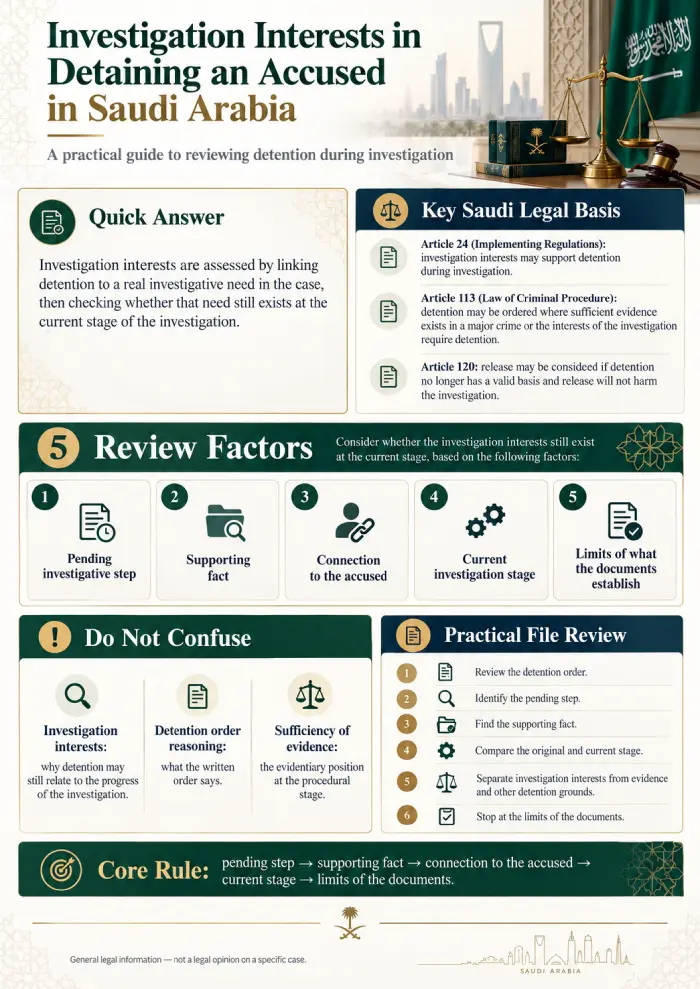
Investigation interests are assessed by examining how detention relates to the progress of the specific criminal investigation. The review should identify the investigative step that remains pending, the facts connecting the accused to that step, and whether the need for detention still exists at the current stage of the case.
Key Saudi Legal Basis
Article 24 of the Implementing Regulations of the Saudi Law of Criminal Procedure includes the interests of the investigation among the grounds relevant to detention during an investigation, together with other grounds set out by the regulations.
Article 113 of the Saudi Law of Criminal Procedure addresses detention, within its scope, where sufficient evidence exists against the accused in a major crime or where the interests of the investigation require detention.
Article 120 is also relevant when the justification is reassessed. It allows the investigator to order release when detention no longer has a valid basis, release would not harm the investigation, and there is no fear that the accused will flee or disappear, subject to the required undertaking to appear.
What Do Investigation Interests Mean in a Detention Case?
Investigation interests are best understood as an analytical way of describing the investigative need that may support detention in a particular case. The Saudi rules do not create a separate statutory definition under a heading called “the investigation interests test.”
Instead, the concept must be read in context. An investigation may still involve witness interviews, a confrontation between parties, technical examination, review of documents, or other incomplete investigative steps.
The existence of unfinished investigative work does not by itself mean that detention is necessary. The next question is whether the accused’s status has a genuine connection to that unfinished step.
For this reason, investigation interests cannot be reduced to the fact that an investigation remains open. The real issue is what the investigation still needs to protect or complete, and why detention is connected to that need in the particular file.
How Should Investigation Interests Be Tested Against the Case File?
The most reliable way to assess investigation interests is to move from general language to specific facts. The phrase itself does not identify the pending investigative step, the supporting fact, or why detention is considered relevant.
Start by identifying the investigative step that had not been completed when the detention decision was made or when the file is being reviewed. Then examine the documents for facts that explain how the accused is connected to that step.
The next question is practical: what effect, if any, would a change in the accused’s detention status have on the investigation? The answer should come from the case documents or the stated reasoning. It should not be invented from assumptions outside the file.
| Review Point | Question to Ask | Error It Helps Avoid |
|---|---|---|
| Investigative step | What investigative step is still pending? | Treating “investigation interests” as an empty formula. |
| Supporting fact | What fact in the file relates to that step? | Adding hypothetical reasons that do not appear in the record. |
| Connection to the accused | Why is this accused specifically connected to the investigative step? | Using the same generic reason in every case. |
| Effect of detention | How does continued detention relate to the progress of the investigation? | Jumping directly from an accusation to a conclusion that detention is required. |
How Do Investigation Interests Differ from Reasoning and Evidence?
These concepts are connected, but they answer different legal questions. Keeping them separate is important because otherwise a single fact, phrase, or piece of evidence may be given more legal weight than it can properly support.
| Concept | Main Question | What It Does Not Mean |
|---|---|---|
| Investigation interests | Why might the progress of the investigation require detention? | They do not establish guilt or replace the alleged offence. |
| Reasoning in the detention order | What does the written order say about why detention was imposed? | It is not merely the name of the alleged offence. |
| Sufficiency of evidence | What is the evidentiary position within the procedural framework? | It does not amount to a final conviction. |
This distinction is particularly important when reading Article 113. The provision refers to sufficient evidence in a major crime or to detention being required by the interests of the investigation. The two concepts should not be collapsed into one test.
If the real issue is the weight, reliability, contradiction, or legal effect of evidence, that is a broader evidentiary question. It belongs within Criminal Evidence in Saudi Arabia rather than being fully repeated on this page.
Can Investigation Interests Change as the Investigation Progresses?
Investigation interests should not be treated as permanently fixed from the first detention decision until the end of the case. Facts relevant to the original justification may change as investigative steps are completed.
Article 120 is significant in this respect. It allows an investigator to order release when detention no longer has a valid justification, release would not harm the investigation, and there is no concern that the accused will flee or disappear.
This does not mean that completion of one investigative step automatically requires release. Other facts or grounds may still need to be considered.
It does mean, however, that the assessment of investigation interests should reflect the current state of the investigation rather than remain frozen at the position that existed when detention first began.
If the original reason was connected to a particular investigative step and the records later show that the step has been completed, that new fact becomes relevant to the review. The question changes from “Why was detention initially ordered?” to “What justification remains at the present stage of the case?”
Time-Sensitive Review Principle
Investigation interests are not a label that should be read only once at the beginning of detention. A proper review compares the original justification with the current stage of the investigation and asks what has been completed, what remains pending, and whether the documents still show a meaningful connection between detention and the investigation.
5 Factors for Reviewing Investigation Interests in Practice
The following five factors are not new statutory conditions. They provide a practical framework for reviewing investigation interests without turning a general legal expression into a predetermined conclusion.
| Factor | What to Review | Why It Matters |
|---|---|---|
| 1. Pending investigative step | Identify what has not yet been completed. | Defines the actual investigative interest instead of relying on a general label. |
| 2. Supporting fact | Find the documented fact connecting the case to that investigative step. | Separates established facts from assumptions. |
| 3. Connection to the accused | Identify why this person’s detention relates to the pending step. | Prevents a generic reason from being copied across different cases. |
| 4. Current investigation stage | Compare the current position with the stage at which detention was ordered. | Shows whether important facts have changed. |
| 5. Limits of inference | Identify what the documents establish and what they do not. | Prevents unsupported conclusions about guilt, invalidity, or release. |
Extractable Review Rule:
A practical review of investigation interests follows five connected steps:
pending investigative step → supporting fact → connection to the accused → current stage → limits of what the documents establish.
These are analytical review points, not additional statutory conditions.
Which Documents Reveal the Current Investigation Position?
A serious assessment cannot be made from the name of the offence alone. The documents show what investigative steps have been completed, what remains pending, and what reasons have been recorded.
For that reason, evaluating investigation interests normally starts with the detention order and the relevant investigation records. Depending on the case, witness interviews, confrontation records, expert reports, technical reports, or other documents may also be relevant.
A missing document should not be treated as proof that the document does not exist. There is an important difference between “I have not reviewed this document” and “this document contains no such information.”
| Document | What to Look For | Limit of the Document |
|---|---|---|
| Detention order | The stated basis, reasoning, and timing of the order. | It does not reveal every event in the investigation. |
| Investigation records | Steps completed, questions asked, and relevant facts. | They should be read with the rest of the file rather than through one isolated sentence. |
| Statements and confrontation records | Which procedures have been completed and which remain outstanding. | A difference in statements does not automatically lead to one legal conclusion. |
| Technical or expert reports | Whether a result remains pending or has already been obtained. | A pending report alone does not prove that detention is necessary. |
What Do Investigation Interests Not Prove by Themselves?
Investigation interests do not amount to a finding that the accused is guilty. Detention operates at a procedural stage that is different from the court’s final determination of the criminal charge.
They also do not establish that every earlier or later procedure was lawful. Arrest, search, seizure, questioning, and other investigative measures must be assessed under the rules that govern each procedure.
A possible weakness in the stated justification should not automatically be converted into a conclusion that the entire criminal case is invalid. The relevant legal requirement, the precise defect, the affected procedure, and the legal consequence must first be identified.
Likewise, a change in the investigation does not automatically require release. Article 120 itself requires consideration of whether detention still has a basis, whether release would harm the investigation, and whether there is a risk of flight or disappearance.
Practical File Review
Before reaching a conclusion about investigation interests, review the file in this order:
- Identify the current detention order and the stage at which it was issued.
- Identify the investigative step that remained pending at that time.
- Find the fact that connects the accused to that investigative step.
- Compare the original position with what has been completed since then.
- Separate investigation interests from sufficiency of evidence and other grounds for detention.
- Identify what the documents actually establish and stop where the evidence ends.
Frequently Asked Questions About Investigation Interests
What are investigation interests in a Saudi detention case?
Investigation interests describe the investigative need that may be connected to detention in a specific criminal case. The assessment looks at the pending investigative step, the supporting facts, the accused's connection to that step, and the current investigation stage rather than relying only on the alleged offence.
When can the interests of the investigation support detention?
Saudi criminal procedure recognises the interests of the investigation as a ground relevant to detention. Whether that ground applies in an individual case depends on the facts and the case record. The analysis should identify the investigative need and its connection to the accused rather than assume detention from a general phrase.
How are investigation interests different from sufficiency of evidence?
Sufficiency of evidence and investigation interests address different issues. Article 113 refers to sufficient evidence in a major crime or detention being required by the interests of the investigation. Evidence concerns the procedural evidentiary position, while investigation interests concern the needs of the ongoing investigation.
Can the justification change as the investigation moves forward?
Yes. Relevant circumstances may change when investigative steps are completed. Article 120 allows the investigator to consider release where detention no longer has a valid basis, release would not harm the investigation, and there is no fear of flight or disappearance. The file should therefore be reviewed at its current stage.
How are investigation interests different from detention order reasoning?
The interests of the investigation concern the substantive basis that may connect detention to the progress of the investigation. Detention order reasoning concerns what the written order says about the reason for detention. The two questions are connected, but they should not be treated as identical.
When is a case-specific legal review more important?
A legal review becomes more important when detention remains in force but the link between the investigation and continued detention is unclear, or when investigative steps connected to the original justification have already been completed. The assessment should begin with the order, investigation records, and the present stage of the file.
Conclusion
Investigation interests should not be assessed from a repeated phrase or from the name of the alleged offence alone. A stronger analysis identifies the investigative step, the supporting facts, the accused’s connection to those facts, and whether that connection remains relevant at the current stage.
The assessment should also separate the interests of the investigation from detention order reasoning and sufficiency of evidence. Each concept answers a different legal question, and none of them automatically proves guilt, validates every procedure, or requires detention to continue indefinitely.
The practical sequence is:
pending investigative step → supporting fact → connection to the accused → current investigation stage → limits of the documents.
For a live case, the next step is not to search for another general rule. It is to review the detention order, investigation records, and documents connected to the stated justification together and in light of the current procedural stage.
About the Author
Attorney Mohammed Aboud Al-Dossary
Licensed Attorney in the Kingdom of Saudi Arabia — License No. 40462 — Practicing since 2013.
Professional licensing details can be reviewed through the
Licensing and Membership.
Disclaimer:
This article provides general legal information about Saudi criminal procedure. It is not a legal opinion on a specific detention order, investigation, or criminal case. The assessment may vary according to the facts, documents, procedural stage, and rules applicable to the particular matter. Reading this article does not create an attorney-client relationship.