Legal content prepared by:
Attorney Mohammed Aboud Al-Dossary
Licensed Attorney in the Kingdom of Saudi Arabia — License No. 40462 — Practicing since 2013.
Published: 20 October 2026 — Last updated: 20 October 2026
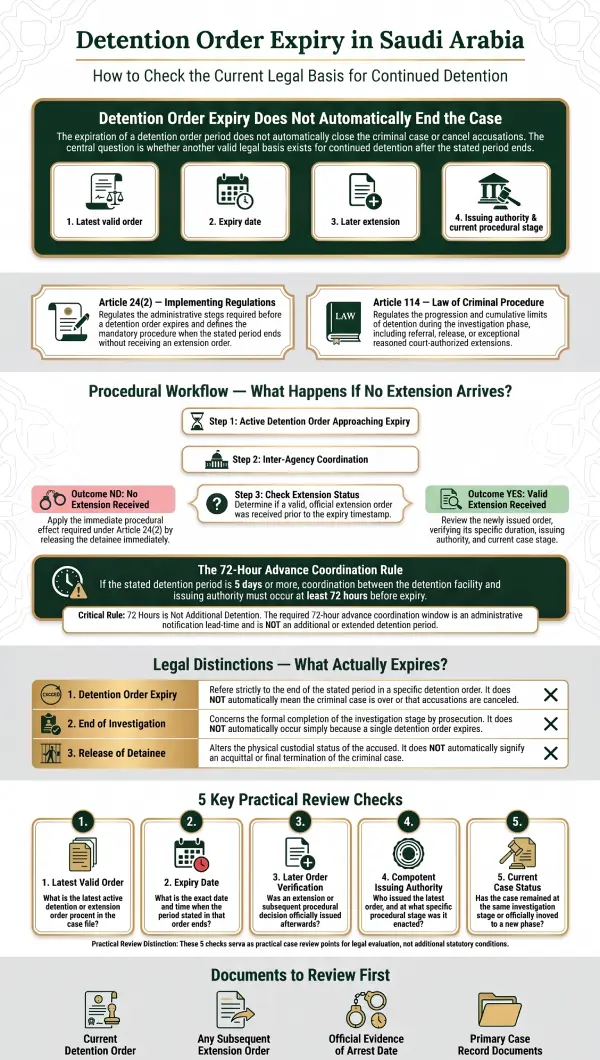
Detention order expiry does not mean that the criminal case has ended or that the accusation has been dismissed. It raises a narrower procedural question: what valid legal basis, if any, allows detention to continue after the period stated in the current order has ended?
The answer cannot be reached by counting days alone. The file must be checked for the latest valid detention order, its expiry date, any later extension, the authority that issued it, and the current procedural stage of the case.
This article therefore focuses on detention order expiry and its procedural effect on the accused and the case file. It does not reproduce a general guide to detention periods, detainee rights, objections, or release procedures.
This page also forms part of Criminal Evidence in Saudi Arabia, because determining whether detention still has a valid procedural basis depends on documents and the sequence of orders, not on a single number viewed in isolation.
Quick Answer:
A detention order expiry review starts with the latest valid order. If the period stated in that order ends and no extension is received, the Implementing Regulations govern the release of the detainee and notification of the authority that issued the order. The assessment therefore depends on the current order and any later extension, not on an informal count of days.
Key Saudi Legal Basis
Article 24(2) of the Implementing Regulations of the Saudi Law of Criminal Procedure regulates the steps taken before a detention order ends and the position where its period expires without receipt of an extension order.
Article 114 of the Saudi Law of Criminal Procedure regulates the progression of detention during the investigation stage and the point at which the case moves toward referral or release, including exceptional court-authorised extensions supported by reasons.
Has the period stated in a detention order ended, but you are unsure whether a valid extension or later order now supports continued detention? The clearest next step is to review the latest order, its expiry date, any later extension, the issuing authority, and the current stage of the case before drawing a conclusion.
Ask About the Current Detention Order
Prefer to understand the legal framework first? Continue reading to see how detention order expiry is assessed from the case documents.
What Actually Ends at Detention Order Expiry?
At detention order expiry, the first thing that ends is the period stated in that particular order. This is different from the end of the investigation, the end of the criminal case, or a finding of innocence.
A detention order provides a procedural basis for restricting a person’s liberty for a defined period. Once that period ends, the correct question is whether another valid order now supports continued detention.
It is therefore incorrect to move directly from “the detention order has expired” to “the criminal case is over.” The investigation may continue, or the case may move to another procedural stage, while the accused’s detention status changes.
| Concept | What It Relates To | What It Does Not Automatically Mean |
|---|---|---|
| Expiry of the detention order | The end of the stated procedural period. | It does not end the case or cancel the accusation. |
| End of the investigation | Completion of evidence gathering and the investigation stage. | It does not occur merely because one detention order expires. |
| Release | A change in the accused’s custodial status. | It does not establish innocence or terminate the criminal proceedings. |
Key Rule:
The expiry of a detention order concerns the end of the time-limited procedural authority for detention. It does not itself terminate the criminal case. The latest valid order and any later extension must therefore be identified before the procedural effect can be assessed.
What Happens If No Extension Arrives Before Detention Order Expiry?
This is the central issue in a detention order expiry analysis. Article 24(2) does more than regulate what should happen shortly before the order ends. It also addresses the situation where the stated period expires and no extension has been received.
Where the detention period stated in the order is five days or more, the detention facility must notify and coordinate with the authority that issued the order at least 72 hours before expiry.
If the period is shorter than five days, notification and coordination must take place sufficiently before the order ends.
If the period expires and no extension order has been received, the regulations provide for the detainee’s immediate release and notification of the authority that issued the detention order.
The 72-hour period should not be misunderstood. It is not a new detention period and does not automatically extend the existing order. Its function is to regulate coordination before the existing order expires.
| Status | What Should Be Checked |
|---|---|
| The order has not yet expired | Its expiry date and whether coordination concerning the next step has begun. |
| An extension has been received | The date, duration, issuing authority, and procedural stage. |
| The period expired with no extension | The procedural effect under Article 24(2) and notification of the issuing authority. |
A Common Misunderstanding:
The key question is not “Have 72 hours passed?” It is: Has the period stated in the order expired, and was a valid extension received before that point? The 72-hour requirement concerns advance coordination. It is not a separate detention period.
How Can You Check Whether a Detention Order Is Still Valid?
A detention order expiry assessment should not start with someone’s memory of how many days have passed. It starts with the documents.
A person may know the arrest date but may not know that a later detention extension was issued. Another person may know that an extension exists but not know its duration or which authority issued it.
The review must therefore combine a document timeline with a procedural timeline. The key questions are simple: What is the latest order in the file? When did it take effect? When does it expire? Was another order issued after it?
The issuing authority also matters. If the case moves from the investigation stage to the court stage, the relevant authority and procedural framework may change.
Documents to Review First
- The current detention order:
to identify the issue date and the stated period. - Any later extension order:
to determine whether the earlier order was followed by a new legal basis for detention. - Evidence of the arrest date:
because some statutory periods are calculated by reference to that date. - Documents showing the current procedural stage:
to identify whether the matter remains under investigation or has moved to court. - The latest decision affecting the accused’s status:
because the assessment should be based on the current position rather than the first order in the file.
If the dispute concerns why detention was ordered rather than when the order expires, see the analysis of a reasoning in a Saudi detention order.
If the issue is whether continued detention remains connected to the needs of the investigation, see the analysis of investigation interests in detaining an accused.
What If the Case Moves to Another Judicial Stage?
A detention order expiry review cannot be completed properly without identifying the current procedural stage. An order that applied during the investigation stage should not be read in isolation from later procedural developments.
Article 114 of the Saudi Law of Criminal Procedure becomes important when the total detention period reaches the statutory point addressed by the provision. At that stage, the case moves toward referral to the competent court or release, while the law also provides for exceptional court-approved extensions supported by reasons.
This page does not reproduce the complete timetable of detention periods. Its narrower purpose is to answer a different question: what current legal basis supports detention at the stage now reached by the case?
For example, looking only for the “last prosecution order” may be insufficient if the case has already moved to court and a later judicial order exists.
The opposite is equally important. A judicial extension should not be assumed merely because a particular number of days has passed. The file must show the relevant order.
Practical Distinction:
An order that expired at an earlier stage does not by itself determine the accused’s present status if the case has moved forward. The expiry date must always be matched against the latest decision and the authority competent at the time of review.
5 Key Checks for Reviewing Detention Order Expiry
These five checks are not additional statutory conditions. They are a practical framework for reviewing detention order expiry without turning the article into a general guide to detention periods or drawing conclusions from one number alone.
| Review Point | Question | Error It Helps Avoid |
|---|---|---|
| 1. Latest valid order | What is the latest detention or extension order shown in the file? | Relying on the first order while ignoring later decisions. |
| 2. Expiry date | When does the period stated in that order end? | Using an approximate calculation that is not tied to the document. |
| 3. Later order | Was an extension or other decision issued afterwards? | Assuming the earlier order still controls the present position. |
| 4. Competent authority | Who issued the latest order, and at what stage? | Confusing the investigation stage with the court stage. |
| 5. Current case status | Has the case remained at the same stage or moved to a new one? | Drawing a conclusion from an outdated procedural position. |
Practical Evidence Check
When reviewing detention order expiry, do not begin with “the detainee has been held for this many days.” Start with:
Arrest date → latest valid order → stated period → expiry date → later order, if any → issuing authority → current procedural stage.
What Cannot Be Concluded from Detention Order Expiry Alone?
The value of a detention order expiry analysis lies not only in knowing what happens when an order ends. It also lies in knowing what conclusions should not be drawn automatically.
An expired order does not cancel the accusation.
The accusation and evidence remain subject to the investigation and the later handling of the criminal case.
Release does not mean acquittal.
Release concerns the person’s custodial status. Acquittal is a judicial determination on the criminal charge.
The expiry of one order does not prove that no later order exists.
The file must be checked before concluding that the legal basis for detention has ended.
An ongoing investigation does not automatically renew detention.
Outstanding investigative work is different from the existence of a valid order authorising continued detention.
A possible procedural defect does not automatically invalidate the entire case.
The relevant rule, the affected procedure, the timing of the issue, and the rest of the case file must first be examined.
Frequently Asked Questions About Detention Order Expiry
What happens when a detention order expires without an extension?
If the period stated in the detention order expires and the detention facility has not received an extension order, Article 24(2) of the Implementing Regulations regulates immediate release and notification of the authority that issued the order. The latest order and current procedural stage should still be checked before applying the rule to a specific case.
What is the purpose of the 72-hour notice period?
Where the detention period stated in an order is five days or more, the detention facility must notify and coordinate with the issuing authority at least 72 hours before expiry. This period is an administrative coordination requirement. It is not an automatic extension of the detention order.
How can I tell whether an extension order is still valid?
Start with the latest order in the case file. Check its issue date, duration, issuing authority, and any later order. The arrest date or the number of days that have passed is not enough on its own to establish whether detention remains authorised.
Does an expired detention order end the criminal case?
No. The expiry of a detention order concerns the legal basis for restricting liberty during a particular period. The criminal investigation or court proceedings may continue even if the accused's detention status changes.
What changes if the case has already been referred to court?
The later judicial stage must then be reviewed. An earlier investigation-stage order may no longer be enough to determine the present position. The competent authority and the latest decision become central to assessing whether detention still has a valid legal basis.
Which document should be checked first?
The review normally begins with the latest available detention or extension order. It should then be compared with the arrest date, any later orders, and documents showing the current procedural stage of the case.
Legal Conclusion
The expiry of a detention order in Saudi Arabia should not be assessed by counting days alone. The more precise question is: what is the latest valid legal basis for continued detention, when does it end, and was another valid order issued afterwards?
Article 24(2) provides a direct procedural rule where the stated period ends without receipt of an extension. The current stage of the case and the authority now competent become equally important if the matter has moved to a later procedural stage.
The most reliable review sequence is:
latest valid order → expiry date → later order → competent authority → current case stage.
About the Author
Attorney Mohammed Aboud Al-Dossary
Licensed Attorney in the Kingdom of Saudi Arabia — License No. 40462 — Practicing since 2013.
Professional licensing details are available on the
Licensing and Membership.
Disclaimer:
This article provides general legal information about Saudi criminal procedure. It is not a legal assessment of a specific detainee, detention order, or criminal case and does not constitute legal advice for an individual matter. The outcome may differ according to the orders, documents, competent authority, procedural stage, and applicable rules. Reading this article does not create an attorney-client relationship.