Criminal Evidence in Saudi Arabia should not be assessed by simply counting how many pieces of evidence appear in a case file. The proper analysis asks where each item came from, how it was obtained, whether it can be reliably linked to the accused or the incident, whether it was preserved correctly, and what it actually proves when read with the rest of the case.
Under the Saudi Law of Criminal Procedure, arrest, search, investigation, seizure, custody of exhibits, trial, and procedural invalidity are governed by specific rules. The Saudi Evidence Law may also apply on a supplementary basis where the Law of Criminal Procedure does not contain a specific rule and where its application is compatible with the nature of criminal cases.
Quick Answer
Criminal Evidence in Saudi Arabia is assessed through five connected questions: Was the procedure lawful? Is the evidence intact? Can it be attributed to the person or event? What is its true evidential scope? Does it fit with the rest of the case? A defect in one procedure does not automatically invalidate the entire case.
This article follows the analytical approach used on Mohammed Al-Dosari’s personal legal website. It focuses on evidence, legal reasoning, and risk analysis rather than step-by-step litigation services.
What Does Criminal Evidence Analysis Mean?
Analysing a criminal case requires two connected reviews.
The first concerns the evidence itself: its source, authenticity, integrity, attribution, and evidential value. The second concerns the procedure that produced, seized, preserved, or introduced that evidence.
A laboratory result may be scientifically accurate, for example, while the real dispute concerns whether the tested sample was correctly linked to the accused. A digital message may clearly contain certain words, but the key issue may be whether the prosecution can reliably prove who created or sent it.
The same applies to statements and confessions. Their value depends not only on what was said, but also on the circumstances in which the statement was taken and how it fits with independent evidence.
Key analytical rule: The strength of Criminal Evidence in Saudi Arabia is not determined by the label attached to it. A forensic report may prove the identity of a trace without proving when or why it was left. A message may prove content without proving who controlled the account. A confession may be important, but it must still be assessed in context.
Legal Framework for Criminal Evidence
The Saudi Law of Criminal Procedure is the primary procedural statute. It regulates when a person may be arrested, searched, detained, questioned, and tried. It also sets rules for the seizure and preservation of evidence and for procedural invalidity.
The Saudi Evidence Law is not the principal statute governing criminal proceedings. Its main field is civil and commercial evidence. However, Article 218 of the Law of Criminal Procedure allows supplementary use of the Evidence Law where no specific criminal-procedure rule exists, provided that the rule does not conflict with the nature of criminal proceedings.
For that reason, Criminal Evidence in Saudi Arabia should always be analysed first through the specific rules of criminal procedure. Supplementary evidentiary rules come second.
Five Questions That Determine Evidential Strength
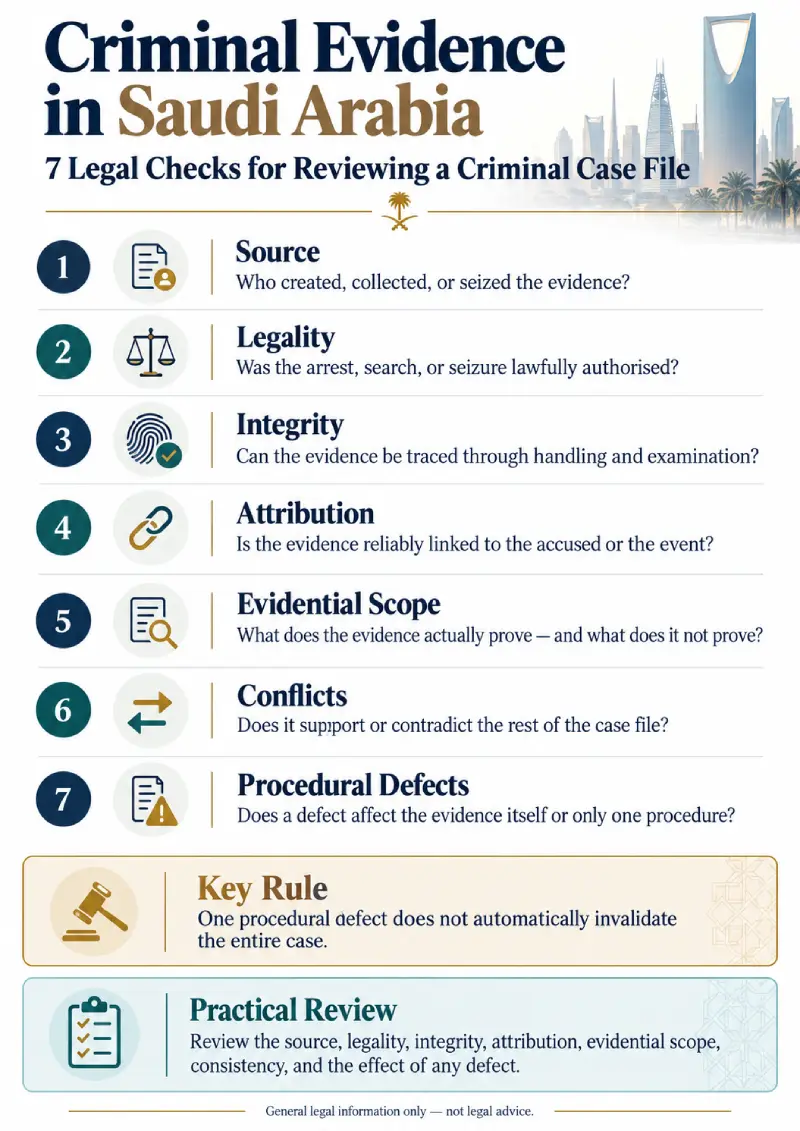
A practical review can be organised around five questions:
| Review Point | Practical Question | Why It Matters |
|---|---|---|
| Source | Who created, collected, seized, or extracted the evidence? | Helps verify origin and reliability. |
| Legality | Was the arrest, search, seizure, or collection legally authorised? | May affect the validity of the procedure and what depends on it. |
| Integrity | Can the evidence be traced through preservation, transfer, and examination? | Helps confirm that the item examined is the same item seized. |
| Attribution | Is the evidence reliably linked to the accused or the event? | Separates the existence of evidence from responsibility for it. |
| Evidential Scope | What does the evidence actually prove, and what does it not prove? | Prevents conclusions that go beyond the evidence itself. |
These questions do not decide a case in advance. They create a disciplined framework for reviewing Criminal Evidence in Saudi Arabia without assuming that every technical, digital, or testimonial item has the same weight.
Arrest and Search: When Procedure Becomes Part of the Evidence Analysis
Physical evidence cannot be separated from the way it entered the case file.
Article 30 of the Law of Criminal Procedure regulates situations of flagrante delicto. Article 35 provides that, outside such situations, arrest or detention requires an order from the competent authority. The law also protects the privacy of persons, homes, and private places and regulates lawful search and seizure.
The purpose here is not to explain criminal investigation procedure step by step. That belongs in a separate procedural guide. The narrower question is whether the procedure affected the reliability or admissibility of the evidence.
When reviewing a search, ask:
- What legal basis authorised it?
- What was the permitted scope?
- What was actually seized?
- Was each item properly described?
- Was it preserved in a way that allows later verification?
- Is the alleged defect curable, or does it affect the procedure itself or evidence derived from it?
Seized Exhibits and Chain of Custody
Article 50 regulates the sealing, recording, and preservation of seized items and documents. In practice, the term chain of custody describes the documented path of an exhibit from seizure through storage, transfer, and examination.
A minor clerical gap does not automatically destroy evidential value. The more useful question is whether the gap creates a real risk of substitution, contamination, confusion, or loss of identity.
How to Review a Chain of Custody
- Compare the description of the item in the seizure record, evidence log, and expert report.
- Check dates, times, locations, quantities, and identifying details where relevant.
- Identify every transfer between the seizing authority, storage facility, and forensic examiner.
- Separate the integrity of the sample from the legal conclusion drawn from it.
- If there is a discrepancy, decide whether it is explainable or whether it affects identity or integrity.
This is especially important in Criminal Evidence in Saudi Arabia where the prosecution relies heavily on laboratory, biological, narcotics, or digital exhibits.
Statements and Confessions: Existence Is Not the Same as Evidential Weight
Saudi law recognises the right of an accused person to use a lawyer during investigation and trial. It also protects the voluntariness of questioning and prohibits coercive methods.
That does not mean every inconsistency automatically proves guilt. Nor does the absence of a lawyer automatically make every statement invalid in every case.
The proper analysis asks:
- What exactly was said?
- At what stage was it said?
- Was the statement voluntary?
- Did the account change later?
- Does independent evidence support or contradict it?
This is why contradictions in an accused person’s statements should be analysed as an issue of evidential weight, not as a ready-made finding of guilt.
Forensic and Expert Evidence: What Does the Report Actually Prove?
Investigators may appoint qualified experts to address technical issues. A party may also rely on an advisory expert report and may challenge an expert where legally relevant grounds exist.
An expert report can be highly persuasive, but it is not a judicial decision and it does not answer every legal question in the case.
A fingerprint may link a person to an object or place, but it may not establish when the contact occurred or why. DNA may strongly establish a biological link to a sample, but it does not by itself explain when the sample was deposited, how it got there, or whether every element of criminal responsibility is satisfied.
Best question to ask: What scientific question did the expert actually answer? Then ask whether the legal conclusion drawn from the report stays within that answer or goes beyond it.
This distinction is central to Saudi criminal evidence analysis because technical accuracy and legal significance are not the same thing.
Digital Evidence: Three Separate Issues
Digital evidence may include messages, records, communications, device data, images, or other electronically stored information.
When such evidence is used in a criminal case, three issues should be kept separate:
- Existence: Does the content actually exist?
- Integrity: Has it been preserved without alteration?
- Attribution: Can it be reliably linked to a specific person?
A screenshot may show a message. That does not automatically prove who typed or sent it. Ownership of a device may be relevant, but it does not always establish who was using it at a particular moment.
Telephone monitoring and recording by investigating authorities are subject to specific legal controls, including reasoned authorisation and time limits. Private recordings require a separate legal assessment based on how they were obtained and the rules that apply to the circumstances.
How Courts Deal With Conflicting Evidence
Article 179 provides that the court bases its judgment on evidence presented during the proceedings and may not decide the case on the judge’s personal knowledge.
A conflict between two pieces of evidence does not mean one must automatically be discarded. Sometimes the conflict is real. In other cases, each item addresses a different issue.
A structured review of Criminal Evidence in Saudi Arabia should distinguish between:
- Direct conflict: two items support incompatible conclusions on the same material point.
- Different evidential scope: each item proves a different part of the case.
- Weak attribution: the evidence exists, but its link to the accused is incomplete.
- Weak integrity: there is a problem in preservation, custody, or source.
- Overstated inference: the underlying data may be correct, but the legal conclusion goes further than the evidence allows.
Procedural Invalidity: Why One Defect Does Not Automatically Invalidate the Whole Case
Article 187 addresses invalid procedures that breach Sharia principles or rules derived from them. The following provisions distinguish between defects that can be corrected and those that cannot.
Most importantly, Article 190 provides that invalidity of one procedure does not automatically invalidate earlier or later procedures if they are not based on the defective one.
So the phrase “what is built on invalidity is invalid” should not replace legal analysis.
The correct questions are:
- What procedure was defective?
- Can the defect be corrected?
- What later step actually depended on it?
- Is the later evidence independent?
- Can the evidence be separated from the invalid procedure?
| Situation | Key Question |
|---|---|
| Curable Defect | Was the procedure properly corrected? |
| Non-curable Defect | Which part of the case is directly affected? |
| Later Procedure | Did it depend on the defective step? |
| Independent Evidence | Did it arise from a separate lawful source? |
A Practical Seven-Step Review of a Criminal Evidence File
A structured review of Criminal Evidence in Saudi Arabia can be carried out in seven steps:
- List the evidence: reports, statements, witness evidence, expert reports, devices, messages, recordings, and seized items.
- Identify the source: who created, collected, seized, or extracted each item?
- Review the preceding procedure: arrest, search, questioning, seizure, expert appointment, or another step.
- Define the proposition: what fact is this evidence being used to prove?
- Test attribution: is the evidence reliably connected to the person, place, device, or event?
- Compare the file: does other evidence support or contradict it?
- Assess the effect of any defect: does it affect weight, legality, integrity, or nothing material?
Practical Method
Where several statements or conflicting items exist, use a comparison table with six columns: evidence, source, fact proved, competing evidence, point of conflict, and possible effect. This is far more useful than simply writing that “the evidence is contradictory.”
Time Limits That May Affect Procedural Review
This article does not target detention procedure as a separate search topic. However, some statutory time limits become relevant when the legality or timing of a procedure is challenged.
The Law of Criminal Procedure regulates how quickly an arrested person must be referred to the investigator and how detention orders may be issued and extended.
The current statutory framework includes an initial detention stage followed by possible extensions. The first extension stage may reach an aggregate of forty days from the date of arrest, and later extensions may take the total period to one hundred and eighty days before referral to the competent court or release, subject to the special cases governed by the law.
Where timing is disputed, the exact sequence of orders and dates should be reviewed against the applicable statutory provisions.
When an Evidence Challenge Becomes Weak
An objection to evidence may lose force when:
- it merely says the evidence is “illegal” without identifying the procedure, legal rule, and effect;
- the defect is minor and does not affect the identity or integrity of the evidence;
- an expert report is challenged for a conclusion it never claimed to make;
- independent lawful evidence exists but the objection does not explain why it should also be affected;
- a statement, message, or report is read out of context.
Effective analysis requires precision. It should identify the defect, the legal rule, and the practical consequence.
What This Article Does Not Cover
This page is an analytical pillar, not a service page or a step-by-step criminal litigation guide.
It does not target commercial or procedural search terms such as “criminal lawyer,” “legal consultation,” “how to file a criminal case,” or “criminal investigation procedure.” Those topics belong to separate service and procedural pages within the MDL network.
The purpose of this page is to own the analytical search intent around Criminal Evidence in Saudi Arabia: legality, integrity, attribution, evidential scope, expert evidence, digital evidence, conflicting evidence, and the effect of procedural defects.
Frequently Asked Questions About Criminal Evidence in Saudi Arabia
Does one invalid procedure invalidate the entire case?
No. The effect depends on the type of defect, whether it can be corrected, and whether later procedures were actually based on it. Article 190 makes clear that invalidity does not automatically extend to earlier or later procedures that are independent of the defective step.
Is a forensic report or DNA result always conclusive?
No. Its strength depends on the scope of the examination, the integrity of the sample, the method used, and what the result actually establishes. A report may identify a trace or biological relationship without proving when the trace was left, why it was present, or every element of criminal responsibility.
Can WhatsApp messages be used as evidence in a criminal case?
They may form part of the evidence, but three questions remain separate: whether the content is genuine, whether it was preserved without alteration, and whether it can be attributed to a particular person. A screenshot or account name does not automatically prove the identity of the actual user in every case.
Do contradictory statements by the accused prove guilt?
No. The effect depends on what changed and whether the inconsistency concerns a material issue. The statements should be compared with seizure records, witness evidence, expert reports, and digital evidence. Contradiction is not a substitute for proving the elements of an offence.
What is the difference between weak evidence and an invalid procedure?
Weak evidence concerns the limited value, attribution, reliability, or scope of an item. Procedural invalidity concerns a breach of procedural rules and the legal effect of that breach. A lawful procedure can still produce weak evidence, while a defective procedure may coexist with independent lawful evidence.
What is the first step when reviewing a criminal evidence file?
Start by listing every item of evidence and linking it to its source, date, and stage of the case. Then identify the fact each item is meant to prove. Only after that should you assess legality, integrity, attribution, consistency, and the effect of any defect.
Conclusion
Criminal Evidence in Saudi Arabia should be analysed by separating four issues that are often confused: legality of the procedure, integrity of the evidence, attribution to the person or event, and evidential weight.
The analysis should not assume that a confession decides the case, that an expert report is automatically conclusive, that a digital message proves who sent it, or that one procedural defect destroys everything that follows. The better approach is to ask what each item proves, where it came from, how it entered the case file, and how it fits with the rest of the evidence.
Disclaimer: This article provides general legal information only. It is not an assessment of a specific criminal case, does not constitute legal advice, and does not create a lawyer-client relationship. The legal outcome of any case depends on its facts, records, evidence, procedures, and the rules that apply to it.