Commercial Arbitration in Saudi Arabia is not an automatic replacement for court. It is also not the right path for every dispute. Its value appears when the contract is clear, the arbitration clause is valid, and the dispute is commercial, technical, sensitive, or cross-border. But if the claim is simple, if there is an enforceable instrument, or if there is no arbitration agreement, court proceedings or enforcement may be the better route.
The arbitration decision should not start only after the dispute arises. In many commercial contracts, it should be considered before signing. The choice between arbitration and court depends on the nature of the relationship, the value of the claim, the need for confidentiality, the expected cost, and the enforceability of the award inside or outside Saudi Arabia.
This article answers a practical question: when is Commercial Arbitration the right path before going to court? And when is the Commercial Court or enforcement more suitable? To understand the court route before choosing arbitration, you may also review our guide on commercial court jurisdiction.
Practical summary:
Commercial Arbitration may be suitable when there is a clear arbitration agreement and the dispute is commercial, technical, sensitive, or international. Court may be more suitable when there is no arbitration clause, the claim is simple, or an enforceable instrument is already available.
Quick Answer: When Should You Choose Commercial Arbitration?
Choose Commercial Arbitration when the contract includes a valid arbitration clause, or when the parties later agree to refer the dispute to arbitration, and the nature of the dispute justifies this route. Common examples include complex commercial contracts, long-term supply agreements, construction contracts, franchise arrangements, distribution disputes, shareholder disputes, and contracts involving a foreign party or assets outside Saudi Arabia.
Does your contract include an arbitration clause, but you are unsure whether Commercial Arbitration or the Commercial Court is the safer route? A focused review can clarify the clause scope, the proper legal path, enforcement risks, and possible annulment issues before you spend time or cost on the wrong procedure.
Prefer to understand arbitration before deciding? Continue reading the guide.
The Commercial Court may be more suitable where there is no arbitration agreement, where the dispute is simple and direct, or where the claim is supported by clear documents that do not require an arbitral route. If the creditor already has a valid enforceable instrument, enforcement may be more direct than starting a new lawsuit or arbitration.
Saudi Arbitration Law regulates the effect and general requirements of arbitration agreements. The Saudi Center for Commercial Arbitration rules may also apply where the parties agree on institutional arbitration. This is why arbitration should be treated as a legal and commercial decision, not as a default clause in every contract.
| Practical Question | If Yes | Likely Route |
|---|---|---|
| Is there a clear arbitration clause? | Yes | Arbitration is often suitable |
| Is the dispute simple and low-value? | Yes | Court may be more suitable |
| Are sensitive business secrets involved? | Yes | Arbitration may be more suitable |
| Is there an enforceable instrument? | Yes | Enforcement |
| Is there a foreign party or assets abroad? | Yes | Arbitration may be practical |
What Is Commercial Arbitration?
Commercial Arbitration is an agreed legal route for resolving a commercial dispute outside court through an arbitrator or arbitral tribunal that issues a binding award under the parties’ agreement and applicable law.
The main idea is simple. The parties agree not to leave the dispute to the court as the first route. Instead, they agree that one or more arbitrators will decide it. This agreement may be included in the original contract as an arbitration clause. It may also be made after the dispute arises, in what is often called a submission agreement.
Arbitration should not be confused with settlement or mediation. Settlement depends on a mutual compromise. Mediation helps the parties reach an agreed solution, but the mediator does not impose a decision. Arbitration, by contrast, ends with an arbitral award issued by the arbitrator or tribunal. That award may be enforced if it satisfies the legal requirements.
In commercial contracts, arbitration is often used when the parties need more privacy, more procedural flexibility, or a decision-maker familiar with a technical or financial dispute. Still, Commercial Arbitration always requires a clear agreement. One party cannot impose arbitration on the other merely by preference.
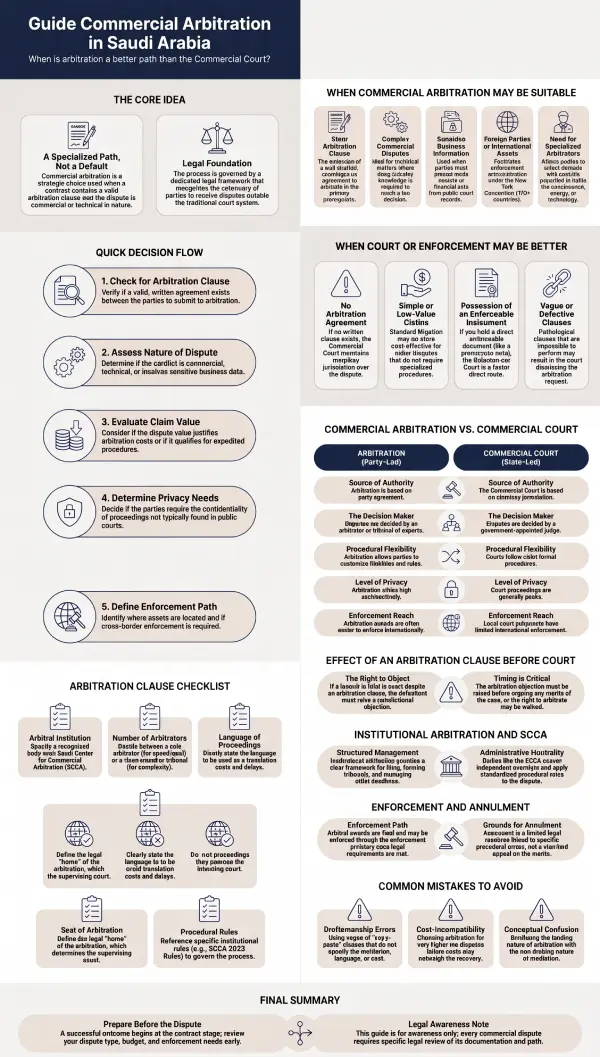
Commercial Arbitration vs Commercial Court
The difference between Commercial Arbitration and the Commercial Court is not only about the venue or the form of hearing. The key difference is that the court derives its jurisdiction from the law, while arbitration is based on party agreement.
Decision-Maker
In the Commercial Court, a judge decides the dispute as part of the official judiciary. In arbitration, the dispute is decided by a sole arbitrator or an arbitral tribunal, depending on the parties’ agreement or the applicable rules.
The advantage of arbitration is that the parties may choose an arbitrator whose background is closer to the nature of the dispute. In a construction, supply, investment, or technical commercial dispute, a tribunal familiar with complex contracts may help. This does not mean that the arbitrator always replaces technical experts. The arbitral tribunal may still need an independent expert, depending on the dispute and applicable rules.
Procedure and Flexibility
The Commercial Court follows formal judicial procedures. This gives the court route structure and predictability. Arbitration gives the parties more room to choose procedural rules, language, seat, number of arbitrators, and case management methods.
However, flexibility does not mean lack of control. Arbitration requires careful management from drafting the clause to enforcing the award. Any uncertainty in the clause or rules may create a separate procedural dispute instead of simplifying the process.
Confidentiality
Arbitration usually offers a higher level of privacy than court proceedings, especially where the dispute includes financial information, trade secrets, pricing details, supplier relationships, or internal business data. This may be important in shareholder disputes, long-term contracts, and cases where public exposure may affect reputation or negotiation leverage.
But confidentiality should not be described as absolute in every case. Its scope depends on the parties’ agreement, the applicable rules, and any requirements connected to enforcement or annulment before the courts.
Cost
Arbitration may be more expensive in some disputes because of institutional fees, arbitrators’ fees, and expert costs. For this reason, Commercial Arbitration is not always economically suitable, especially in simple or low-value claims.
On the other hand, arbitration may be efficient in large or complex disputes if it helps shorten the dispute, preserve confidentiality, allow a specialized tribunal, or support international enforcement. Cost should therefore be assessed as part of the overall dispute strategy, not as an isolated number.
When Is Arbitration a Suitable Alternative to Court?
Arbitration is a suitable alternative to court when it serves the nature of the dispute rather than complicating it. The practical rule is this: arbitration is not chosen because it is “better” than court in every case. It is chosen when it fits the specific file.
A Clear Arbitration Clause
A clear arbitration clause is the starting point. The clause should identify the arbitral institution, applicable rules, number of arbitrators, language, seat, and scope of disputes covered by arbitration.
A vague clause may create disagreement over the competent forum, the tribunal’s formation, or the types of disputes covered. The clearer the arbitration clause, the lower the risk of procedural delay.
It is also risky to copy an arbitration clause from a template without reviewing the contract. A clause that suits a cross-border investment contract may not suit a limited local supply agreement.
Complex Commercial Disputes
Arbitration may suit disputes requiring deeper technical or contractual understanding, such as construction contracts, long-term supply agreements, franchise agreements, distribution arrangements, investment contracts, and shareholder disputes.
In these cases, the question is not always whether a debt exists. The dispute may involve contract interpretation, calculation methods, delay effects, performance quality, or reciprocal obligations. In such files, arbitration can be more suitable if managed properly.
Need for Confidentiality
Commercial Arbitration may be useful where the dispute includes financial data, trade secrets, pricing structures, supplier relationships, or internal management information.
In some shareholder or family business disputes, confidentiality is not merely a procedural preference. It may help protect the business itself. The purpose is not only to resolve the dispute, but also to reduce the impact on reputation, supplier relationships, and market position.
Foreign Party or International Contract
Where the contract includes a foreign party, assets abroad, or potential enforcement outside Saudi Arabia, arbitration may become an important option. This is linked to the recognition and enforcement of arbitral awards under the New York Convention.
Still, international enforcement is not automatic in every case. The seat of arbitration, governing law, wording of the clause, target enforcement country, and possible objections must all be reviewed.
Need for a Specialized Arbitrator
In technical or financially complex disputes, the parties may want an arbitrator with relevant experience. This does not replace legal analysis, but it may help in understanding the dispute and reviewing technical documents.
Examples include construction, energy, technology, distribution, and complex accounting disputes. In these cases, selecting the arbitrator may be part of the risk-management process before the dispute escalates.
When Is Arbitration Not the Best Option?
Commercial Arbitration is not suitable for every case. Sometimes court proceedings, enforcement, or settlement may be more appropriate.
In small or simple claims, arbitration costs may not match the value of the dispute. If the claim is specific, clear, and does not require special expertise, court or enforcement may be faster and less costly.
If there is no arbitration agreement, one party cannot simply choose arbitration alone. Arbitration is based on agreement. It does not arise from one party’s preference.
Also, if the creditor already has an enforceable instrument, there may be no need for a lawsuit or arbitration. The enforcement path should be reviewed before starting any dispute process. For financial claims, you may also review our guide on financial claim lawsuit.
A vague arbitration clause is another risk. A poorly drafted clause may not create a fast route. It may instead trigger another dispute over jurisdiction, validity of the agreement, or tribunal formation.
Arbitration Clauses in Commercial Contracts
An arbitration clause is a contractual provision where the parties agree to refer disputes arising from the contract to arbitration instead of court, within the limits allowed by law.
What Is an Arbitration Clause?
An arbitration clause is a prior agreement on the dispute resolution route. Its importance lies in deciding, from the beginning, where the dispute will go if the contract is not performed smoothly.
A general phrase such as “disputes shall be resolved by arbitration” may not always be enough. The clause should clearly identify the institution, rules, procedures, and scope of disputes. Institutional model clauses may be useful, but they should be adapted to the specific contract.
Arbitration Clause vs Submission Agreement
An arbitration clause is usually included in the contract before any dispute arises. A submission agreement is a later agreement made after the dispute has already appeared.
The practical difference is that an arbitration clause gives the parties a ready route when conflict begins. A submission agreement requires later consent from both parties, which may be difficult once the dispute has escalated.
Key Elements to Review
A well-drafted arbitration clause should address the following:
| Element | Why It Matters |
|---|---|
| Arbitral institution | Identifies who administers the proceedings |
| Number of arbitrators | Reduces disputes over tribunal formation |
| Language | Important in international contracts |
| Seat of arbitration | Affects procedural law and supervising court |
| Procedural rules | Defines how the arbitration will proceed |
| Scope of disputes | Clarifies what is included and excluded |
Effect of an Arbitration Clause When a Lawsuit Is Filed
If a lawsuit is filed before court despite an arbitration agreement, the party relying on arbitration should raise the arbitration objection before making any request or defense on the merits. If the objection is raised on time, and the agreement is valid and applicable, the court may decline to hear the merits of the dispute.
Arbitration Objection
An arbitration objection is a defense raised by a party to say that the dispute should not continue before court because the parties had agreed to arbitration.
Timing is important. If a party begins arguing the merits before court without relying on the arbitration clause, this may affect its ability to rely on the clause later. The clause should therefore be reviewed before any substantive defense is filed.
When May the Court Still Hear the Case?
The court may continue hearing the case if the arbitration clause is not raised on time, if the clause is invalid, if it does not apply to the dispute, or if the dispute falls outside its scope.
Other situations may also involve applications that do not prevent arbitration, depending on the nature of the request, such as certain interim or conservatory measures. The existence of a clause is therefore not enough by itself. Its validity, scope, and timing must be reviewed.
Why Review the Clause Before Filing?
Reviewing the clause before filing helps avoid choosing the wrong route. A party may start in court and then face an arbitration objection. Another party may start arbitration and later discover that the clause is vague or inapplicable.
Early review helps assess the available paths and avoid losing time in a process that does not match the parties’ agreement.
Institutional Arbitration and the Saudi Center for Commercial Arbitration
Institutional arbitration is arbitration administered by an arbitral institution under defined rules. In Saudi Arabia, the Saudi Center for Commercial Arbitration, or SCCA, is one of the recognized institutional options for managing commercial disputes.
Institutional Arbitration
Institutional arbitration provides a structured framework for filing requests, forming the tribunal, managing deadlines, and applying procedural rules. This may reduce procedural disputes between the parties.
At the same time, institutional arbitration does not guarantee the outcome. The quality of the process still depends on the clarity of the arbitration clause, strength of documents, arbitrator selection, and case management.
Saudi Center for Commercial Arbitration SCCA
The SCCA arbitration rules apply to cases administered under those rules. They help organize the arbitration process, tribunal formation, timelines, and submissions according to the parties’ agreement and the applicable rules.
The center also provides special procedures for certain disputes, subject to their requirements, such as expedited procedures. But not every dispute is suitable for them. The applicable rules, claim value, and nature of the dispute should be reviewed before relying on any special track.
Ad Hoc Arbitration
Ad hoc arbitration is conducted without administration by an arbitral institution. It may be flexible, but it requires precise drafting and a clear method for appointing arbitrators and managing the process.
If the ad hoc clause is vague, tribunal formation or procedural rules may become difficult. Institutional arbitration is often more organized for parties that want to avoid a separate procedural dispute.
Commercial Arbitration Procedure in Brief
Commercial Arbitration usually passes through a sequence of stages. It begins with reviewing the arbitration agreement to confirm the clause, its scope, the institution, and the applicable rules. The party seeking arbitration then files the request under the agreed rules or the rules of the chosen center.
The sole arbitrator or arbitral tribunal is then appointed. Appointment may be made by party agreement, by a method stated in the clause, or under institutional rules.
The tribunal then sets the procedural framework, including submissions, documents, hearings, language, and the method for presenting evidence. The parties exchange statements, defenses, and supporting documents. Hearings may be held to hear the parties, witnesses, or experts, depending on the needs of the case.
After the proceedings are closed, the tribunal issues its award. If the losing party does not comply voluntarily, the winning party may move to enforcement. In some cases, the other party may file an annulment action if a specific legal ground exists.
These steps may seem straightforward, but they require careful legal management. An early mistake may affect enforcement or annulment later.
Enforcement of Arbitral Awards in Saudi Arabia
The effect of an arbitral award does not end when it is issued. Its practical value appears when it can be enforced. For that reason, the arbitration clause and the proceedings should be managed from the beginning in a way that reduces later objections.
Is an Arbitral Award Binding?
An arbitral award is generally binding when it satisfies the legal requirements. But enforcement may still be needed if the losing party refuses to comply.
In international disputes, the New York Convention supports recognition and enforcement of foreign arbitral awards between contracting states, subject to the convention and applicable laws.
Enforcement Request
At the enforcement stage, the focus is not on re-arguing the merits. The focus is on whether the requirements for enforcement are satisfied. This includes reviewing the arbitration agreement, tribunal formation, procedure, operative part of the award, and compliance with relevant legal controls.
Annulment of an Arbitral Award
Annulment is not a route to reargue the facts or evidence as in an ordinary appeal. It is linked to specific legal grounds. Filing an annulment action also does not automatically suspend enforcement unless the competent court orders suspension under the applicable controls.
This means that challenging an arbitral award requires a serious legal ground, not merely dissatisfaction with the result.
This article is prepared for legal awareness on Commercial Arbitration in Saudi Arabia, focusing on when arbitration may be a suitable alternative to court, the effect of an arbitration clause, and enforcement of arbitral awards. It does not replace reviewing the contract and documents in each specific case.
License No.: 40462
Last updated: September 2026
Common Mistakes in Arbitration Clauses
Most arbitration mistakes begin in the contract, not after the dispute. An arbitration clause should be treated as a provision that may determine the entire dispute route, not as a standard sentence at the end of the contract.
One common mistake is using a vague clause, such as referring to “arbitration” without naming the institution, rules, or appointment mechanism. This ambiguity may create a dispute over how arbitration should begin.
Another mistake is failing to identify the language or seat in contracts involving a foreign party. Language affects translation and submissions. The seat affects procedural law and the supervising court.
The clause may also be weak if it does not identify the scope of disputes covered by arbitration. The parties may later disagree on whether the clause covers all or only part of the dispute.
A practical mistake is using a template clause without considering the value of the contract and the nature of the relationship. International arbitration may be suitable for a major contract, but too costly for a limited-value dispute.
Parties should also avoid confusing arbitration with mediation or settlement. Each route has a different effect. If the contract uses more than one dispute resolution method, the order and consequences should be clear so that the clause does not delay the claim.
When Do You Need Professional Review Before Choosing Arbitration?
Professional review is important before choosing arbitration when the contract value is high, the arbitration clause is unclear, a foreign party is involved, or the contract includes more than one governing law, seat, or language.
Review becomes more important if a lawsuit has been filed before court despite the presence of an arbitration clause. The first issue is whether an arbitration objection should be raised, when to raise it, and whether the clause is valid and applicable.
Review is also important when receiving an arbitration request. The initial position may affect tribunal formation, the scope of the dispute, counterclaims, and procedural deadlines.
The need also appears before enforcing an arbitral award or filing an annulment action. This stage does not restart the dispute from the beginning. It requires reviewing the award, the procedure, the arbitration agreement, and the specific grounds of challenge.
If you are facing a commercial dispute and need to assess whether arbitration or the Commercial Court is the more suitable route, the contract, arbitration clause, and supporting documents can be reviewed to identify the lower-risk path before taking action.
Legal Summary
Commercial Arbitration in Saudi Arabia is an important route in some disputes, but it is not suitable for every file. The correct decision starts with reading the contract, reviewing the arbitration clause, identifying the nature of the dispute, estimating cost, and assessing whether confidentiality, specialization, or international enforcement matters.
If the clause is clear and the dispute is complex, sensitive, or cross-border, arbitration may be a practical option. But if the claim is simple, if there is no arbitration agreement, or if there is a ready enforceable instrument, court or enforcement may be more suitable.
The most important point is that the choice of route should not wait until after the dispute. In commercial contracts, successful arbitration begins with drafting the clause before signing and reviewing its effect before filing any lawsuit or defense.
FAQs About Commercial Arbitration
What is Commercial Arbitration in Saudi Arabia?
Commercial Arbitration is an agreed legal route for resolving a commercial dispute outside court through an arbitrator or arbitral tribunal that issues a binding award under the parties’ agreement and applicable law.
When should Commercial Arbitration be chosen instead of court?
Commercial Arbitration may be suitable when there is a clear arbitration clause, the dispute is complex or technical, confidentiality matters, or the contract involves a foreign party or assets outside Saudi Arabia.
What is the difference between Commercial Arbitration and the Commercial Court?
Commercial Arbitration is based on party agreement and is decided by an arbitrator or tribunal. The Commercial Court derives its jurisdiction from law and is decided by a judge within the official judiciary.
Can one party force arbitration without an arbitration clause?
No. Arbitration is based on agreement. One party cannot impose arbitration alone unless there is a valid arbitration clause or a later agreement to refer the dispute to arbitration.
What makes an arbitration clause effective?
A strong arbitration clause should identify the arbitral institution, number of arbitrators, language, seat of arbitration, procedural rules, and the scope of disputes covered by arbitration.
When is court a better option than arbitration?
Court may be more suitable when there is no arbitration agreement, the claim is simple or low-value, or the creditor already has an enforceable instrument that can be taken directly to enforcement.
Does an arbitration clause prevent filing a lawsuit?
An arbitration clause may affect court proceedings if the other party raises the arbitration objection on time and the clause is valid and applicable to the dispute.
Is an arbitral award binding in Saudi Arabia?
An arbitral award is generally binding when it satisfies the legal requirements. If the losing party does not comply voluntarily, enforcement may be requested through the competent route.
Can an arbitral award be annulled?
Yes, but annulment is not a normal appeal on the merits. It is linked to specific legal grounds, such as issues with the arbitration agreement, procedure, tribunal formation, or other legal defects.
What are the most common mistakes in arbitration clauses?
Common mistakes include vague wording, not selecting an arbitral institution, omitting the seat or language, using a copy-paste clause, and choosing arbitration for a simple or low-value dispute.
Official Sources: